

Fort Andrews map (click to enlarge)
GUIDED TOURS
Park Rangers lead one-hour tours of Fort Andrews on a daily basis from late June through Labor Day Weekend. The tour covers a little over a mile and requires walking up one steep hill. Not all sections of the fort are visited. Three artillery batteries and a fire control tower located at the very north end of Peddocks Island are skipped, so you will need to visit these on your own. A tour schedule is posted at the Peddocks Island Visitor Center. There is no need to register, so just show up if interested.
SELF-GUIDED TOUR
If you are not able to catch a guided tour of Fort Andrews, you can see the fort on your own. Be sure to pick up a Self-Guided Tour brochure inside the Visitor Center. There are a few wayside exhibits placed throughout the fort as well, but the brochure provides the most information about the surviving buildings outside of a guided tour.
If you stop at Batteries McCook, Rice, and Bumpus, which are skipped on the Ranger tour, add a quarter mile to the walk (1.5 miles in total). Including the trip to the batteries, the tour took me one hour to complete.
A tour of Fort Andrews begins at the Guardhouse, which is now the Peddocks Island Visitor Center. It is the first building you come to when arriving on the island. Built in 1910, it served not only as a guardhouse but also as the fort’s prison. The building was restored in 2011 and is the only building in the fort that is open to the public on a regular basis.

Guardhouse at Fort Andrews on Peddocks Island, Boston Harbor Islands National Recreation Area
The building next to the Guardhouse was built in 1906 and served as the fort’s original guardhouse. It was converted into a workshop when the new guardhouse opened. It is still used as a workshop today by the State and National park maintenance crews.
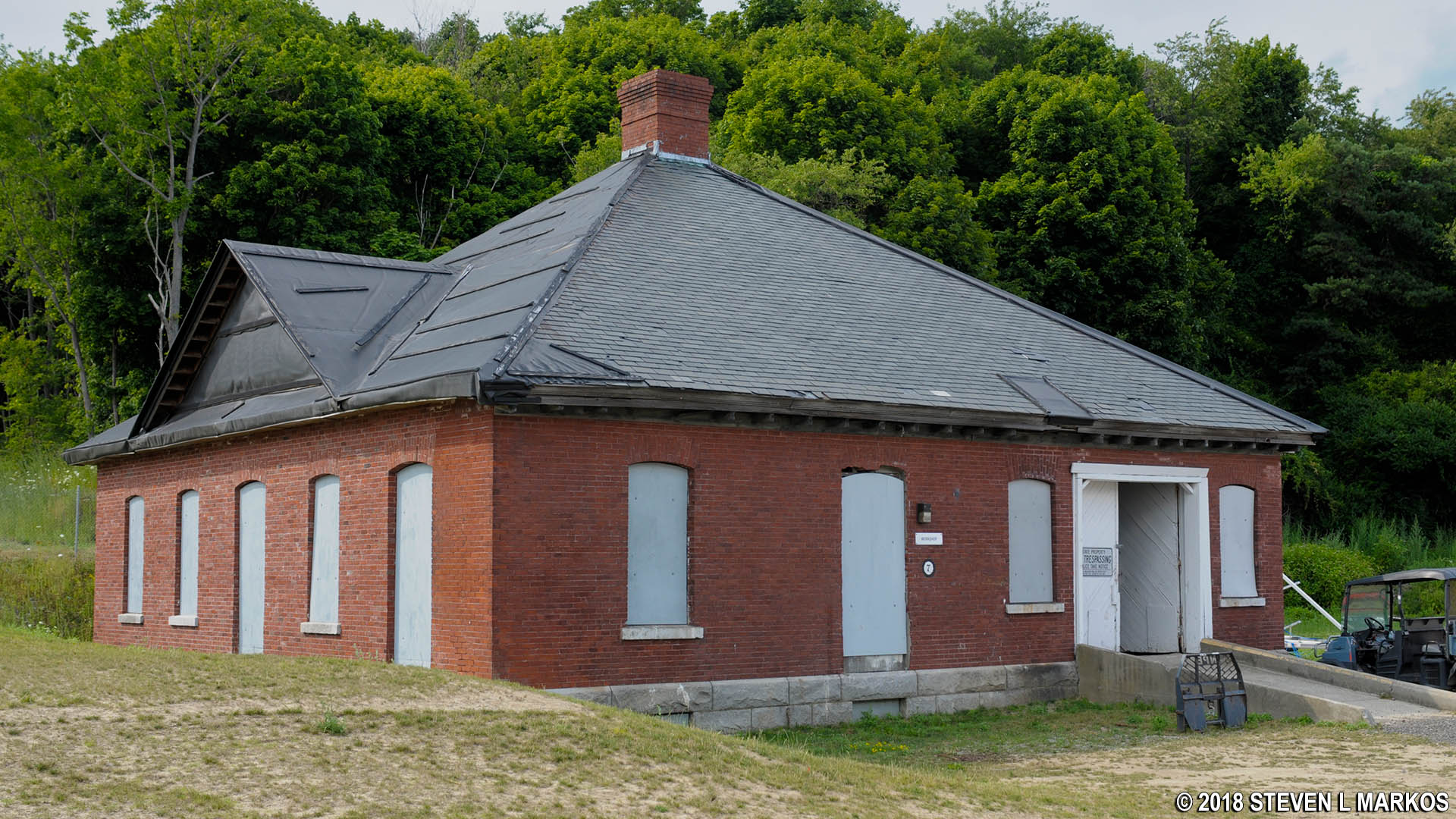
Workshop at Fort Andrews on Peddocks Island, Boston Harbor Islands National Recreation Area
If you take a detour off the paved road and venture to the right of the Guardhouse and Workshop, you will come to the Stable. Remember, cars weren’t around when Fort Andrews was built—at least not practical automobiles—so transportation was provided by horses and mules. In fact, mules were still used at the fort all the way through World War II.
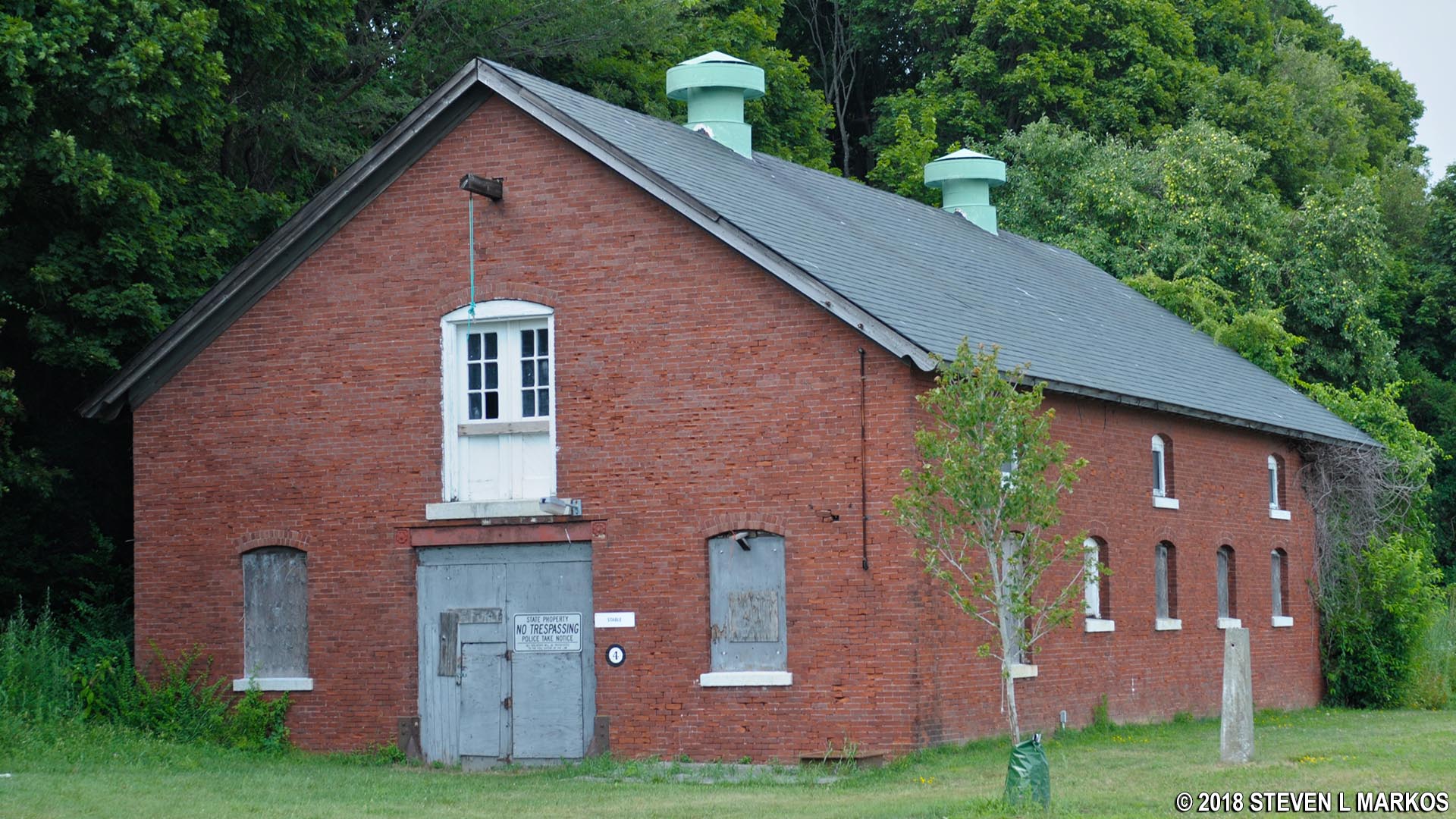
Stable at Fort Andrews on Peddocks Island, Boston Harbor Islands National Recreation Area
As you continue up the road, you will see two large buildings on the right, plus some open space between the buildings and the Workshop. These are the surviving Enlisted Men’s Barracks. Two other barracks once occupied the empty ground. One burned down in the 1920s and was replaced by a wooden Recreation Hall (no longer exists). The other burned down in 1989 and was finally removed in 2010. In all, twelve decrepit buildings were torn down during 2010 and 2011.

Enlisted Men’s Barracks at Fort Andrews on Peddocks Island, Boston Harbor Islands National Recreation Area
The large field in front of the barracks is the Parade Ground. This is where troops drilled, had inspections and ceremonies, and played sports.
The ruins of the Administration Building are in front of the barracks. This is where the main offices for the fort were located. The building burned down in 1991, and the debris was removed in 2010. All that remains is part of the walls and the foundation.
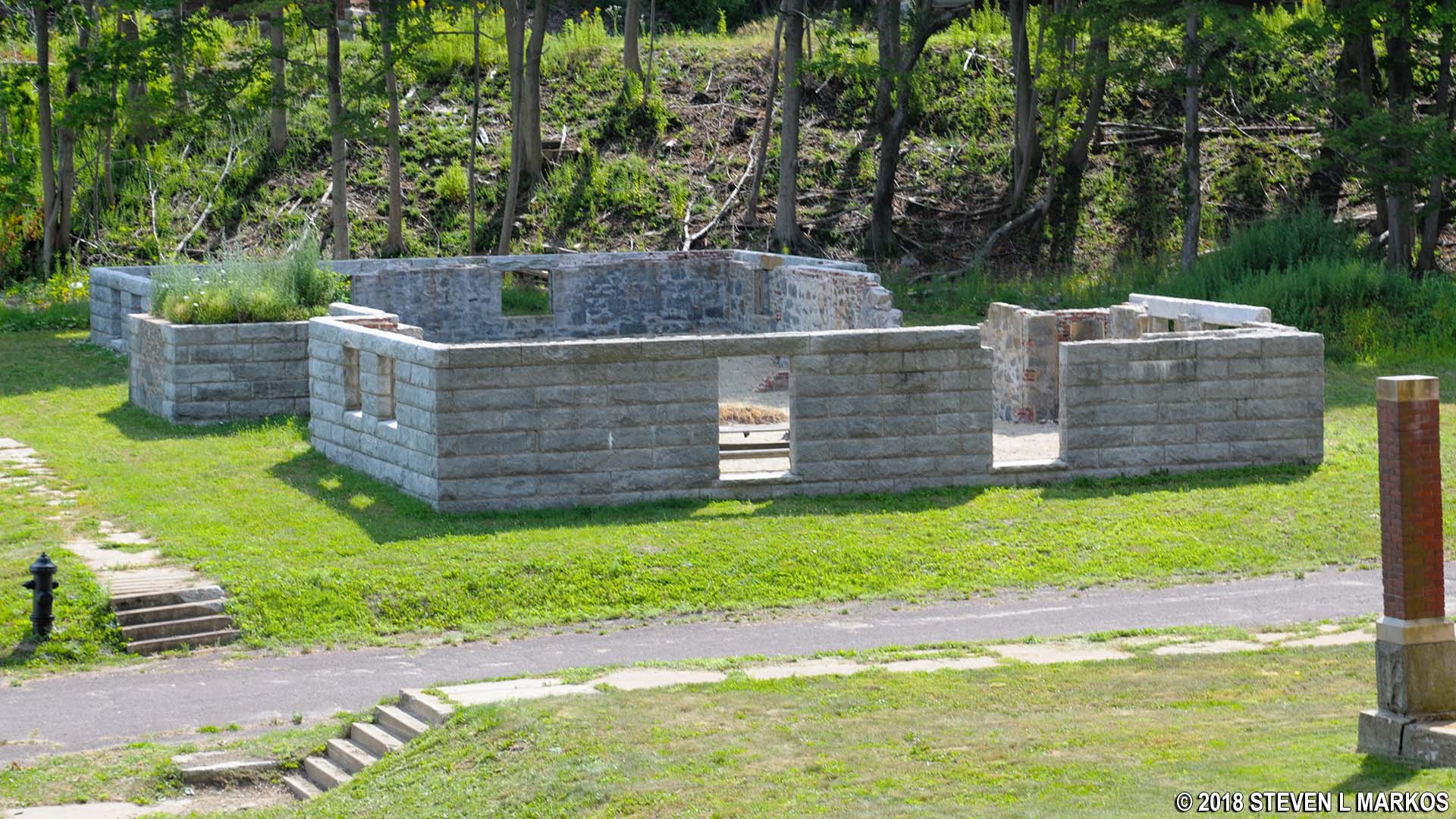
Administration Building ruins at Fort Andrews on Peddocks Island, Boston Harbor Islands National Recreation Area
Just past the barracks are three buildings. The two on the same side of the path as the barracks are the Bakery (larger building on the right) and the base’s fire station. Sometime between the World Wars, the Bakery was converted into the Post Exchange (general store).
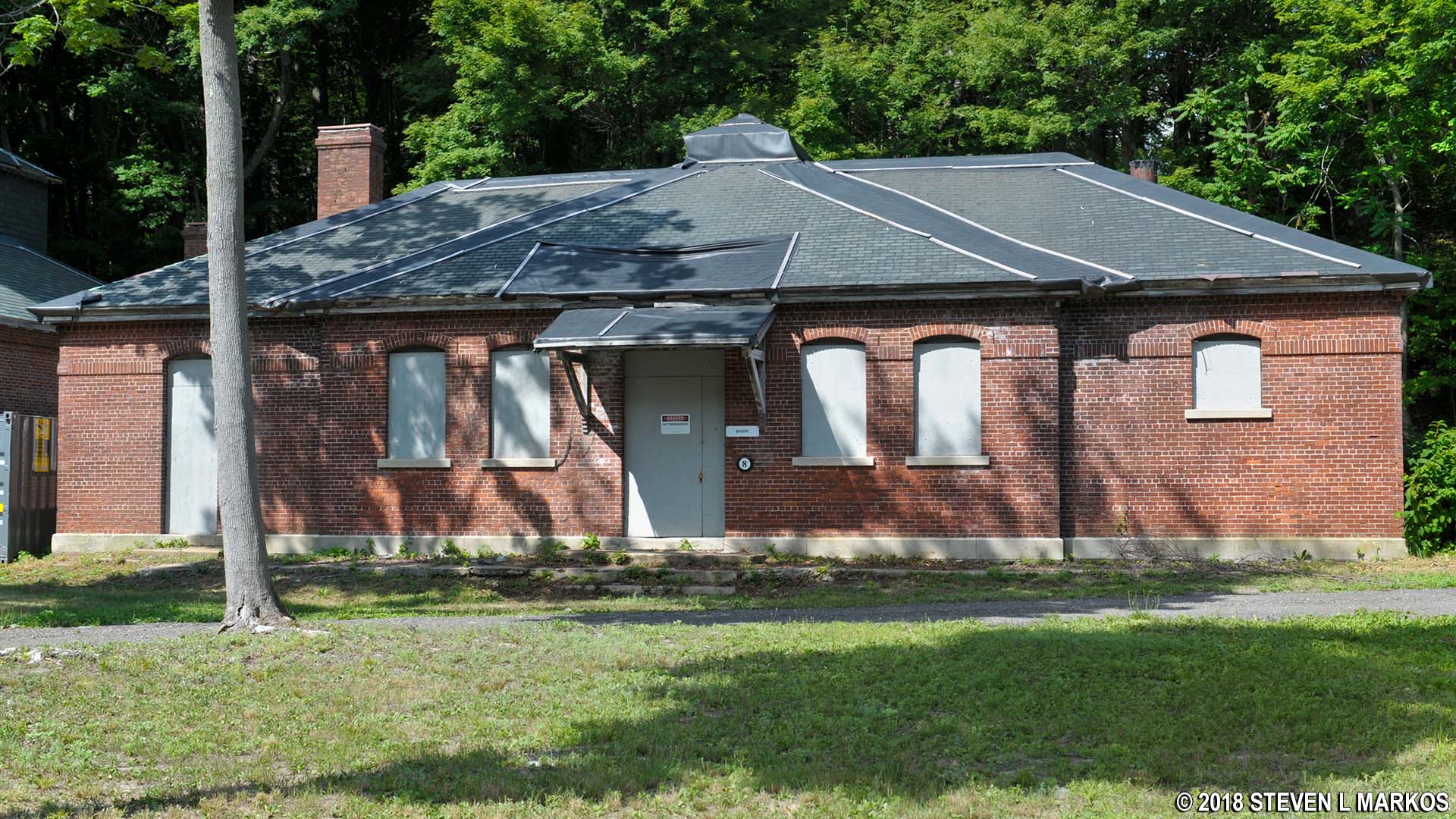
Bakery at Fort Andrews on Peddocks Island, Boston Harbor Islands National Recreation Area
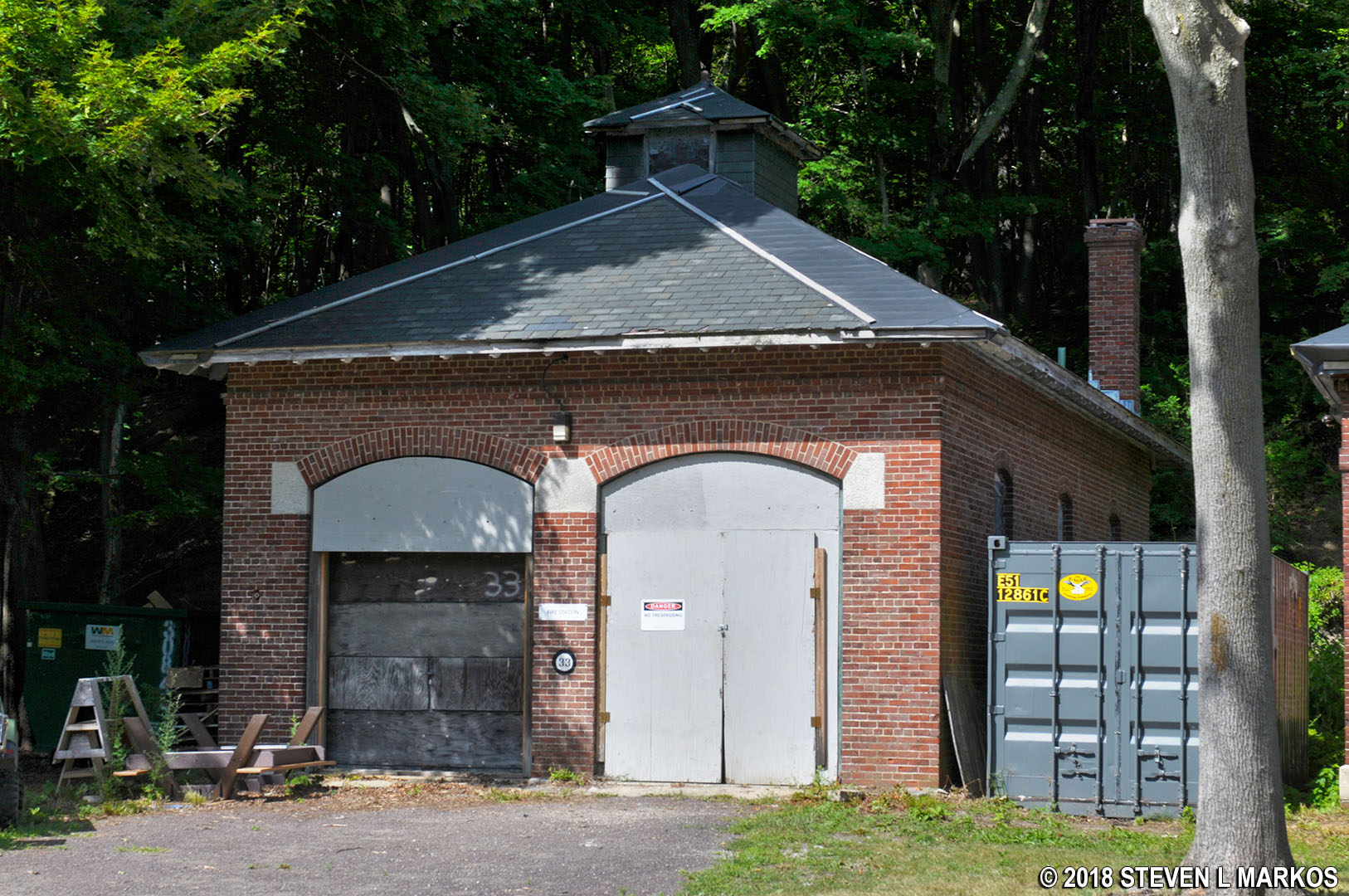
Fort Andrews Fire Station on Peddocks Island, Boston Harbor Islands National Recreation Area
The other building at the intersection is the Gym. It housed a bowling alley and full-size basketball court. It also served as the Post Exchange until the Bakery took on that role.
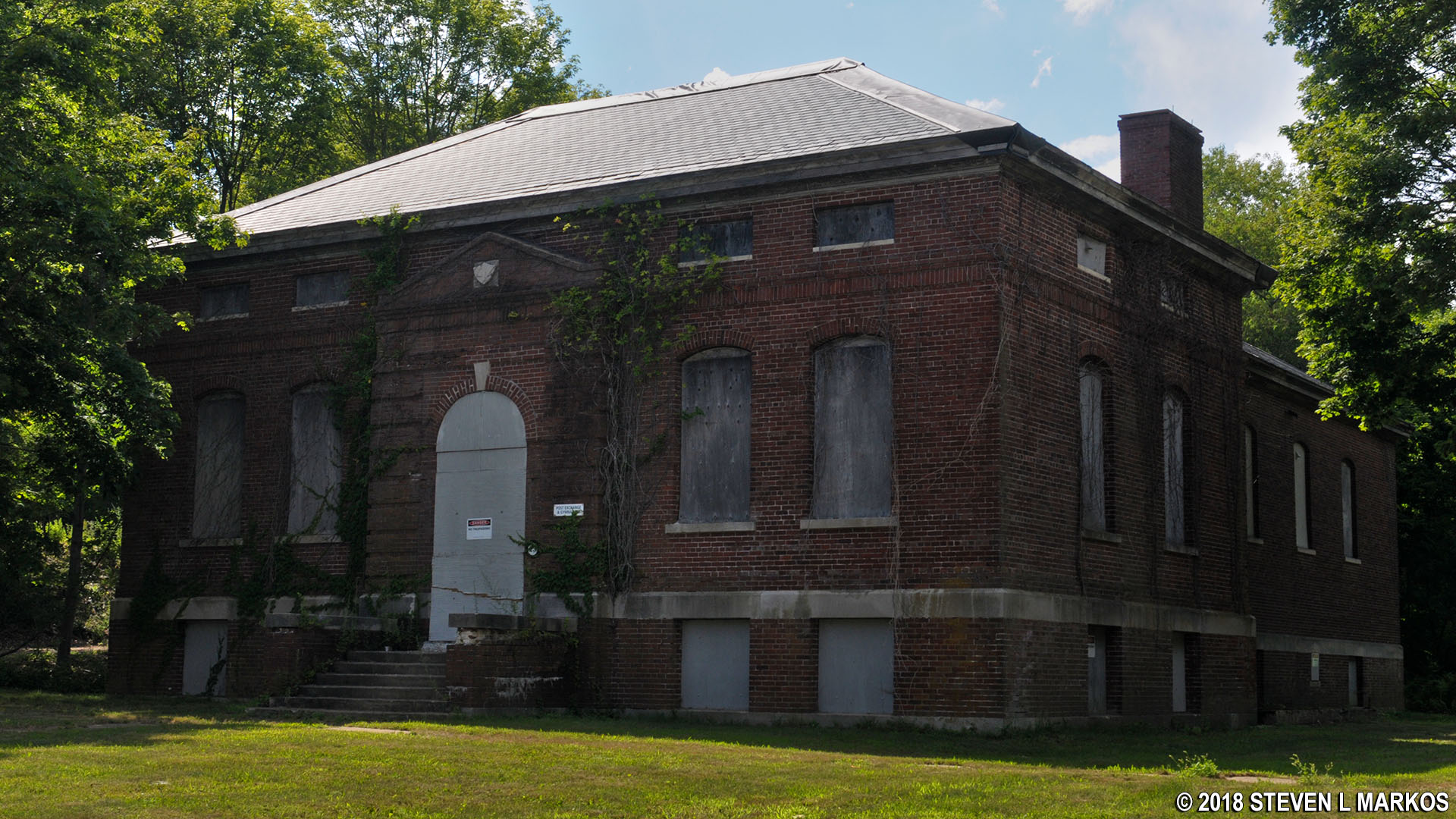
Gym at Fort Andrews on Peddocks Island, Boston Harbor Islands National Recreation Area
If you want to see Batteries Rice, McCook, and Bumpus, take the steep, paved path that runs between the Bakery and the Barracks. This also leads up to the yurts and individual tent sites of the Peddocks Island Campground.
If facing the batteries, Battery Rice is the one on the left. Construction began in 1899 and was completed in 1901, though it was not in use until 1904, and guns were not installed until 1909. It had two 5-inch M1900 guns mounted on M1903 pedestal carriages. The guns were located on the top level of the structure while the bottom was used as an ammunition magazine. Shells were moved between floors by a manual hoist. The guns and carriages were removed in 1917 and transferred to Fort Story on Cape Henry in Virginia. After this time, Battery Rice was no longer used. In 1925, a coincidence range finding station for Battery Bumpus was built on one of the gun emplacements.
Battery McCook is the middle battery. It was built between 1901 and 1904 and armed with two 6-inch M1900 guns mounted on M1900 pedestal carriages. Like Battery Rice, the guns were on the top level while the bottom was used as an ammunition magazine. The battery was used in World War I and II, then deactivated along with the rest of Fort Andrews in 1947.
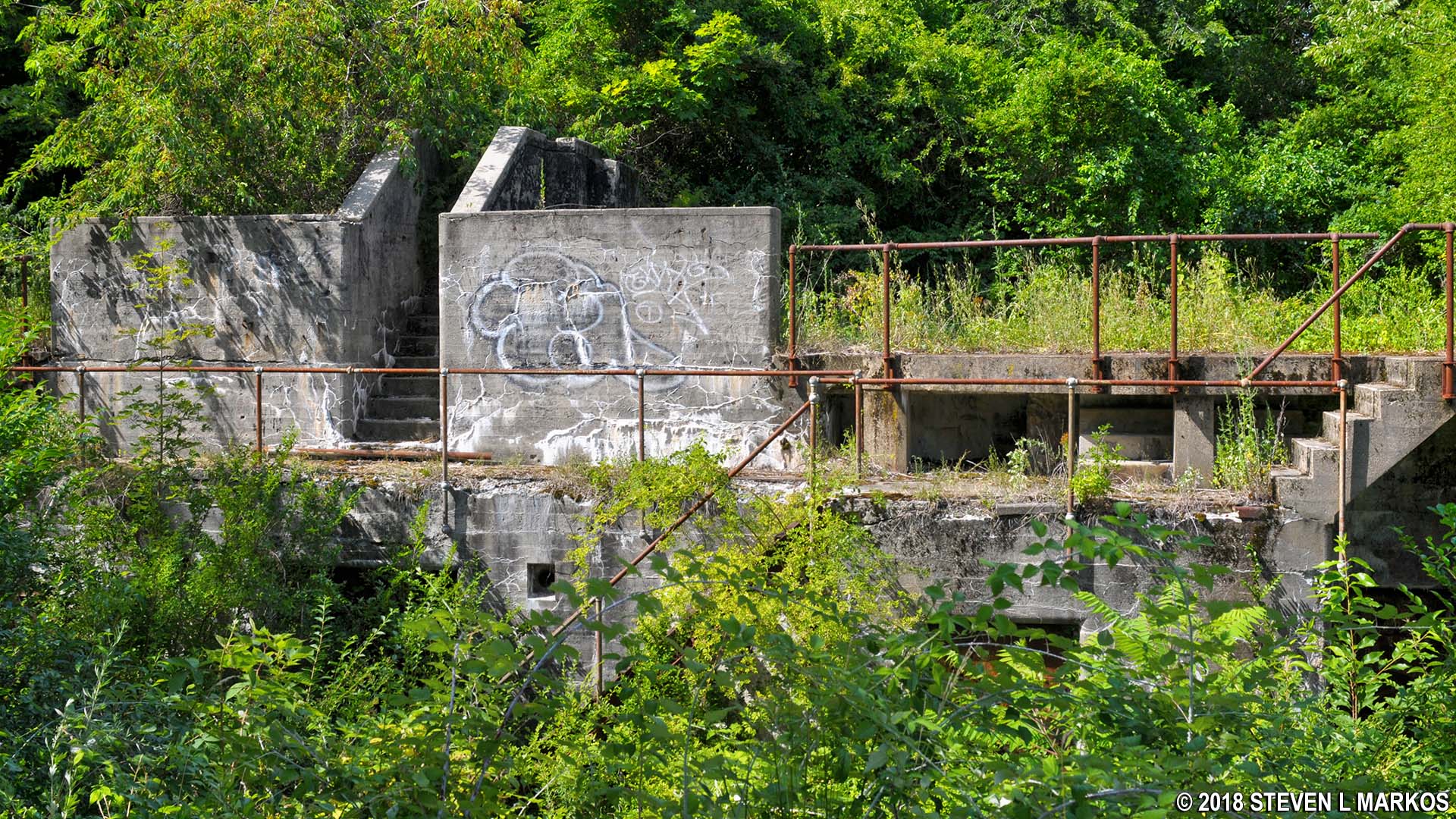
Ruins of Battery McCook at Fort Andrews on Peddocks Island, Boston Harbor Islands National Recreation Area
Battery Bumpus, the battery on the right, was built between 1902 and 1904. It had two 3-inch M1902 guns mounted on M1902 pedestal carriages. It was also a two level battery, but it did not have a shell hoist; shells were carried to the guns by hand. The battery was deactivated when World War II ended in 1945, and the guns were scrapped in May 1946.
The Fire Control Tower on the hill was not used to spot forest fires, but to spot enemy ships and to help provide firing coordinates for the batteries. It is closed to the public.
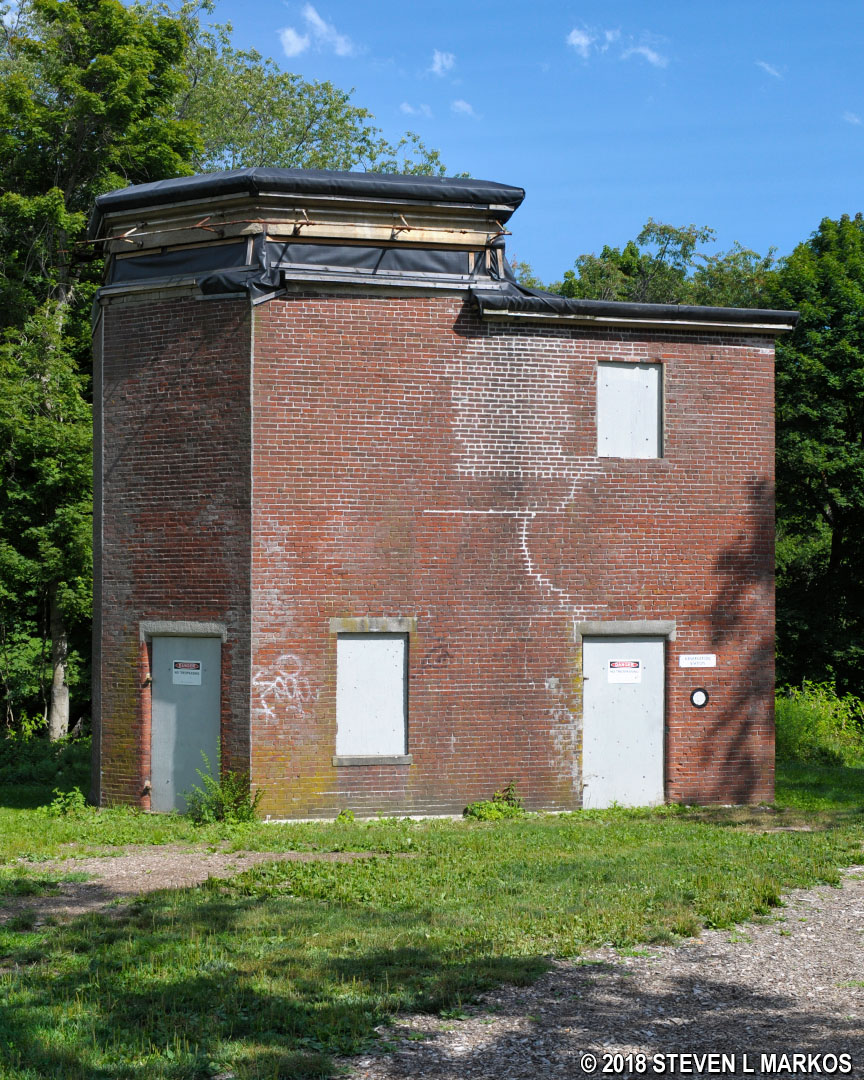
Fire Control Tower at Fort Andrews on Peddocks Island, Boston Harbor Islands National Recreation Area
The batteries are in poor condition and largely covered in vegetation, so I wasn’t going to risk picking up ticks or brushing up against poison ivy in order to get a closer look. However, while there is not much to explore, you do get good views of Boston Harbor from the top of the hill.

View of Boston Harbor from the hill where the Fort Andrews batteries are located, Peddocks Island, Boston Harbor Islands National Recreation Area
Once back down to the main road, take a right to continue the tour. The next structure you come to is Battery Cushing, and next to it is Battery Whitman, both of which are mortar batteries.
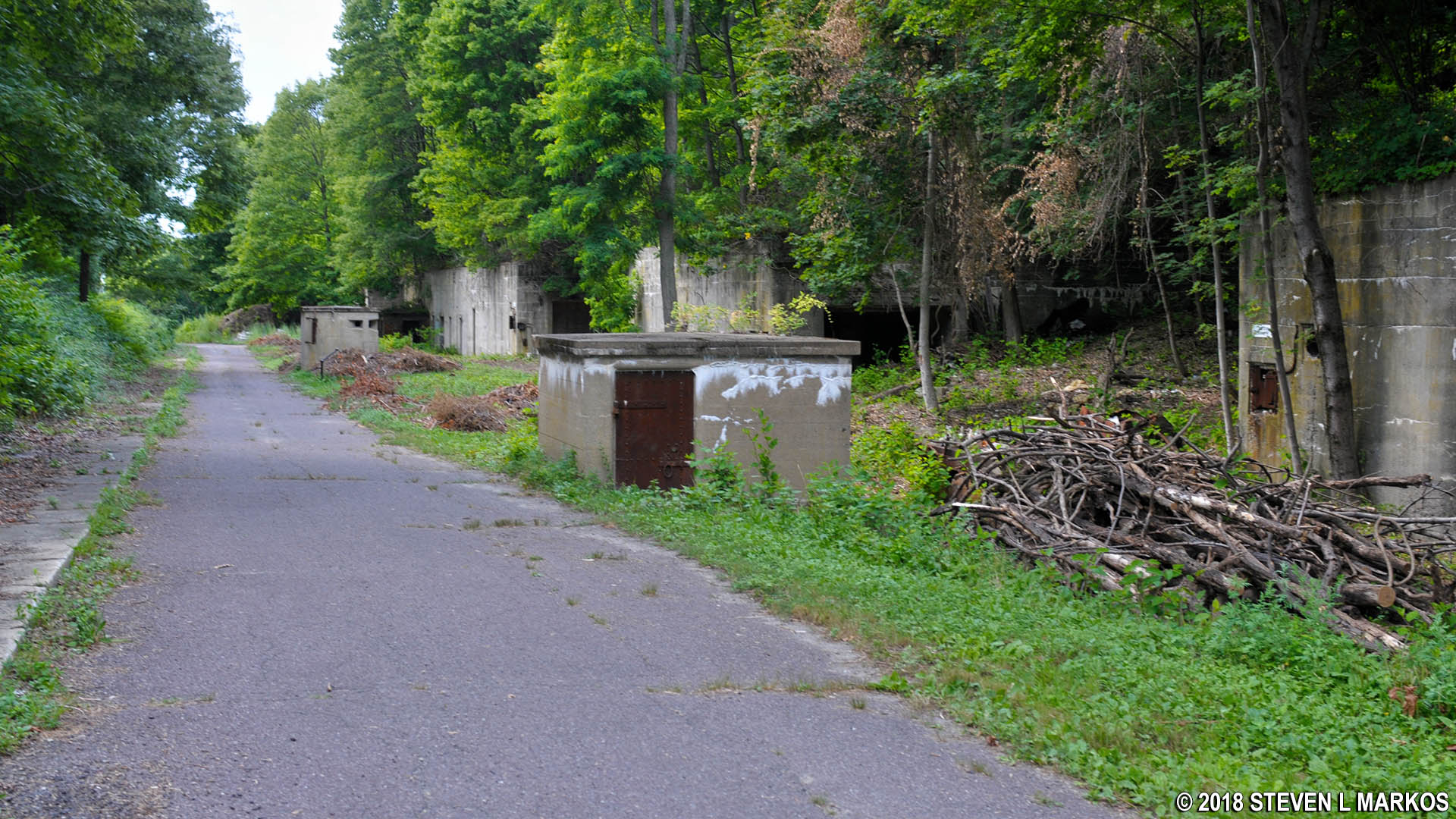
Mortar batteries at Fort Andrews on Peddocks Island, Boston Harbor Islands National Recreation Area
Mortar shells are shot into the air at steep angles so they either come down onto the lightly protected decks of ships or explode in the air, sending shrapnel down upon the enemy. Since they did not require an elevated position, the mortars were located in ground-level pits surrounded by high walls. Each mortar battery at Fort Andrews had eight 12-inch M1890MI mortars that could launch 1,000-pound shells. The mortars were arranged in two pits of four guns each.
Other than the mortar pits, a mortar battery is completely covered with earth to hide it from the enemy, and since the guns could not be seen, it was difficult to determine where the shells were coming from. Furthermore, the only way for an enemy ship to knock out a mortar pit was to lob mortars of its own, and ships did not have mortars. Artillery rounds from an enemy ship could only slam into the sides of earthen mounds and sand dunes that protected the battery.

12″ mortars in a mortar battery pit
Battery Cushing, the first you come to, was built between 1901 and 1904. In World War I, four of its mortars were dismantled for shipment to Europe, a common practice at the time. Many such guns were mounted on trains so they could be easily transported to the Western Front in France and Belgium.
Battery Whitman was actually the first battery at Fort Andrews, with construction taking place between 1889 and 1901. It originally had the same configuration and guns as Battery Cushing, but in 1910 it was remodeled and the mortars were removed and shipped to Fort Mills in the Philippine Islands. Replacements were installed in 1913: M1908 mortars on M1908 carriages. During World War I, two of these mortars were removed for shipment to Europe.
Once airplanes became common to warfare in World War II, mortar batteries became obsolete—planes could just fly overhead and drop bombs on them. As a result, both batteries were deactivated in 1942 and the guns were scrapped.
The mortar pits of Battery Cushing run parallel to the road. Pit A is in poor condition and has a lot of vegetation growing on and in it. Pit B is in better shape, but there is still a good bit of debris, and the locations of the gun emplacements are hidden by dirt that now covers the floor. It does, however, appear that you can get into the interior where offices, day rooms, storage rooms, and the ammunition magazine were located, but you must walk through weeds and possible poison ivy to get there.
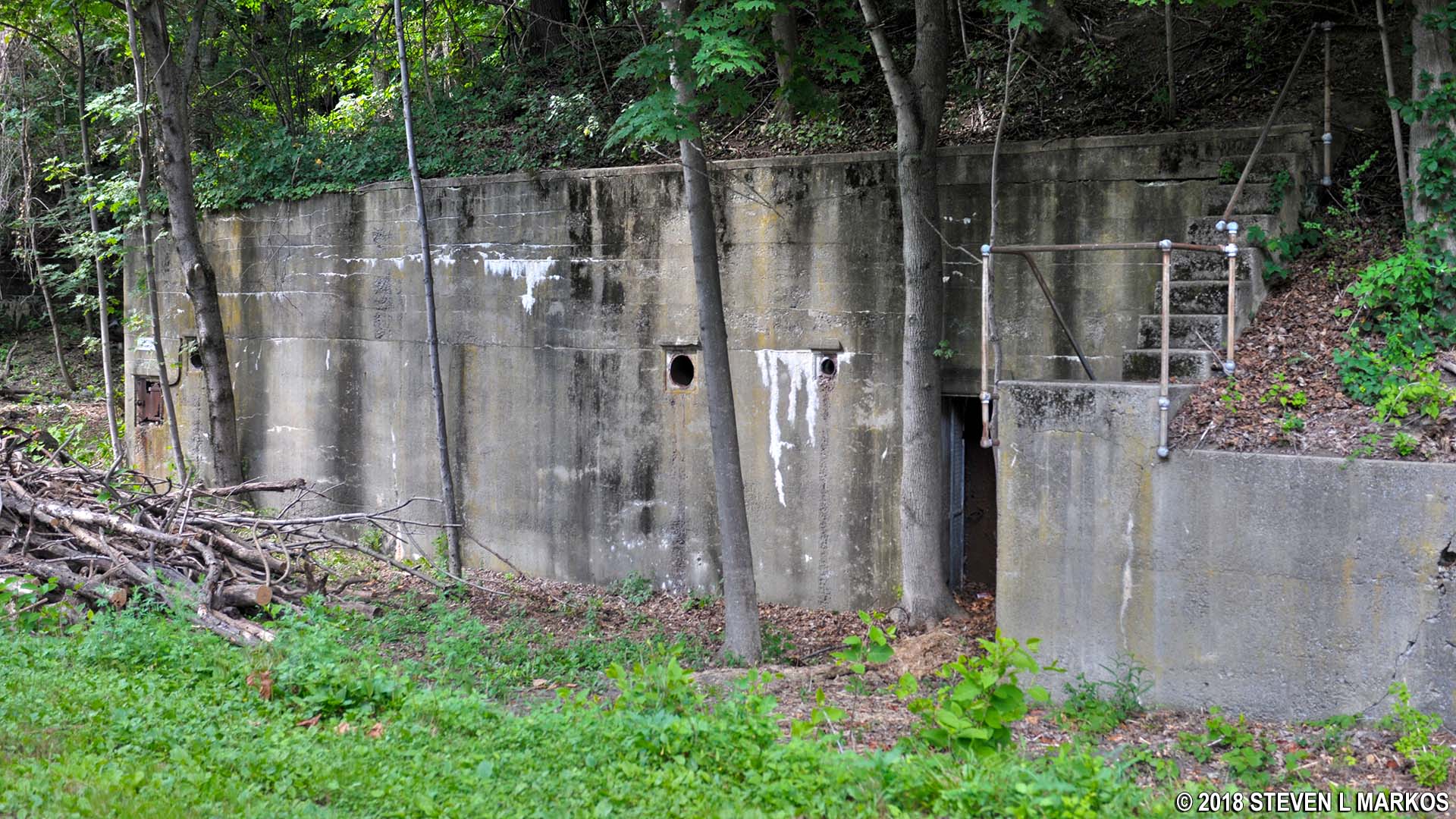
Bunker of Battery Cushing at Fort Andrews on Peddocks Island, Boston Harbor Islands National Recreation Area
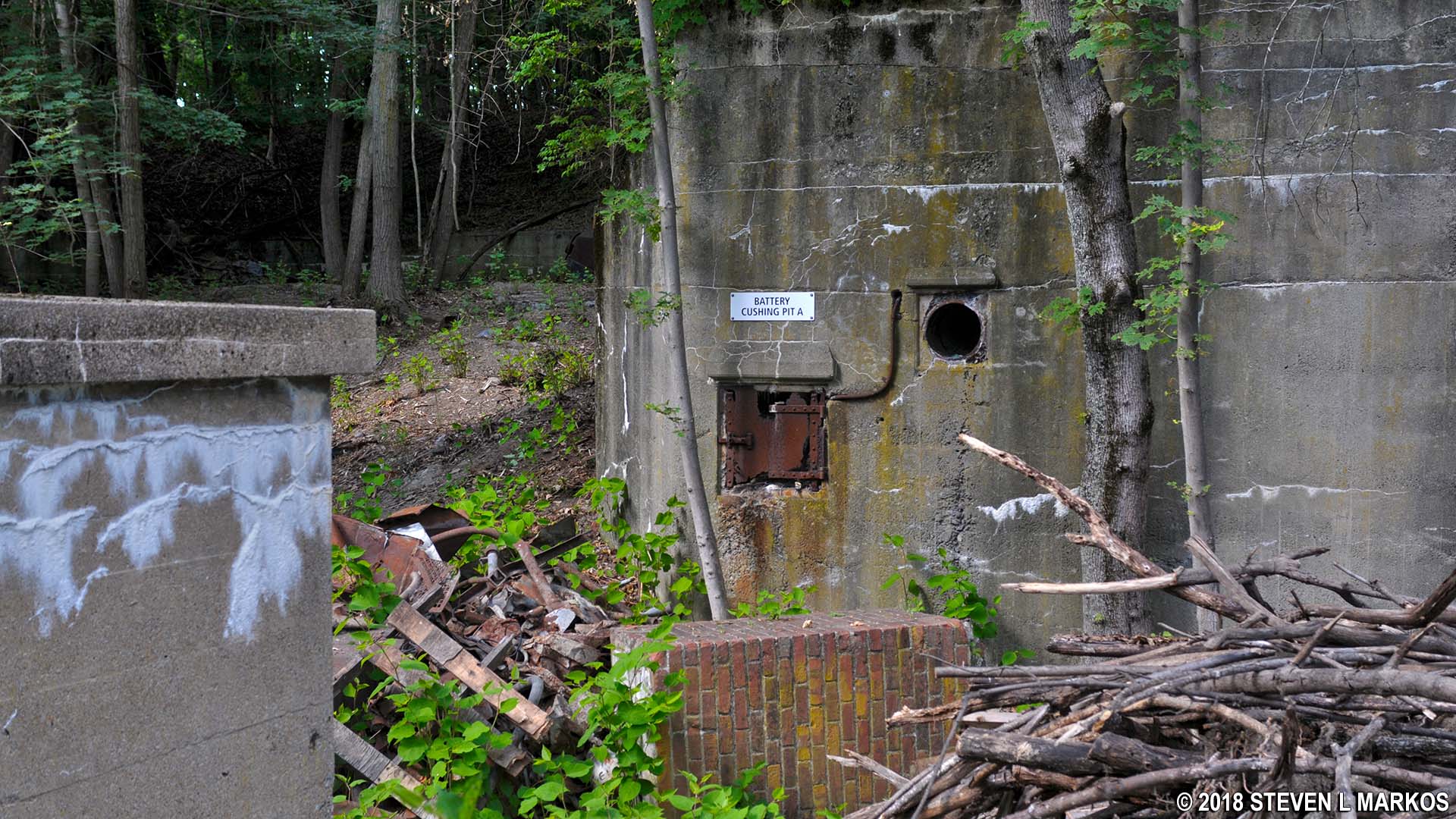
Debris and trees fill Pit A of Battery Cushing at Fort Andrews on Peddocks Island, Boston Harbor Islands National Recreation Area
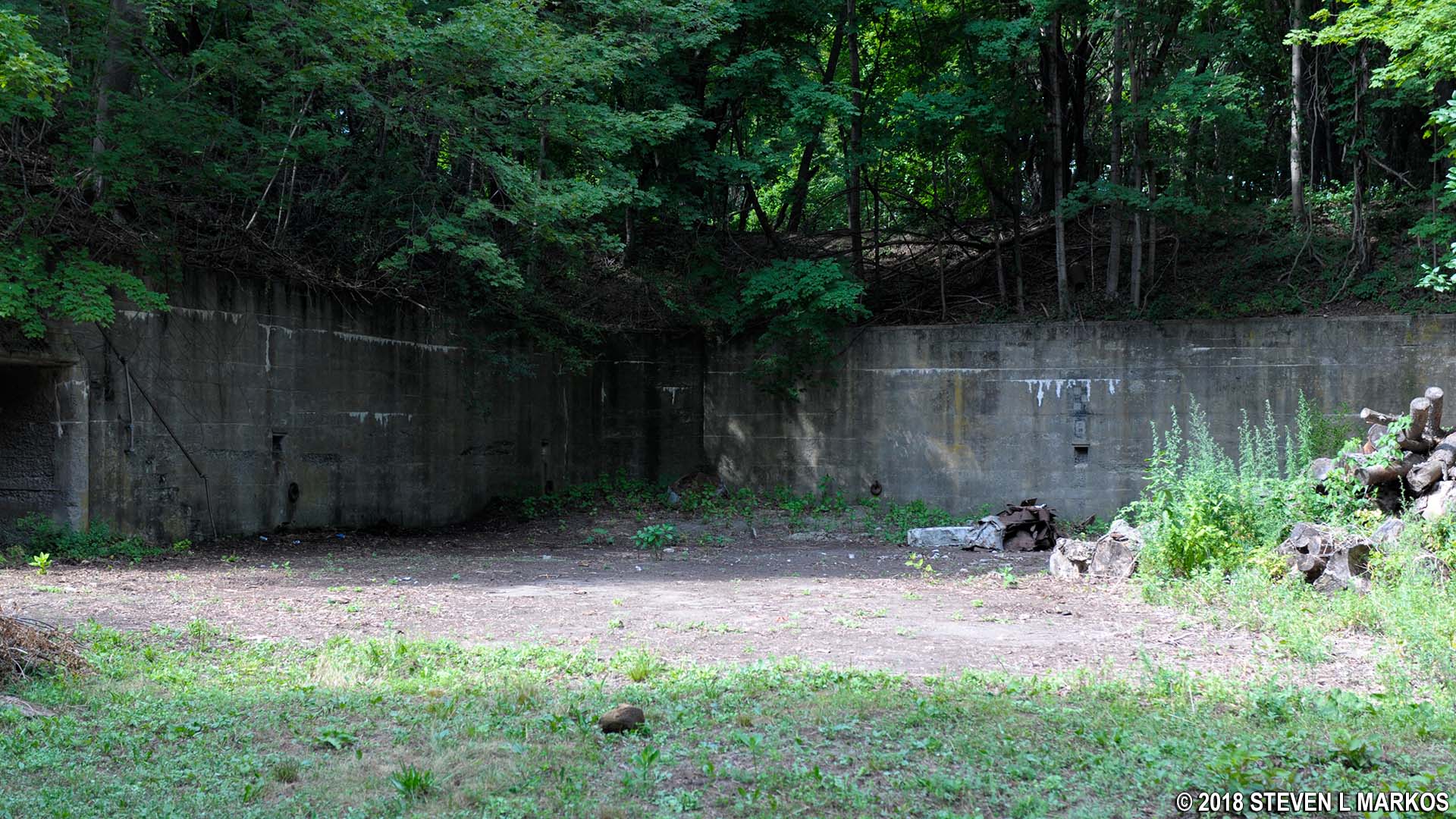
Pit B of Battery Cushing at Fort Andrews on Peddocks Island, Boston Harbor Islands National Recreation Area
Battery Whitman is in much better shape. The mortar pits are facing west, thus only Pit A can be seen from the road. A tunnel connects it to Pit B. The mortar pits at Whitman are much more interesting because you can still see the circles where the gun carriages were once installed. You can also get into the interior without having to bushwhack your way, but it is dark inside. Without a flashlight you can’t see much. I hate to spoil the surprise, but there is nothing inside other than empty rooms with concrete walls.
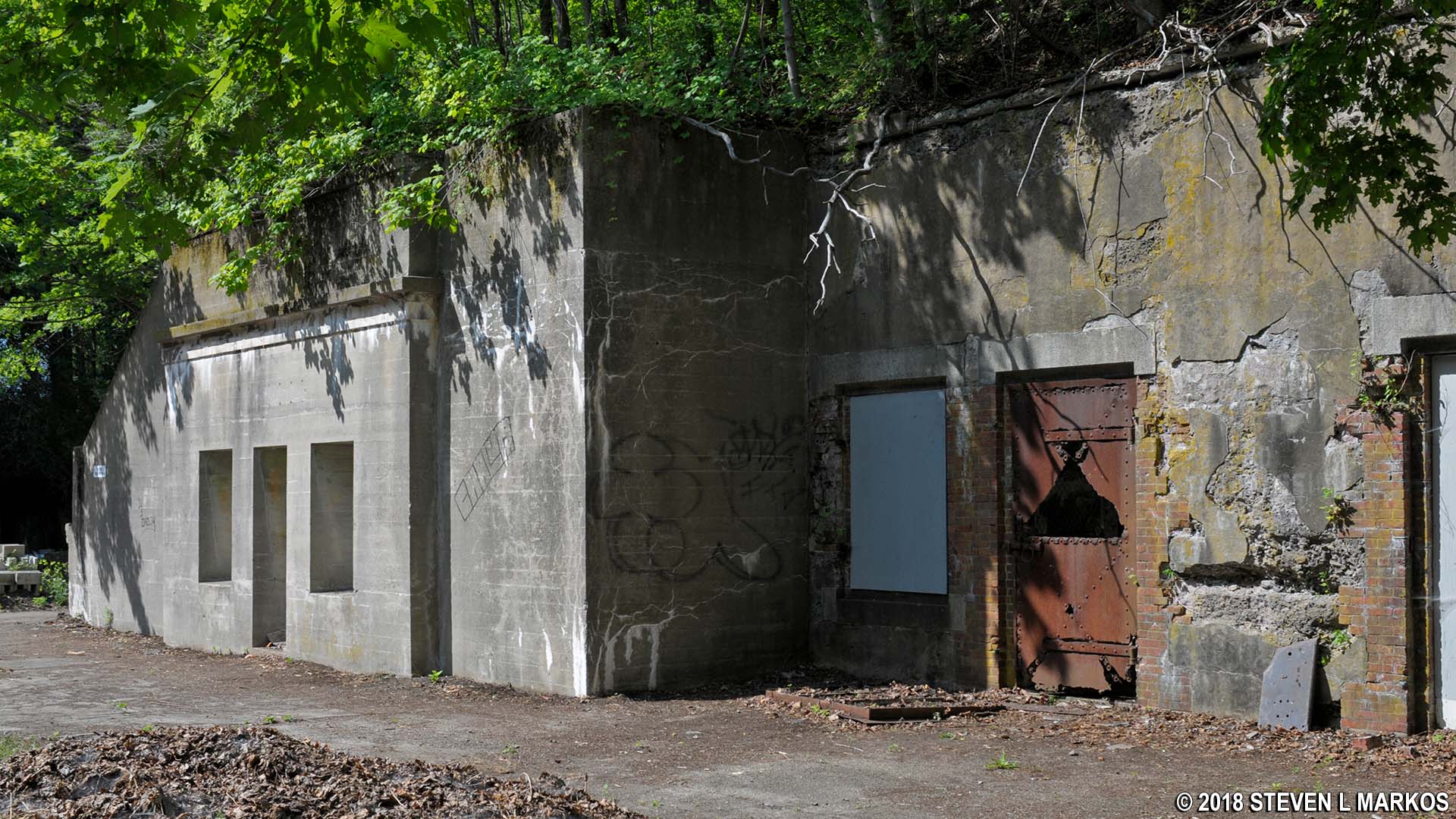
Battery Whitman at Fort Andrews on Peddocks Island, Boston Harbor Islands National Recreation Area

Tunnel connects Pit A (in foreground) with Pit B of Battery Whitman at Fort Andrews on Peddocks Island, Boston Harbor Islands National Recreation Area
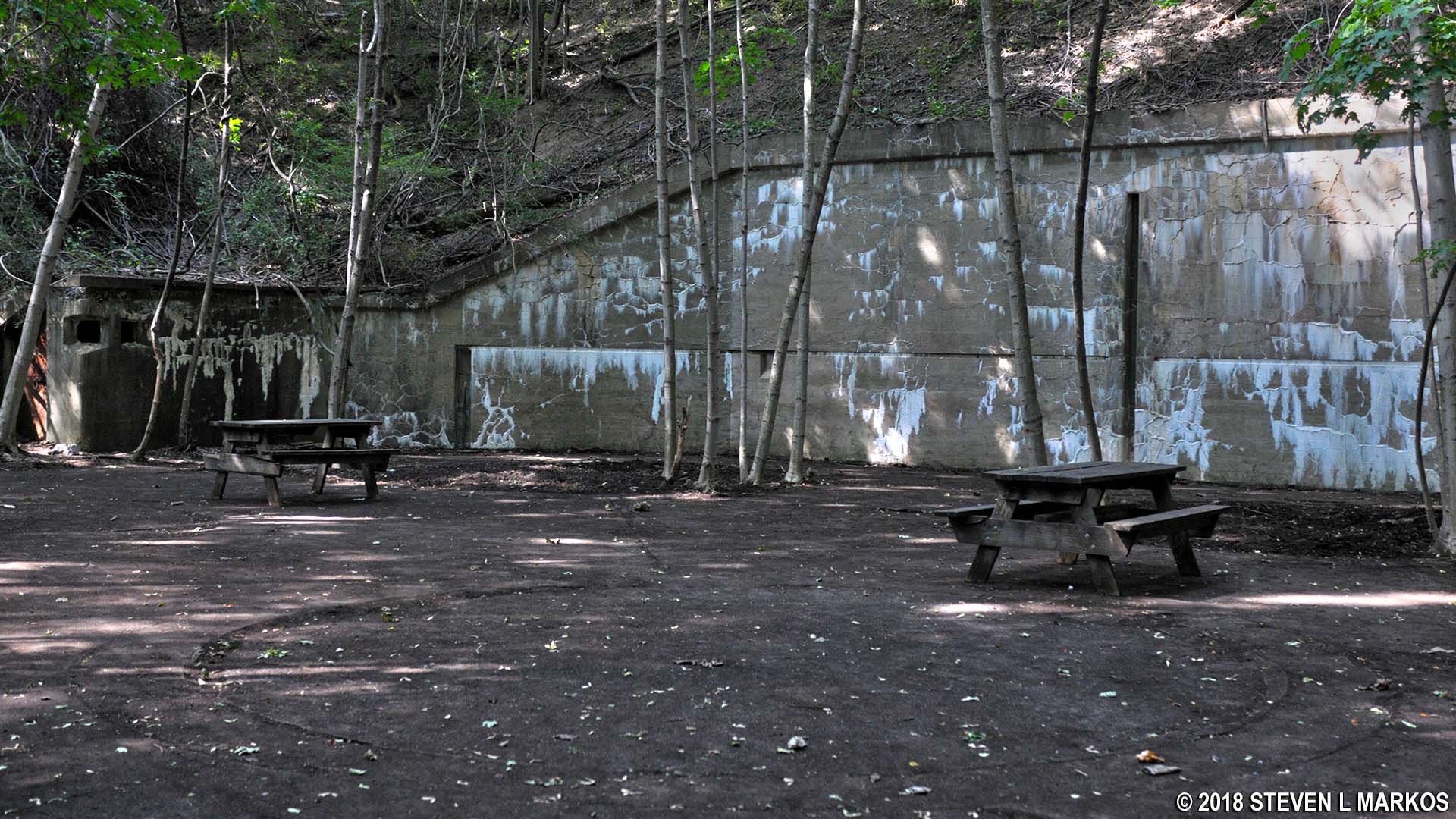
Pit B of Battery Whitman at Fort Andrews on Peddocks Island, Boston Harbor Islands National Recreation Area
Along the street in front of the batteries are two smaller structures that look like pill boxes. These are called Data Booths: radio stations that received firing coordinates from the plotting rooms inside the batteries. Since the men in the pits could not hear if the coordinates were shouted to them from the station, they were written on a board that stuck out from the side of the building. Part of a board is still intact on one of the stations.
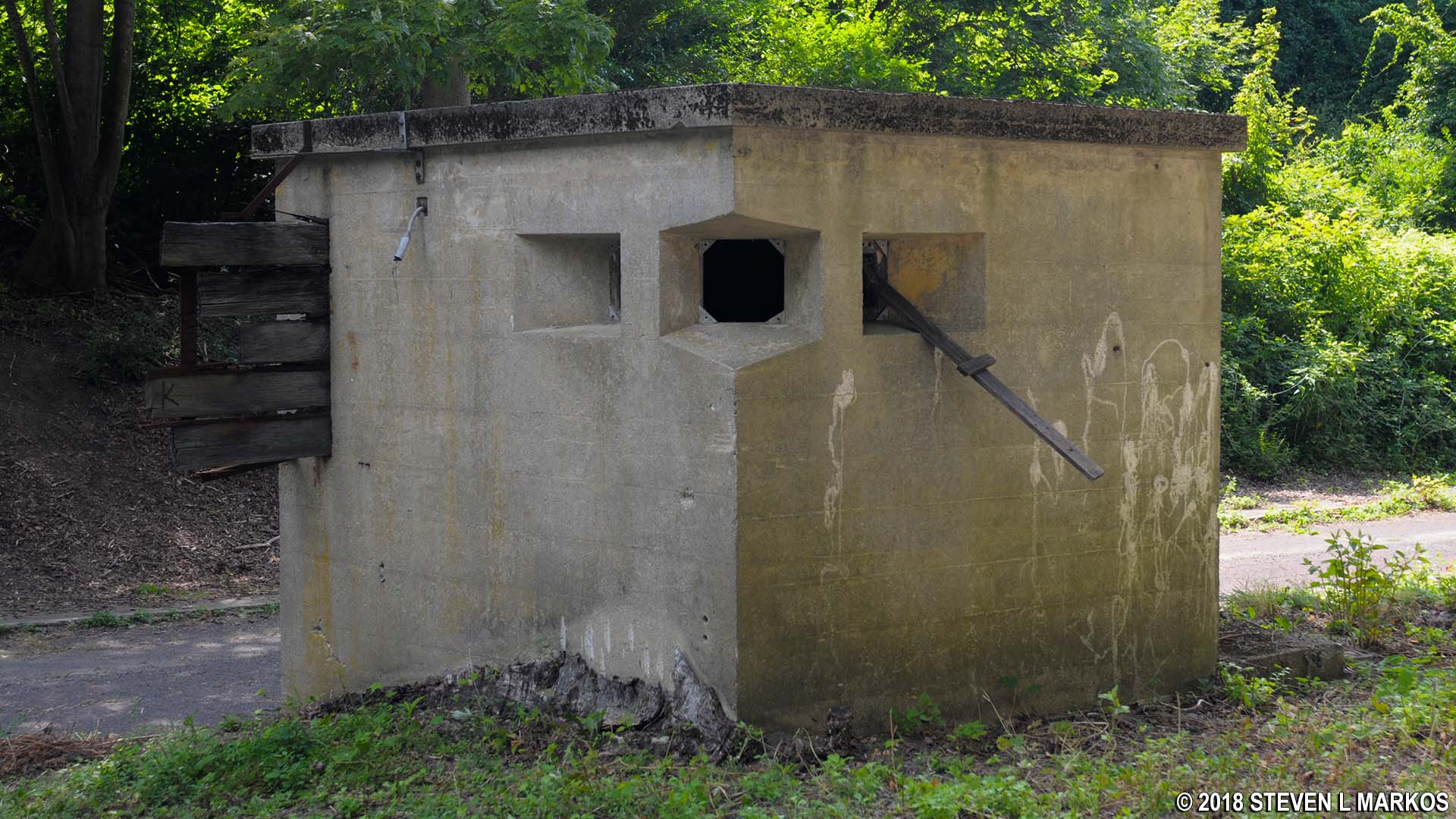
Data Booth for the mortar batteries at Fort Andrews on Peddocks Island, Boston Harbor Islands National Recreation Area
If you look south, you will see two buildings on the other side of a large field. The field is now home to six additional yurts used by campers, but back in World War II this was where temporary barracks were built to house members of the Italian Service Unit (ISU). Once Italy surrendered to the Allies and then declared war on Germany in October 1943, stateside Italian POWs with no known fascist bent and who pledged allegiance to the United States became part of the ISU (those who didn’t were sent to a prison in Texas). They were given United States Army uniforms and paid a wage, but were mainly used for manual labor on military bases across the United States. In the Boston area, the ISU—around 1,000 men—originally lived at Camp McKay in South Boston, but after numerous fights with local residents who still saw them as the enemy responsible for the deaths of their sons, they were moved permanently to Fort Andrews and remained until the war was over. No part of the barracks remain.
When the road forks just past the batteries, stay to the left—a right leads to the shore. The next building you come to is the Storehouse, the largest building within Fort Andrews. It is so big that I could only get a photo of the east wing.
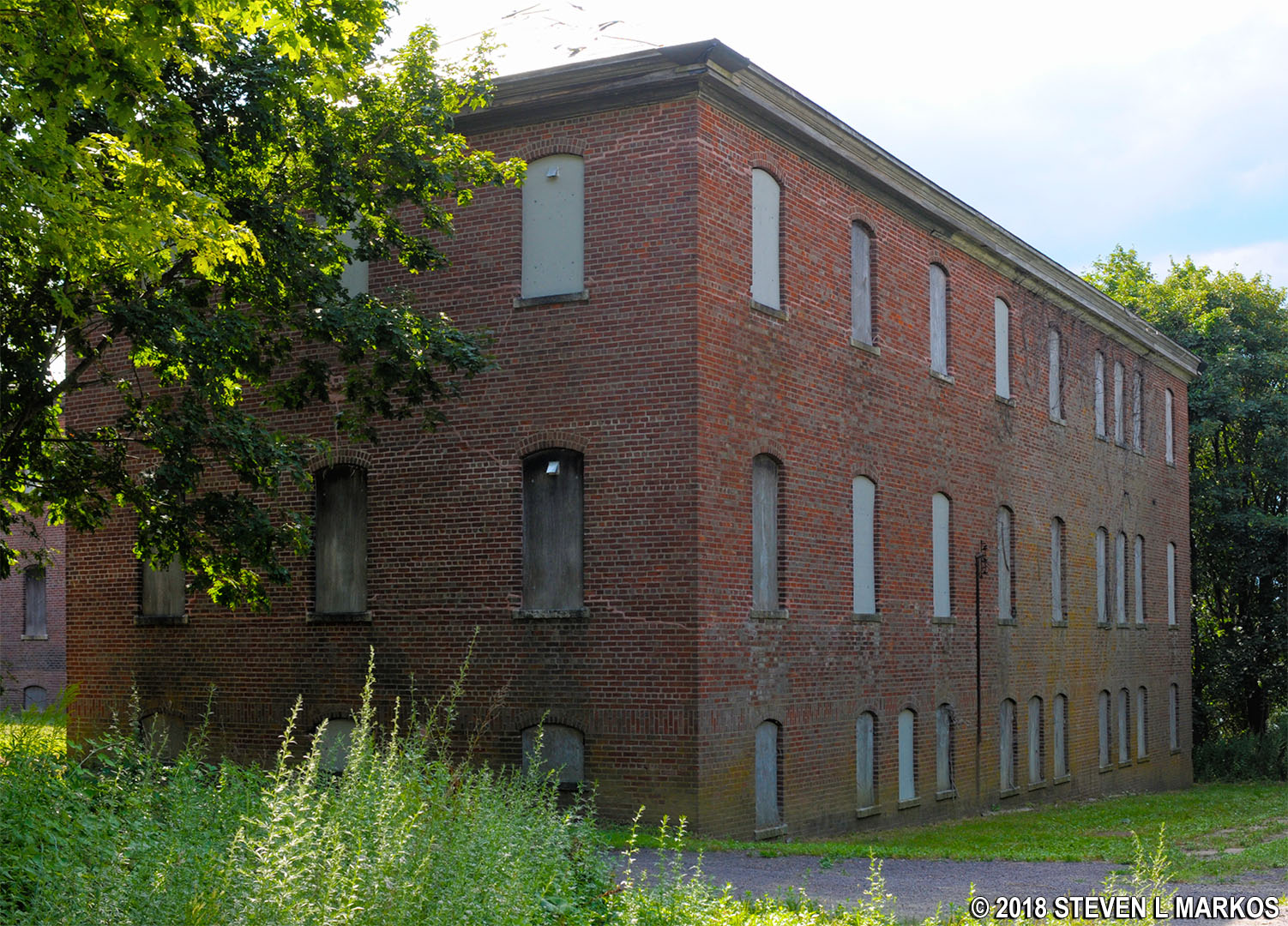
East wing of the Fort Andrews Storehouse on Peddocks Island, Boston Harbor Islands National Recreation Area
The road heads up a very steep hill just beyond the Storehouse, then curves to the south. The first two buildings you arrive at are Non-Commissioned Officer houses. The short posts in front of the buildings were once supports for a porch.
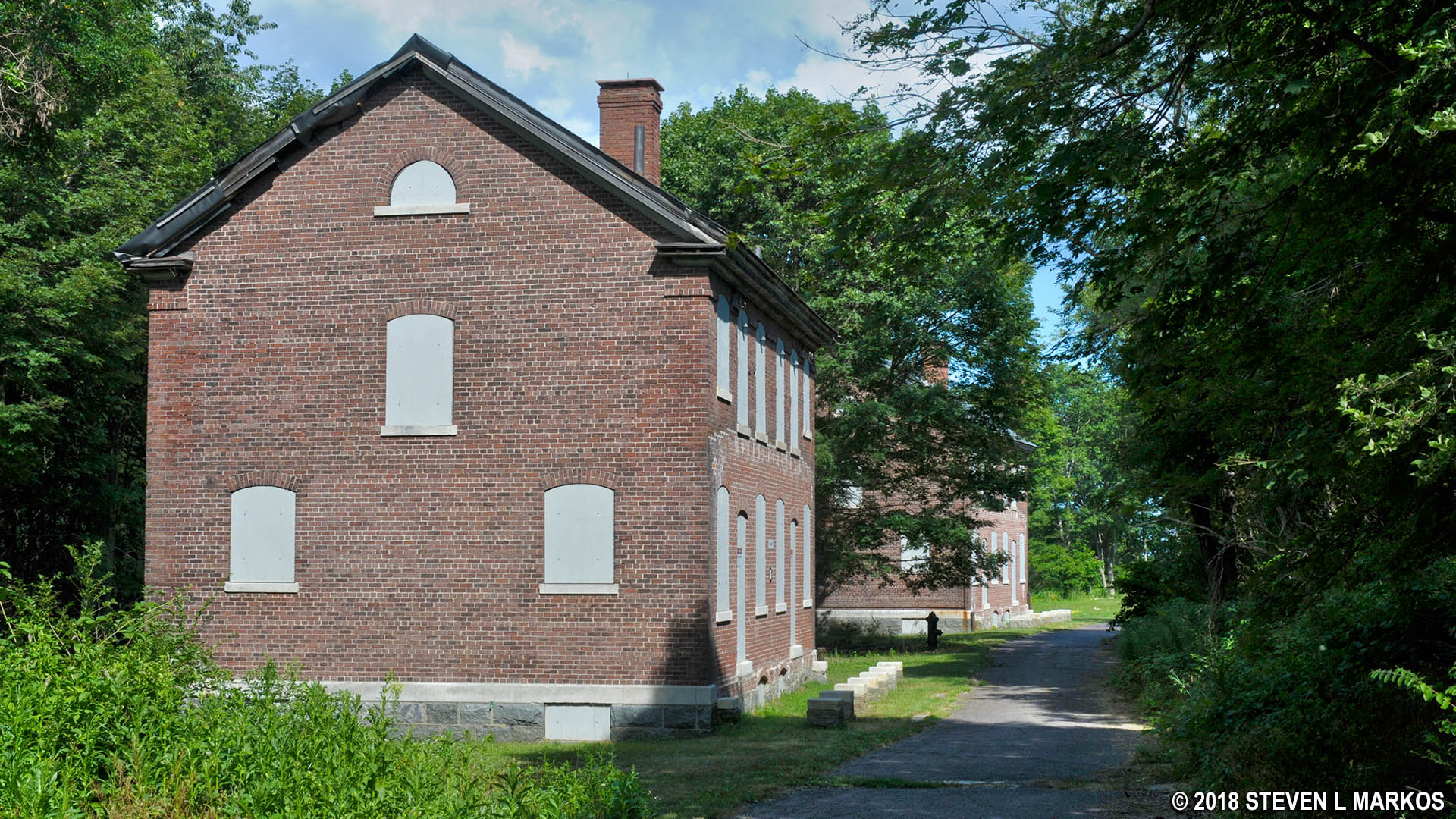
NCO Housing at Fort Andrews on Peddocks Island, Boston Harbor Islands National Recreation Area
There is a large gap between the NCO houses and the next group of two buildings, another NCO house and a more narrow building that was occupied by the Hospital Steward, an NCO who managed the 50-bed hospital that used to sit next door. The gap between the two sets of buildings was once filled with additional NCO houses, but they have been torn down.
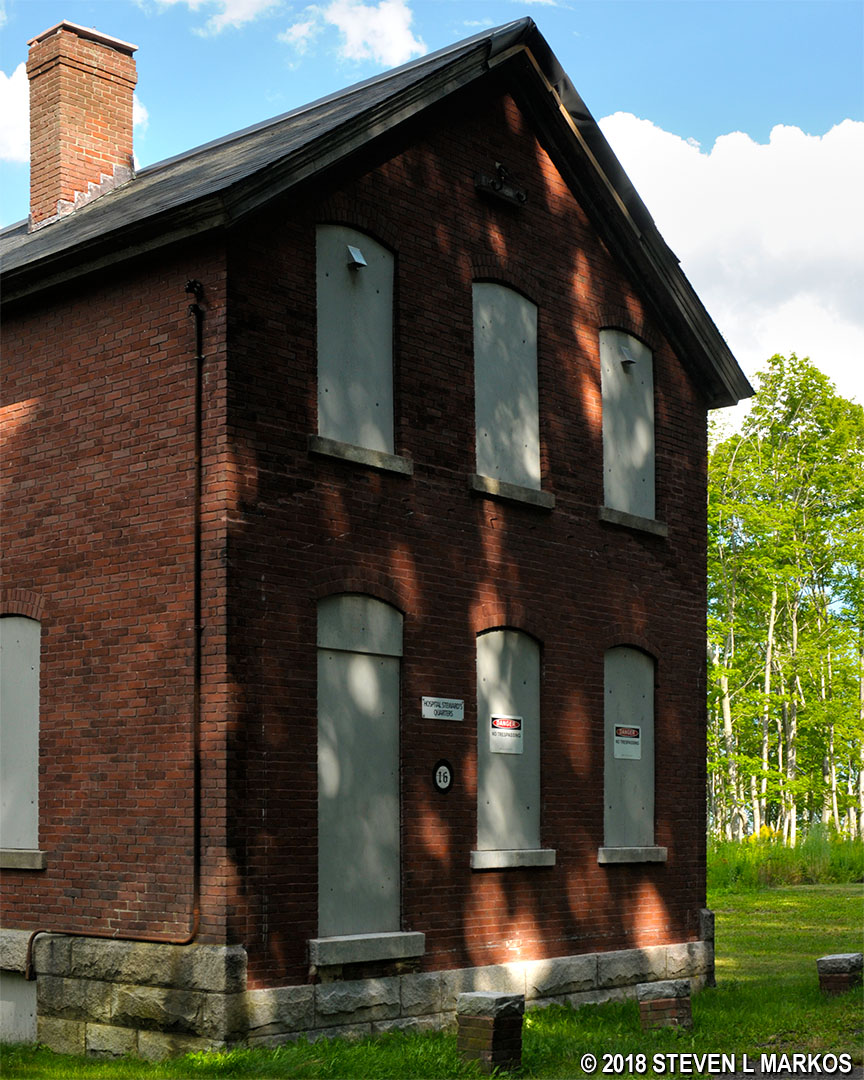
Hospital Steward’s House at Fort Andrews on Peddocks Island, Boston Harbor Islands National Recreation Area
The hospital was one of the buildings removed in 2011 after being deemed unstable. All that remains is its foundation.
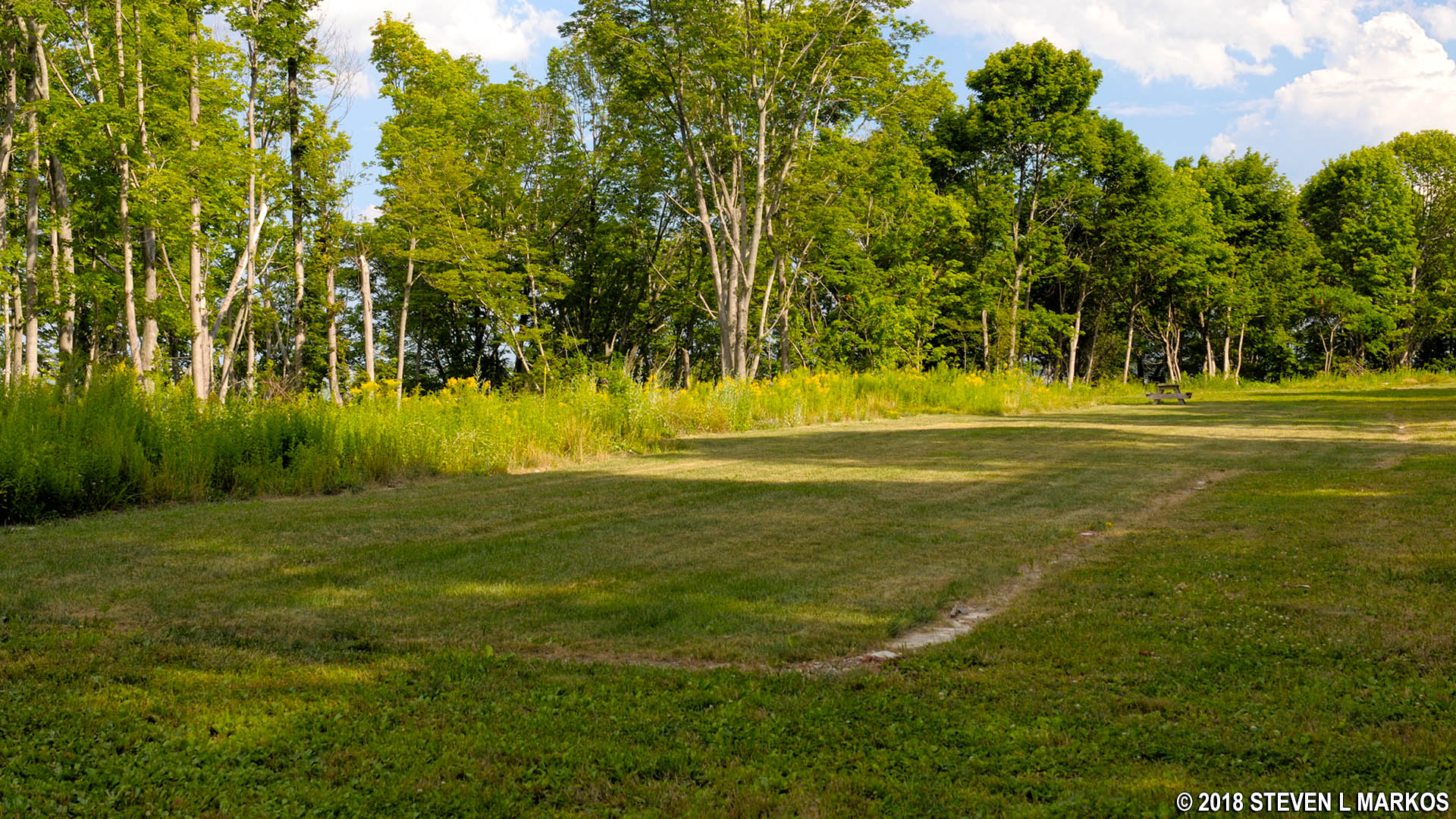
Site of the Fort Andrews hospital on Peddocks Island, Boston Harbor Islands National Recreation Area
The Hospital Steward’s Quarters is the last of the buildings on the hill, for none of the Commissioned Officer housing survived. Being more luxurious, most were made of wood, which is why they deteriorated much faster than the brick buildings. There were six homes in total, with the largest being the fifteen-room Field Officer’s Quarters. There was also a tennis court on the hill. The area is now used as the Peddocks Island Group Campground.

Peddocks Island Group Campground occupies the section of Fort Andrews where Officers’ Housing once stood, Boston Harbor Islands National Recreation Area

Foundation of one of the officers’ houses at Fort Andrews on Peddocks Island, Boston Harbor Islands National Recreation Area
The road eventually curves downhill and dead ends into another paved road. Take a left to continue the tour and head back to the Visitor Center (a right sets you off hiking to the west end of the island). As you walk back, you will pass the Chapel. During World War II, over thirty temporary wooden structures were built at Fort Andrews. The Chapel, which dates to 1941, is the only wooden building that remains. It was renovated in 2011 and is now used as a rental facility for weddings. It is not open on a regular basis. If interested in holding your wedding at the Chapel, visit the Host Your Event web page of the Boston Harbor Islands National and State Park website for more information.
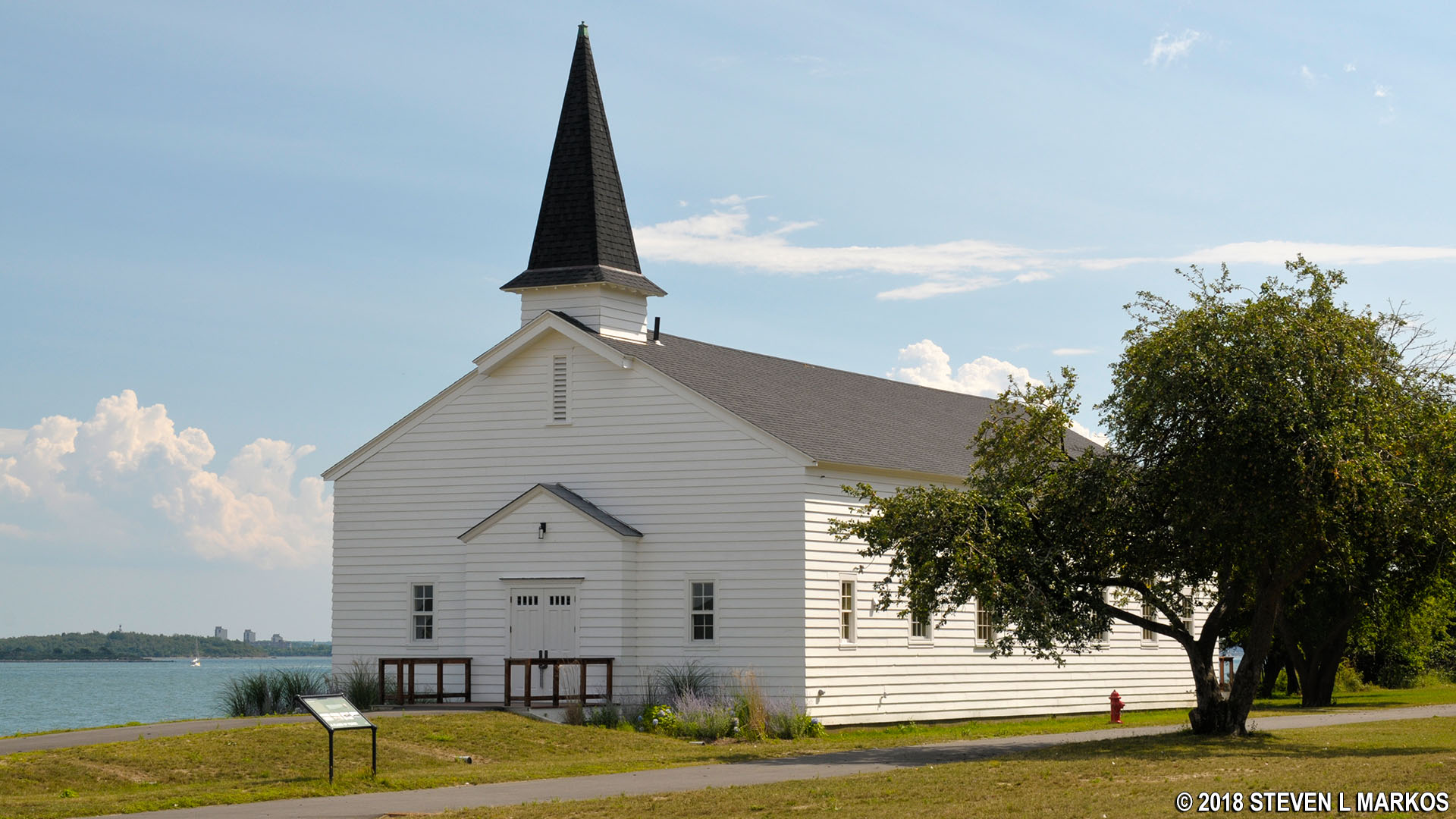
Fort Andrews Chapel on Peddocks Island, Boston Harbor Islands National Recreation Area
With a few exceptions, use of any photograph on the National Park Planner website requires a paid Royalty Free Editorial Use License or Commercial Use License. See the Photo Usage page for details.
Last updated on January 21, 2024


