
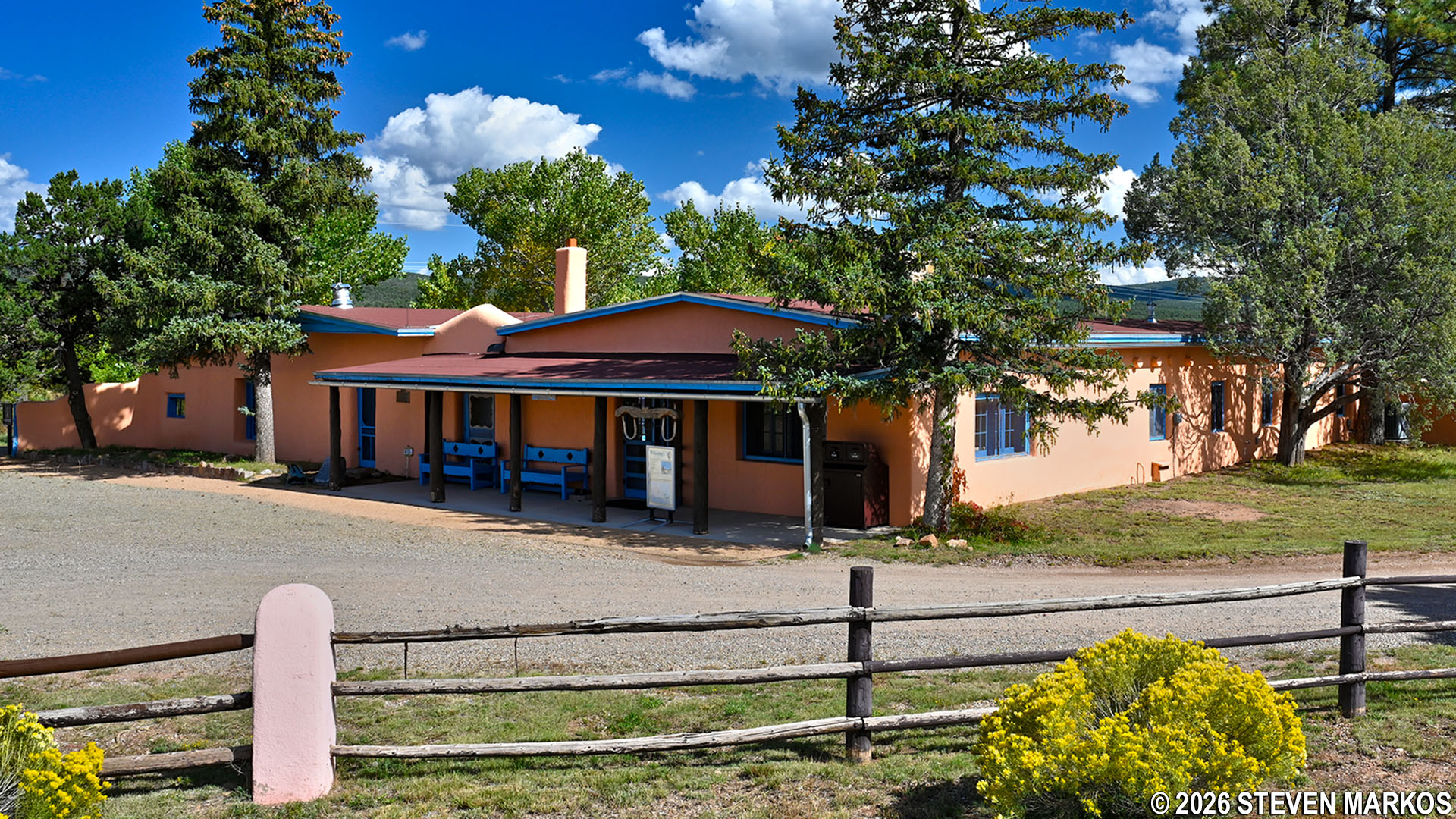
The Trading Post at Pecos National Historical Park
OPERATING HOURS
The Trading Post at Pecos National Historic Park is not open on a regular basis due to staffing shortages. It is most likely to be open for a short period after the conclusion of the Forked Lightning Ranch Tour or the Battle of Glorieta Pass Ranger Talk. These events are typically held in the afternoon on Mondays through Saturdays starting in April and continuing through the end of October. Be sure to check the National Park Service’s official Calendar of Events web page for the latest program schedule. If you are at the park’s Visitor Center, you can inquire about the Trading Post’s operating hours for the day.
TRADING POST HISTORY
Martin Kozlowski purchased the property that became the location of the Kozlowski Trading Post and Stage Stop in 1858. There was an existing structure that operated as a trading post and stagecoach stop, but whether he tore this down and built a new trading post from scratch or simply expanded it into a larger trading post building is not known with certainty. What is known is that his trading post (and inn) was a popular stop along the Santa Fe Trail, and it played a significant role during the Civil War and the Battle of Glorieta Pass.
In 1925, the Kozlowski Family lost the property to the state due to non payment of taxes, and it was purchased by Tex Austin, a famous rodeo promoter. Wanting to capitalize on the popularity of the “romantic west,” he built the Forked Lightning Ranch and ran it as a dude ranch for the wealthy. Austin used the Trading Post as the ranch headquarters and office, and he expanded it extensively during his time of ownership.
Austin eventually lost the property to creditors in 1935, and it was purchased by W. C. Currier. In 1941, Currier sold the ranch to Buddy Fogelson, a rich oilman from Texas. Fogelson married Hollywood movie star Greer Garson in 1949, and it is from Garson that the National Park Service acquired the Trading Post and Forked Lighting Ranch for inclusion in Pecos National Historical Park. She actually sold it to the Conservation Fund in 1991, and the Conservation Fund donated it to the federal government. Garson died in 1996 at the age of 91.
The Trading Post served as an office and storage space for the National Park Service from 1999 until 2005, at which time it was deemed to dilapidated for continued occupation. Funds were obtained to renovate the building, and the work was carried out from 2018 through 2022. It opened the public in May 2023 and now serves as a museum dedicated to the modern history of the area, from the Sante Fe Trail to the Civil War to the colorful ranching period of the early 1900s.
A stone marker was placed in front of the Trading Post by the Daughters of the American Revolution and the Territory of New Mexico in 1910 to commemorate the Sante Fe Trail. Another commemorative marker was placed in 1990 by the New Mexico State Society of the Daughter’s of the Colonists, this one implying that the Trading Post was built in 1810. This is confusing because there was no Kozlowski Trading Post in 1810. There was no Sante Fe Trail in 1810. New Mexico wasn’t even a United States Territory in 1810. Is this some sort of glaring error? What this is referring to is a building at this location built in 1810 that was part of Kozlowski’s purchase. Since it was around at the start of the Sante Fe Trail in 1821, it apparently served as a trading post and stagecoach stop under a different owner. As mentioned, Kozlowski either tore it down and built a new trading post or incorporated it into his much larger 1858 Trading Post building.
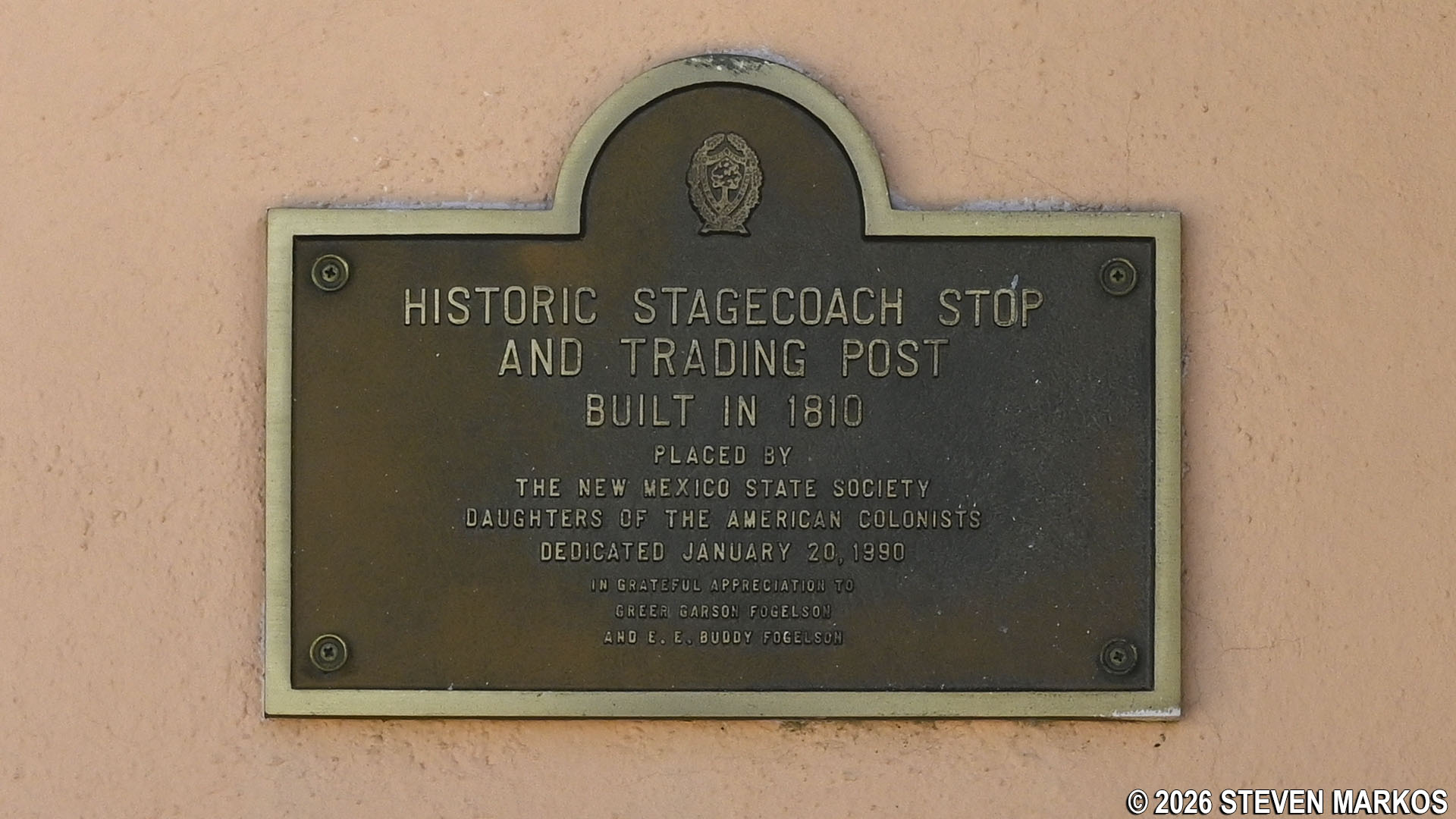
Historical marker on the wall of the Trading Post at Pecos National Historical Park
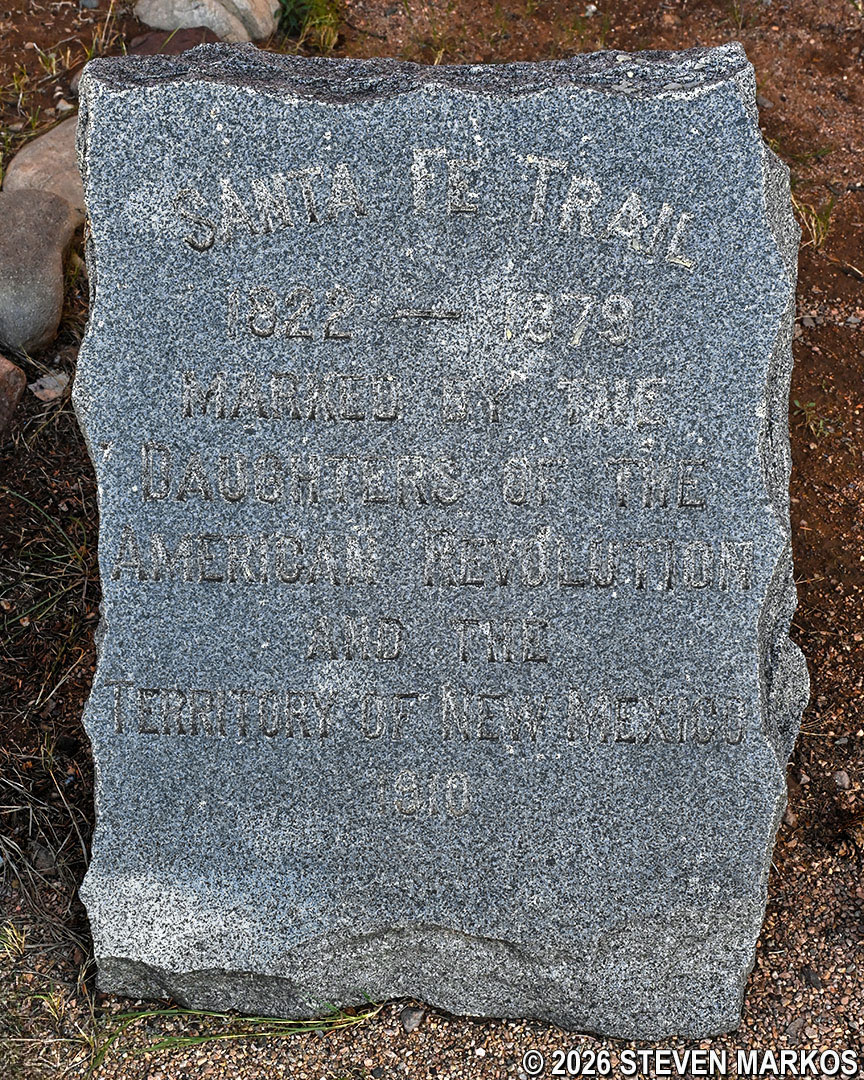
Stone marker outside of the Trading Post at Pecos National Historical Park
TRADING POST MUSEUM
Inside the Trading Post is a museum spread across four rooms that focuses on the history of the Forked Lightning Ranch and the surrounding region. The first room provides a brief historical timeline of ownership of the ranch and the construction progression of the Trading Post over the years.
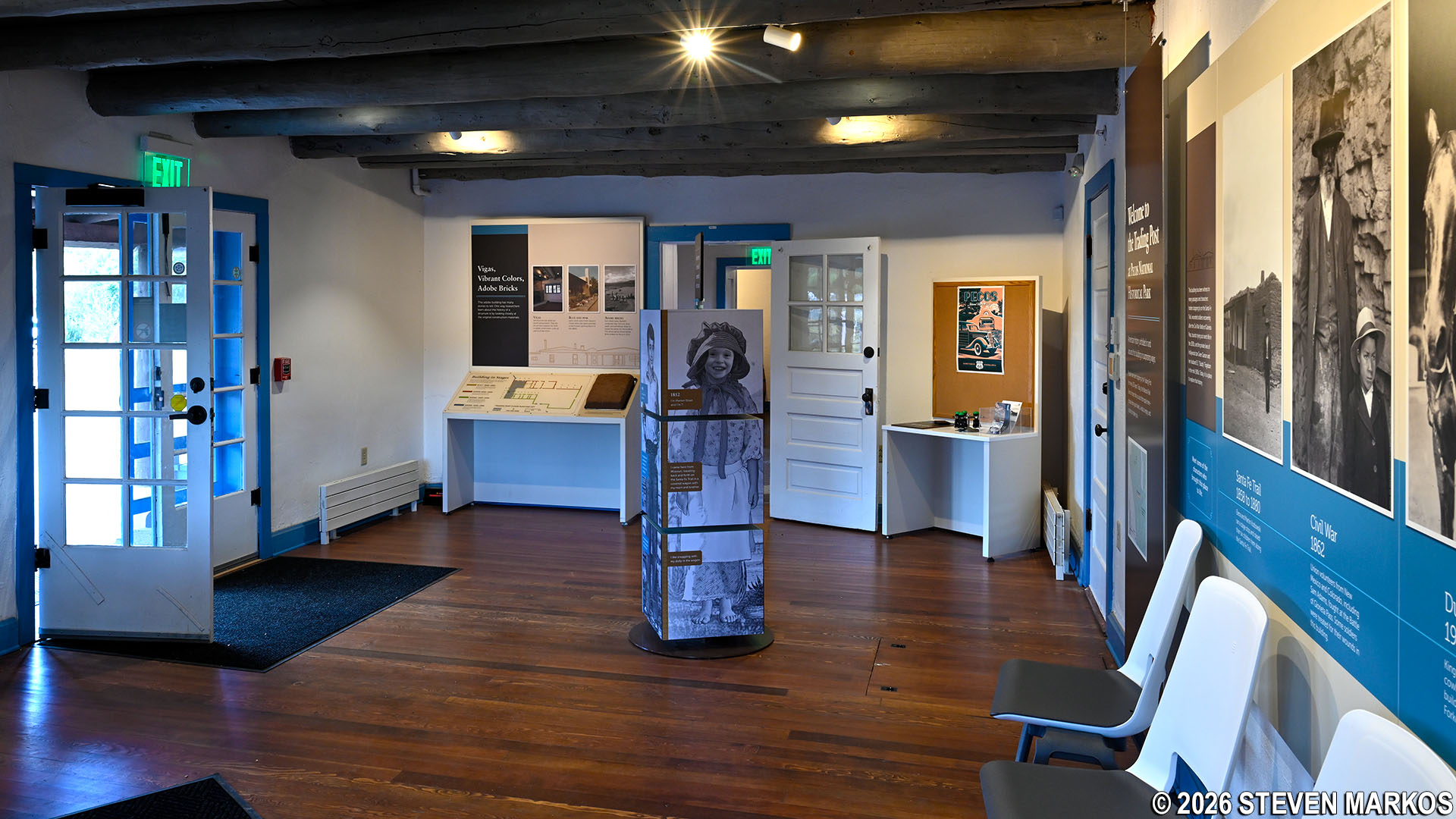
Exhibits on the Forked Lightning Ranch property ownership over the years at the Trading Post Museum, Pecos National Historical Park
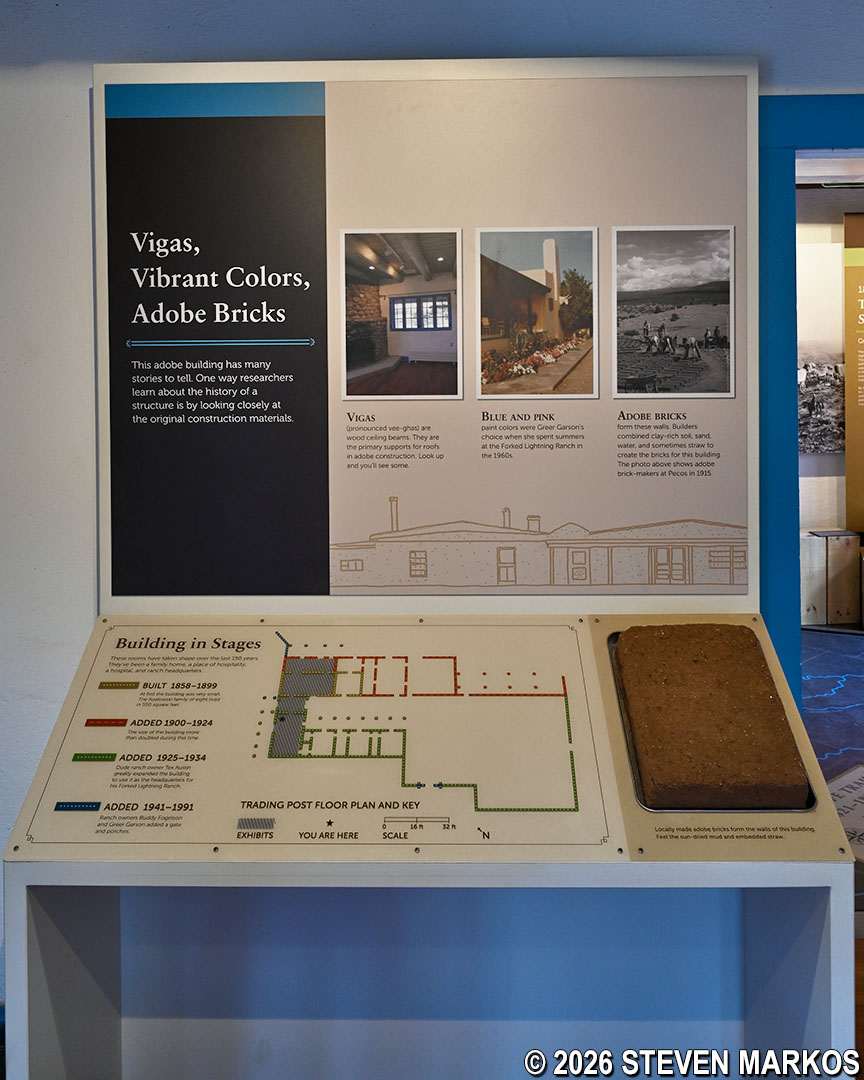
Exhibit featuring the stages of the Trading Post’s construction in the Trading Post Museum, Pecos National Historical Park
A second room has information on the Santa Fe Trail and how it shaped the Trading Post, which became a popular stop for travelers. Examples of some of the items that were traded at the time are on display. The floor of the room also doubles as a map of the Sante Fe Trail.
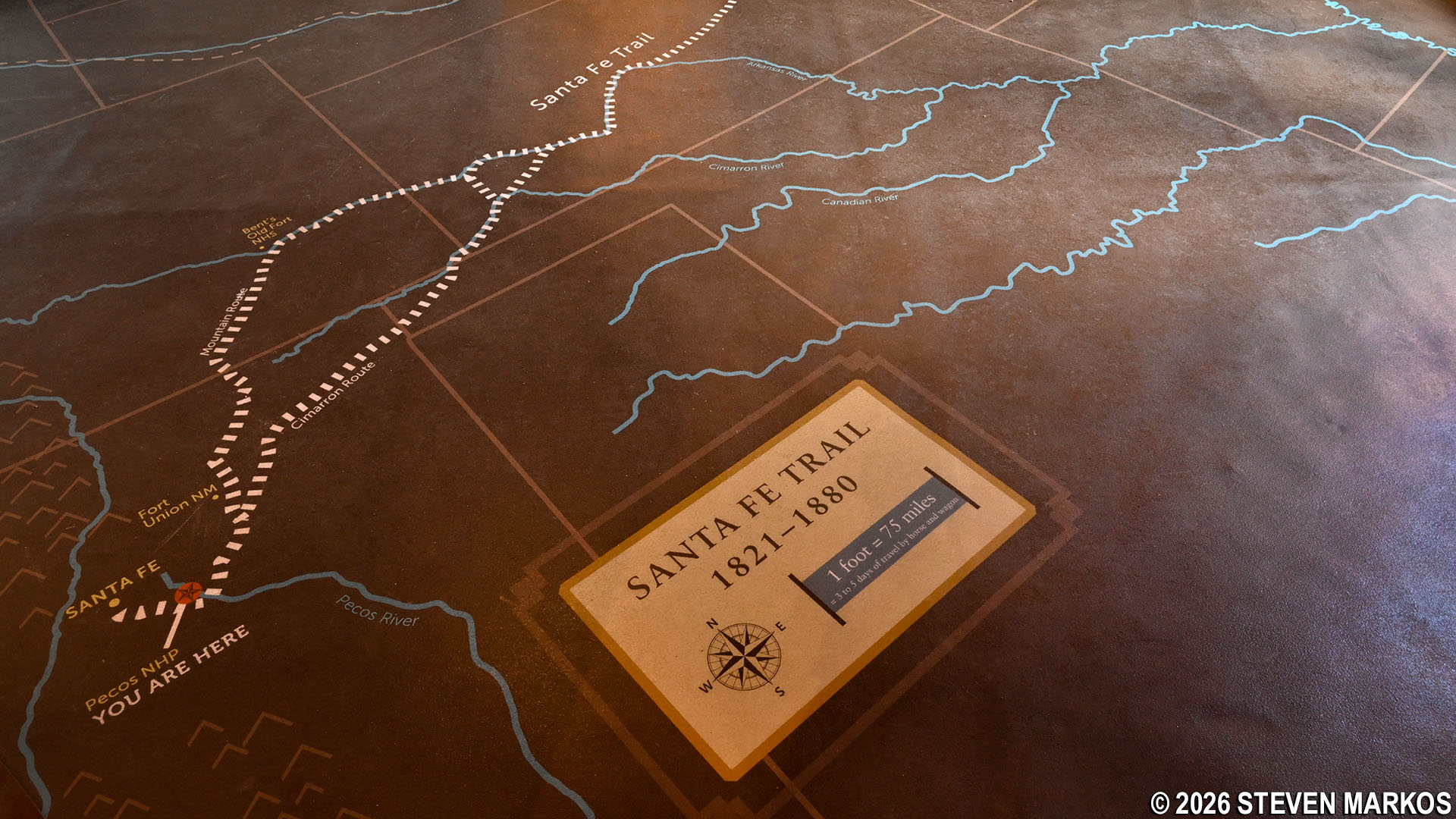
Santa Fe Trail floor map inside the Trading Post at Pecos National Historical Park
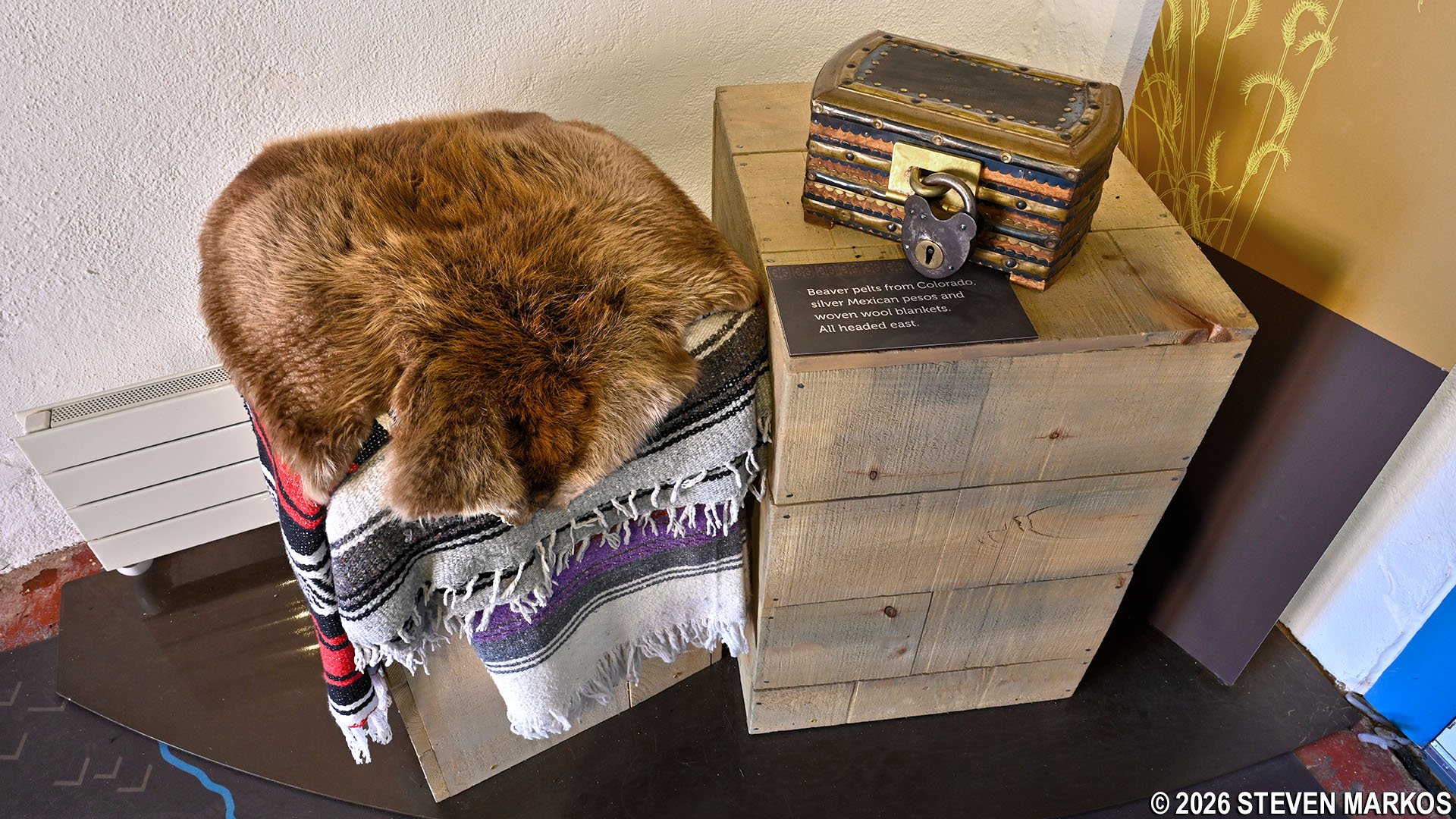
Typical items traded in the 1800s at the Trading Post in Pecos, Pecos National Historical Park
The exhibits in the third room focus on the mid to late-1800s when the Kozlowski’s owned the Trading Post. Fittingly, this room is part of Kozlowski’s original building (before it was expanded in the 1900s). During this time, the Civil War took place and the Battle of Glorieta Pass was fought. The Union Army temporarily moved in, setting up camp and using the Trading Post as a base of operations and a makeshift hospital.
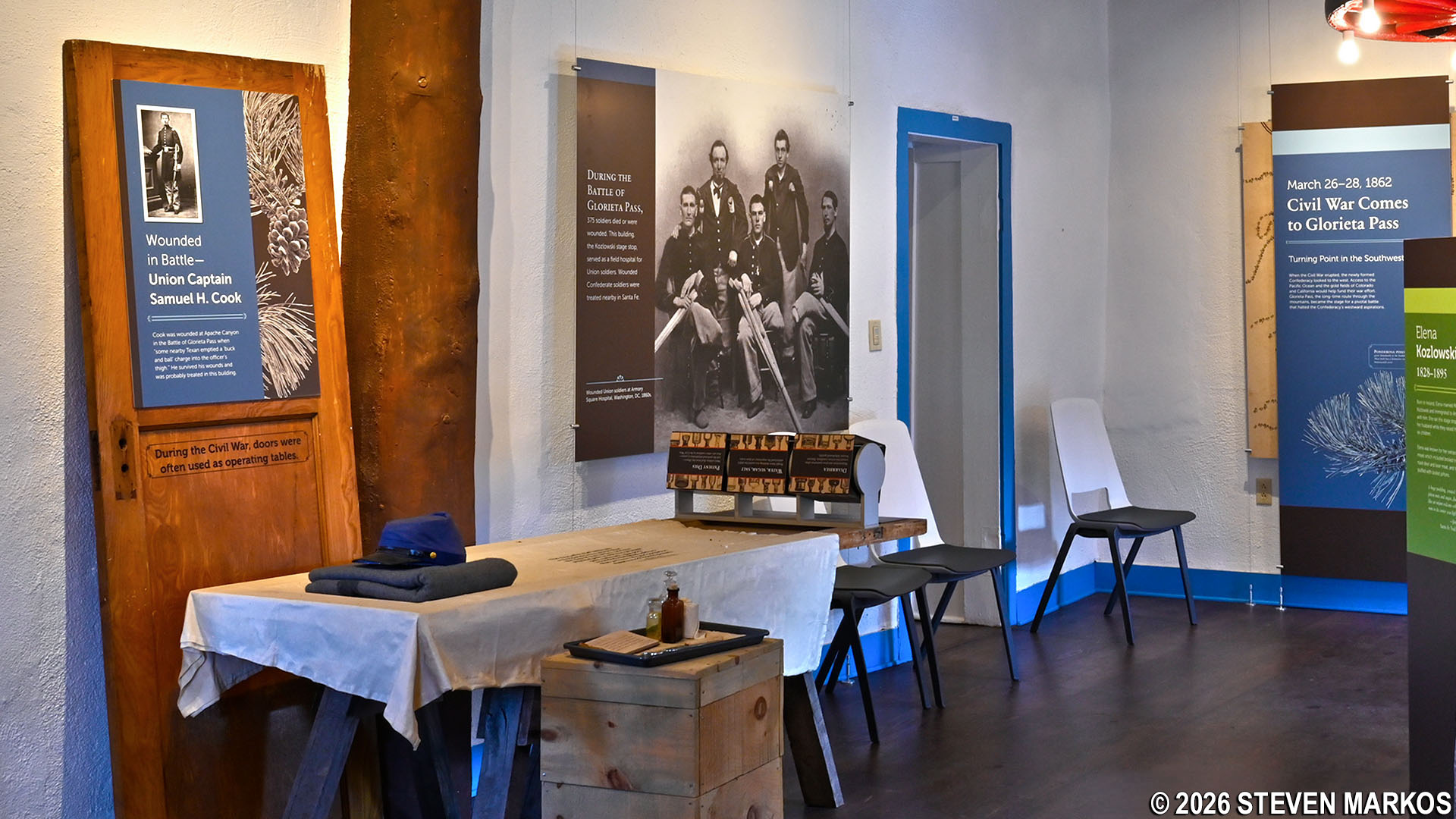
Civil War exhibit in the Trading Post Museum at Pecos National Historical Park
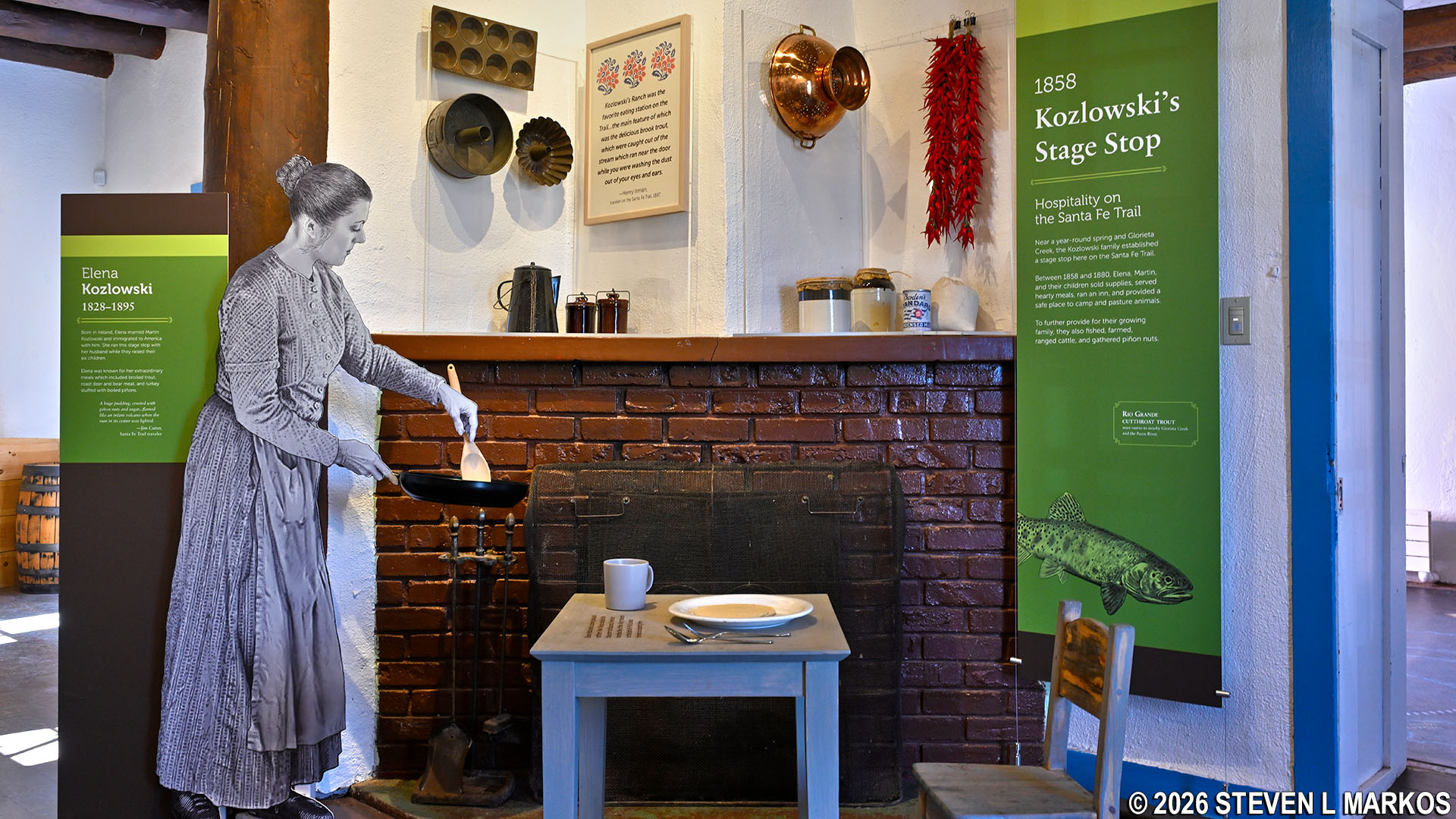
Exhibit featuring the Kozlowski Stage Stop at the Trading Post Museum, Pecos National Historical Park
The last room in the Trading Post Museum has exhibits on Tex Austin, Buddy Fogelson, and his wife, Greer Garson. During Tex Austin’s ownership, the trading post was turned into the Forked Lightning Ranch’s office. Austin built the ranch as an upscale dude and working cattle ranch that catered to the wealthy looking for a “real-life” ranch experience. When Buddy Fogelson purchased Forked Lightning, he continued running it as a cattle ranch. After he married Hollywood actress Greer Garson, the ranch became their summer home, and they hosted parties for the rich and famous.
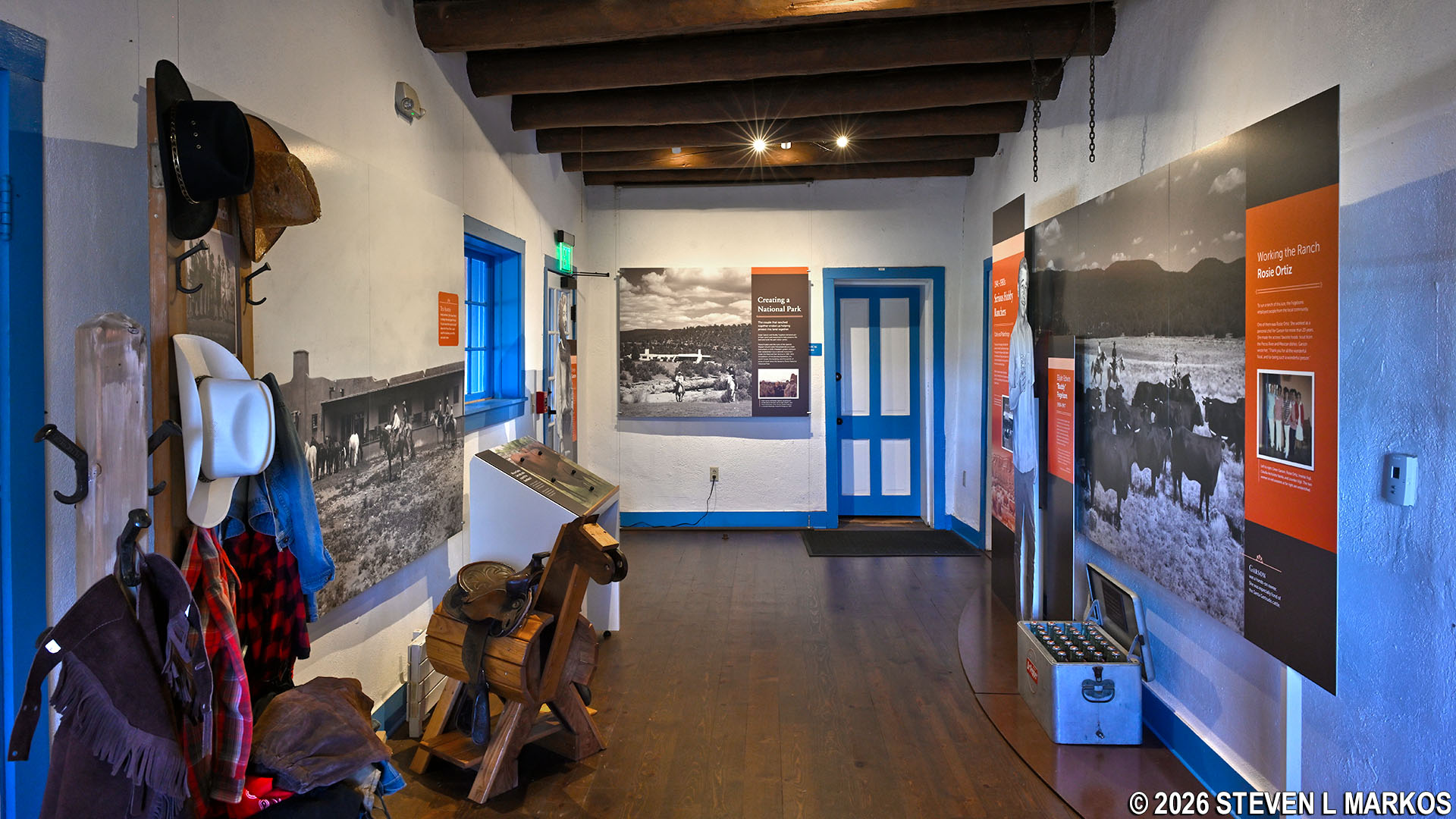
Exhibit room featuring information on the Forked Lighting Ranch at the Trading Post Museum, Pecos National Historical Park
With a few exceptions, use of any photograph on the National Park Planner website requires a paid Royalty Free Editorial Use License or Commercial Use License. See the Photo Usage page for details.
Last updated on August 5, 2026


