
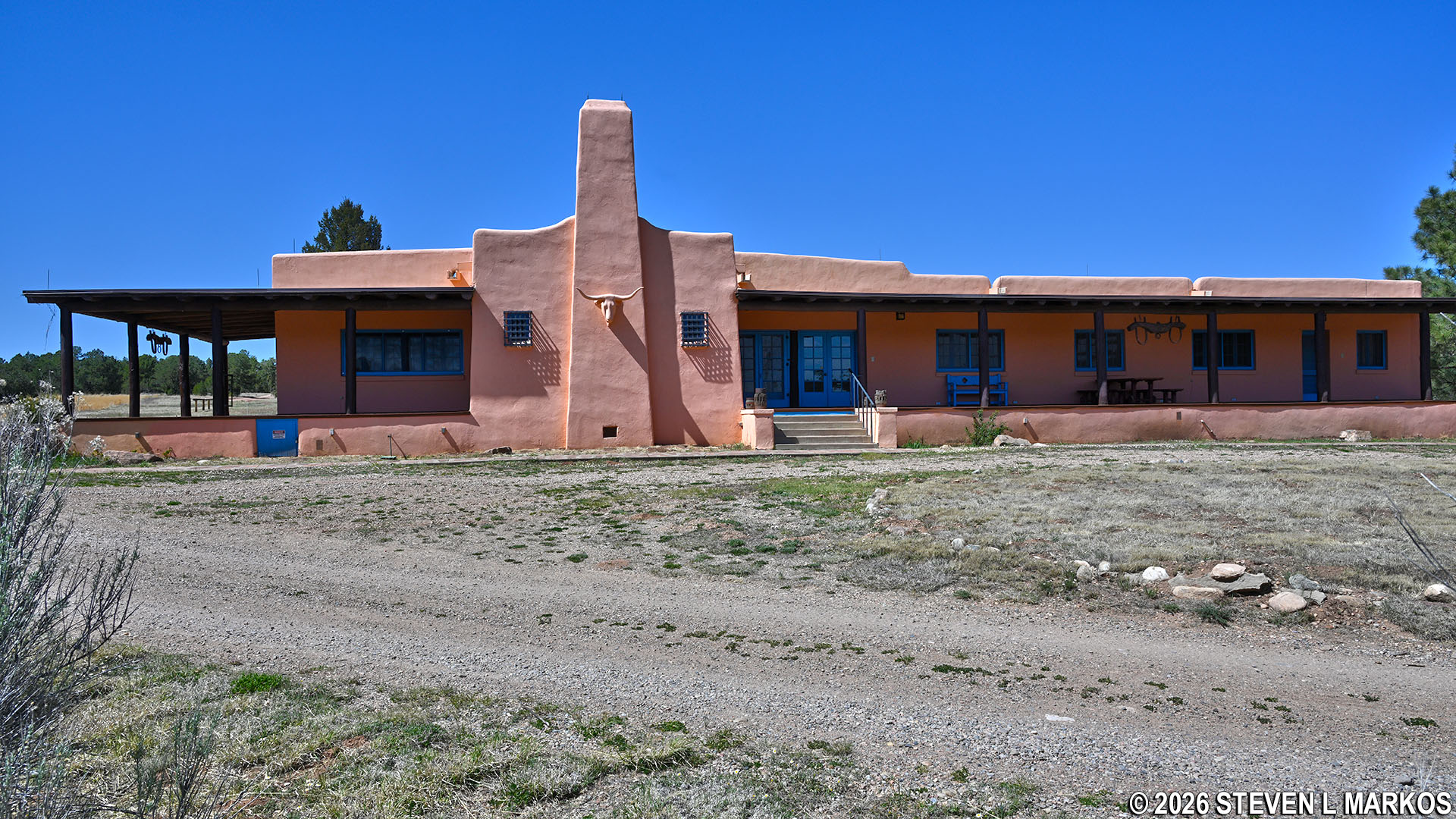
Forked Lightning Ranch main house at Pecos National Historical Park
RANCH TOUR DETAILS
The only way to see the Forked Lightning Ranch at Pecos National Historical Park, including the interior of the main Ranch House, is on a free Ranger-guided tour. These are typically offered in the early afternoon on Wednesdays through Saturdays starting in April and continuing until the end of October. Tours are approximately two hours long and are limited to 15 people. All spots are taken on a first-come, first served basis, but the park isn’t that popular, so it is usually not a problem to get on a tour. For the current schedule, check the National Park Service’s official Calendar of Events web page.
The tour begins at the Visitor Center. After a brief orientation, participants drive in their personal vehicles to the Forked Lightning Ranch site, first stopping at the Trading Post for another short lecture. A gravel road on the right side of the Trading Post leads to the main house. Keep in mind that large RVs and vehicles towing trailers are not allowed on the road, and Rangers cannot transport participants in their vehicles. (The trailhead for the South Pasture Loop Trail is also located off the same road.)
RANCH HISTORY
The Forked Lightning Ranch was founded by rodeo promoter Tex Austin. Known as the “King of the Rodeo,” Austin was instrumental in popularizing the sport outside of the American West. During the 1920s and early 1930s, he put together rodeos in Chicago Stadium, Madison Square Garden, and Gilmore Stadium in Hollywood. Austin even took his rodeo all the way to the United Kingdom, producing shows at Wembley Stadium in London and at Croke Park in Dublin, Ireland. He brought his rodeo back to London in 1934 and performed in front of the king and queen.
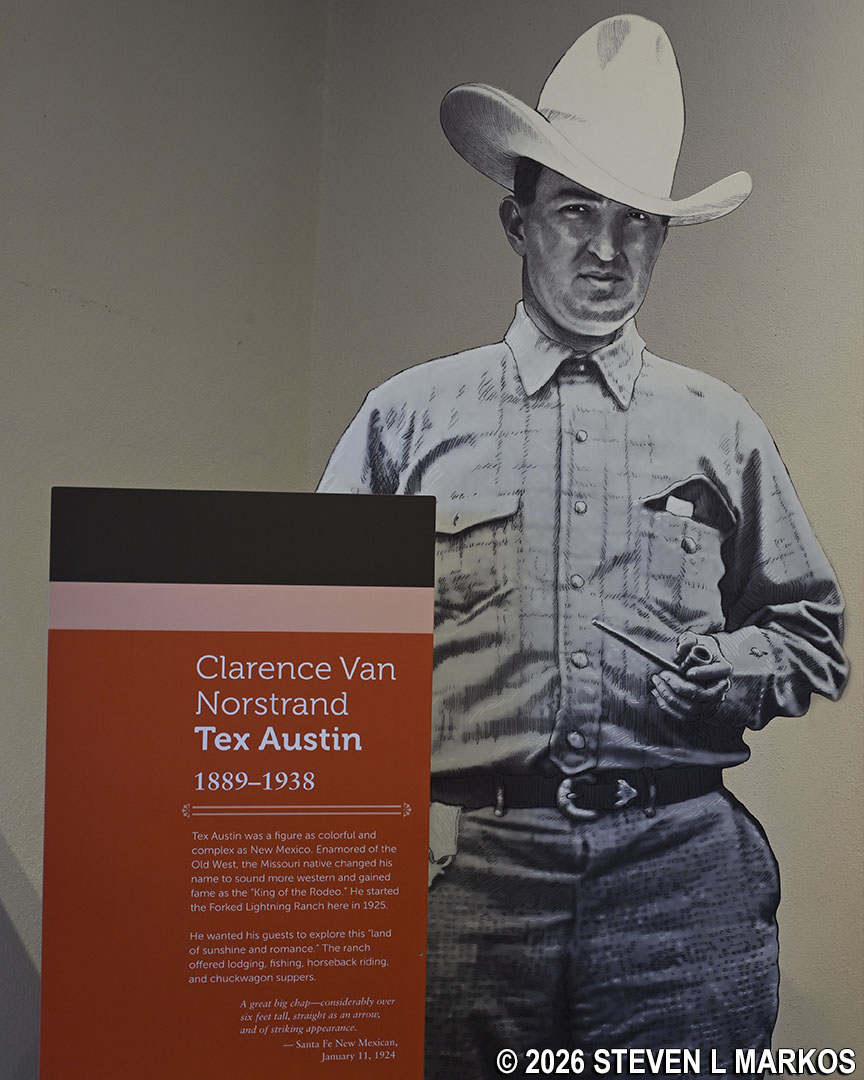
Tex Austin exhibit inside the Trading Post Museum, Pecos National Historical Park
When Austin purchased the property, only the Trading Post existed. This was built by Martin Kozlowski around 1858 and served as commerce center, inn, and stagecoach stop on the Sante Fe Trail up until the early 1880s. It remained in the Kozlowski Family until 1925, at which time Thomas Kozlowski (who was deeded the property in 1898 by his father) lost it to the state due to non payment of taxes. Austin purchased it along with other land parcels near the Pecos River, totaling 5,500 acres, and created the Forked Lightning Ranch. He planned to run it as an upscale dude ranch and resort that catered to the wealthy. It has been said that the ranch was named after the crazy lightning that can be seen during the summer monsoon season.
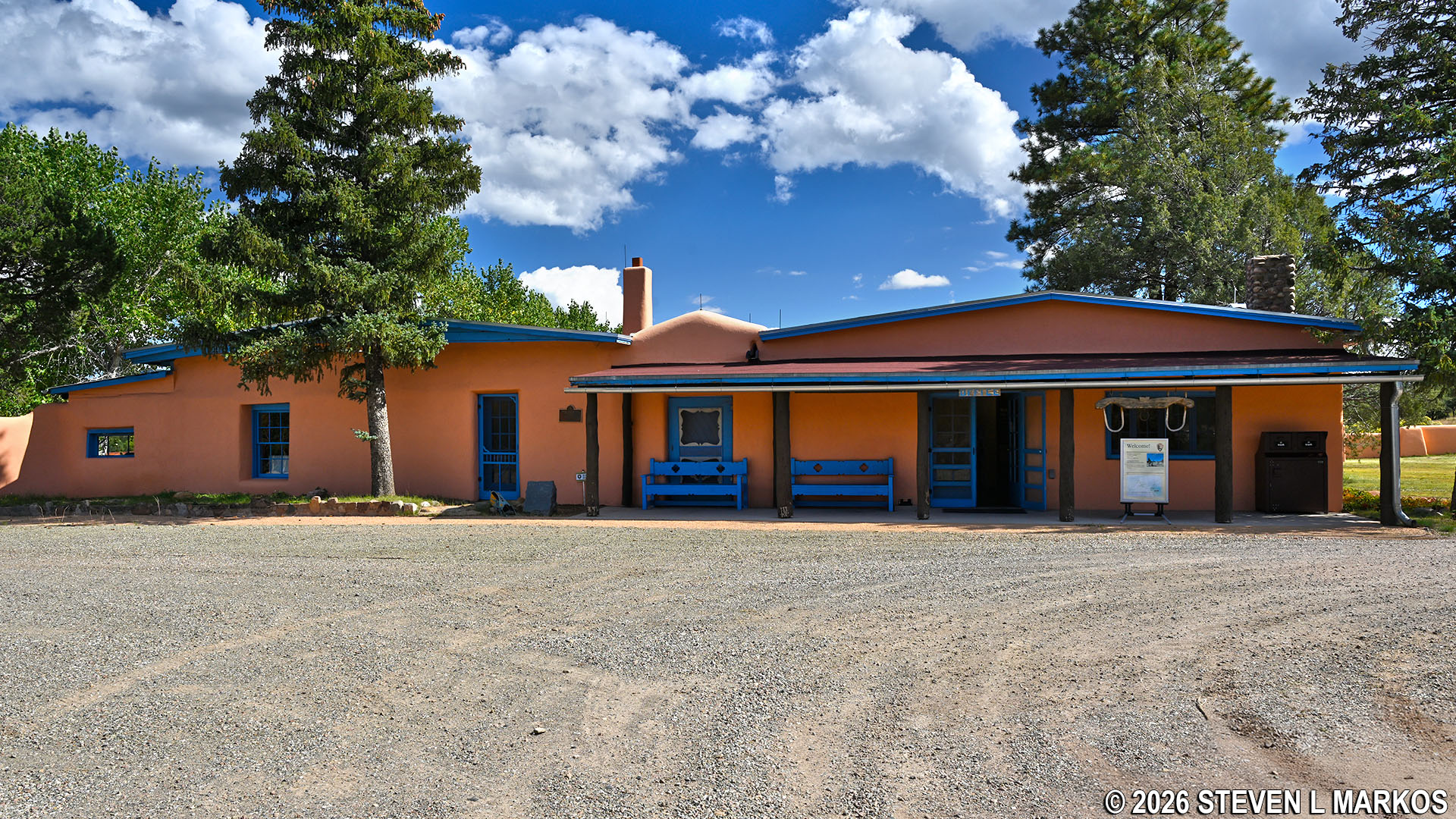
Trading Post building at the Forked Lightning Ranch, Pecos National Historical Park
Austin expanded the Trading Post and used it as the dude ranch headquarters and store. He built corrals, sheds, barns, a tennis court, and even a polo field. Western wear and equipment, such as outfits, boots, and hats, could be purchased at the Trading Post. Guests were offered a full range of activities, including riding parties, picnics, tennis, golf, croquet, horseshoes, and ping pong. Motor trips to Santa Fe and other nearby points of interest were also available, and each guest was provided a private horse to use at any time.
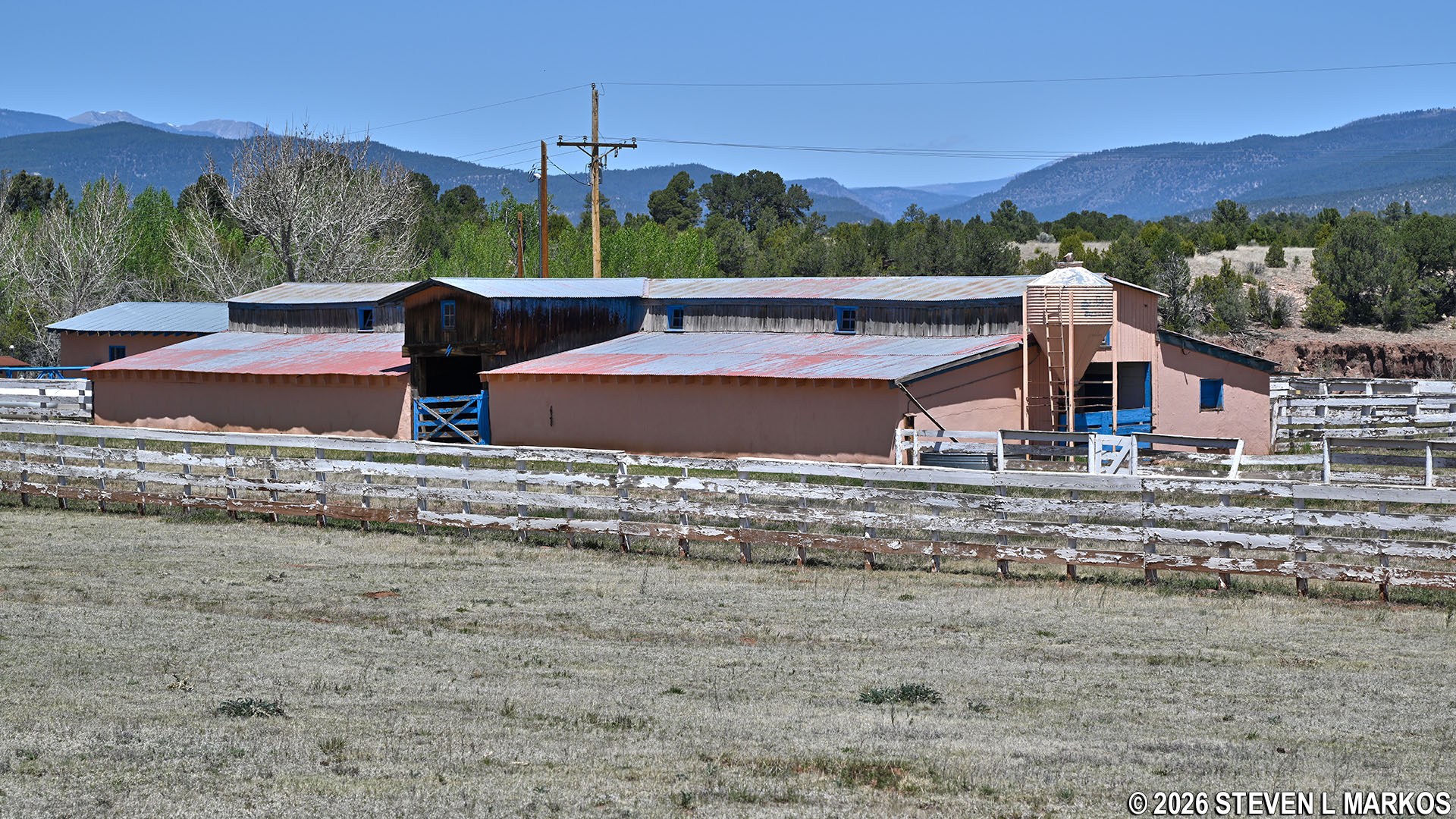
Forked Lightning Ranch buildings at Pecos National Historical Park
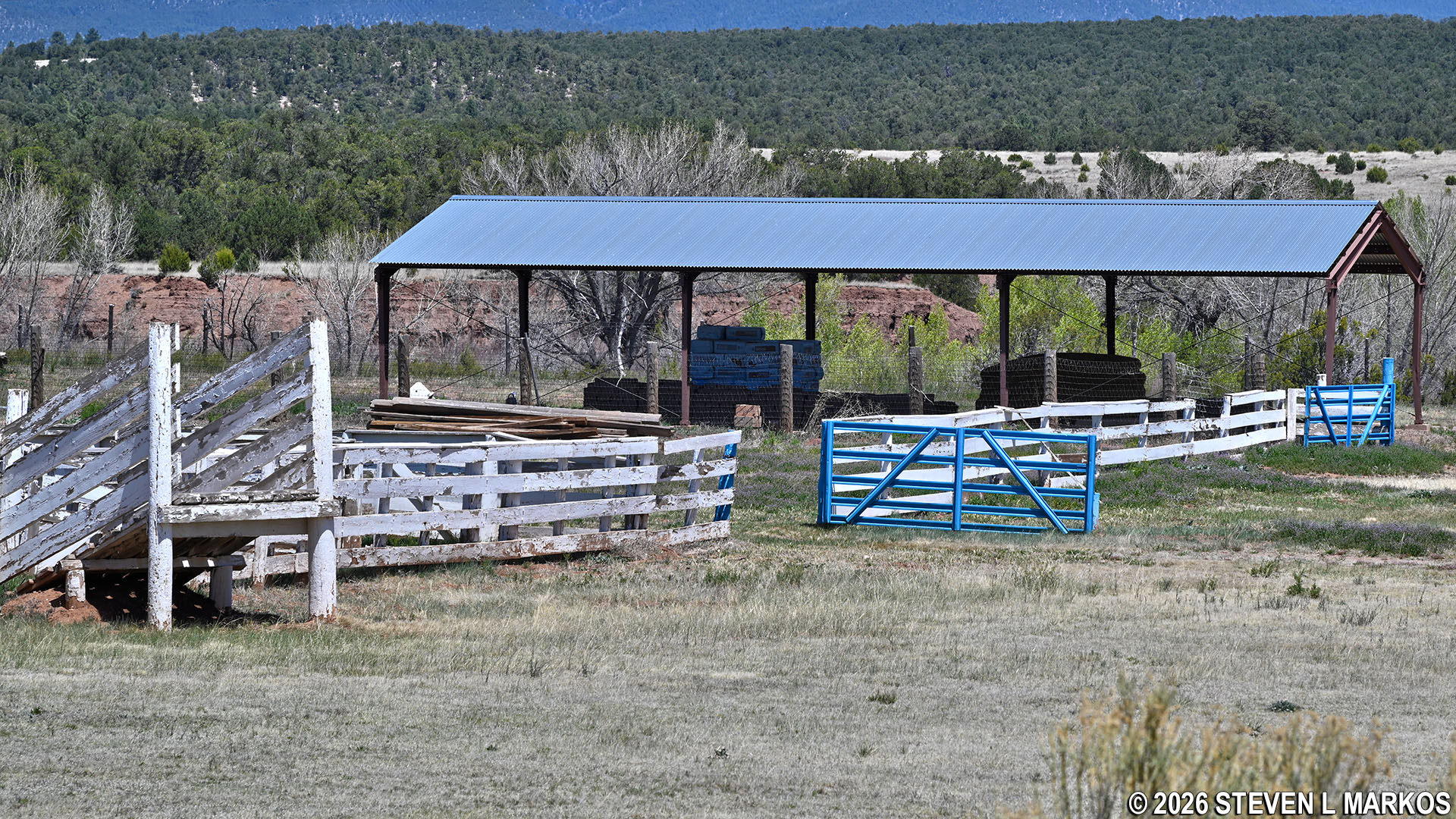
Forked Lightning Ranch buildings at Pecos National Historical Park
The Forked Lightning Ranch was only in operation for seven years before falling victim to the Great Depression. The last guest left in 1933, and two years later Austin, who had heavily mortgaged the ranch and could no longer pay the debt, signed it over to the bank. It was purchased by W. C. Currier, Sr. in 1936, and he continued to operate it as a dude ranch for guests.
Five years later, Currier sold the ranch to E. E. “Buddy” Fogelson, a wealthy oilman from Dallas, Texas. Fogelson continued to buy land near the ranch, eventually expanding it to over 13,000 acres, and turned Forked Lightning into a small cattle ranch.
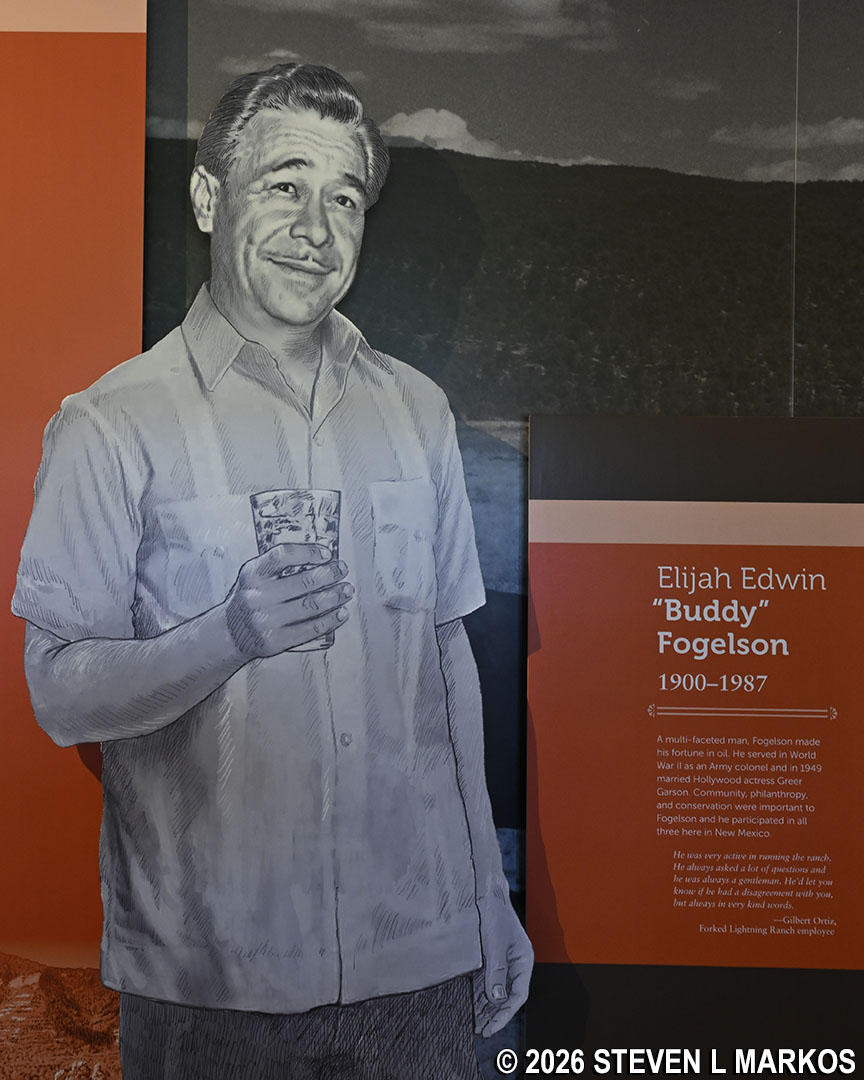
Buddy Fogelson exhibit inside the Trading Post Museum, Pecos National Historical Park
Fogelson did not enlarge any of the existing buildings during his ownership of the ranch. He did, however, expand the archway behind the Trading Post so that it was large enough to drive a vehicle through.
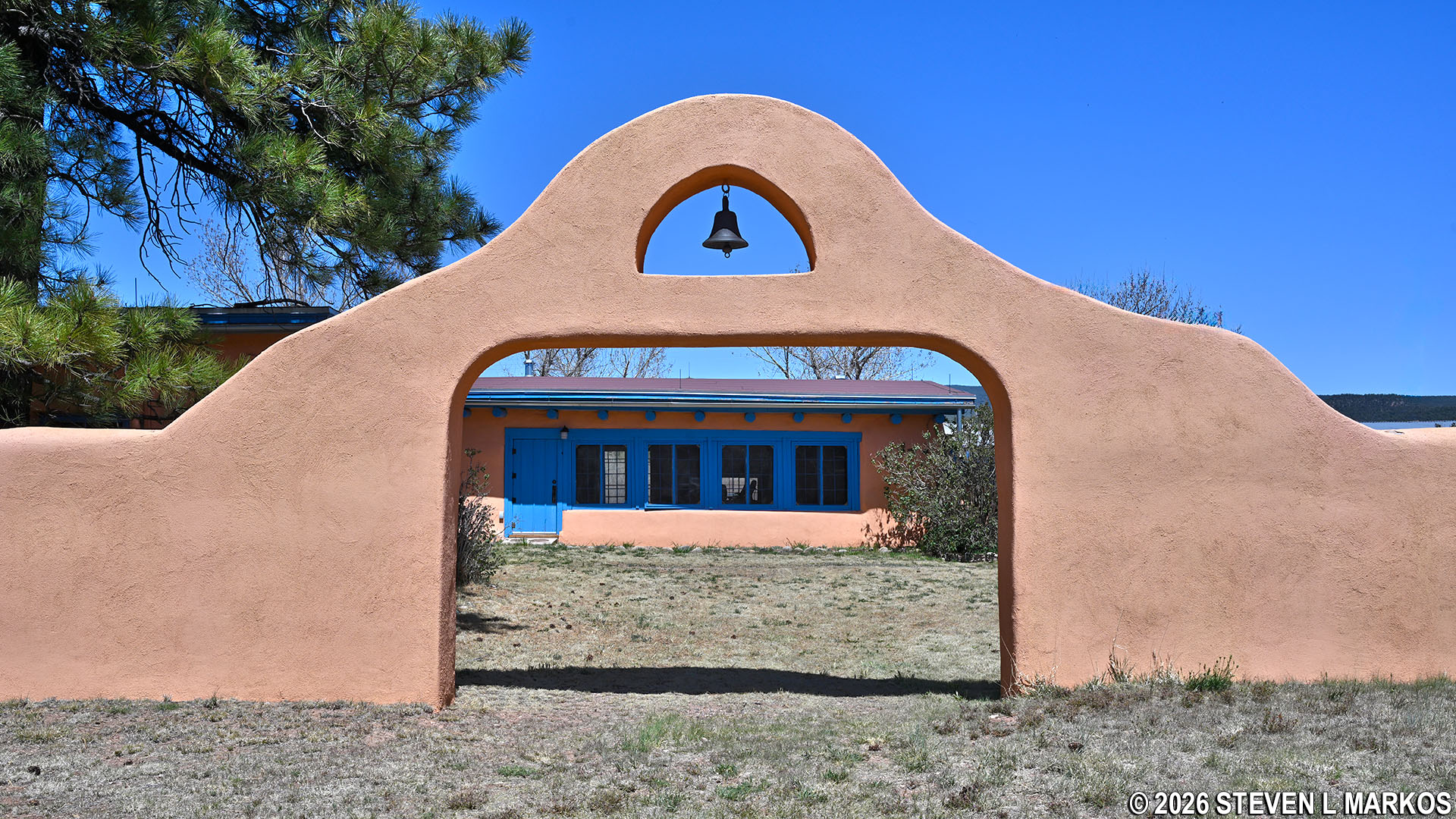
Expanded archway behind the Trading Post at the Forked Lightning Ranch, Pecos National Historical Park
In 1949, Folgeson married Hollywood movie star Greer Garson. The ranch became a center of entertainment for the Fogelsons, and they threw lavish Hollywood parties that attracted the rich and famous. Despite having homes in Dallas and Beverly Hills, they spent a great deal of time at the ranch, particularly in the summer, raising and breeding cattle and thoroughbred racehorses.
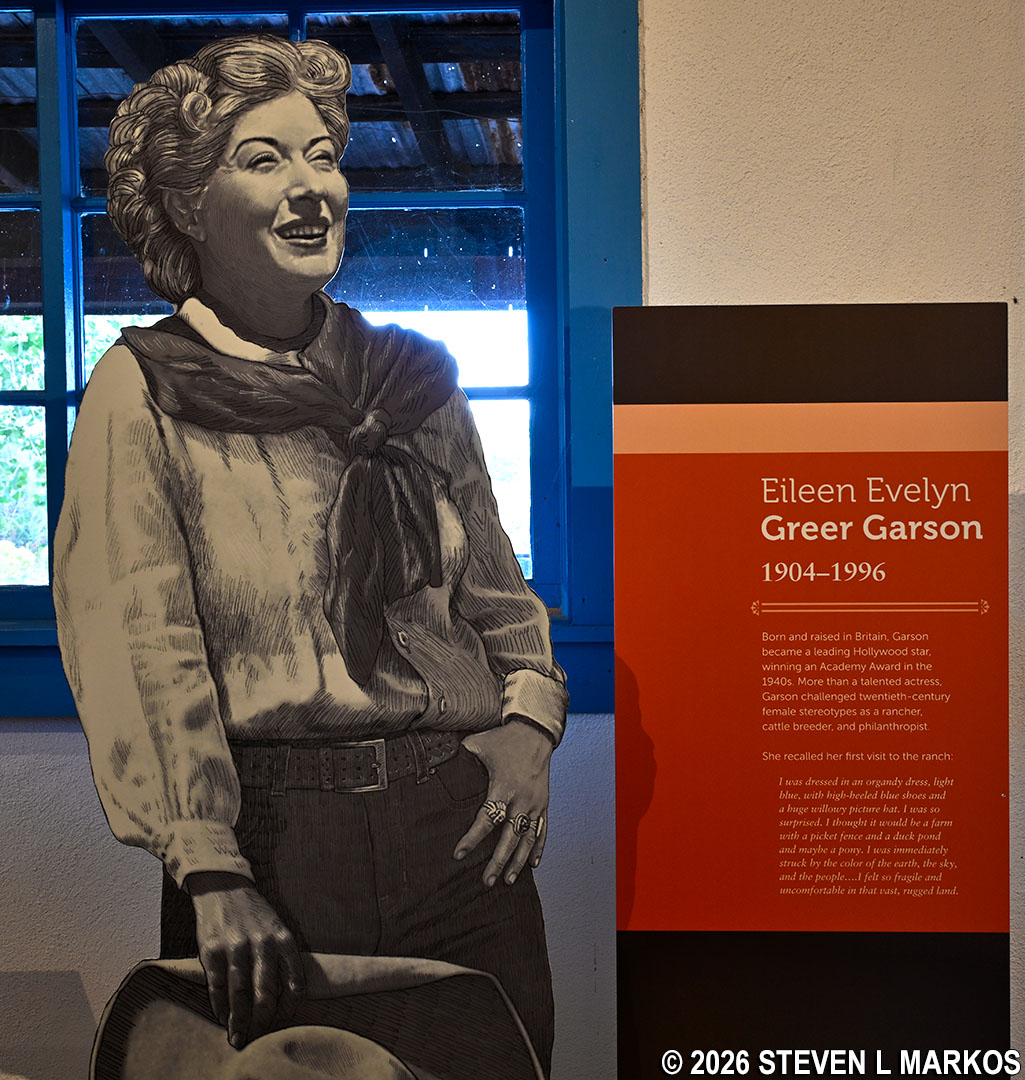
Greer Garson exhibit inside the Trading Post Museum, Pecos National Historical Park
After first raising Hereford cattle and then unsuccessfully attempting to raise white Shorthorn cattle imported from Scotland, Fogelson purchased a Santa Gertrudis bull and three heifers at a 1958 auction. A Brahman-Shorthorn cross with a distinctive red color, the Santa Gertrudis are referred to as America’s original beef breed. They have also proved to be one of the world’s leading and most efficient producers of quality beef, with an average of 70.9 percent of their meat being Prime and Choice.
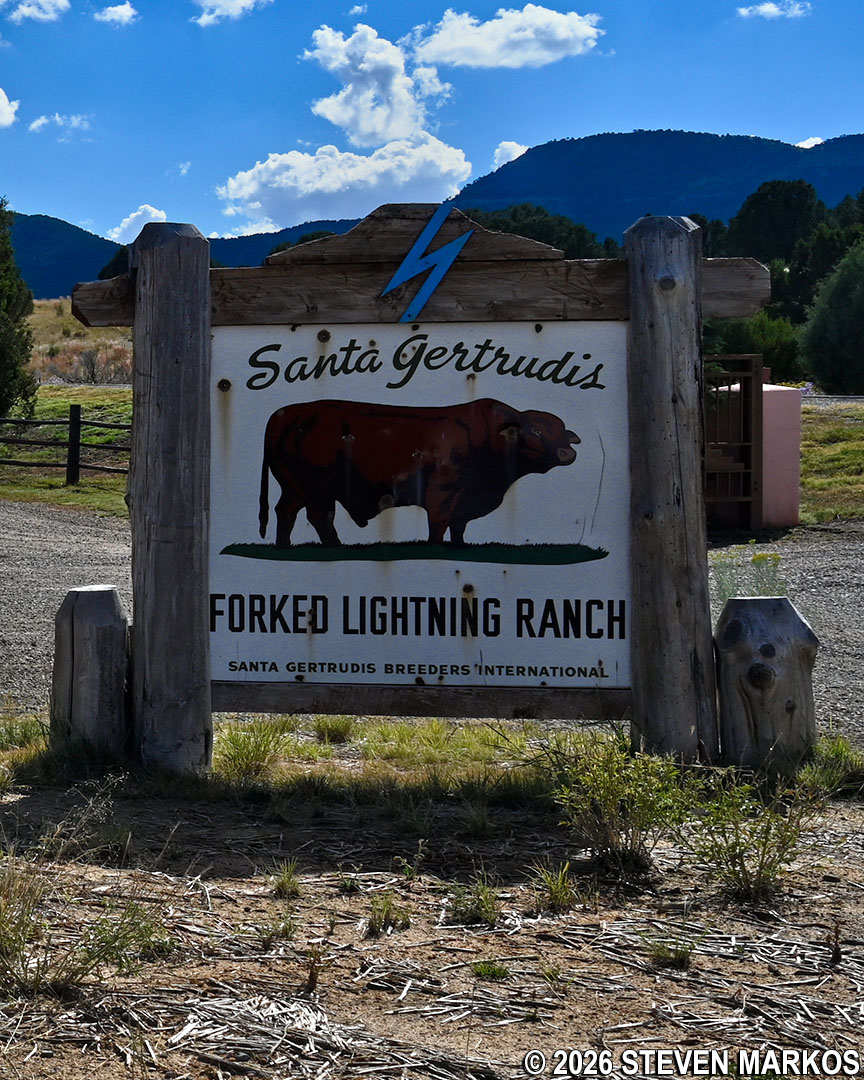
Santa Gertrudis cattle sign in front of the Trading Post at the Forked Lightning Ranch, Pecos National Historical Park
In 1971, the Fogelson’s purchased Ack Ack, a thoroughbred racehorse, for $500,000 from the Harry F. Guggenheim estate (yes, those Guggenheims). Ack Ack would go on to dominate that year, winning seven of eight races and finishing second in the race he didn’t win. He was named Horse of the Year in 1971, the highest honor given in American Thoroughbred horse racing. Having competed since the age of two, the five-year-old Ack Ack was retired at the end of the year. He went on to sire 40 stakes race winners and in 1986 was inducted into the National Racing Hall of Fame. In 1999, BloodHorse magazine (the top thoroughbred industry publication) selected Ack Ack (#44) as one of the top 100 racehorses of the 20th century, putting him up there with famous champions like Man o’ War (#1), Secretariat (#2), and Seabiscuit (#25).
After Buddy died in 1987 from Parkinson’s disease, the ranch was divided between his wife and adopted son, Gayle David Fogelson. Greer received the original 5,500 acres, which included the ranch house and trading post. In 1991, due to her failing health, she sold her portion of the ranch to the Conservation Fund, which then donated it to the National Park Service in 1993 for inclusion in Pecos National Historical Park. Gayle received the remaining 8,000 acres, and he sold these to two local residents. Over the years, other famous Hollywood stars would come to own portions of the land, including Jane Fonda and Val Kilmer.
RANCH HOUSE
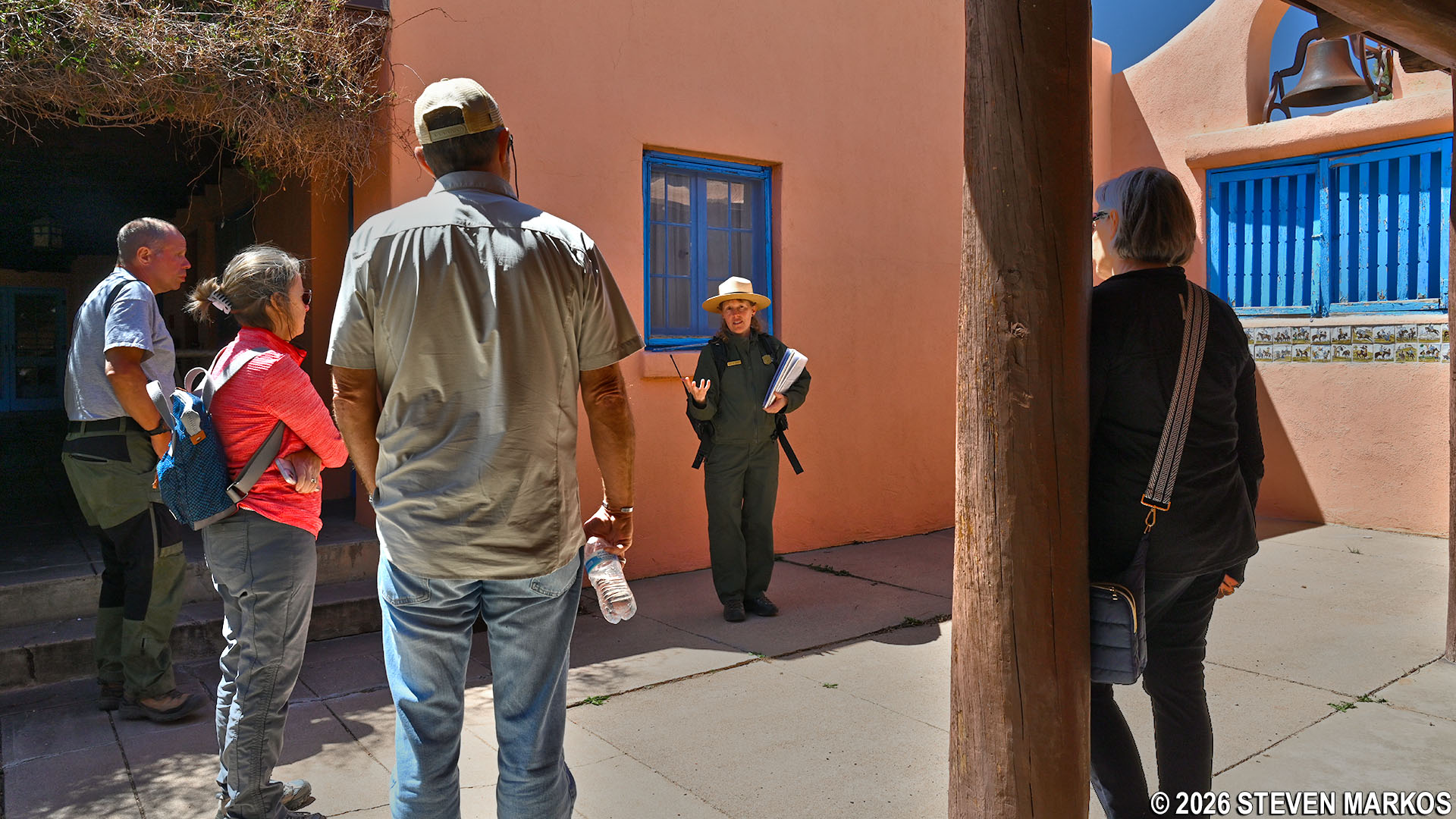
Ranger conducts a tour of the Forked Lightning Ranch main house at Pecos National Historical Park
The main house at the Forked Lightning Ranch was built in 1925 by Tex Austin. He hired architect John Gaw Meem (who would later become one of the most influential architects in New Mexico) to build a ranch house on the bluff overlooking the confluence of the Pecos River and Glorieta Creek.
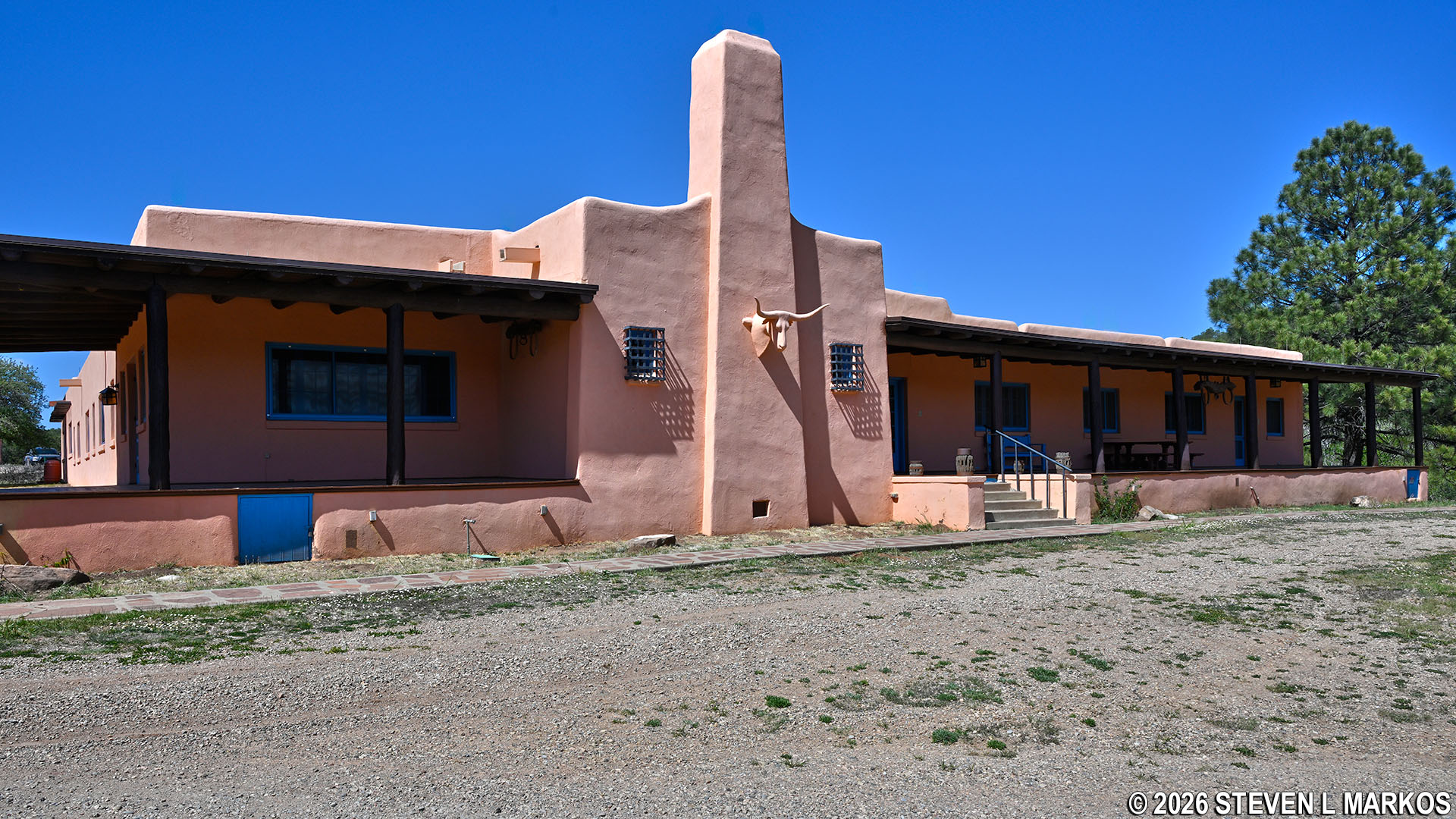
Forked Lightning Ranch main house at Pecos National Historical Park
The Ranch House is a square donut, and the hole in the middle serves as a courtyard. Surrounding the courtyard are covered walkways—or portals—which are a traditional architectural feature of the Santa Fe style known as Pueblo Revival. Another distinctive feature of the style is the exposed wooden roof beams, called vigas, that are part of the portal walkways.
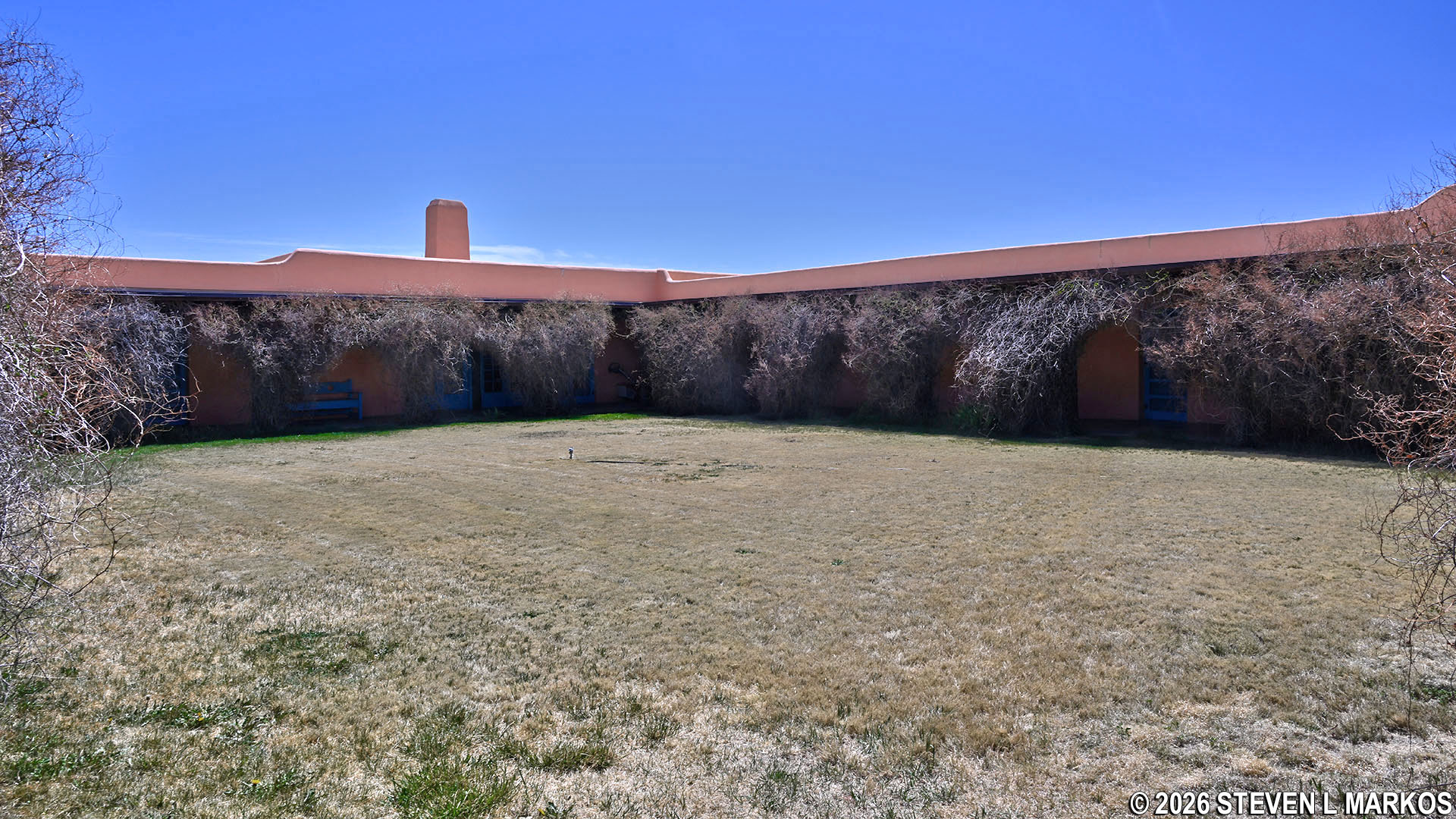
Courtyard at the Forked Lightning Ranch main house, Pecos National Historical Park
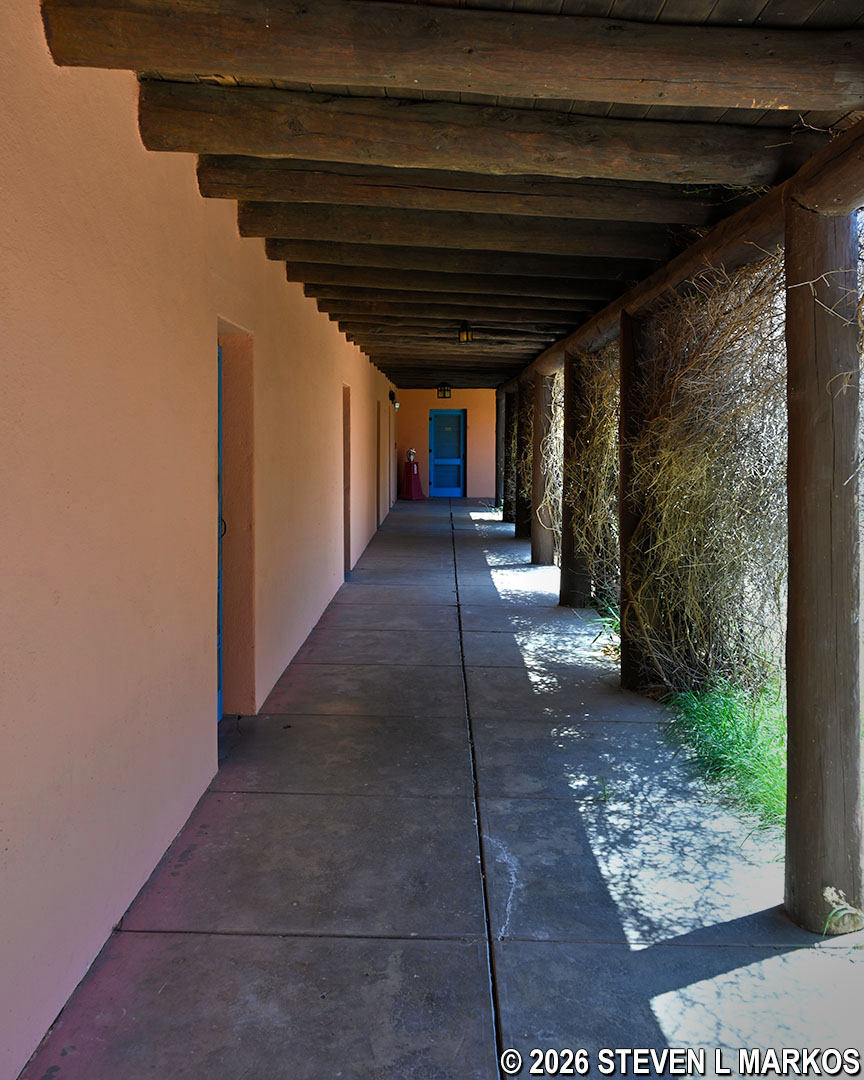
Portal walkway around the courtyard at the Forked Lightning Ranch main house, Pecos National Historical Park
You may notice a blue-shuttered window on the narrow, south-facing wall immediately to your right when entering the courtyard. Directly underneath the window are two rows of hand-painted, glazed ceramic tiles. Known as azulejos, this type of painted tile is a traditional 14th-century Spanish and Portuguese decorative art form that was revived and became popular with southwestern architecture of the early 20th century. These specific tiles depict scenes from the Spanish novel Don Quixote.
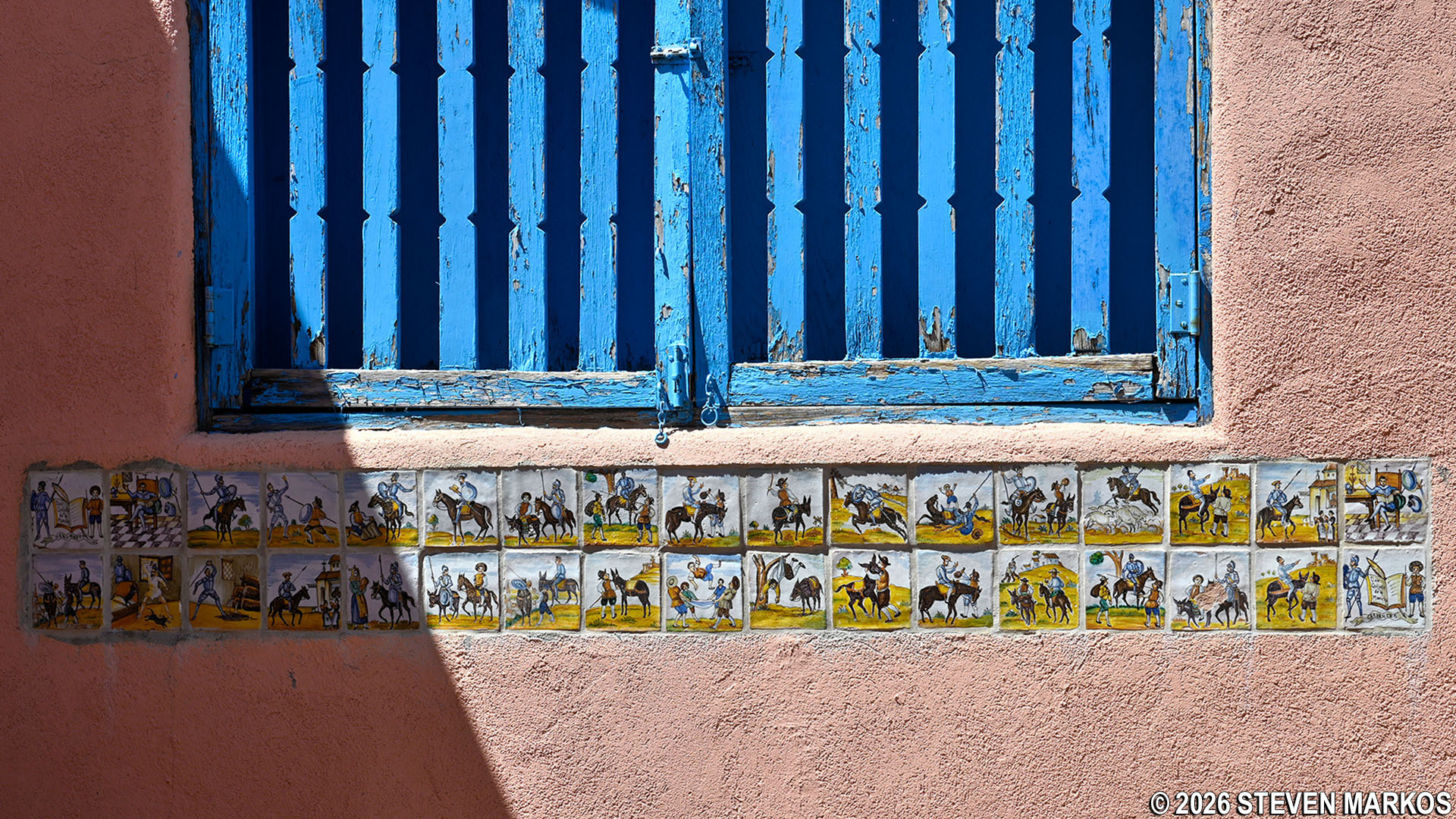
Painted ceramic tiles featuring Don Quixote inside the courtyard at the Forked Lightning Ranch, Pecos National Historical Park
The tour continues into one of the nine guest bedrooms, which all open up into the portal and the courtyard. The bedrooms were set up for double occupancy during the dude ranch days. The hand-painted twin beds with matching trunks in the bedroom visited on the tour belonged to Buddy Fogelson and Greer Garson when they lived at the ranch. In fact, a lot of the furnishings and decor throughout the house belonged to the Folgelsons. Other guest bedrooms in the house are now used as offices by the National Park Service.
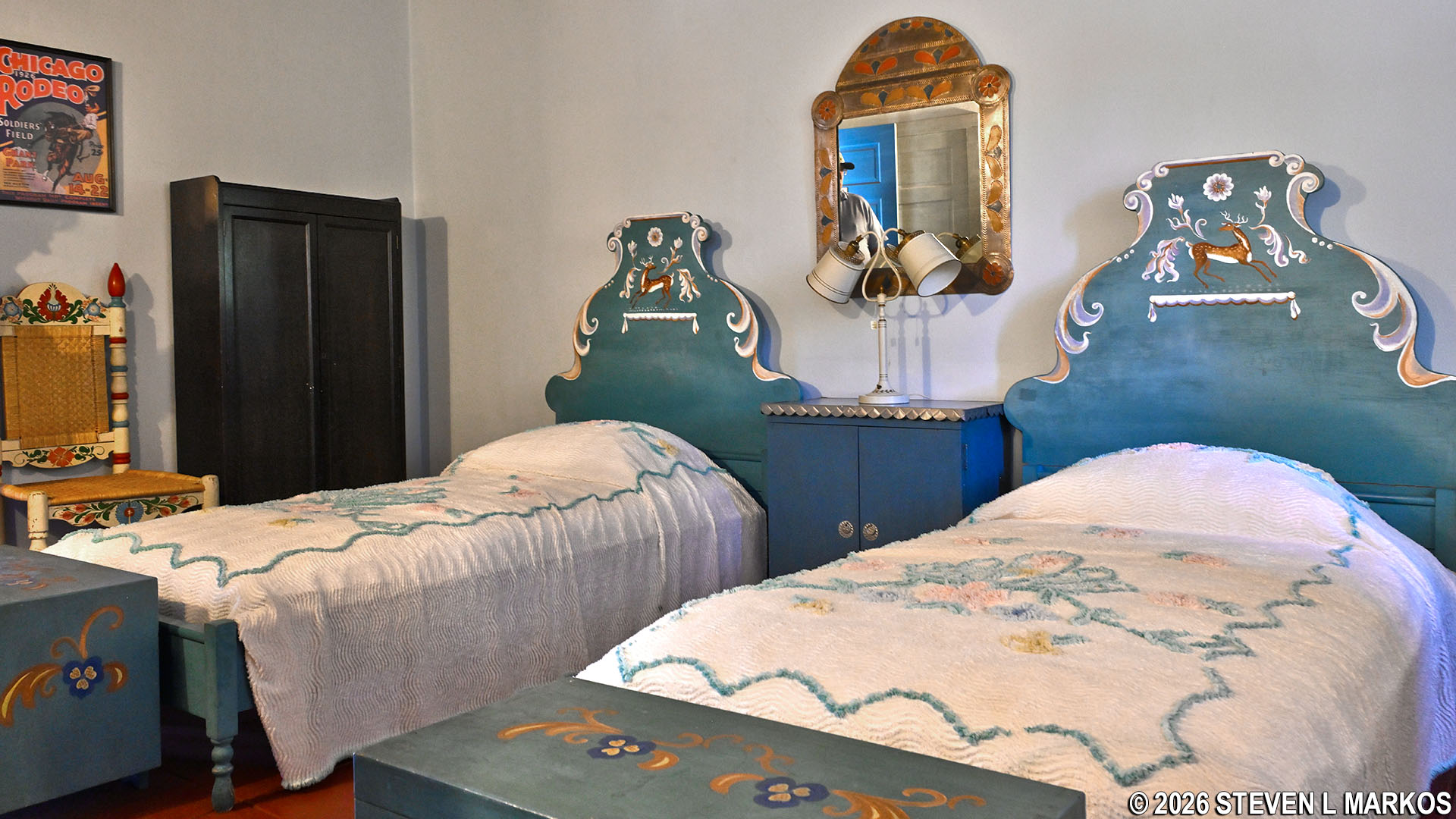
Guest bedroom at the Forked Lightning Ranch main house, Pecos National Historical Park
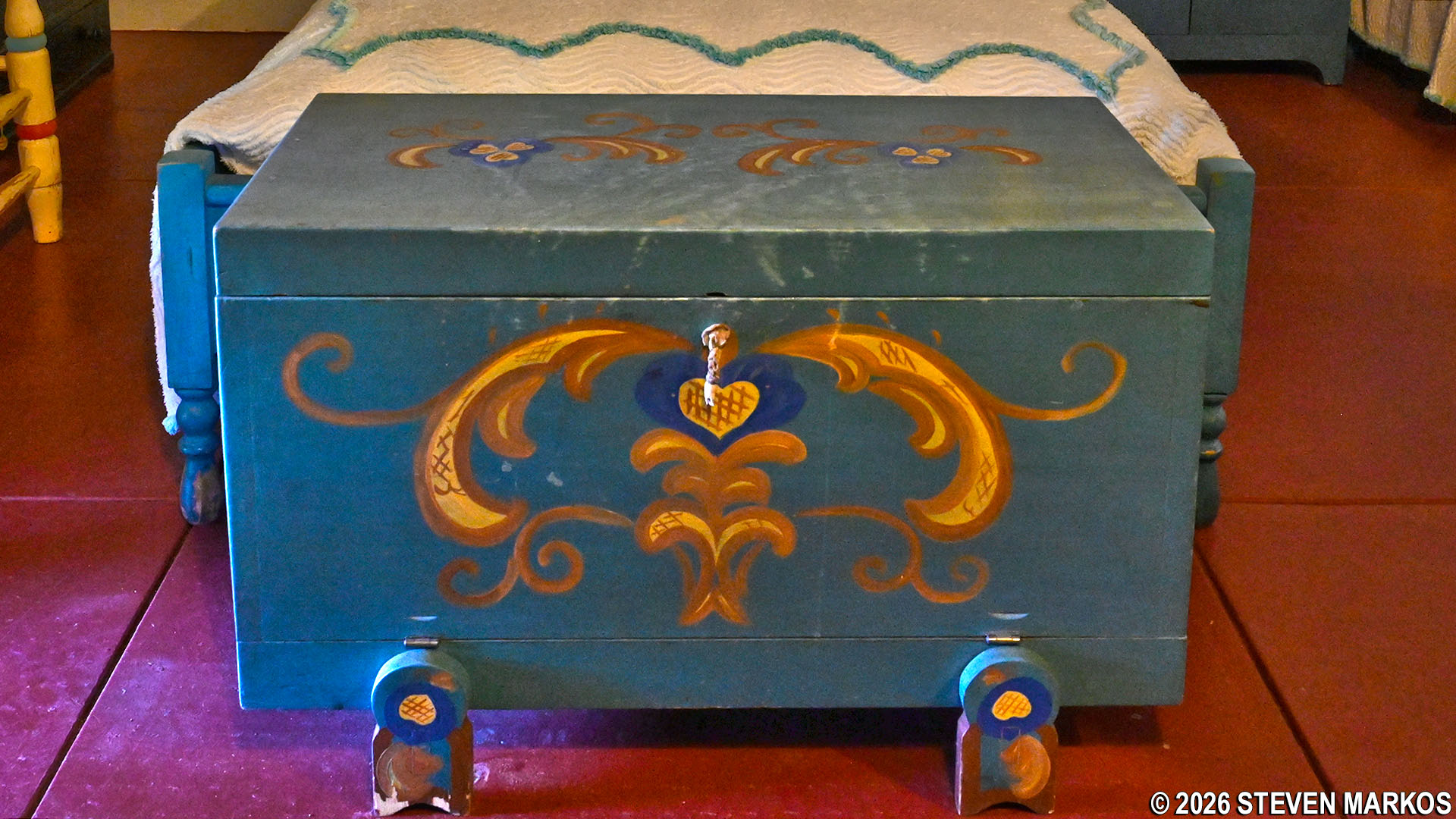
Hand painted trunk in a guest bedroom at the Forked Lightning Ranch, Pecos National Historical Park
With Buddy operating the cattle ranch and Greer having her own Hollywood career, they each kept a separate office space at the Forked Lightning Ranch. Greer’s office was one of the few rooms with a door that led directly outside, while Buddy had a smaller, interior office that only opened into the courtyard. I like to think this was because he was a gentleman who wanted his wife to be able to enjoy a great view of the landscape.
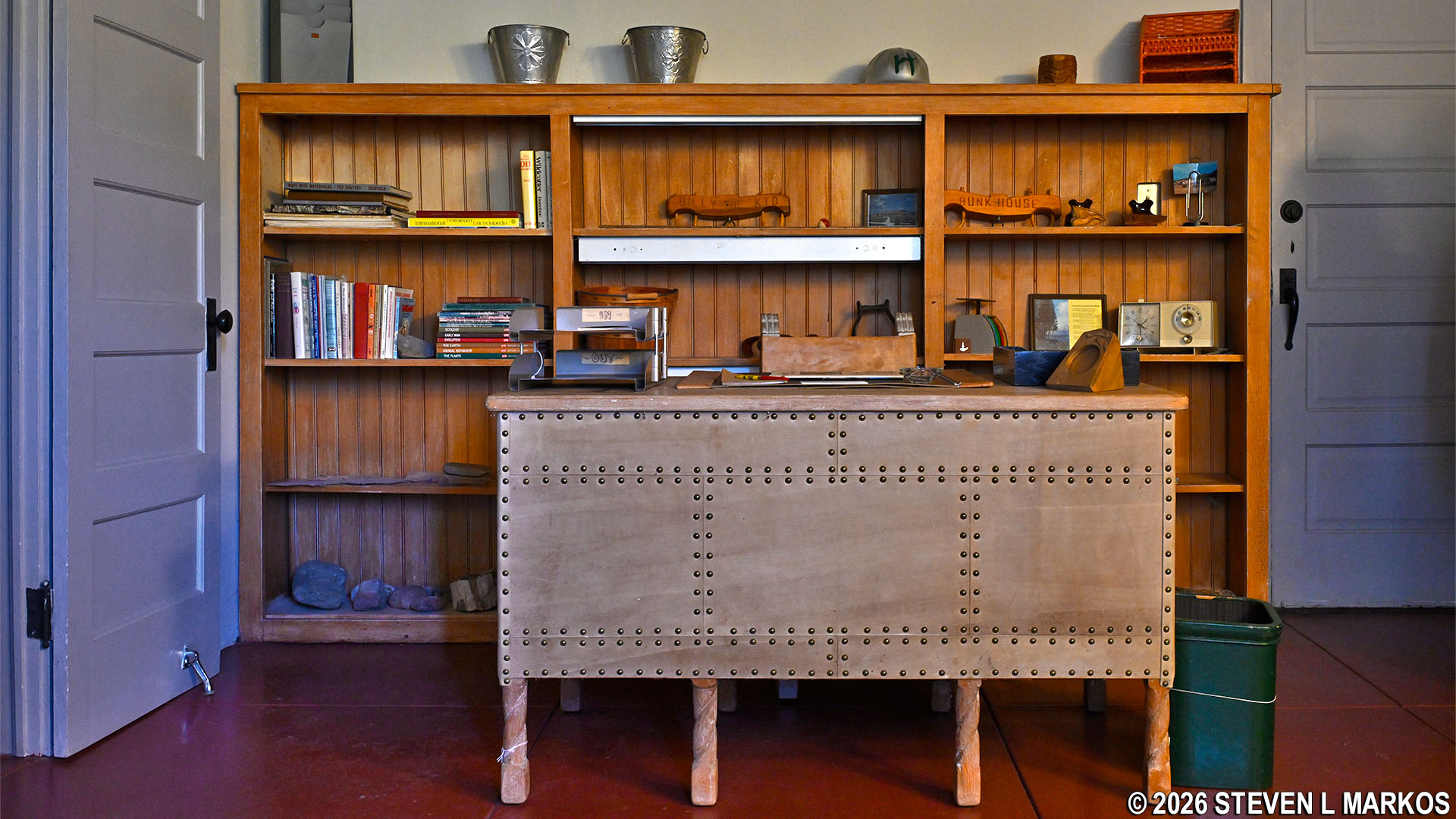
Buddy Fogelson’s office at the Forked Lightning Ranch, Pecos National Historical Park
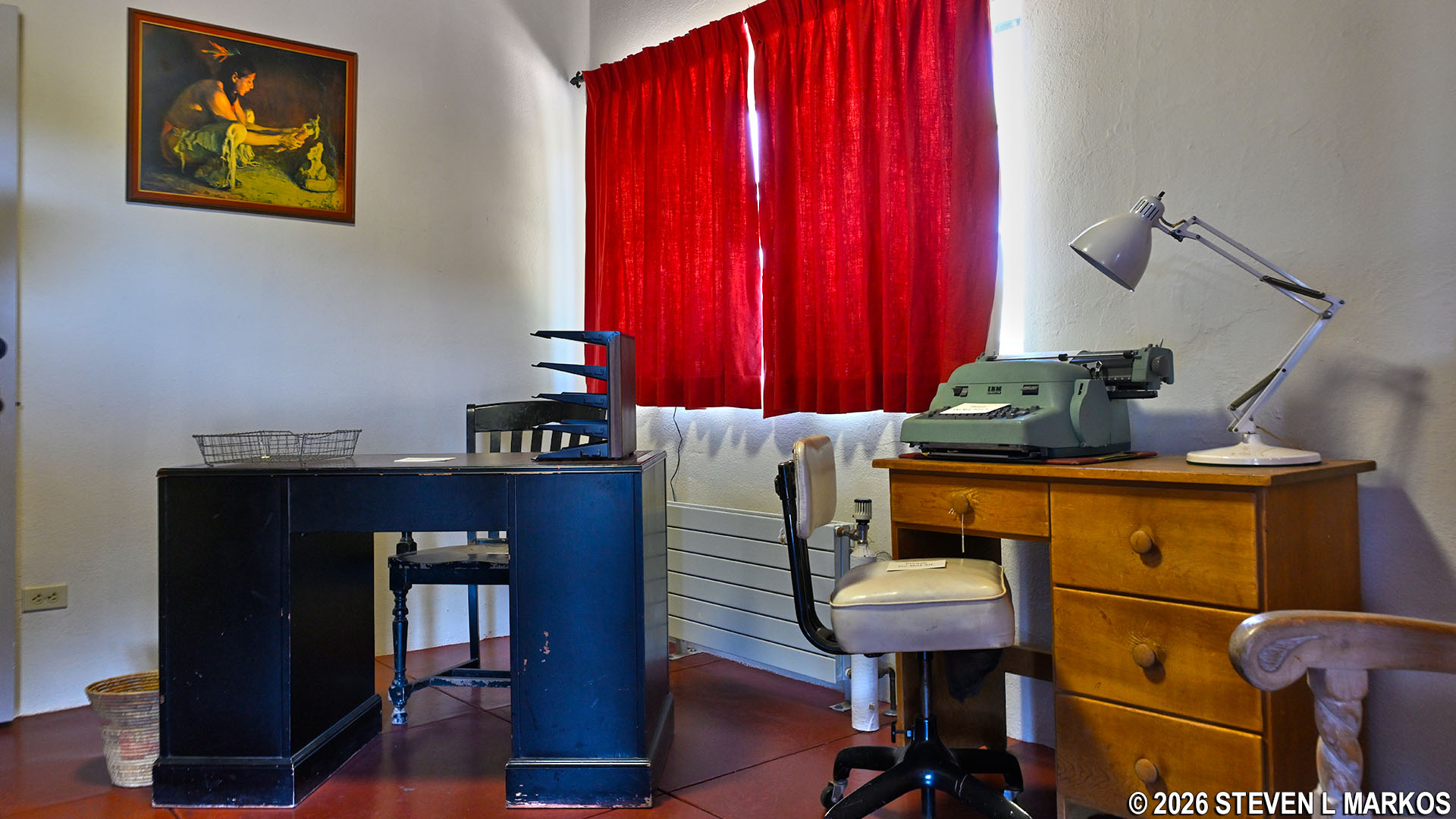
Greer Garson’s office at the Forked Lightning Ranch, Pecos National Historical Park
The bathrooms inside the ranch house definitely appear to have been updated during the Fogelson’s ownership. They give off a 1950s vibe with brightly colored subway tiles and fixtures. With that being said, one of the showers has a built-in seat made from adobe with hand-painted tiles embedded into it. Similar to the Don Quixote tiles in the courtyard, the ones in the bathroom depict individual maritime scenes.
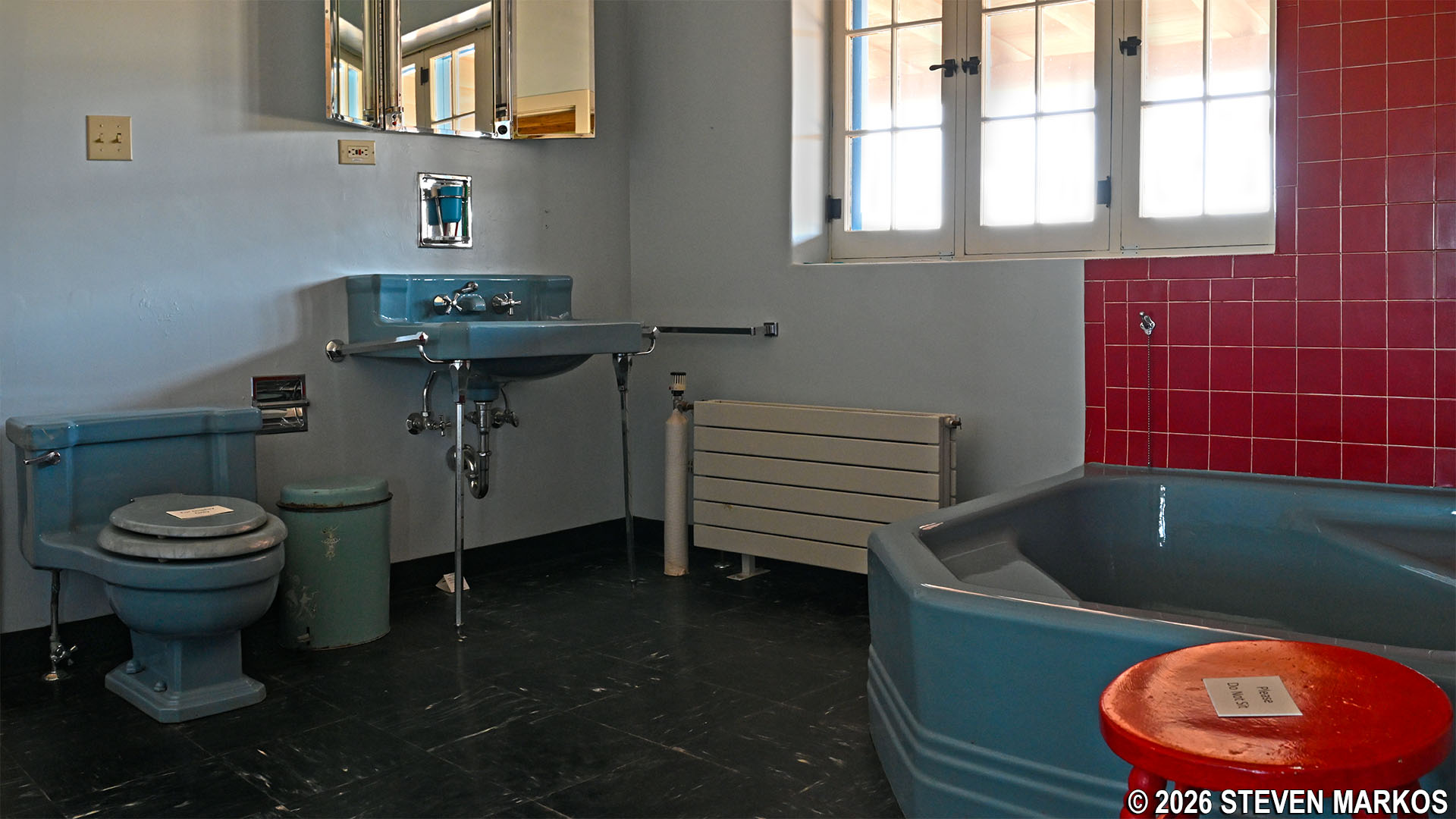
Bathroom inside the Forked Lightning Ranch main house at Pecos National Historical Park
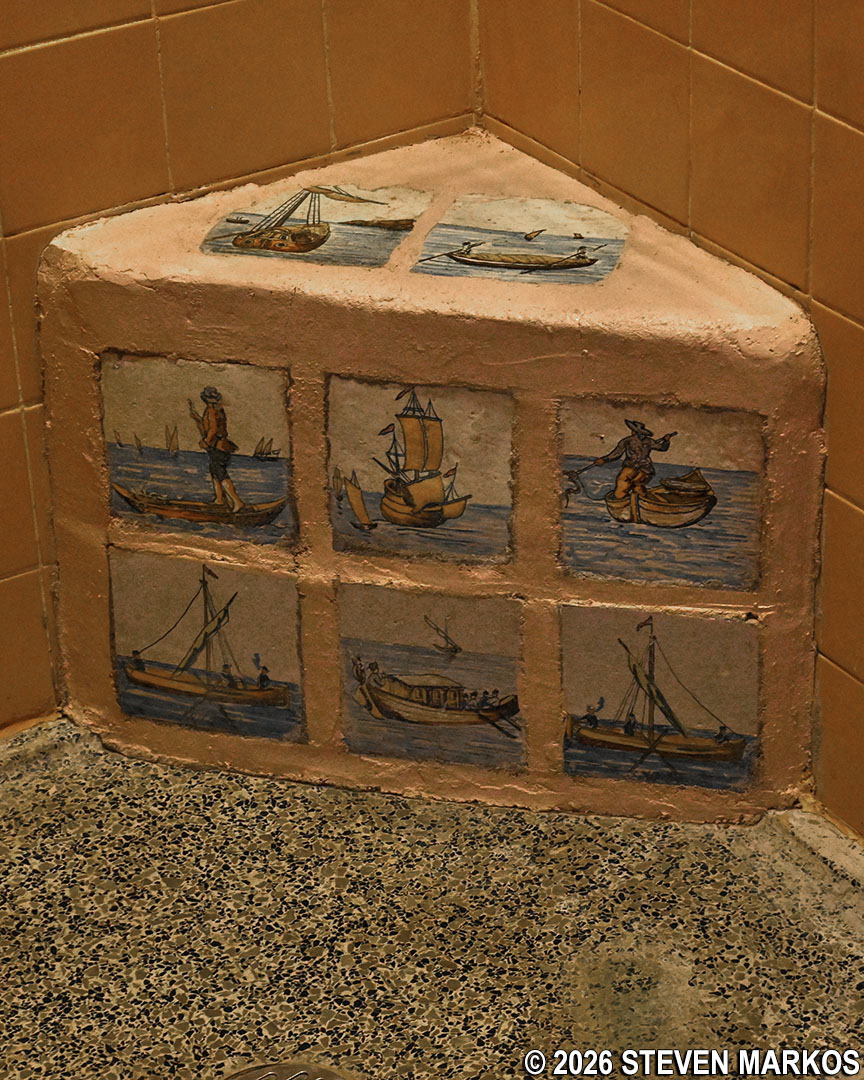
Built-in shower seat with hand-painted tiles inside a bathroom at the Forked Lightning Ranch, Pecos National Historical Park
The main house also includes a huge living space with multiple seating areas, perfect for running a ranch and entertaining guests. There would have been many visitors coming and going when Austin was operating the dude ranch for wealthy vacationers, and the Fogelson’s hosted numerous parties for their rich and famous Hollywood friends.
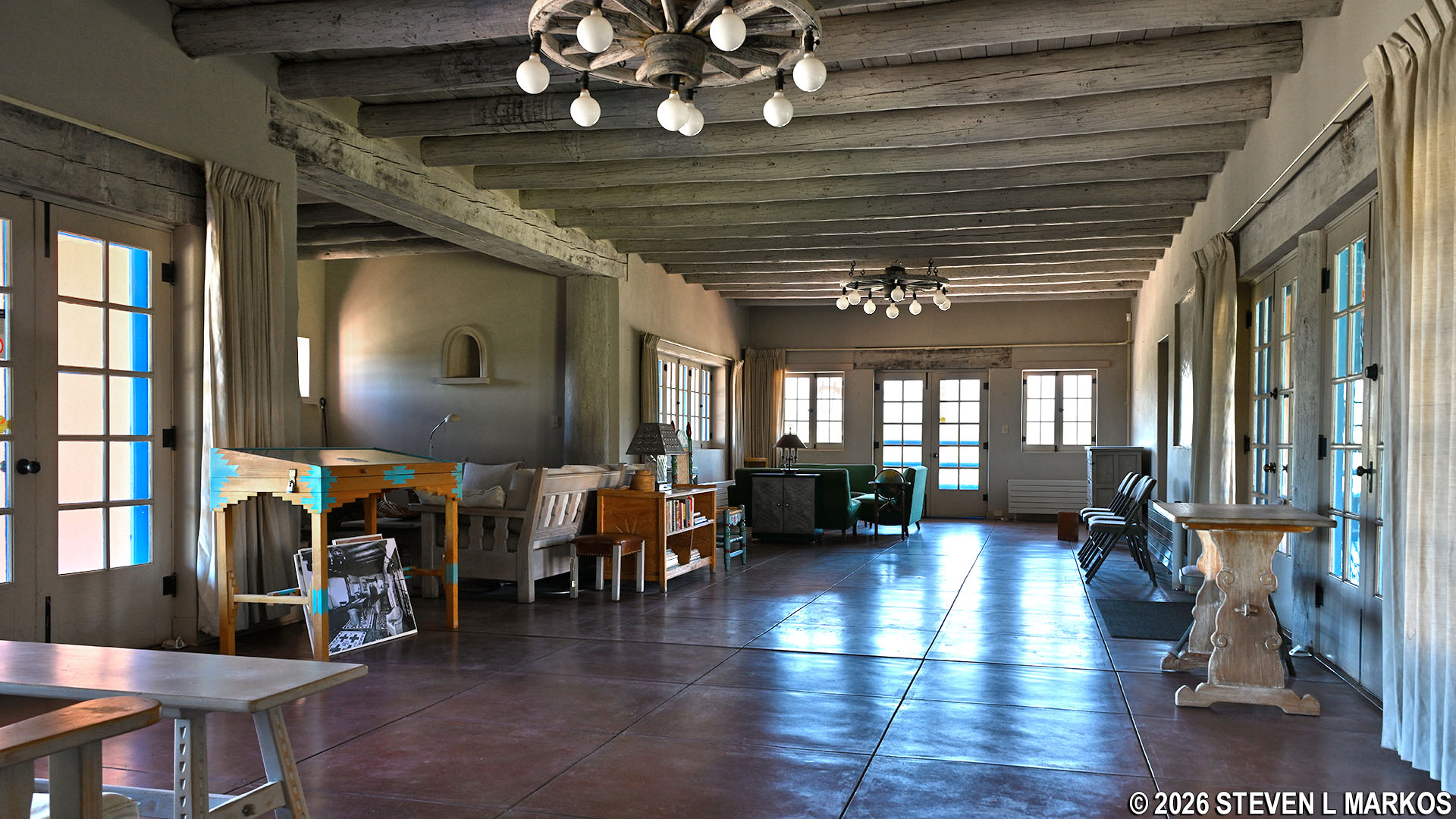
Living room at the Forked Lightning Ranch, Pecos National Historical Park
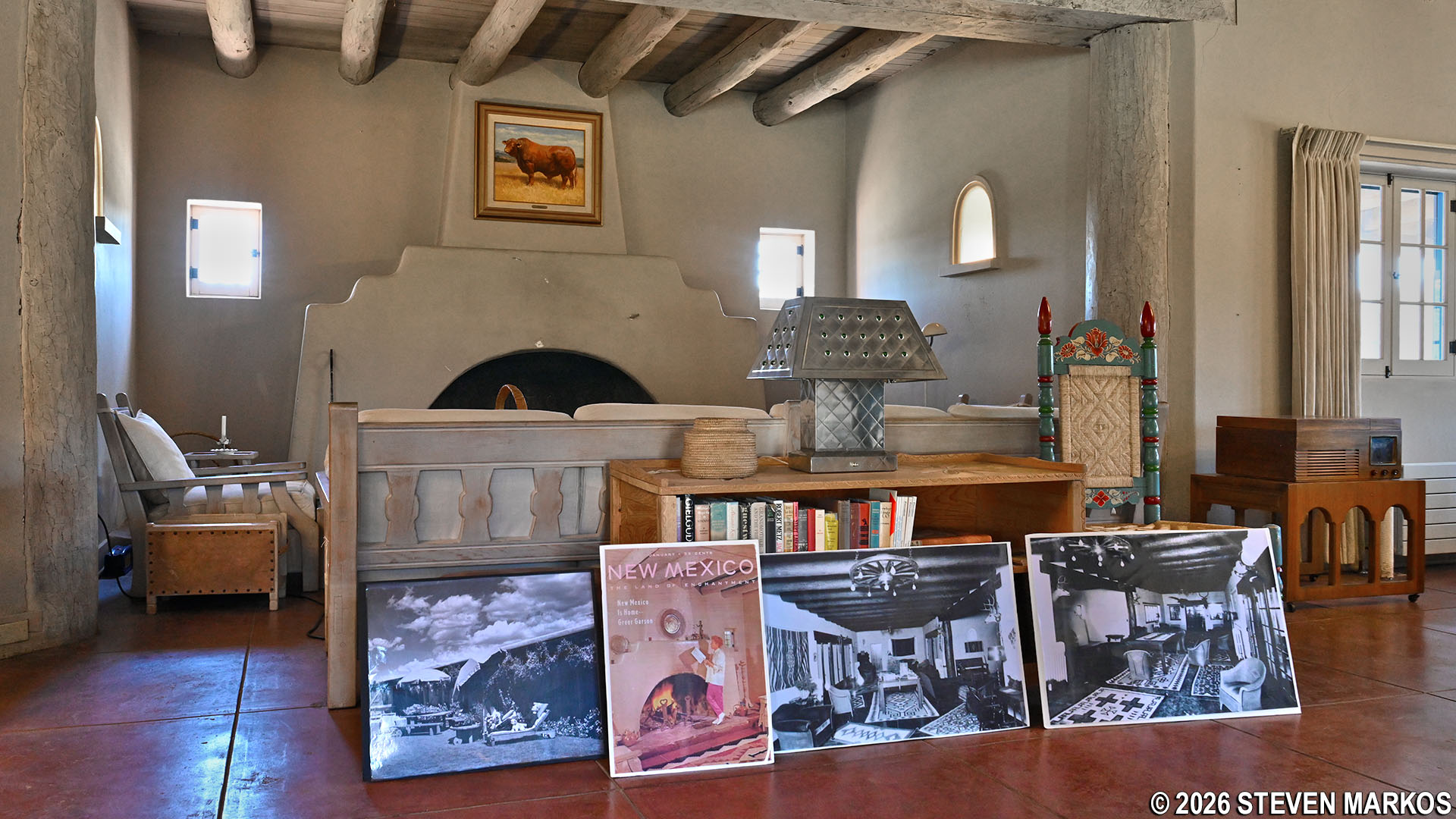
Living room sitting area at the Forked Lightning Ranch, Pecos National Historical Park
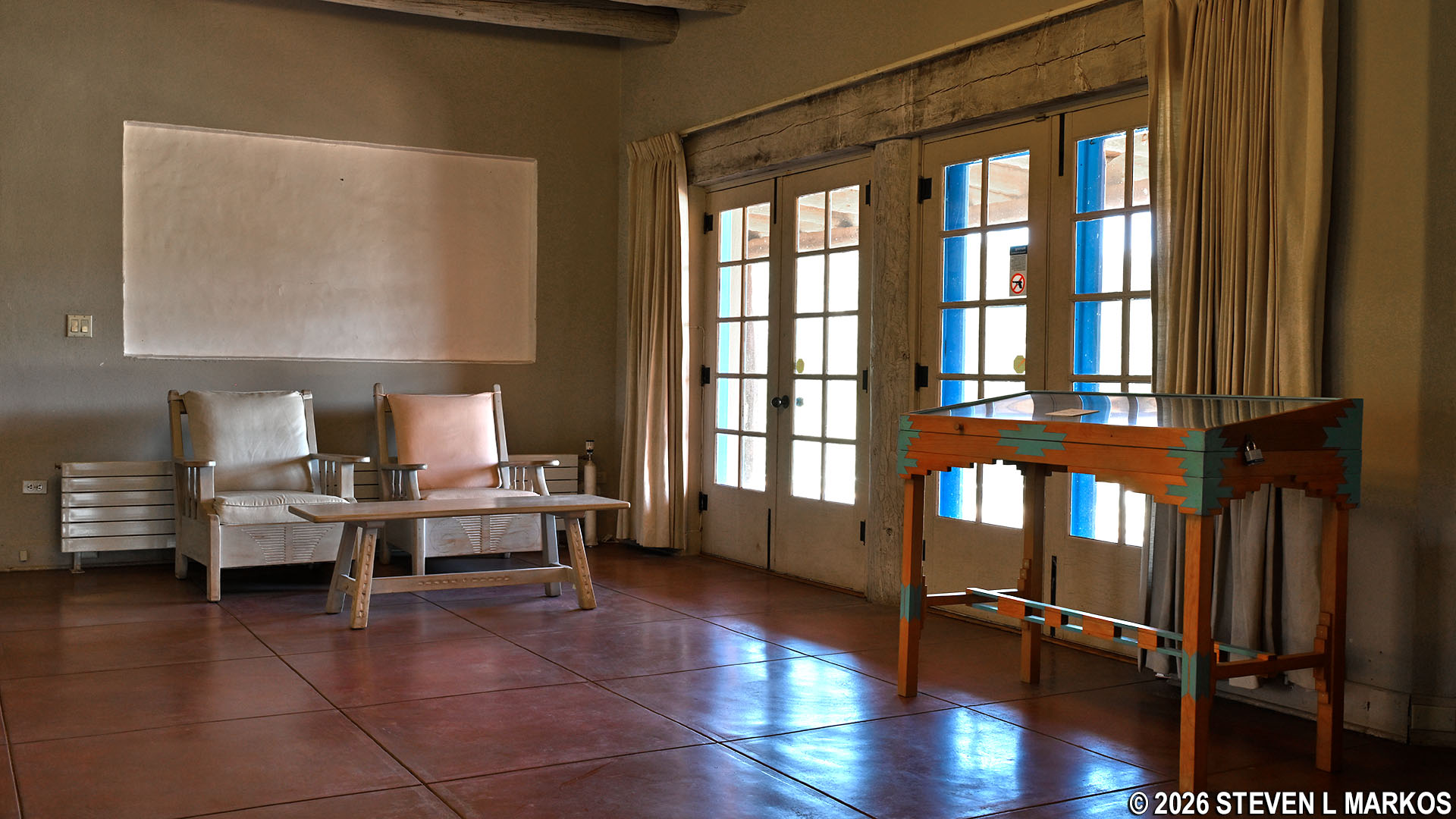
Living room sitting area at the Forked Lightning Ranch, Pecos National Historical Park
The tour ends on the front porch. During the time that the Fogelsons lived here, they would have had a fantastic view of the Pecos River and Glorieta Creek. Today, the vegetation has grown up significantly, leaving almost no view of the water (but still great views of the landscape).
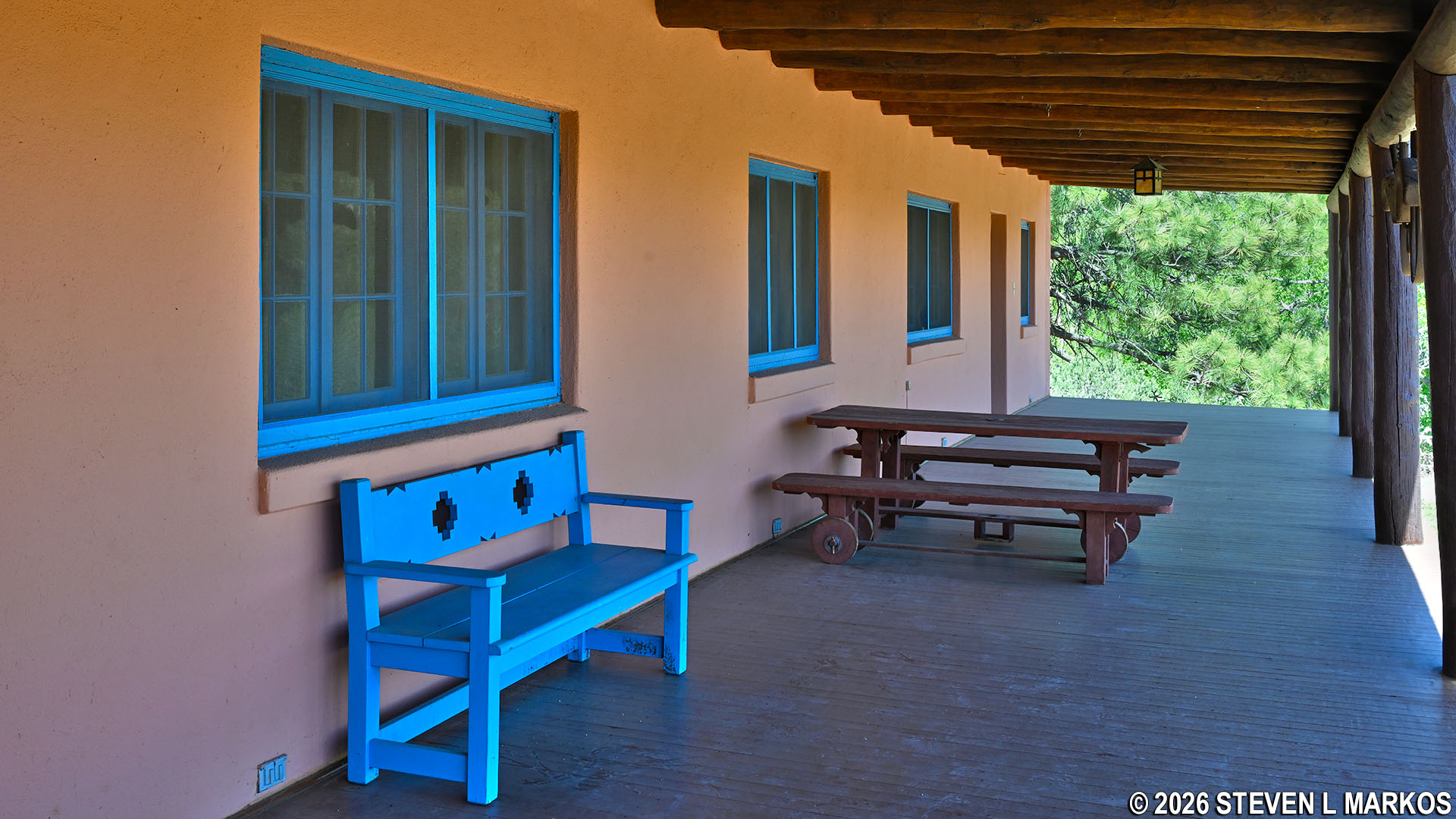
Front porch of the Forked Lightning Ranch main house, Pecos National Historical Park
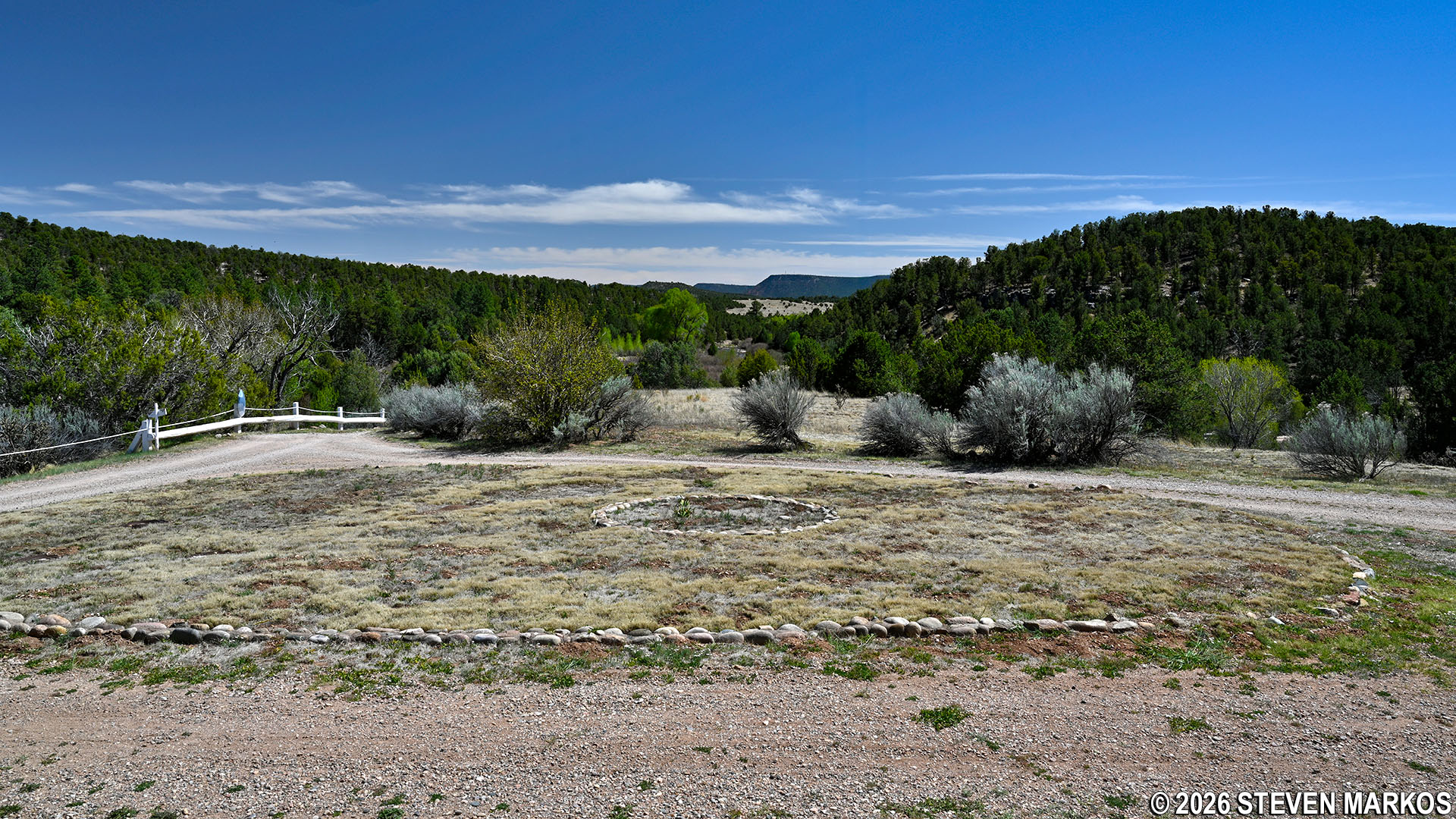
View from the front porch of the Forked Lightning Ranch main house, Pecos National Historical Park
While not an official stop on the Forked Lightning Ranch tour, right behind the main house is a second smaller house. Known as the Casita—Spanish for little house—it was built at the same time as the main house for use as living quarters for the dude ranch staff. Today, it is home to some of the Pecos National Historical Park staff.
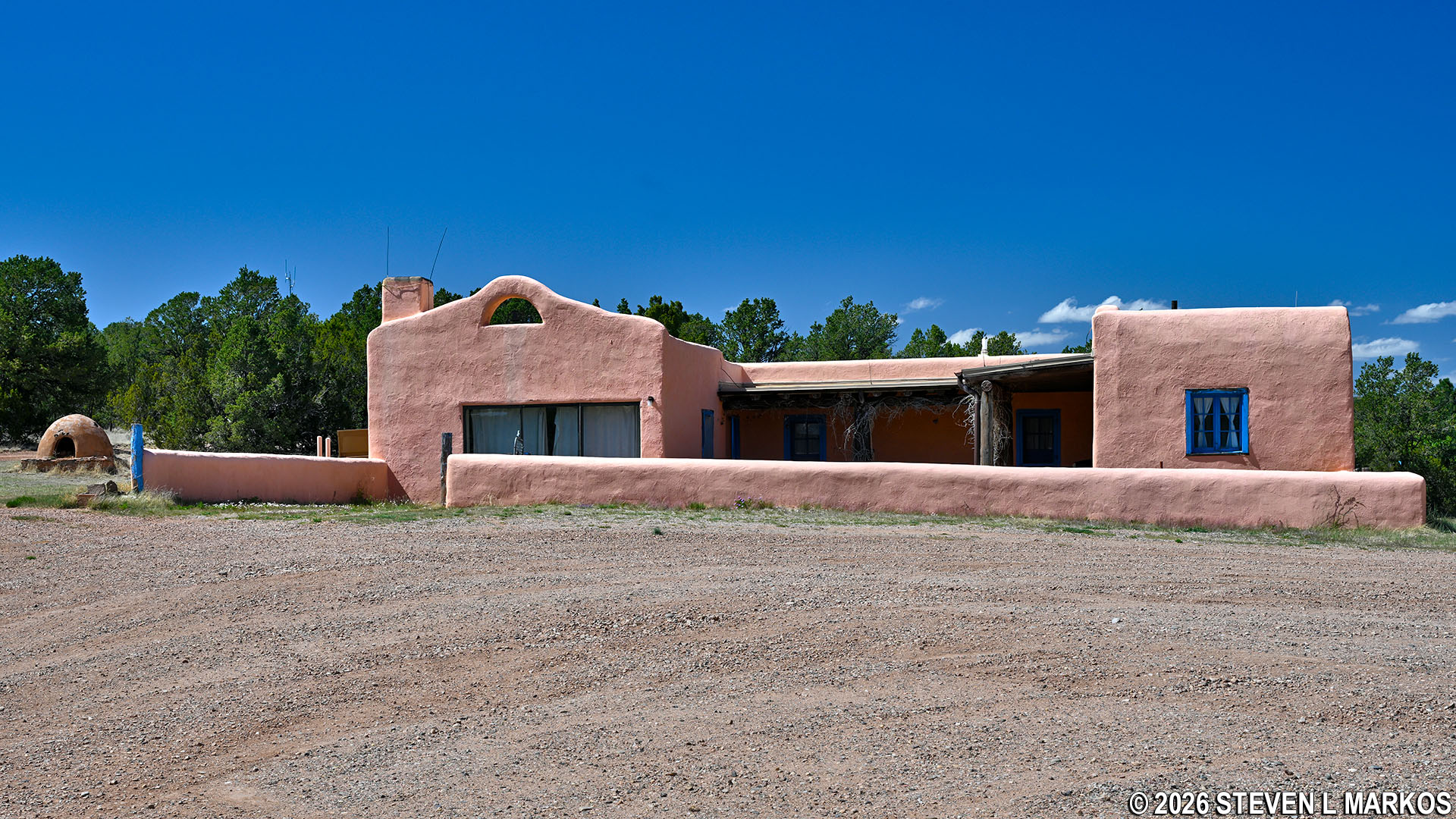
The Casita behind the main house at the Forked Lightning Ranch, Pecos National Historical Park
With a few exceptions, use of any photograph on the National Park Planner website requires a paid Royalty Free Editorial Use License or Commercial Use License. See the Photo Usage page for details.
Last updated on August 31, 2026


