
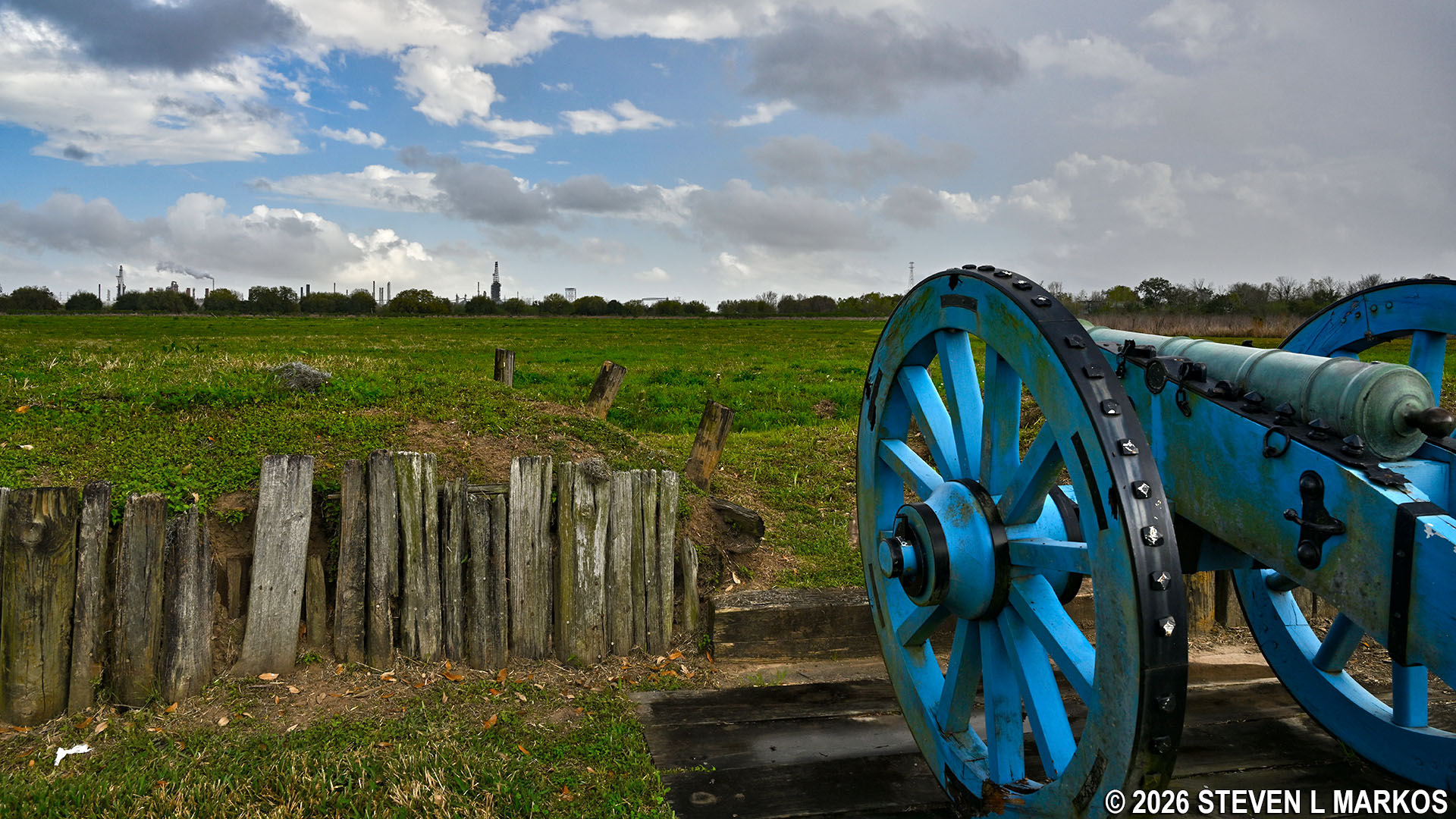
American gun aims towards the British position on the Chalmette Battlefield, Jean Lafitte National Historical Park and Preserve
In September of 1814, the British began a five-month military campaign to capture west Florida and New Orleans. Doing so would give them access to the American interior via the Mississippi River and serve as a vital bargaining chip during peace talks. The fighting, which began on December 23, 1814, culminated in the Battle of New Orleans on January 8, 1815. Ironically, a peace treaty ending the War of 1812, the Treaty of Ghent, was signed on December 24, 1814, but news did not reach the United States until a few weeks later, and the treaty wasn’t officially ratified by the United States government until February, 17, 1815.
The British attempt to capture New Orleans began on December 14, 1814, with the Battle of Lake Borgne. A victory allowed them to land troops unhindered at Bayou Bienvenue less than 20 miles east of New Orleans. Prior to this, on December 1st, U. S. Major General Andrew Jackson had arrived in New Orleans to begin planning the city’s defense. He assembled a hodgepodge army of American society consisting of Tennessee and Kentucky militia, New Orleans businessmen, privateers commanded by Jean Lafitte, Choctaw Indians, free Black men, United States regulars, and marines.
On December 23rd, 1,800 British soldiers under the command of General John Keane traveled through Bayou Bienvenue to Bayou Mazant and then along the Villeré Canal to the east bank of the Mississippi River where they set up camp at the seized Lacoste Plantation. Keane himself forcibly occupied the home of Gabriel Villeré on the adjacent Villeré Plantation (to the east), and once settled, waited for reinforcements. The camp was nine miles south of New Orleans and just a couple of miles east of the Chalmette Plantation.
Gabriel Villeré, a major in a local militia regiment in New Orleans, managed to escape his home through a window and went to warn Jackson of the approaching British Army. Upon learning of their position, Jackson immediately assembled approximately 2,100 soldiers and marched that evening from New Orleans to the British camp and made a brief, surprise, night attack before pulling back to the Rodriguez Canal (dividing line between the Rodriquez and Chalmette plantations). This allowed two U.S. gunboats and the USS Carolina to shell the British position.
Thirty minutes later, American troops attacked once again, but by this time additional British reinforcements had arrived. Jackson and his men eventually retreated back to the Rodriguez Canal where they set up camp on the Rodriquez and the adjacent Macarty plantations and began transforming the canal into a heavily fortified earthwork that would become known as the Line Jackson.
At the time, the Rodriguez Canal had been abandoned and was now just a shallow ditch. United States troops along with slaves from the nearby plantations dug out the dirt in the canal and used it to build a rampart (earthen wall, in this case fortified with wood) that was 8 to 14 feet tall and 20 feet thick in places. When completed, the canal was refilled with water. The National Park Service has reconstructed part of the rampart at the Chalmette Battlefield, though the canal itself is once again filled with dirt after over 200 years of erosion.
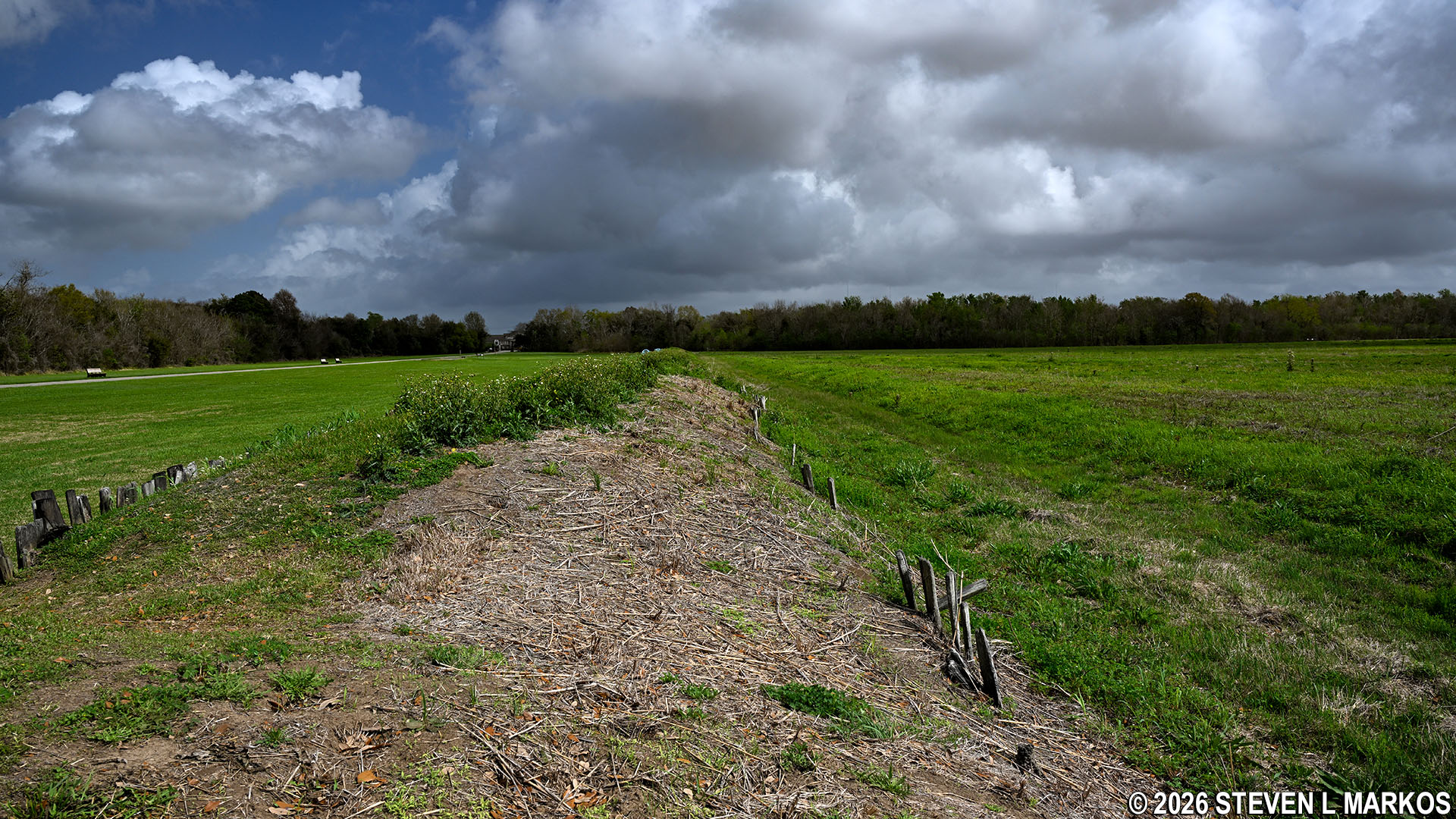
Reconstructed American rampart (hill) and remnants of the Rodriguez Canal (base of the rampart on the right) at Chalmette Battlefield, Jean Lafitte National Historical Park and Preserve
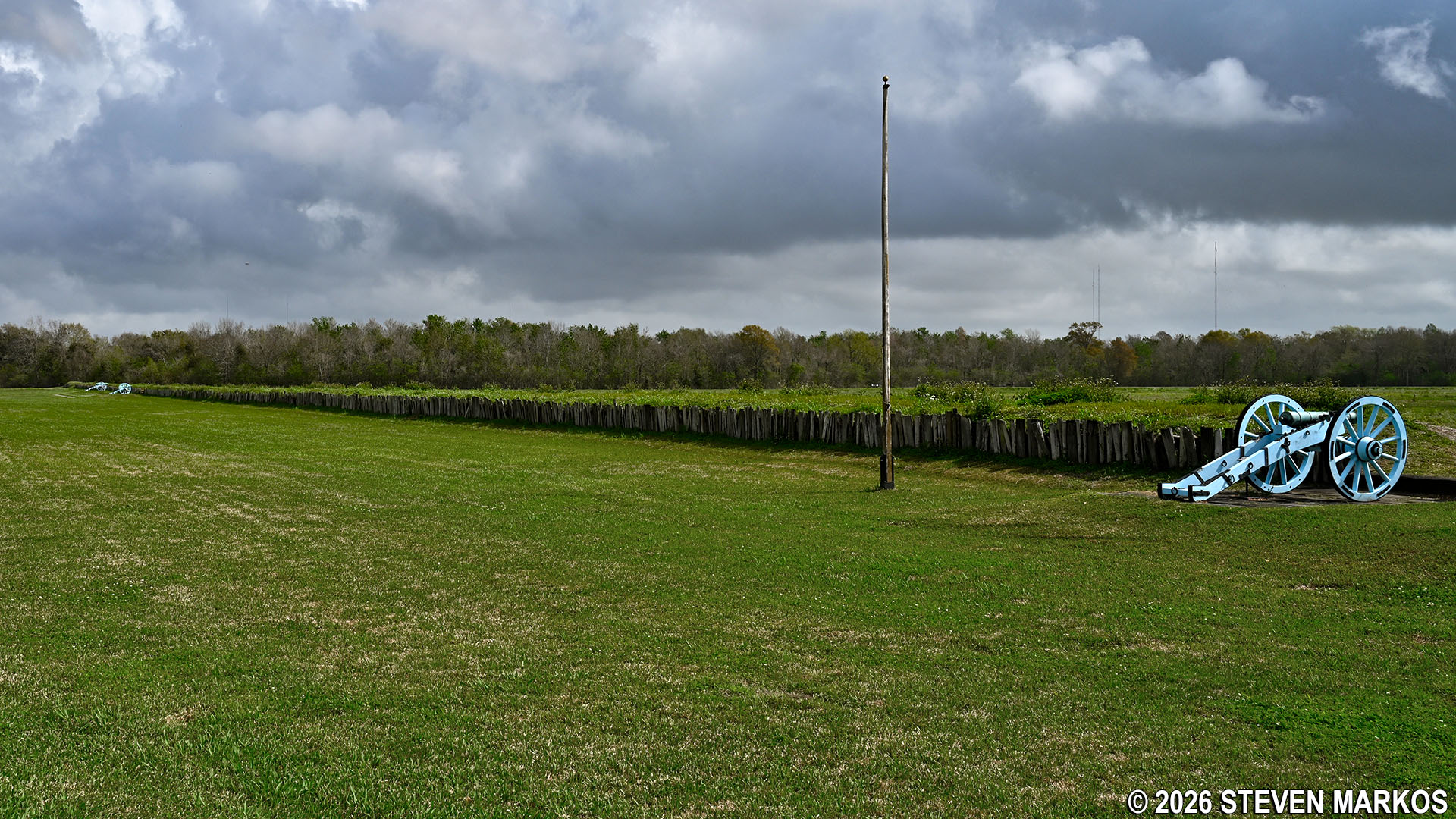
Reconstructed rampart at the Chalmette Battlefield in Jean Lafitte National Historical Park and Preserve
The American line along the Rodriguez Canal was anchored at one end by the Mississippi River and at the other end by a cypress swamp. Short of sailing up the Mississippi or into Lake Pontchartrain and attacking New Orleans from the north, there was no way for the British to go around Line Jackson from their current position at the Lacoste Plantation. The only way to get to New Orleans was to attack and break through the line.
To understand the positions of both the Americans and the British, it is necessary to know the locations of the various plantations involved in the Battle of New Orleans. The following is a list from the British position in the east to the American position in the west: Villeré, Lacoste, Laronde, Bienvenu, Chalmette, Rodriguez, and Macarty plantations. Total distance between the Villeré Plantation and the Rodriguez Canal is less than three miles. British troops controlled all lands up to the west side of the Chalmette Plantation.
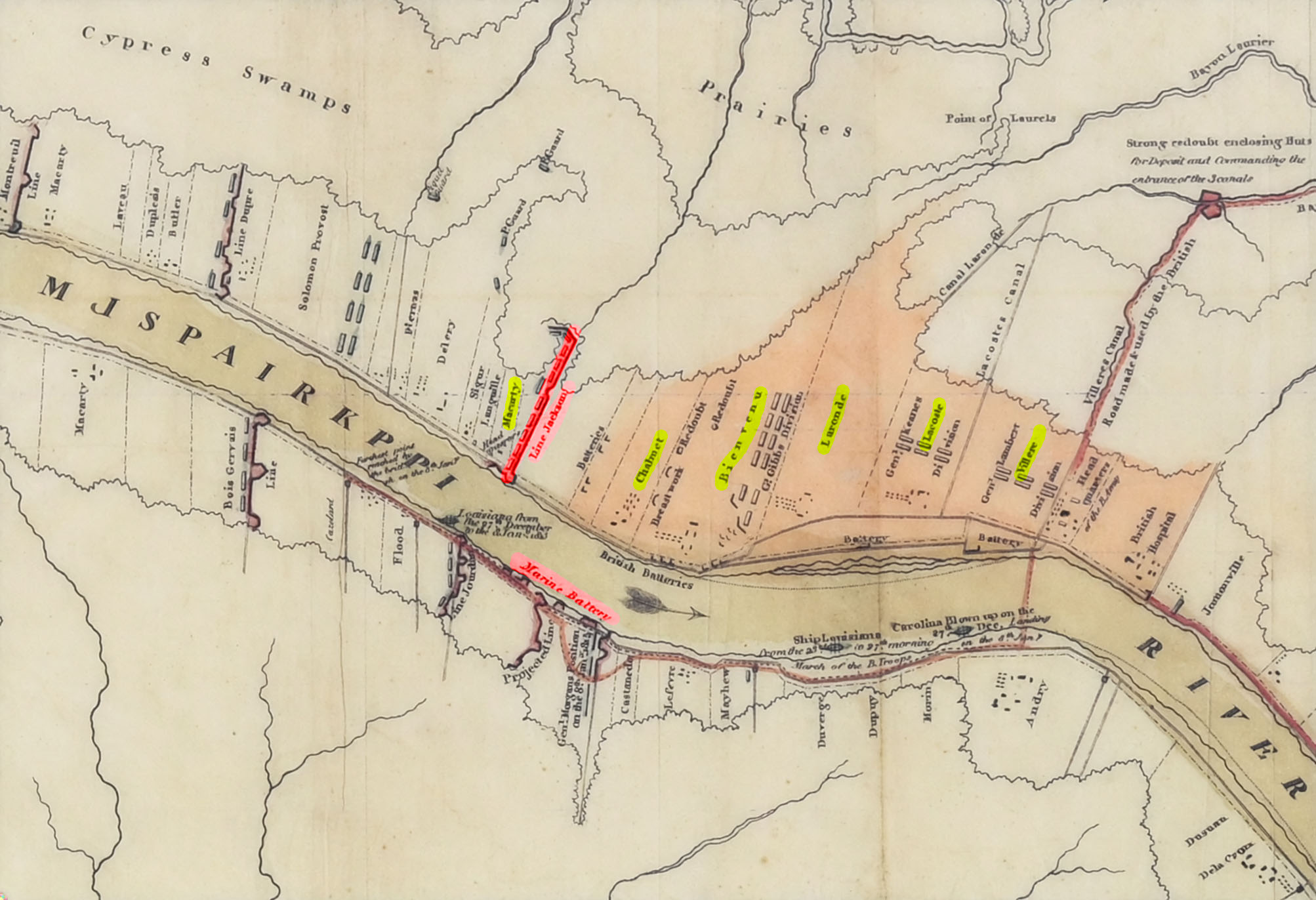
Plantations involved in the Battle of New Orleans
There were also a few preexisting irrigation and drainage ditches on the grounds, and the British troops utilized these for cover and from where to launch their attacks.
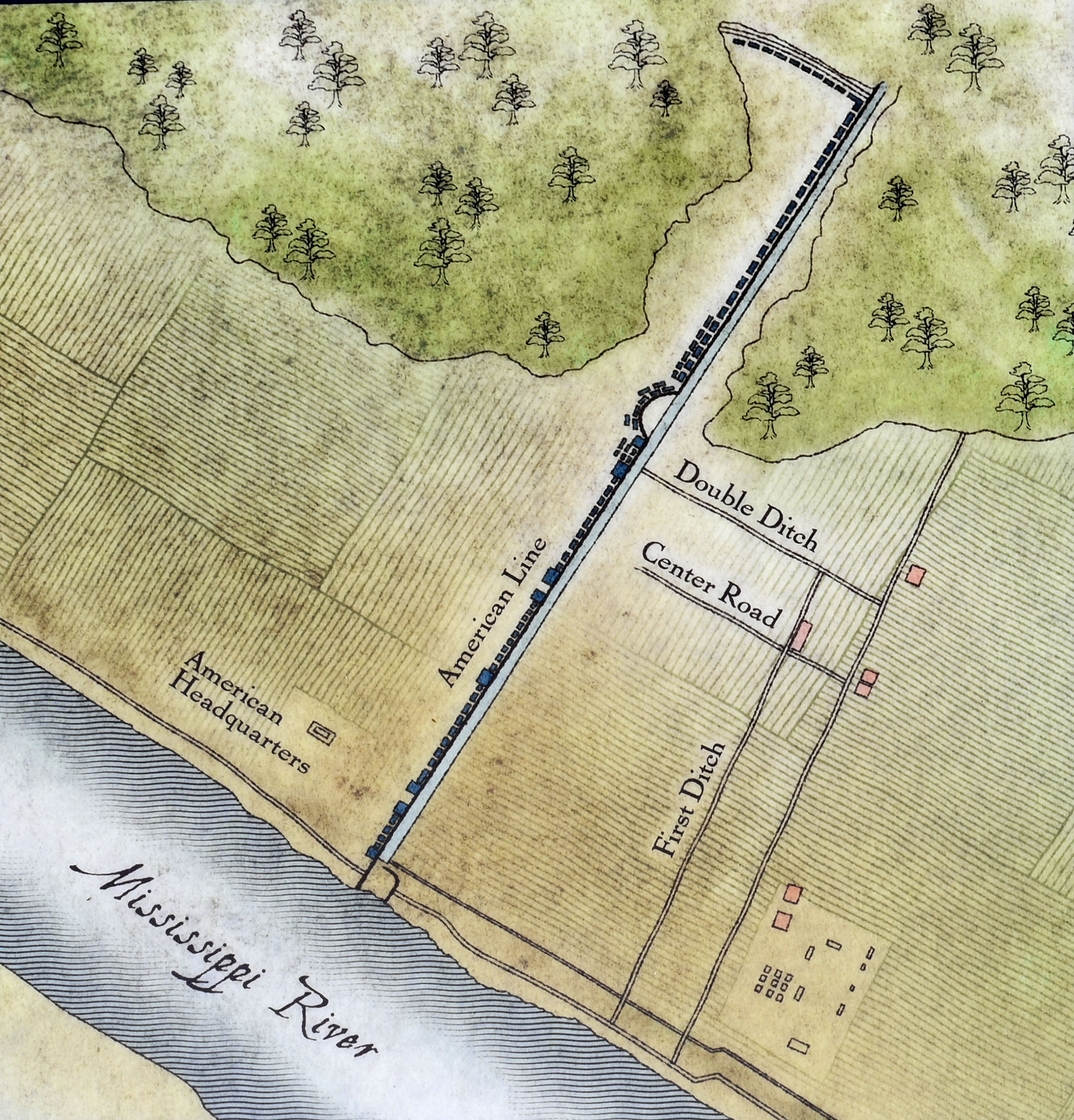
Ditches on the Chalmette Plantation
British Major General Edward Pakenham arrived on December 25th and took control of the British forces. His first action was to set up a concealed battery of cannon and a hotshot furnace along the bank of the Mississippi River so that he could sink the USS Carolina and other ships that were often bombarding his camp. The Carolina was hit and sunk on the 27th. (A hotshot furnace was used to heat cannonballs so they could catch wooden ships on fire.)
On December 28th, Pakenham ordered a reconnaissance-in-force against the Line Jackson in order to test its strength. The attack was not supported with artillery, yet the British nearly overran the American left flank near the swamp (at this time the rampart did not go all the way to the swamp). However, they were cut down on the right side by the American land-based artillery in conjunction with offshore artillery fire from the USS Louisiana. Pakenham, not fully aware of the success on Jackson’s left flank but well aware of the loses his men were taking on the right, called off the attack and retreated back to his camp at Lacoste. Had the British broken through on the left, the Line Jackson would have collapsed, and the British most likely would have won the fight to take New Orleans that evening.
Realizing an unsupported frontal attack was not going to work, Pakenham ordered the construction of artillery batteries on the east side of the Chalmette Plantation. While within range of the U.S. artillery, the work was done at night. The Americans could hear work being done but could not see where to fire.
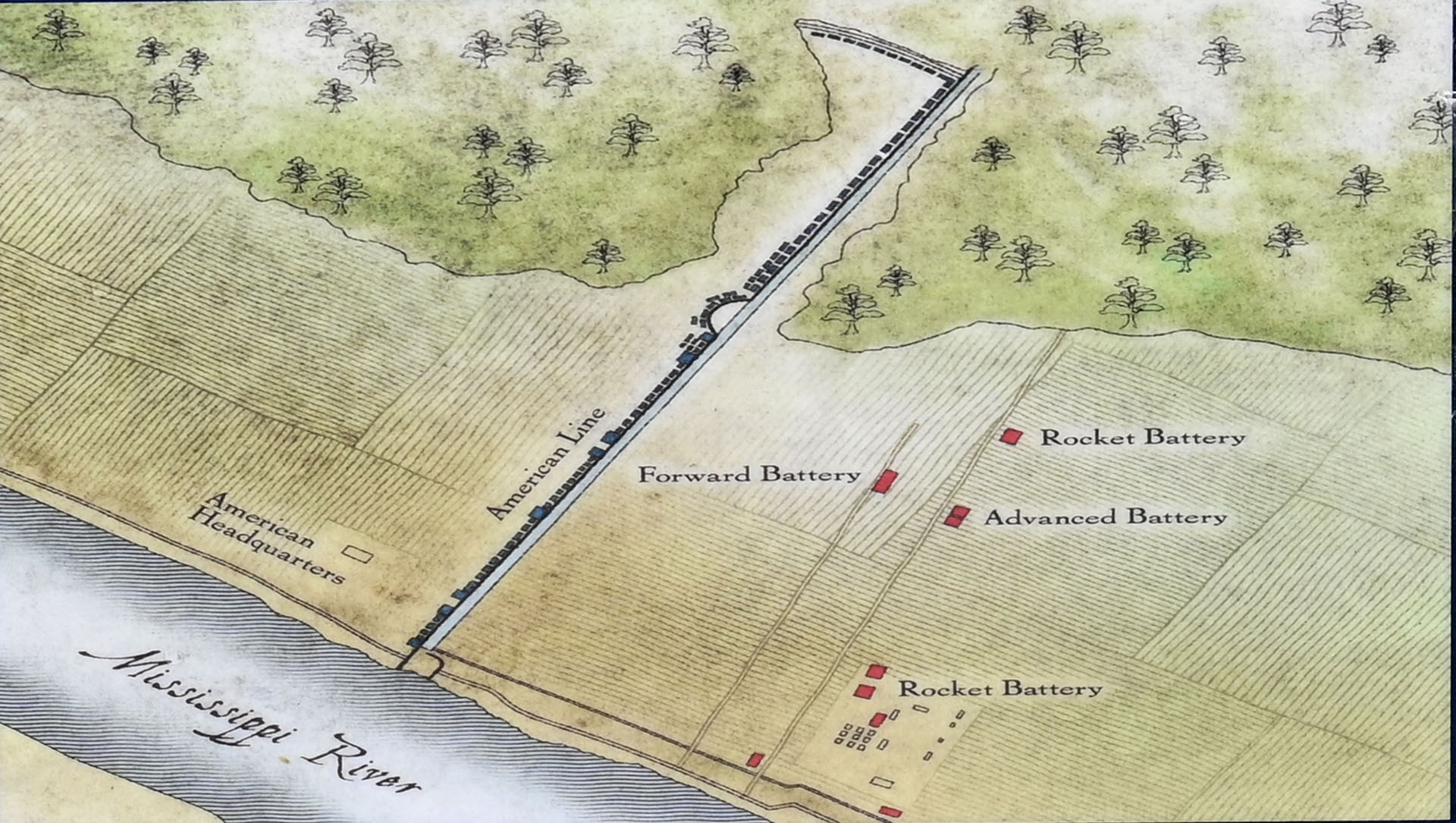
British artillery batteries (in red) at the Chalmette Battlefield during the Battle of New Orleans
Following the battle on the 28th, the Americans began strengthening Line Jackson by extending the rampart all the way to the swamp and installing two more artillery batteries, bringing the total to eight. In all, there was one 32-pounder gun, three 24-pounders, one 18-pounder, three 12-pounders, four 6-pounders, 1 four-pounder, and 2 howitzers. (Pounder refers to the weight of the cannonball that could be fired.)
The Americans also built a battery on the opposite bank of the Mississippi River called the Marine Battery. Three artillery pieces taken from the USS Louisiana were initially installed, and more guns arrived over the following days. Firing from a position perpendicular to the British battle line set up a scenario called enfilading fire. When firing head on, shells may fall short or overshoot the target, but when firing from the side, it’s hard to miss. No remnants of Marine Battery exist today.

Enfilading Fire Diagram
More British troops arrived at Lacosta on New Year’s Day 1815, and from their newly constructed artillery batteries, they immediately began bombarding the Line Jackson. This started an exchange of artillery fire that lasted for three hours. Jackson’s headquarters at the Macarty Plantation next to the battlefield was completely destroyed (Augustin de Macarty was a member of an influential Creole family who would later become the mayor of New Orleans). Pakenham canceled the attack around 3 PM after his artillery shot ran out, but he initiated another infantry attack later that afternoon on the American left flank, the area near the swamp that they nearly overran during the fighting on the 28th. This was a short-lived attack that did minimal damage. The end result of the battle was that the Americans lost three artillery pieces, include their largest, the 32-pounder. However, the British lost even more guns. Jackson and his men speculated that they were down to as little as two cannon.
During the first week of January, the British began work extending the Villeré Canal all the way to the Mississippi River. This would allow them to bring their boats from Lake Borgne to the river, cross to the other side, and attack the Marine Battery. When captured, the British could turn the American guns on the Line Jackon. Work was finished on January 6th.
Starting on January 6th, the Americans began construction on a redoubt at the far right of the canal on the bank of the Mississippi. A redoubt is an enclosed fort usually built in an outlying area, sort of an outpost for soldiers sent to defend a strategic point. Faced with an overwhelming attack, this is a place where the soldiers can fall back to. Redoubts can be earthen, temporary structures, or permanent structures made of brick or stone. At Chalmette, the redoubt was an earthen fort built behind the rampart.
The final battle at New Orleans began on the morning of January 8, 1815. It is estimated that Andrew Jackson had around 5,000 men, with roughly 550 of these stationed at the Marine Battery on the other side of the river. The British had around 8,000 men.
Pakenham’s plan was to send General Keane with a small contingent of men against the American right flank and the redoubt while sending the bulk of his troops—three full regiments and three companies of a fourth under command of General Samuel Gibbs—to the left flank at the swamp. The reasons for this are that the rampart wall was not nearly as high and thick in that area, the American militia defending this area were thought by the British to be inferior soldiers, and they had had success during the December 28th attack. Two regiments were left in reserve under the command of General John Lambert. Furthermore, Colonel William Thornton and 1,200 men were to cross the Mississippi and attack the Marine Battery.
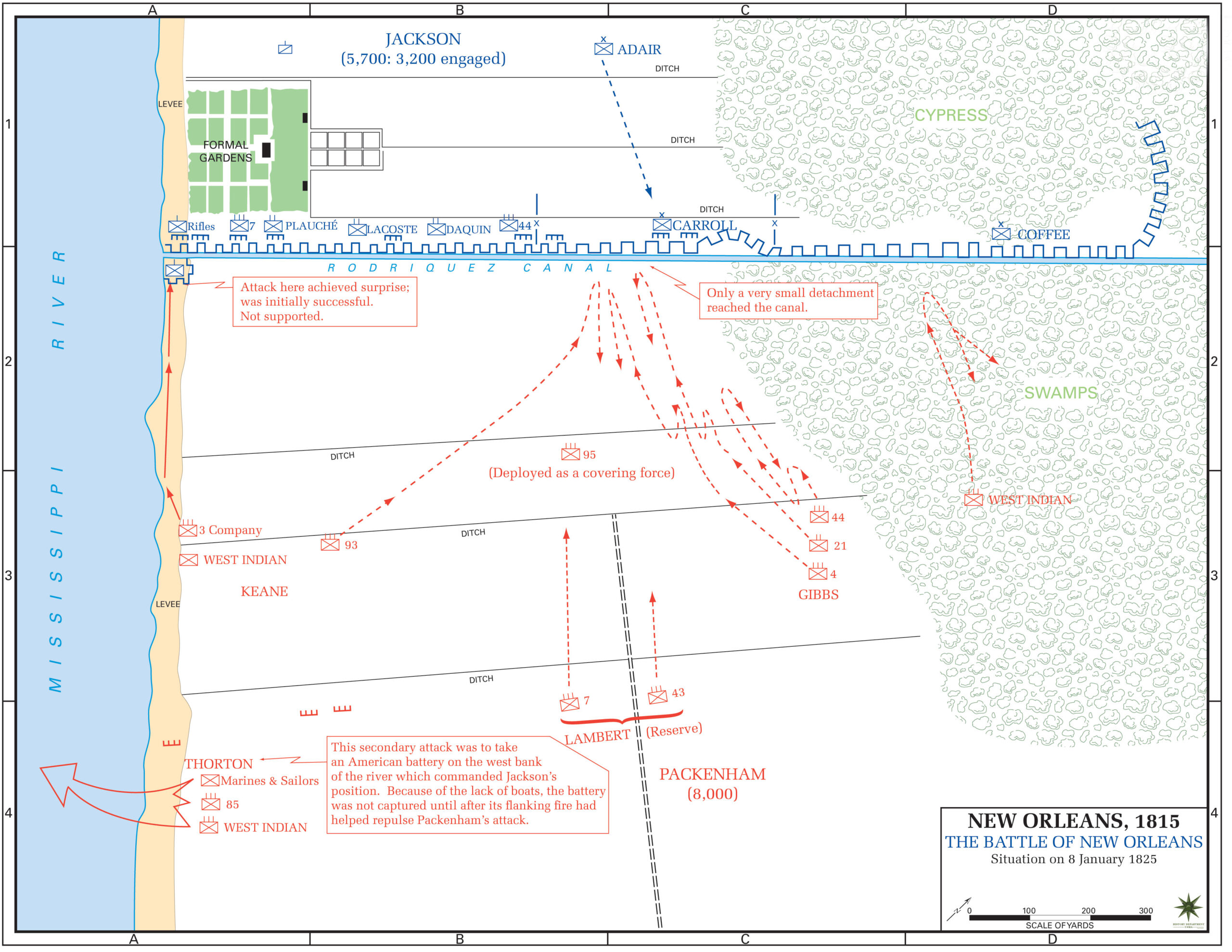
Battle of New Orleans map (Department of History, U. S. Military Academy)
The battle did not start well for the British, and needless to say, it didn’t end well either. The Villeré Canal extension collapsed before all the intended boats could enter the Mississippi. Only 24 made it through, and departure was delayed as many had to be dragged through the mud to the river. They were ultimately able to capture the Marine Battery, but the victory came as the main British army was defeated on the other side of the river. Furthermore, the Americans manning the battery destroyed all of the artillery pieces before retreating.
To get across the Rodriguez Canal, the British had made fascines, which are bundles of sticks—in this case, sugarcane stalks—that they could throw into the water and mud and walk across on. To climb the rampart wall, they had made ladders. The only problem was that when the first regiment to depart for the Line Jackson, the 44th Regiment commanded by Lieutenant Colonel Thomas Mullins, began its march, Mullins did not know where the fascines and ladders were stored. They were in a redoubt that had been built the night before, but Mullins marched passed this thinking they were stored in a battery further down the field. He sent 300 of his roughly 425 men back to the redoubt, but with other regiments now marching towards them, they got lost in the confusion. Thus the attack proceeded without the proper equipment.
Whether this ultimately mattered is debatable, for very few of Gibbs’s men even made it to the canal on the American left flank. Once near the American line, they were raked with cannon fire, and when within musket range, barrages of bullets. The American infantrymen were reported to have been stacked three deep behind the rampart, and as soon as one fired his gun, a second popped up to fire, and then a third, until it was back to the first man, who had reloaded, to shoot again. Gibbs himself was killed. Mullins, whom many British blamed for the defeat, was also killed.
In the meantime, the men in charge of taking the American redoubt, led by Colonel Robert Rennie, were able to successfully capture it. However, success was short lived. The Americans counterattacked, killing Rennie and nearly all of his men in the process of recapturing the fort.
Realizing Gibbs was in trouble, Keane took his 93rd Highlanders to the swamp, forcing them to cut diagonally across the battlefield where they were exposed to heavy cannon fire. The Highlander’s commander was killed, and Keane was shot and was no longer able to command troops. From a force of 900, only 130 Highlanders lived to see the end of the Battle. Pakenham himself was killed trying to rally the troops, who by this time were in chaotic retreat. Lambert, realizing the battle was lost, only used his reserves to cover the British soldiers returning hastily from the front lines.
The fighting at the Chalmette battlefield lasted roughly 45 minutes. It is estimated that the British lost a little over 2,000 men (killed / injured / missing), while the Americans had less than 100 casualties. However, this was not the end of the British. They returned to camp and did not officially leave the area until January 19th. In the meantime, there was sporadic cannon fire between the two sides. When the British did abandon New Orleans, they continued attacking American forts in the Gulf, even capturing Fort Bowyer in Mobile Bay on February 11th. News that a treaty had been signed arrived a few days later.
The Battle of New Orleans is remembered as one of the most lopsided victories in modern military history. For the first half of the 19th century, people throughout the United States celebrated January 8th as a major holiday. Victory made a hero of Andrew Jackson, and this was one of the main contributors to his successful presidential campaign in 1828, making him the seventh president of the United States. He won reelection in 1832.
With a few exceptions, use of any photograph on the National Park Planner website requires a paid Royalty Free Editorial Use License or Commercial Use License. See the Photo Usage page for details.
Last updated on September 3, 2026


