

River Styx inside Mammoth Cave
For reviews of all Mammoth Cave National Park tours, how to get tickets, what to wear, and rules for the tours, see the Cave Tours web page here on National Park Planner. Keep in mind that not all tours are offered year-round, and the schedule of what tours are available changes often. Be sure to check the National Park Service’s official Cave Tours web page for the current schedule.
OVERVIEW
The River Styx Tour at Mammoth Cave National Park covers the same route as the Historic Tour and nearly the same as the Extended Historic Tour, but it adds a side trip to see one of Mammoth Cave’s two underground rivers, the River Styx (the other is the Echo River). However, the differences in these tours go beyond the areas of the cave that are visited. The Historic and Extended Historic tours focus on the history of Mammoth Cave, whereas the River Styx Tour covers geology. So while you will be walking by the same historical features—remnants of a saltpeter mining operation, graffiti on the walls and ceiling—the Ranger giving the River Styx Tour will not stop to talk about these things. Thus, you aren’t exactly wasting your time by taking the River Styx Tour and one of the historical tours. If you have time for only one, choose based on your interests: history or geology.
If you are more interested in history, the even better option—for some people—is the Grand Historic Tour. This not only covers everything seen on both of the other historic tours, but it also covers the entire Gothic Avenue Tour and the River Styx side trip. With this one tour you wipe out the need to do four other tours. There are, however, two problems with the Grand Historic Tour. One, it is not offered often, and two, it is not for everyone. It is four hours long and covers four miles, and in truth, four hours is a long time to spend walking and standing inside a cave. It is definitely not for young children or anyone else with a short attention span. Nor is it for those who need to sit down often. Participants should be in good physical condition, like history, and can mentally handle a long tour.
There are no lights along the trail to the River Styx, so lanterns are used for this part of the tour. This gives visitors a chance to experience the cave just as all early tourists did before electric lighting was installed beginning in the 1920s. I recommend that all visitors to Mammoth Cave take a lantern tour, so the River Styx Tour may suffice for some. However, it is not a full-fledged lantern tour like the Star Chamber Lantern Tour, the Violet City Lantern Tour, or the Great Onyx Lantern Tour. These tours are completely or nearly completely done in the dark with only lanterns to light the way. The lantern portion of the River Styx Tour comprises only about ten percent of the overall tour.
The River Styx Tour lasts 2.5 hours and covers 2.5 miles of Mammoth Cave. It is not overly strenuous, but there are 600 stair steps, which is typical for most tours that begin at the Historic Entrance. There are a few sections with very low ceilings, and anyone other than a child will most likely have to walk bent over. It certainly is not for someone with mobility or other physical health problems, but neither are any of the tours of Mammoth Cave besides the Accessible Tour. If you can walk two-and-a-half miles, bend over, and can climb stairs, you shouldn’t have any problems.
Like all tours that enter Mammoth Cave through the Historic Entrance, the River Styx Tour starts off down a steep, .2-mile paved hill from the Visitor Center. It is even steeper on the way up, believe me. For a young person or those in great shape, the hill is probably inconsequential. But for those who are older, drastically overweight, or have problems walking up or down steep hills, it’s no picnic. At 59 years old, I dreaded the walk back up to the Visitor Center far more than anything inside the cave. There are benches along the path, and there is no shame in sitting down and resting. I will say that if you get to the bottom and realize that getting back up to the Visitor Center is going to be extremely difficult, you should not be going into the cave in the first place.

Walking up from the Historic Entrance of Mammoth Cave to the Visitor Center
TOUR HIGHLIGHTS
Giant’s Coffin
While just about all tours that enter Mammoth Cave through the Historic Entrance pass by the Giant’s Coffin, most discuss it in terms of its historical aspects, particularly how it relates to tourism. On the River Styx Tour, the geology of the large rock is discussed.

Giant’s Coffin in the main section of Mammoth Cave
The slab is 40 feet long and 20 feet tall, and it fell from the ceiling above. If it were possible to lift it up, it could be matched to the exact spot where it was originally located. Before it fell, water was running underneath it. After it fell, the water was diverted to behind it, and this eventually created the passageway to the left of the slab that many of the cave tours now take, including the River Styx Tour.

Passageway to the left of the Giant’s Coffin in Mammoth Cave
Bottomless Pit
The passageway leads to some of the most interesting sections of Mammoth Cave, passing a number of geological features such as the Bottomless Pit before entering into a narrow and sometimes very short (as in low ceilings) passageway called Fat Man’s Misery. Getting there first requires descending a staircase. The ceilings even here are often low, and adult tour participants must constantly duck to avoid hitting their heads. Once at the bottom, the tour continues down a passageway called Dante’s Gateway.

Staircase down to Dante’s Gateway inside Mammoth Cave
The first points of interest are Sidesaddle Pit and the Bottomless Pit, with the Bottomless Pit being the more photogenic of the two. In the early days of cave tourism, guides would toss rocks or even lighted torches into the Bottomless Pit so customers could watch them disappear. It wasn’t really bottomless, and explorers eventually figured out it was only 105 feet deep. When the tour eventually gets to the River Styx, the elevation of the observation platform overlooking the river is just slightly above the bottom of the Bottomless Pit.

Sidesaddle Pit inside Mammoth Cave

The Bottomless Pit inside Mammoth Cave
Prior to the 1840s, when a tour group reached the Bottomless Pit, it had to turn around because there was no way to proceed past this point. In the 1840s, Stephen Bishop, a guide, cave explorer, and slave, rose to international prominence as an expert on Mammoth Cave. He was often the requested guide for visiting geologists and other scientists, and he learned from each of them until he knew as much as they did. He was the first to cross the Bottomless Pit by placing a ladder across it (horizontally) and then crawling over it with his lantern held by his teeth. Today there is a bridge across the pit.
Fat Man’s Misery

The start of Fat Man’s Misery inside Mammoth Cave
When the tour reaches the start of Fat Man’s Misery, you are approximately 260 feet below the surface. This section of Mammoth Cave is a winding passageway that runs for only 100 feet but feels like a mile due to all the twisting, turning, and bending you must do. On a typical adult, it is narrower from the waist down and wider from the waist up, giving it a keyhole shape. Near the end, the floor comes up two feet, which means if you were barely walking straight up prior to this, the ceiling is now two feet lower. All of this is why Fat Man’s Misery is so much fun. You won’t be crawling through the dirt on your hands and knees, but it is more of what people expect from a cave.

Visitors to Mammoth Cave make their way through Fat Man’s Misery
The narrow passageway ends at the aptly named Great Relief Hall where, believe it or not, there is a modern restroom facility (which can also be a great relief).

End of Fat Man’s Misery at Great Relief Hall inside Mammoth Cave
River Hall and River Styx
Once emerging from Fat Man’s Misery, the River Styx Tour continues down a much wider and taller passageway to River Hall, 283 feet below the surface. This area has seating, and most every cave tour that passes through Fat Man’s Misery stops here for a lecture of some sort. In plain view is a staircase that leads to a fire tower inside Mammoth Dome that tour participants must climb in order to get back to the Historic Entrance and exit the cave at the end of the tour.

Setting area inside Mammoth Cave’s River Hall
Less obvious is a dark passageway to the rear of the seating area that leads to the River Styx. There is no electricity in the passageway, so the Rangers hand out battery operated lanterns. There is not one for every person, so you don’t have to be bothered with carrying one if you don’t want to. The typical arrangement is one or two lanterns per family group.

Ranger prepares visitors for a trip into the dark passageway to the River Styx in Mammoth Cave
What most people do not realize is that no matter where you are in Mammoth Cave, you are at a higher elevation than the Green River outside. This is possible because Mammoth Cave is inside a small mountain. Any rivers within the cave, such as the River Styx, flow through the lowest levels of the cave.
River Styx itself is 360 feet below the surface. It eventually emerges at River Styx Spring before flowing into the Green River. At extreme high water levels on the Green River, water actually backs up into Mammoth Cave. In 2021, River Hall was a few feet underwater. And remember, River Hall is 77 feet above the River Styx.

Ranger illuminates the River Styx inside Mammoth Cave

River Styx inside Mammoth Cave
A staircase leads from the River Styx overlook through a passageway that circles back to the lecture area of River Hall.

Staircase takes visitors beyond the River Styx inside Mammoth Cave
Mammoth Dome
All tours that reach River Hall eventually proceed out of the cave by way of Mammoth Dome. This is a geological feature that was created when a sinkhole on the surface formed and allowed water to seep into the limestone, eventually eroding a hollow pit approximately 190 feet deep, or 190 feet tall from the perspective of those standing at the bottom. The journey to Mammoth Dome begins by taking the staircase at River Hall through a passageway known as Sparks Avenue.

Staircase through Sparks Avenue eventually leads to Mammoth Dome inside Mammoth Cave
Other than Fat Man’s Misery, Mammoth Dome offers the best photo opportunities on the tour. The formations are known as the Ruins of Karnak.

Ruins of Karnak inside the Mammoth Dome, Mammoth Cave National Park

Calcite formations and the Ruins of Karnak inside the Mammoth Done at Mammoth Cave National Park

Flowstone formations in Mammoth Dome, Mammoth Cave National Park
The stairs continue at the Ruins of Karnak, and there are a few landings on the way up where you can get different views of the formations.

View from the stairs above the Ruins of Karnak inside Mammoth Dome at Mammoth Cave National Park
The stairs eventually end at the fire tower, which is just more stairs, except these head straight up through the pit. It’s like climbing a lighthouse, if you’ve ever done that. There are landings at the top of every flight of stairs that have enough room for you to take a break and still allow others to pass by.

Staircase tower inside Mammoth Dome, Mammoth Cave National Park
Cave Exit
Once at the top of the fire tower, the River Styx Tour continues down Auburn Avenue, a large and uneventful passageway, and comes out at the saltpeter mine. From there, take a left to get back to the Historic Entrance and exit Mammoth Cave.
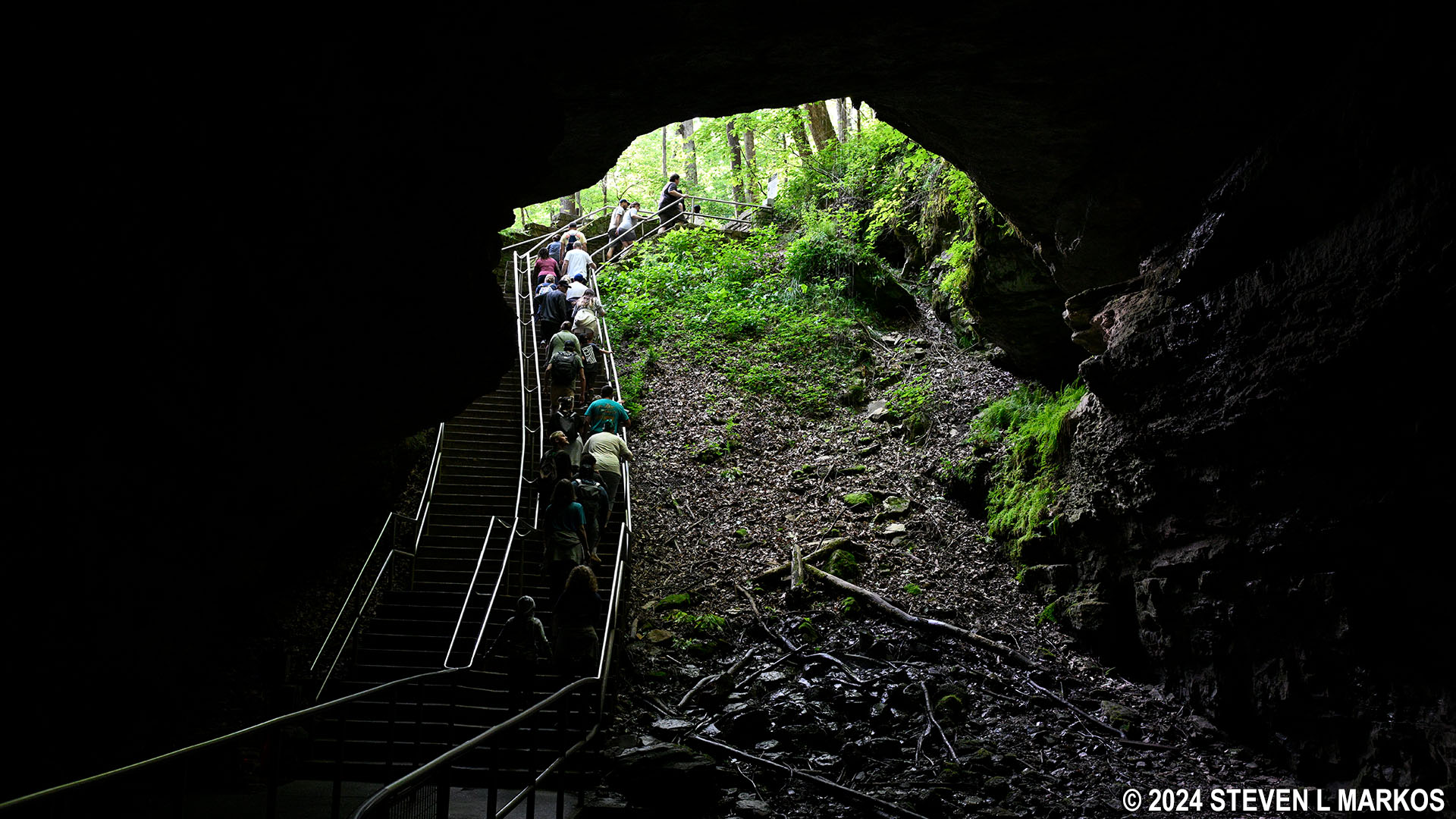
Visitors to Mammoth Cave exit via the Historic Entrance
With a few exceptions, use of any photograph on the National Park Planner website requires a paid Royalty Free Editorial Use License or Commercial Use License. See the Photo Usage page for details.
Last updated on October 11, 2024


