

Five Forks Intersection stop on the Five Forks Battlefield Driving Tour at Petersburg National Battlefield
FIVE FORKS BATTLEFIELD DRIVING TOUR
STOP 3: Five Forks Intersection
Allow 10 minutes for a visit
The third stop on the Five Forks Battlefield Driving Tour at Petersburg National Battlefield is the Five Forks intersection itself. Today three roads converge at the five-way intersection: White Oak Road, which runs east and west through the intersection; Courthouse Road, which runs southeast and north through the intersection; and Wheelers Pond Road, which comes in from the southwest and ends at the intersection. During the Civil War, however, four of the five roads went by different names. White Oak Road still ran through the intersection east to west. However, Courthouse Road was called Dinwiddie Court House Road southeast of the intersection and Ford’s Road north of the intersection. Wheelers Pond Road was called Scott’s Road.
On March 31, 1865, Confederate troops under the command of General George Pickett were successfully engaging Union soldiers defending the recently captured Dinwiddie Court House Road-Boydton Plank Road intersection when Union reinforcements began arriving late in the battle (Battle of Dinwiddie Court House). Realizing he could be trapped, Pickett retreated to the Five Forks area later that night. General Robert E. Lee had instructed him to hold Five Forks at all costs. Why?
The goal of Union general Ulysses S. Grant as he moved east to west on the southside of Petersburg was to capture all roads and railroads leading into the city, thus cutting off Lee’s supply lines from the south and west (significant supplies weren’t coming from the north). By the end of March, the last major supply line was the South Side Railroad, which connected Petersburg to Lynchburg, Virginia, a hub for other railroads in the Shenandoah Valley. The quickest and easiest way to get to the railroad was on Ford’s Road. Sure, Union soldiers could reach the railroad countless ways, perhaps tear up the tracks, but most likely they’d eventually run into a freight train full of Confederate soldiers who would shoot them and then repair the tracks. To take complete control of a section of the railroad, a sizeable force armed with heavy artillery was needed, and there was no way to move artillery through forests, up and down hills, and across creeks and streams without a road. Short of building a new one, Ford’s Road was the key.

Battle of Five Forks map
Just how vital was the South Side Railroad? The Union won the Battle of Five Forks late in the evening on April 1st, and Lee started moving his entire army out of Petersburg and Richmond the next night.
The Five Forks Intersection parking lot is on White Oak Road on the west side of the intersection. At the actual intersection are two wayside exhibits, a cannon, and two monuments. There are no remnants of earthworks or other fortifications.
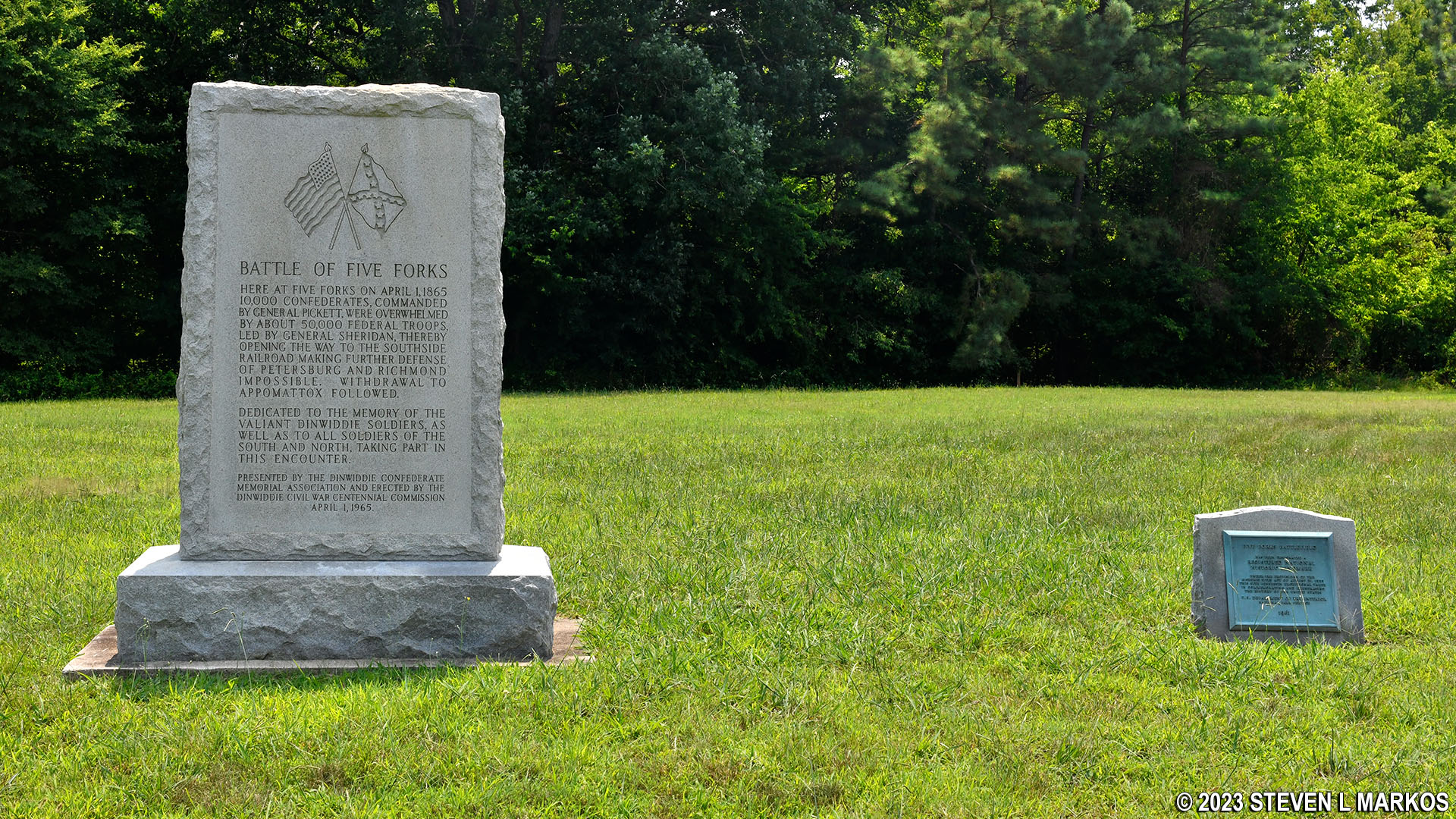
Monuments at the Five Forks intersection, Petersburg National Battlefield
Stop 4: The Final Stand | Stop 2: The Angle | Five Forks Battlefield Tour Home Page
With a few exceptions, use of any photograph on the National Park Planner website requires a paid Royalty Free Editorial Use License or Commercial Use License. See the Photo Usage page for details.
Last updated on March 24, 2023


