
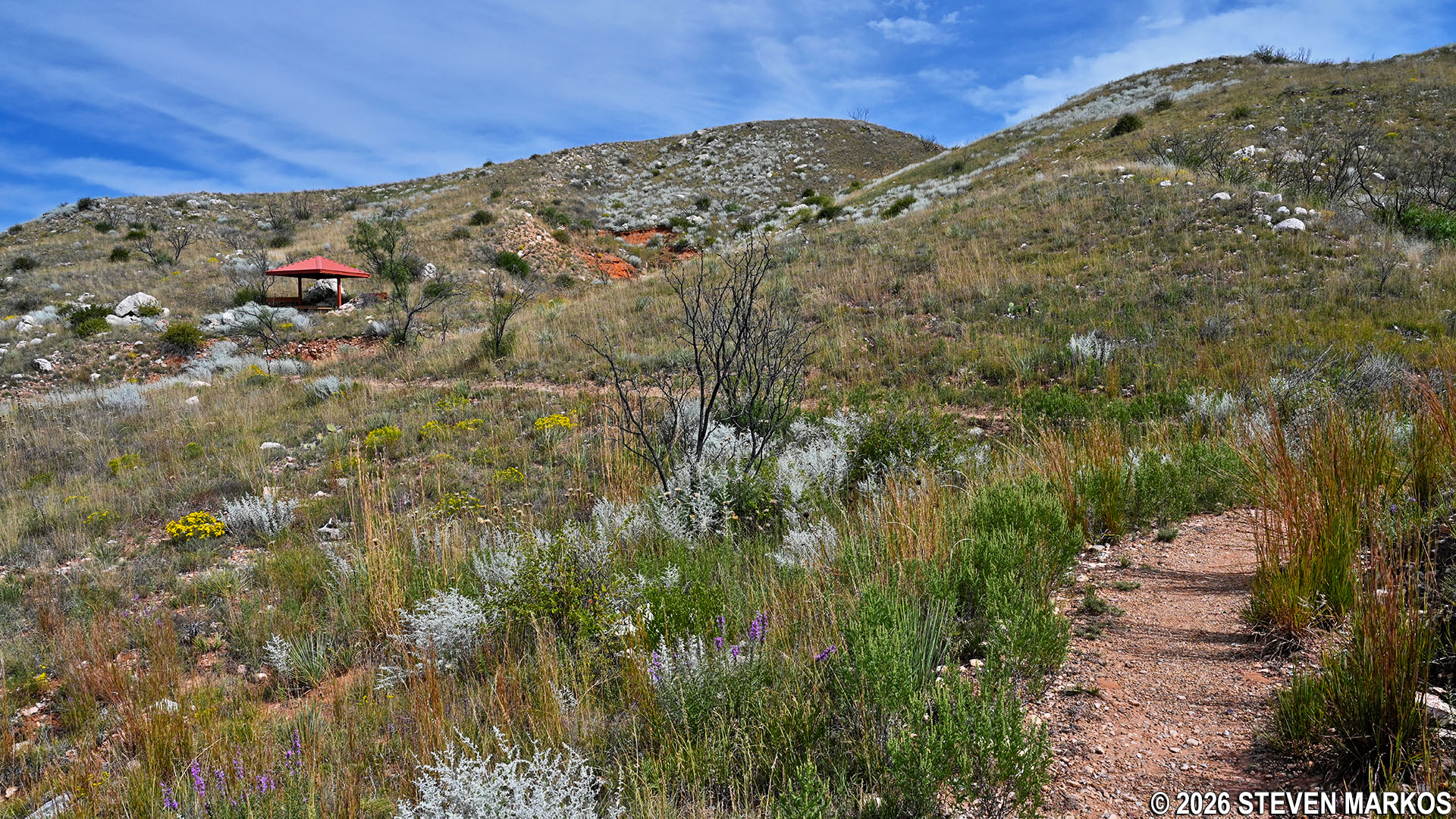
Trail leading up to the top of the mesa on the Quarry Tour at Alibates Flint Quarries National Monument
PARK OVERVIEW
Alibates Flint Quarries National Monument in Fritch, Texas, preserves and protects the ancient quarry pits where flint was sourced by prehistoric and early Native Americans for more than ten thousand years. The park was first established on August 31, 1965, as Alibates Flint Quarries and Texas Panhandle Pueblo Culture National Monument. After the park boundaries were adjusted on November 10, 1978, it was renamed Alibates Flint Quarries National Monument.
Alibates flint is a vibrant, multicolored rock with distinctive banded patterns. It is extremely hard and develops a sharp edge when properly shaped. Alibates flint is only found in a small area of the Texas Panhandle (roughly ten square miles) along the Canadian River.
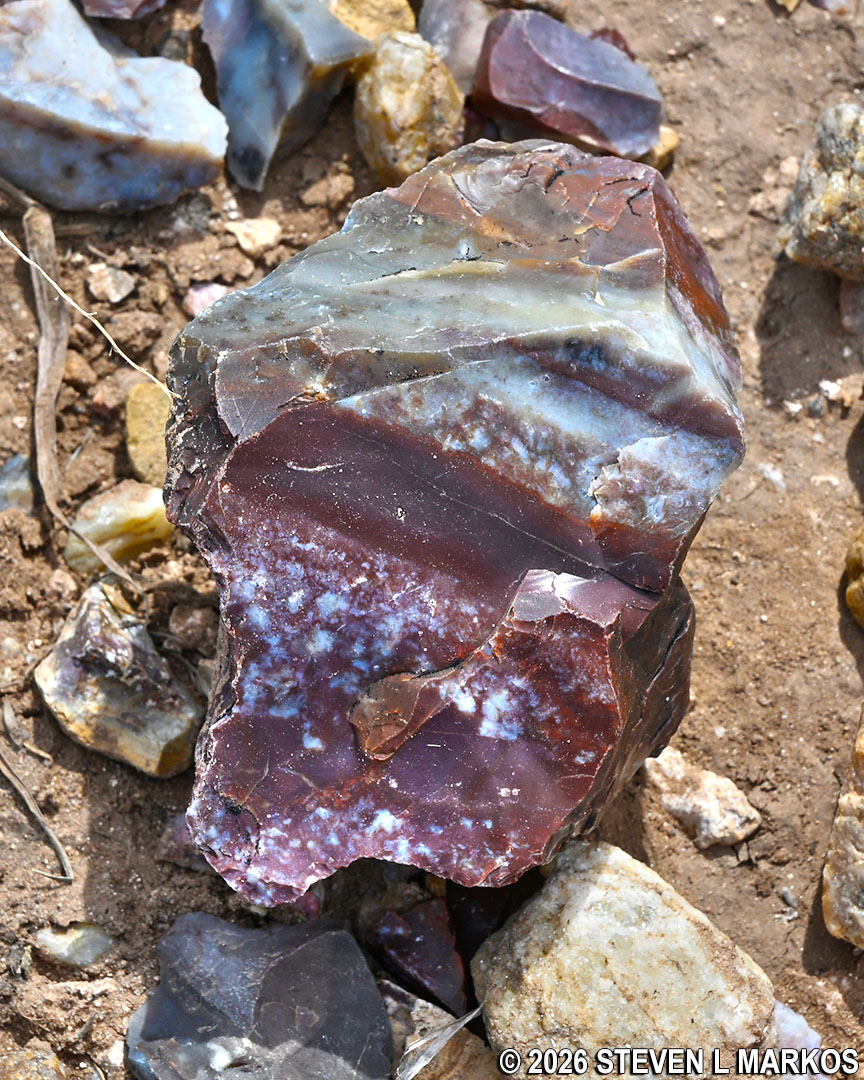
Piece of Alibates flint from the Alibates Flint Quarries at Alibates Flint Quarries National Monument
The first modern reference to the area was recorded in 1845 by James W. Abert, a lieutenant in the United States Army Corps of Topographical Engineers, during an expedition along the Canadian River. He called the area the Agate Bluffs and described it as “a plain strewn with Agates, colorized with stripes of rose and blue, and with colors resulting from their admixture.” Unfortunately, being in such a remote area, his discovery was soon forgotten.
The Agate Bluff’s geological and historical significance was not reestablished until 1906 when Charles N. Gould, a geologist commissioned by the United States Geological Survey, visited the area while investigating the Canadian River’s water sources. At the time, the land was part of the LX Ranch that was established by W. H. “Deacon” Bates and David T. Beals shortly after the Plains Indians were forcibly removed from the region following the Red River War in 1874. While exploring, Gould came across the white chalk-like dolomite in which the flint formed. Allen “Allie” Bates, a cowboy on the LX Ranch and the supposed son of W. H. Bates, served as a guide for Gould while he toured the area. Both a ravine where Bates was living while running a line camp and the dolomite were named for him.
The Clovis Mammoth Hunters are the earliest known people to have used Alibates flint. They lived in the area near the end of the last Ice Age, from around 9500 BC to 9000 BC. The Clovis people hunted mammoths, mastodons, and other Ice Age animals using projectile points and tools made from Alibates flint.
The next people to live in the Texas Panhandle and use Alibates flint were the Folsom (8000 BC to 6000 BC). They lived a similar hunter-gatherer lifestyle to the Clovis. The Folsom people hunted large herds of the now-extinct bison antiquus, which were larger than today’s bison, using an atlatl. The revolutionary lever-powered spear launcher allowed them to hunt bison and other large animals from a distance.
From 6000 BC to 750 AD, the Archaic Indians lived in the Texas Panhandle. Not only did they use dart points and arrowheads made from Alibates flint, but they also used the dolomite to make manos (hand-held stones) and metates (stone slabs for grinding) to process seeds and plants for food.
One of the most influential people to live in the area was the Antelope Creek people (1150 to 1450). They realized that underground flint was of higher quality than the exposed flint lying on the ground and dug hundreds of quarries to get to its source, the dolomite boulders. Unique to the Antelope Creek people were their stone-slab houses, known as pit houses, which they built out of dolomite. Hundreds of their settlements have been found near spring-fed streams and atop the mesas along the Canadian River, and over 700 flint quarries have been discovered.
Begin your visit to Alibates Flint Quarries National Monument by stopping at the Visitor Center to pick up a park brochure, check out the exhibit area, and watch the park film. Afterwards, you can walk through the Alibates Gardens just outside the Visitor Center, hike the Mesquite Trail, and take a Ranger-guided Quarry Tour (reservations required) to see what remains of the quarry pits—not much—along the top of the mesa.
OPERATING HOURS
Alibates Flint Quarries National Monument is open every day from 9 AM to 4 PM except when closed for Thanksgiving and Christmas. Keep in mind that times can always change, so be sure to get the latest schedule on the National Park Service’s official Operating Hours and Seasons web page for the park.
FEES
There are no fees to visit Alibates Flint Quarries National Monument.
SCHEDULING YOUR TIME
Visitor Center
Allow 30 to 45 minutes
Mesquite Trail
Allow 15 minutes
Quarry Tour
Allow 2 to 2.5 hours
With a few exceptions, use of any photograph on the National Park Planner website requires a paid Royalty Free Editorial Use License or Commercial Use License. See the Photo Usage page for details.
Last updated on September 22, 2026


