

Visitor Center at Saugus Iron Works National Historic Site
Note: Saugus Iron Works is a modern name. When in operation, the iron plant was called Hammersmith, and it was located in Lynn, Massachusetts. The town of Saugus was not incorporated until 1815.
GENERAL INFORMATION
The Visitor Center for Saugus Iron Works National Historic Site is located in an addition on the west side of the Iron Works House, the multi-gabled building from the early 1680s first seen when entering the park. The addition—technically called an ell since it was added at a right angle to form an “L” shape—was built to look like the original house, but it was not part of its construction, and nobody knows exactly when it was added. The ell was not shown on detailed illustrations done in 1879, but it was there in 1915 when Wallace Nutting purchased the house and remodeled it to look like it does today. He enlarged the ell and turned it into a house for his resident blacksmith, Edward Guy.
The Iron Works Museum is located in the barn-like building next door. This was a blacksmith shop built by Nutting in 1917. The annex was built in 1952 to hold additional museum space and the restrooms. In addition to exhibits, this is where visitors can watch the park film, Iron Works on the Saugus.

Iron Works Museum housed in the former 1917 blacksmith shop next to the Saugus Iron Works National Historic Site Visitor Center
OPERATING HOURS
The Visitor Center and Iron Works Museum are typically open from mid-May until November on Wednesdays through Sundays between the hours of 9:30 AM and 4 PM. For the exact opening date and current hours, be sure to check the National Park Service’s official Basic Information web page for Saugus Iron Works National Historic Site.
AMENITIES
- Information desk where you can pick up a park brochure and speak with a Ranger
- Sign up for a Guided Tour of the Iron Works House
- Small book and souvenir store
- Museum and park film

Inside the Visitor Center at Saugus Iron Works National Historic Site
PARK FILM
The 12-minute documentary Iron Works on the Saugus is shown on a big-screen TV in the museum building—just push a button to start it. There is an English, Spanish, French, and German language option. This is a fantastic film, and it provides everything you need to know about Saugus Iron Works. Don’t venture out to explore the site until watching it. Some of it was shot at the park, so it is not a random documentary but one made specifically for Saugus Iron Works National Historic Site with actual actors. There is no objectionable material, so the film is suitable for all ages.
The National Park Service has posted the film on YouTube, and you can watch it in advance to save some time on the Documentary web page here on National Park Planner.
MUSEUM
Exhibits in the Iron Works Museum cover the history and geology of the area, how the Saugus Iron Works was founded, and how iron is processed into finished products.

Exhibits in the Iron Works Museum at Saugus Iron Works National Historic Site
After the Saugus Iron Works closed around 1670, the land and facility fell into the hands of private individuals who had no means to remove heavy equipment. What could be easily salvaged was carted off and recycled for other purposes, but the heavy items were simply buried over time, and Saugus Iron Works was forgotten until the early 1940s. At this time the Iron Works House was sold to the Henry Ford Trade School and was slatted to be moved to Ford’s Greenfield Village in Dearborn, Michigan, an outdoor living-history museum like the one at Williamsburg, Virginia. Up until that time, nobody really cared about the house, but once it was sold, local preservationists began a push to keep it in Saugus, and money was successfully raised to buy it back.
This newfound interest in the Iron Works House, which at the time was thought to have been the house of the iron works manager, was the catalyst that started a search for the industrial site itself. Historian and amateur archaeologist Rolland Robbins was hired, and an excavation of the area began in the fall of 1948. Results were immediate, and by 1953 the foundations of the blast furnace, finery forge, rolling and slitting mill, and warehouse and dock had been located. The items that were left behind nearly 300 years earlier could be viewed once again. These artifacts include a 500-pound hammer, part of a waterwheel and its housing, and massive timbers. Also found were tools, finished products that had been dropped and lost by workers, and hundreds of Indian artifacts such as arrowheads and pottery. Much of this is now on display in the Iron Works Museum.

Remnants of one of the original Saugus Iron Works waterwheels on display in the Iron Works Museum
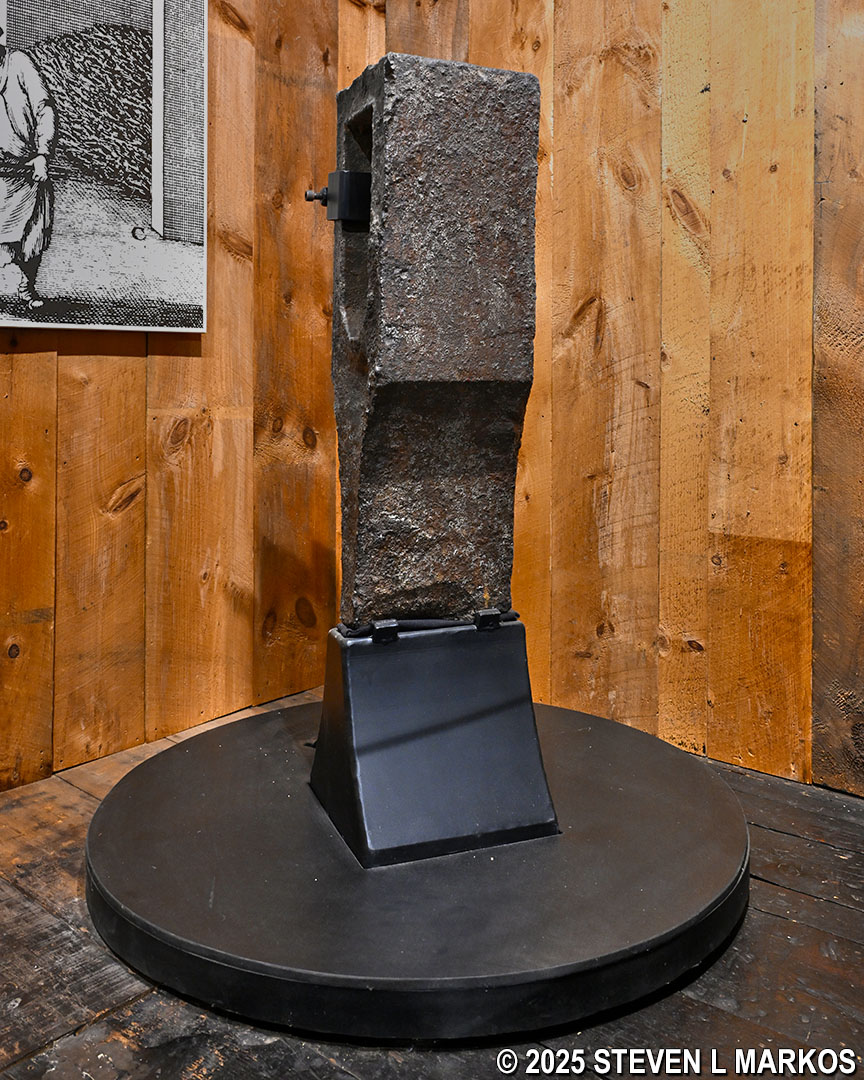
500-pound trip hammer found during the excavation of Saugus Iron Works in the mid-1900s on display in the Saugus Iron Works Museum

Pawtucket Indian arrowheads, projectile points, and other tools found during the excavation of Saugus Iron Works in the mid-1900s are now on display in the Saugus Iron Works Museum
The process of refining iron is also explained in detail at the Iron Works Museum. Models of the furnace, forge, and splitting mill are excellent visual tools, and I highly recommend examining these, along with all the other exhibits, so you understand what you are looking at when you venture out to see the actual iron works site.
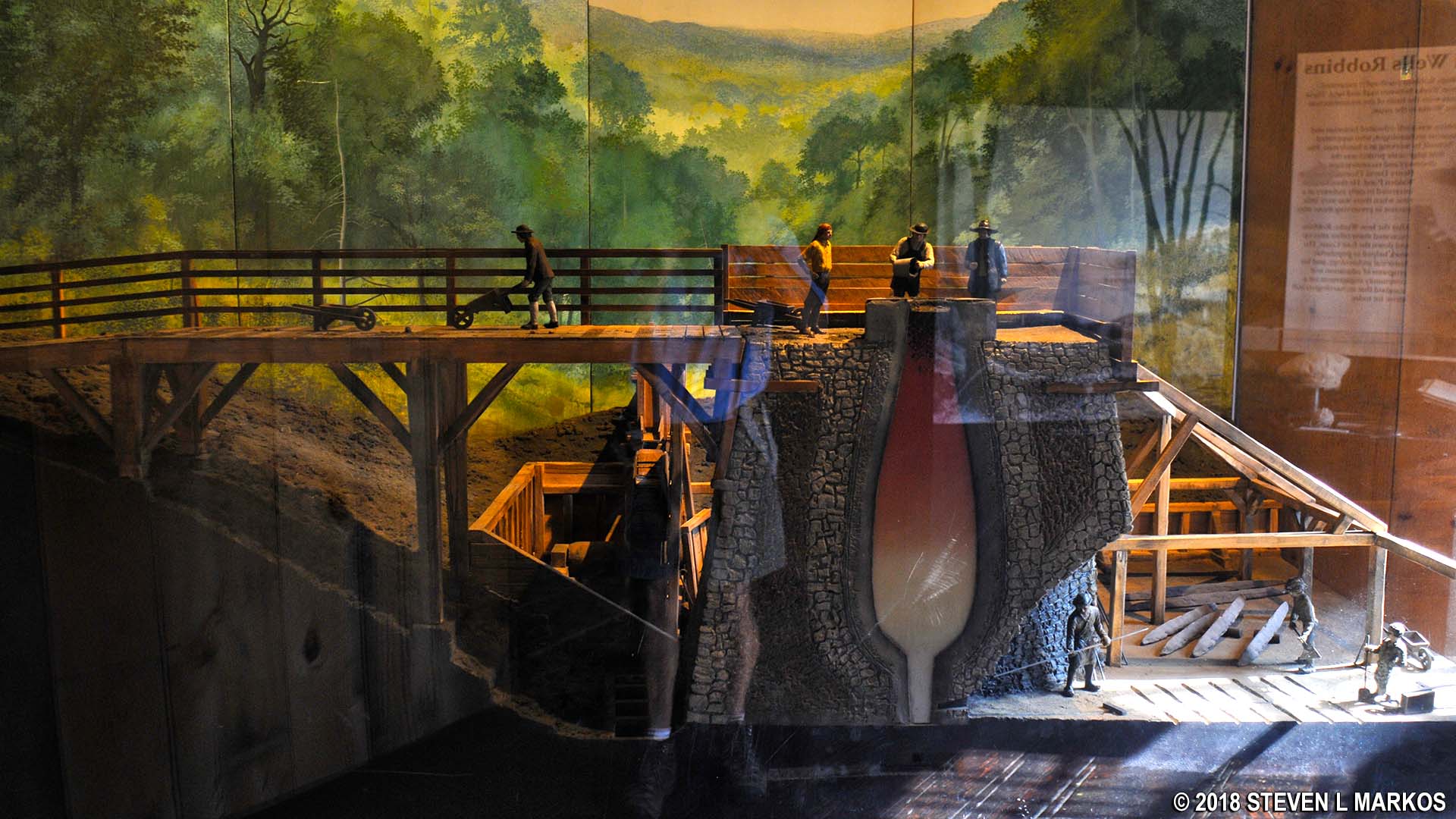
Model of the blast furnace on display at the Iron Works Museum at Saugus Iron Works National Historic Site
SCHEDULING YOUR TIME
Other than asking questions, picking up a park brochure, and shopping for souvenirs, there is nothing to do inside the actual Visitor Center. The museum itself takes about 45 minutes to go through if you read all of the information, and the film takes another 15 minutes. Thus, give yourself up to an hour for a stop at the Visitor Center and Iron Works Museum.
There are two tours given at Saugus Iron Works National Historic Site, one of the Iron Works House and one of the Iron Works Industrial Complex. I mention this because you should schedule your visit around them. Get the current tour times on the National Park Service’s official Things to Do web page, then arrive an hour before the first tour. This gives you plenty of time for the museum. There is still a two-hour gap between tours, which is a good time to get lunch.
With a few exceptions, use of any photograph on the National Park Planner website requires a paid Royalty Free Editorial Use License or Commercial Use License. See the Photo Usage page for details.
Last updated on September 16, 2026


