
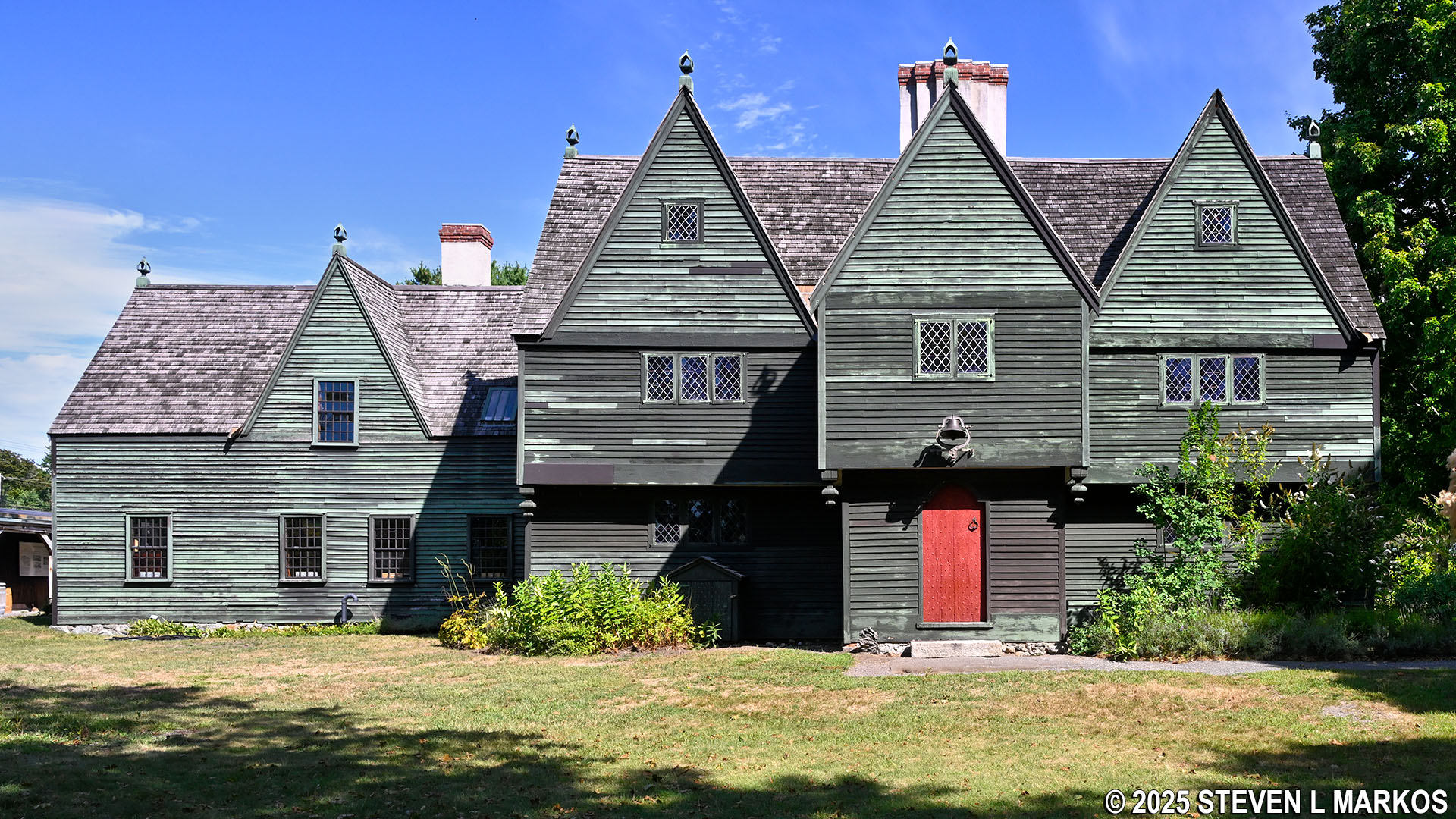
Iron Works House at Saugus Iron Works National Historic Site
Note: Saugus Iron Works is a modern name. When in operation, the iron plant was called Hammersmith, and it was located in Lynn, Massachusetts. The town of Saugus was not incorporated until 1815.
The Iron Works House is the multi-gabled building you first see when entering Saugus Iron Works National Historic Site. Up until the latter part of the 20th century it was thought to be the house of the Saugus Iron Works manager, and while it was certainly built in the 1600s, today its connection to the complex is considered to be doubtful. The Saugus Iron Works itself was in business from 1646 to around 1670. There are references to “dwelling houses” for employees in the financial records of the company, but there are little or no descriptions of these houses, so there is no way to identify the Iron Works House as being one of them.
Ultimately, nobody knows the exact date of when the Iron Works House was built, only that its first recorded occupant was Samuel Appleton Jr., grandson of William Paine, a man who by purchasing the debts of the Saugus Iron Works had managed to become a 75-percent owner by 1657. When Paine died in 1660, his estate went to his son John. In his will he had promised money to his three grandchildren when they turned twenty-one or got married, whichever came first. To ensure that this money was around when the time came, John Paine mortgaged his 75-percent share of the Saugus Iron Works to Samuel Appleton Sr., who had married William Paine’s daughter, Hannah.
Samuel Appleton Jr. turned twenty-one in 1675 and was set to inherit £500. Unfortunately, John Paine was nearly bankrupt, and when he died that same year without repaying the mortgage to Samuel Appleton Sr., Appleton became the rightful owner of 75 percent of the company. Though out of business by then, the Saugus Iron Works property was still managed by Oliver Purchas. When the Appletons attempted to take possession, Purchas would not allow it. This resulted in Appleton Sr. and Jr. filing a lawsuit against Purchas in June 1676. The case was heard in July, with the courts awarding the property to the Appletons.
The next year, Appleton Jr. began a farming operation on the land, which he called the Ironworks Farm, and set about dismantling the blast furnace and cutting wood. The only problem was that 25 percent of the Saugus Iron Works was still owned by Thomas Savage, another man who had acquired ownership by purchasing the company’s debt. Savage filed a lawsuit against Appleton for cutting his wood and tearing down his blast furnace. Appleton argued that Savage would never sit down with him to work out a division of the property. Litigation continued until July 1681, at which time it was agreed that the division of the property would be made by the end of October, with Savage getting to pick his 25 percent first. Savage died shortly afterwards, and there is no mention of whether the land was ever divided. However, in May 1682, Appleton purchased the remaining 25 percent of the property from the Savage Family.
In October 1683, Appleton Jr. took out a loan of £100 and mentioned on the mortgage his “mansion house” on the “Ironworks Farm,” which meant that by this time he was living in a substantial house on the property, most likely the Iron Works House. Whether the house existed at the time that the Saugus Iron Works was in operation or if it was built by Appleton at a later date is open to discussion, though today most historians believe the house was built by Appleton. First off, many of the features in the house did not exist in Massachusetts until around the mid-1660s or later. Second, most of the houses built during the Iron Works era were for employees, so it is doubtful that one of them would have been a “mansion” worthy of a rich man like Appleton. Besides, every one of these houses was gone, so it seems unlikely that one of them would have survived and still have been in such good shape that Appleton would want to live in it.
As to when the house might have been built, assuming Appleton did build it, many historians feel that since the entire estate was in litigation until 1681 and that Appleton didn’t completely own the property until May 1682, that it was most likely built sometime between then and the time he took out the loan. Others argue that since he was dismantling the furnace and cutting lumber from the property as early as 1677, he may well have felt comfortable building a house any time after then, thus making the possible construction date sometime between 1677 and 1683. Regardless, this is long after the era of the Saugus Iron Works.
Appleton began selling off the Ironworks Farm in 1685. He sold four small lots before his father, who was still alive and who actually owned the property, stepped in and sold the remaining 488 acres and the Iron Works House to Boston merchant James Taylor in February 1688. Though the Taylors had a mansion in Boston, it is believed that they moved into the Iron Works House and made it their primary residence (at the time, Taylor described himself as being from Lynn). When Taylor died in 1716, his will instructed his family to sell everything, but that they could live off rents and any other profits the land might bring until a sale was made. However, his family made no effort to sell it, and when Mrs. Taylor died two years later, the property was divided among his seven children. The division was recorded in 1724.
Daughters Abigail Taylor Pell and Anne Taylor Roby received 17 acres each that were adjacent to each other. While the Iron Works House sat just north of the dividing line on Abigail’s land, the house itself was split between the two—Abigail got the northern half and her sister the southern half. In 1734, Anne sold her half of the house to Abigail’s husband, Edward Pell, making the Pells the owner of the entire house, though each spouse owned a half. (The selling of half a house was not uncommon in Colonial times. The owners may never have lived in it, instead renting it out to multiple families, or perhaps to one family and splitting the revenue. The fact remains, that while ownership of the Iron Works House can be traced, there is no record of who actually lived in it.)
In 1742, Abigail, now a widow, sold her 17 acres and her half of the house to her brother-in-law, William Roby. Her husband’s heirs sold their half of the house to William Pratt in 1749. Pratt eventually sold his share to Anne Roby, putting the Robys in possession of the house, the 17 acres of land originally given to Abigail, and Anne’s 17 acres to the south. Thus, the entire estate was under ownership of one family for the first time since James Taylor died, though it was still divided between the spouses.
When they married in 1730, Anne and William Roby signed an agreement that Anne’s share of the Ironworks land and house, should she die first, would go to the heir of the survivor, which would be the couple’s daughter, Elizabeth Roby Bartlet. As it turned out, Anne did die first, so half the house and her land to the south became property of Elizabeth.
Thus begins a bizarre history of land transactions in which the Iron Works House remained split in half all the way until 1868. To summarize, after the Taylor sisters, the main players involved with the Iron Works House and land were members of the Mansfield Family. They had been buying up pieces of the Ironworks Farm ever since Samuel Appleton Jr. starting selling lots back in 1685, and they were actively purchasing parcels from the Taylor siblings. A Mansfield owned half the house starting in 1756; a Mansfield uncle and nephew owned the house together from 1789 through 1809. It was their heirs who eventually sold both halves to Andrew Scott in 1868, making him the first single person to own the entire house since James Taylor purchased it in 1688. By this time the 34 acres had been divided and sold so many times that the house now came with less than an acre.
The house remained in the Scott Family until it was foreclosed on and sold by the bank to George Niven in February 1915. It was from Niven that Wallace Nutting purchased the house two weeks later. Nutting, a major player in the Colonial Revival movement of the early 20th century, is the man who restored the Iron Works House to its present design. He would go on to purchase and restore three other Colonial-era houses in New England: the Cutter-Bartlett House in Newburyport, Massachusetts; the Hazen House in Haverhill, Massachusetts; and the Wentworth Gardner House in Portsmouth, New Hampshire.
Nutting began his professional career as a minister, but in 1904 he started photographing landscapes and colonial-era houses and actually managed to make a living selling them. He started a reproduction furniture business in 1917. He was also the author of a number of books on furniture, as well as a series of New England travel guides filled with his photographs. Both his furniture and photographs are collected to this day.
When Nutting purchased the Iron Works House, which he called Broadhearth, it looked nothing like it does today. In fact, nobody knows what it originally looked like, for the earliest known illustrations were done by Edwin Whitefield in 1879; the house still looked like the sketches in 1915.

Iron Works House in 1915
An examination of the house in 1914 by preservationist William Sumner Appleton Jr., founder of the Society for the Preservation of New England Antiquities in 1910, led him to believe that the original house was a two-story structure with an attic, and that there was evidence of a western and central gable, but it could not be determined if a third gable existed due to plaster covering up potential evidence. Nutting’s renovation was based on drawings done by Henry Dean a few years earlier. Dean had added a third gable—which is not exactly contrary to Appleton’s assessment—and Nutting ultimately made the central gable larger than Dean envisioned.
There was also an addition to the house, an ell (L-shaped) on the left side, that was not part of the original house and was not shown on the drawings done in 1879, but it was there in 1915. Nutting enlarged this and used it as the home for his on-site blacksmith, Edward Guy (this is now the park’s Visitor Center). The renovation was completed in 1917, and what stands today is the result of Nutting’s work. Its accuracy is up for debate.
Nutting used the house as a showroom for his reproduction furniture, photography, and wrought iron pieces made by Guy in the blacksmith shop he built next door (now the park’s Iron Works Museum). However, he soon ran into financial difficulty and set about selling all four of his houses. It took until 1920 to find a buyer for the Iron Works House, Charles Cooney. Cooney sold it in 1925 to Philip Rosenberg, who in turn sold it to the Henry Ford Trade School in 1941 for $10,000, a sale that stirred up a huge controversy in Saugus. (It is interesting to note that Edward Guy remained living in the ell and working as the caretaker up until the time the house was sold to the school.)
The Henry Ford Trade School purchased the house with an agreement to move it by October 1942, its destination being the living-history outdoor museum of Henry Ford, Greenfield Village in Dearborn, Michigan. Prior to this, nobody in Saugus really cared much about the house, but after its sale preservationists began rousing local residents and politicians to keep it in Saugus. When approached about buying the house back, the school reminded the preservationists that the house had been for sale for many years and nobody wanted it. The group appealed to Henry Ford himself, and it was eventually agreed that the house could be purchased for the original sale price plus expenses occurred to date, a total of $12,000.
World War II was going on, so raising funds to buy back an unwanted house was not a top priority of state and local government officials, so funds had to be raised by the private sector. The war also resulted in the Henry Ford Trade School being in no hurry to move the house, and it extended the sale offer until June 1943, and once that passed, Ford himself extended it to January 1944.
The Society for the Preservation of New England Antiquities was eventually able to raise the money. What lacked from public fundraising, the Town of Saugus picked up. The house was then leased to the First Iron Works Association, an organization founded for the purpose of managing the house (the group purchased it outright in 1949). The property that contained the Saugus Iron Works Industrial Site, which hadn’t even been rediscovered at the time, had been purchased by the Parson Roby Chapter of the Daughters of the American Revolution in 1938, and the group donated the land to the First Iron Works Association in 1949.
Interest in the Iron Works House stirred up interest in finding the original Saugus Iron Works. The slag pile (waste materials) from the 1600s still existed, so the general area of the site was known, but it would take an archaeological excavation to find it. Funded mainly by the American Iron and Steel Institute, a trade organization that still exists today, work began in the fall of 1948 under the eye of historian and amateur archaeologist Roland Robbins and continued through 1953. As one building was discovered and studied, a working replica was built on its spot. Reproductions of the blast furnace, forge, rolling and slitting mill, warehouse, and dock were constructed, and the site opened to the public in 1954 under the name Saugus Ironworks Restoration.
In the mid-1960s, the American Iron and Steel Institute ceased to sponsor the project, and the First Iron Works Association soon found that it did not have the funds to sustain its operation. The National Park Service was approached, and with Congressional approval, Saugus Iron Works National Historic Site was created in 1968. Both the Iron Works House and the Industrial Site were included in the new park. Today, visitors can see the interior of the Iron Works House on a Ranger-guide tour. See the Guided Tours web page for details.
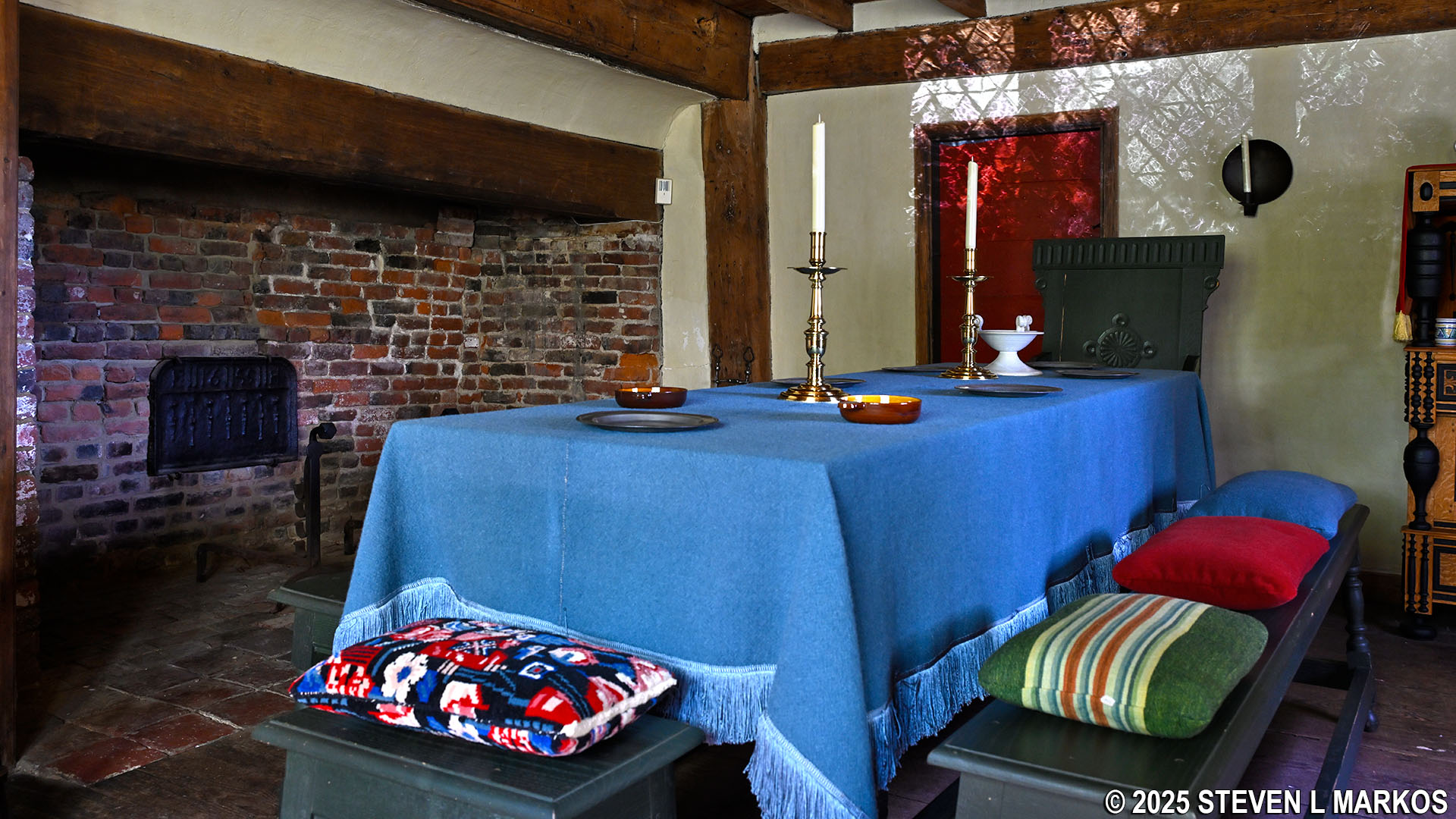
Parlor in the Iron Works House at Saugus Iron Works National Historic Site
With a few exceptions, use of any photograph on the National Park Planner website requires a paid Royalty Free Editorial Use License or Commercial Use License. See the Photo Usage page for details.
Last updated on September 16, 2026


