

Seamen’s Bethel in New Bedford, Massachusetts
New Bedford Historical District Walking Tour
GENERAL INFORMATION
Built in 1832, the Seamen’s Bethel served as a non-denominational church that catered to the transient sailors who worked on the whaling and fishing boats in New Bedford. It was made famous by Herman Melville’s novel, Moby Dick. Melville himself took a shot at whaling, leaving on his first and only voyage in 1841. While waiting to sail, he attended services at the Bethel.
Since its inception, the church has been owned by the New Bedford Port Society, which also owns the Mariners’ Home next door. Both are part of New Bedford Whaling National Historical Park through a partnership with the National Park Service.
The Seamen’s Bethel is located at 15 Johnny Cake Hill. Limited street parking is available, so unless you are disabled, do yourself a favor and park in the public garage on Elm Street and walk the two blocks to the church.
The Seamen’s Bethel is open year-round, but hours and days vary depending on the season. Get the current schedule on the New Bedford Port Society website.
The church is also a venue for weddings, christenings, funerals, and other religious-oriented events, most of which take place on weekends from May through October. If an event is being held, the building may be closed to tourists. You can call the Port Society at (508) 992-3295 and inquire about the schedule for the day you plan to visit, otherwise just show up and hope for the best.
Both the Seamen’s Bethel and the Mariners’ Home were recently renovated. A major addition to the Bethel is an elevator for taking guests to the chapel on the second floor, which now makes the building handicap accessible. Of course renovations don’t come cheap, and while there is no charge to enter the Bethel, donations are highly welcomed.
TOURING THE SEAMEN’S BETHEL
The Seamen’s Bethel is open for self-guided tours. Port Society staff members are on duty to answer questions, plus visitors can pick up a Self-Guided Tour brochure that has information about the church and points out all the areas of interest. Bethel, by the way, is the combination of two Hebrew words, beth and el. Beth means house and el means god.

Self-Guide Tour brochure for the Seamen’s Bethel in New Bedford, Massachusetts
The bottom floor of the building is called the Salt Box. While there are rows of what appear to be ordinary church pews, this level was actually used as a classroom where sailors were taught reading, writing, arithmetic, and navigational skills. So as not to scare them away, instead of using the word classroom, the term salt box was used, which is the area on the lower deck of a ship where fish and other meats are salted for preservation.
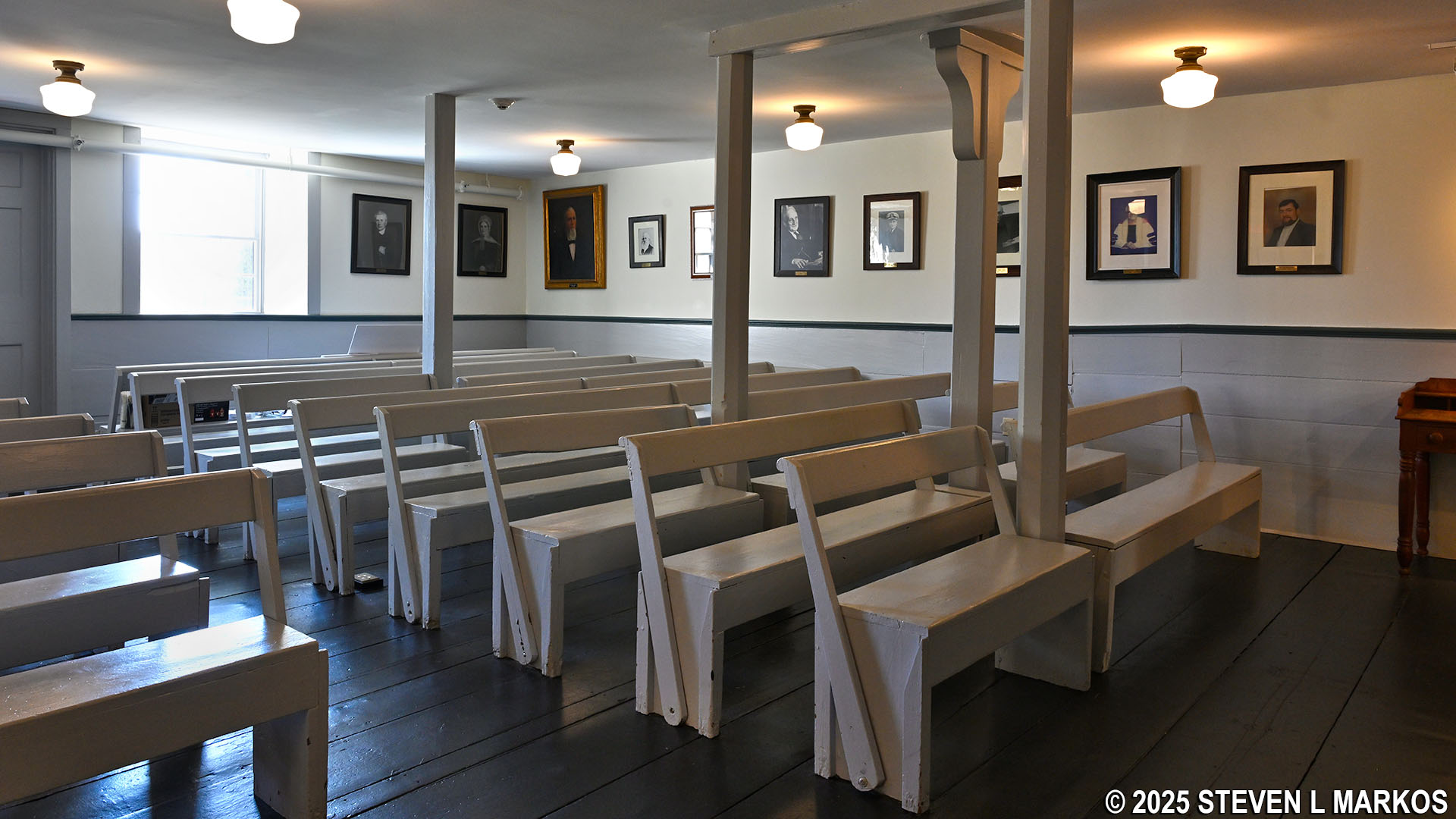
Pews in the Salt Box of the Seamen’s Bethel in New Bedford, Massachusetts
On the walls are photographs of some of the men who served as chaplain of the Bethel. There is also a small memorial to four chaplains who were on the S. S. Dorchester when it was hit by torpedoes from a German submarine on February 3, 1943, in the frigid waters off the coast of Greenland. After helping survivors into life boats, the four men, having given up their own life preservers, stayed on the deck and went down with the ship. In total, 672 men died that night.

Painting of the four chaplains who died aboard the S. S. Dorchester during World War II hangs in the Seamen’s Bethel in New Bedford, Massachusetts
The upper level of the Bethel is where the Whaleman’s Chapel is located. The most prominent feature is the pulpit shaped like the prow of a ship, which was how Melville described the pulpit in his book. However, at the time this did not exist. When the 1956 film version of Moby Dick was being shot, director John Huston decided to design the pulpit as described in the book. The film was quite successful and generated a lot of tourism for the Bethel. However, visitors were disappointed to find an ordinary pulpit. As a result, in 1961 the New Bedford Port Society built a pulpit like in the movie to appease visitors and perhaps entice them to be more generous with their donations.

Whaleman’s Chapel in New Bedford’s Seamen’s Bethel
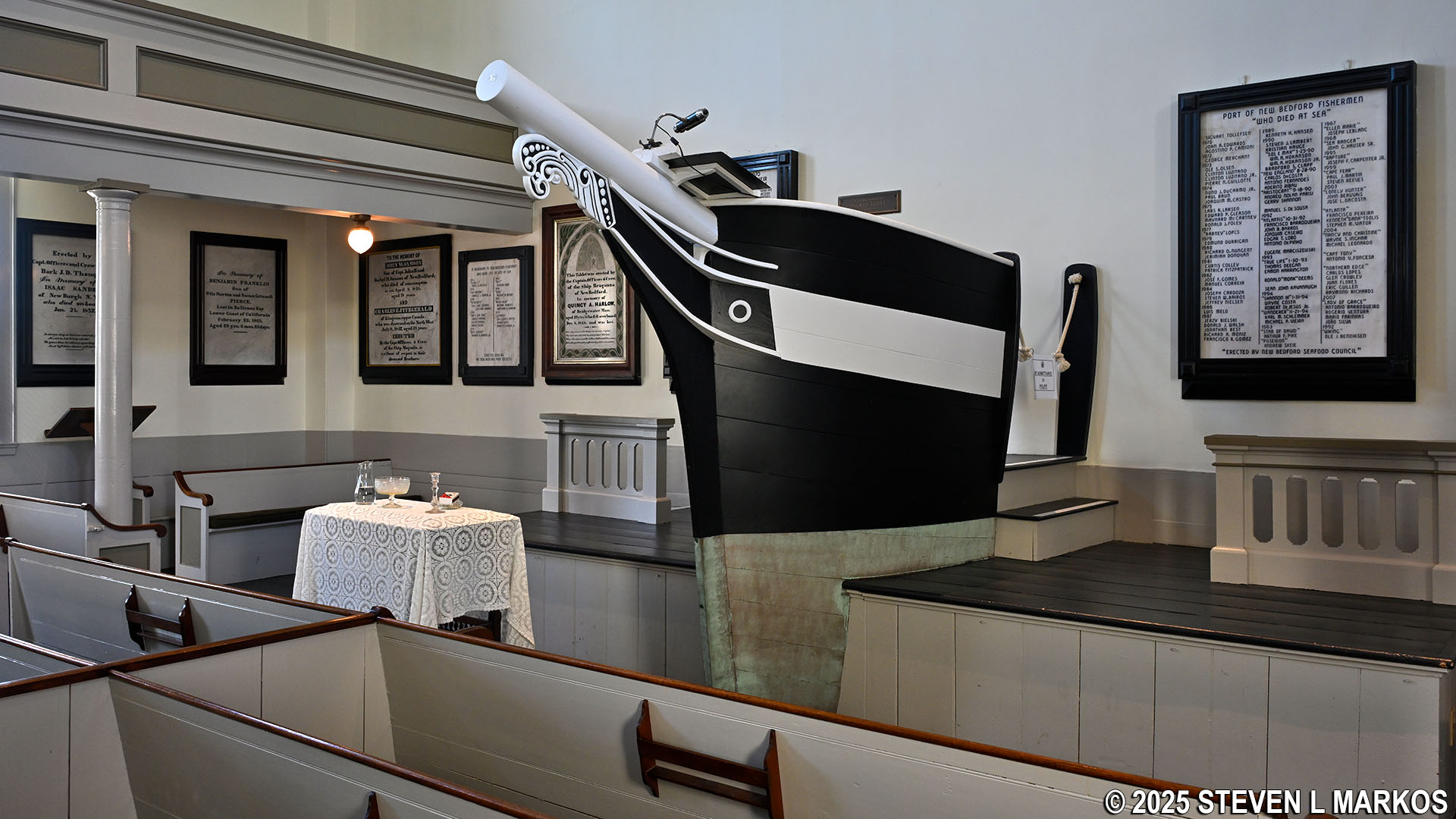
Prow-shaped pulpit in the Whaleman’s Chapel of the Seamen’s Bethel in New Bedford, Massachusetts
The second most prominent feature of the chapel are the cenotaphs located on the walls. These were paid for by the families and friends of men who died at sea. Cenotaph means empty grave, and since there was no body to bury, these made a fitting memorial to the men.

Cenotaph dedicated to William Kirkwood
Another object of interest is the clock that hangs on the wall. Dating back to 1833, it is the work of Aaron Willard Jr. of Roxbury, Massachusetts, the center of clock making in New England at the time. Aaron and his brothers began one of the first companies that made clocks that the average person could afford.

Willard Clock from 1833 hangs in the Whaleman’s Chapel of the Seamen’s Bethel in New Bedford, Massachusetts
SCHEDULING YOUR TIME
The Seamen’s Bethel is a small church, and other than reading the two pages of the Self-Guided Tour brochure and taking a look around, there’s not much to a visit. I spent 30 minutes inside and was able to read all of the information within this time.
With a few exceptions, use of any photograph on the National Park Planner website requires a paid Royalty Free Editorial Use License or Commercial Use License. See the Photo Usage page for details.
Last updated on November 25, 2025


