
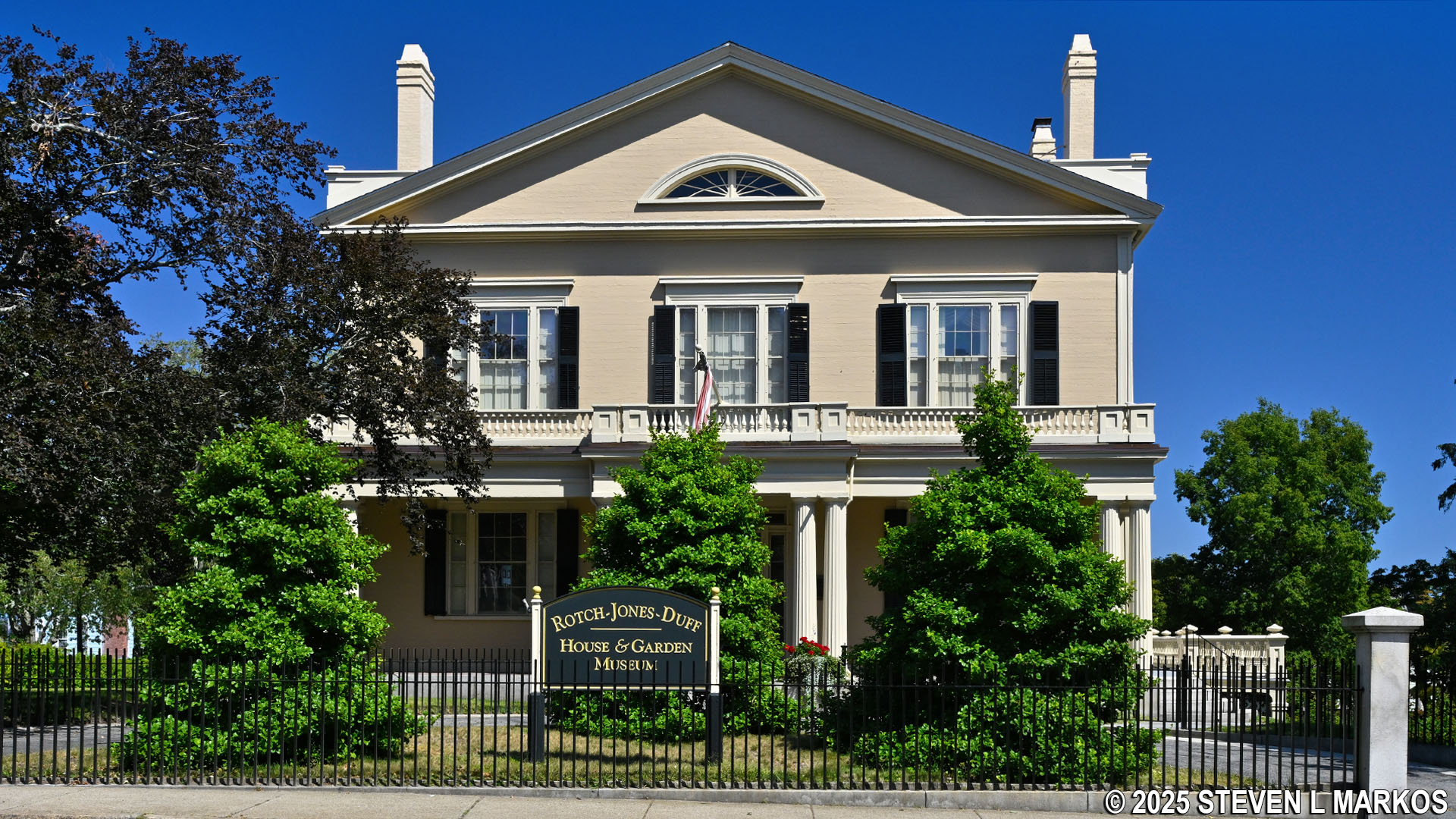
Rotch-Jones-Duff House in New Bedford, Massachusetts
GENERAL INFORMATION
Location: 396 County Street
The Rotch-Jones-Duff House and Garden Museum (RJDH) is a privately owned museum house that gives visitors a chance to see the inside of a mansion built with whaling money. It is part of New Bedford Whaling National Historical Park through a partnership with the National Park Service. Unfortunately, it is not in the historic downtown area like the rest of the park, so reaching it requires a .6-mile walk, one way, from the Visitor Center, or you can drive to the house; parking is street parking. If you don’t want to deal with finding a parking spot and can use the exercise, I suggest parking at the public garage on Elm Street, which is just a block from the Visitor Center, and walking from there. If you take the self-guided New Bedford Historic District Walking Tour, which covers two miles, the RJDH is on the route.
The RJDH is open year-round, but operating days and hours vary per season, and there is a fee to enter. For the current schedule and fees, visit the Rotch-Jones-Duff House and Garden Museum website. There are also plenty of concerts, lectures, and workshops held at the house throughout the year. Schedules are posted on the RJDH website under the Calendar menu. In addition, the house and grounds can be rented for weddings and other events.
Unless you have a group of eight or more, tours of the house are self-guided, though there are staff members on hand to answer questions. I was inside for an hour and spent another 30 minutes in the garden talking with the gardener.

Event area at the back of the Rotch-Jones-Duff House in New Bedford, Massachusetts
HOUSE HISTORY
The RJDH is a Greek Rival-style mansion that was built by whaling merchant William Rotch Jr. in 1834. It is approximately 12,500 square feet in size and has 42 rooms, and it is the only estate from the 1800s in the historic area of New Bedford that has retained all of its original property. The other mansions in the area originally sat on parcels of land as large as a city block, but most of the land has been sold off over the years.
Up until the early 1800s, whaling merchants lived closer to the wharf in order to be in the thick of things, and Rotch was no exception. Prior to his County Street home, he lived on the corner of Water and William streets in what would go on to be known as the Mariners’ Home. As New Bedford became the hub of the whaling industry, the rich escaped the noise and smell of the wharf by building mansions on the hill along County Street.
The Jones and Duff portion of the house name come from the two subsequent owners. When Rotch died in 1850, the estate was purchased by Edward Jones the following year. Jones was also a whaling agent, owning or having an interest in sixteen ships stationed in New Bedford. In fact, he was the wealthiest of the three RJDH owners. After his death his daughter Amelia lived in the house for 85 years until she died in 1935.
Mark Duff was the last owner before the house became a museum. He was also in the whaling business, but as petroleum whittled away at whale oil sales, he diversified into coal and home heating oil. When he died in 1967, his wife, Beatrice, took over the house and lived there until the late 1970s. In 1981 she put the house up for sale, for it was too large for her to maintain. Most offers came from developers who wanted to tear up the garden and put in a parking lot or commercial building. Fortunately, Beatrice ended up selling to the Waterfront Historic Area League (WHALE), a preservation society in New Bedford that was responsible for saving many of the historical buildings in the downtown area. The house and surrounding one acre of land were turned into the current museum in 1983. At the time, Beatrice felt she got the raw end of the deal, selling for only $150,000, but a few years later she visited the museum and was glad that she sold to WHALE and not to a developer.
TOURING THE ROTCH-JONES-DUFF HOUSE
Tours of the RJDH for individual visitors and groups of less than eight people are self-guided. An online guide is available through the RJDH website, and there is a PDF that you can download and print at home if you prefer a paper guide (see the Hours and Admissions web page for links to the guides). There are also plenty of information panels posted throughout the house, plus knowledgeable staff members are on duty to answer any questions. If you have a group of eight or more people, you can schedule a guided tour by calling (508) 997-1401.

Museum exhibits and information panels inside the Rotch-Jones-Duff House in New Bedford, Massachusetts
After purchasing your ticket, take time to watch a 10-minute film on the RJDH. The film gives a general overview of the estate’s history and a rundown of the different families that lived in the house from 1834 to 1980. There is no objectionable material, so the presentation is suitable for all ages.
The rooms that are furnished are decorated as they might have been in the 1850s during the Jones era. The house was purchased empty, so most of what you see today are authentic antiques that were donated by local residents of New Bedford. Many items are accompanied by information cards that give a description and the age of the item, plus the donor’s name. There are, however, some pieces that belonged to the original families.

Antique trunks on display in the Rotch-Jones-Duff House with information about their histories
Some of the rooms are used as temporary exhibition space, thus the “museum” in the name Rotch-Jones-Duff House and Garden Museum. The exhibits change over time, so there is always something new to see. When I visited there was a display of women’s clothing from the 1800s.

Rotating exhibit on women’s clothing from the 1800s at the Rotch-Jones-Duff House in New Bedford, Massachusetts
The following are photos of some of the rooms in the mansion.
WILLIAM ROTCH JR. EXHIBIT ROOM
One room in the Rotch-Jones-Duff House contains a permanent exhibit about William Rotch Jr., the original builder of the house. A portrait of Rotch hangs on the wall.

Portrait of William Rotch on display in the Rotch-Jones-Duff House in New Bedford, Massachusetts
REAR PARLOR (MUSIC ROOM)
The black marble fireplace and mirror in the parlor were installed by the Joneses. The wallpaper is an exact reproduction of the paper that hung in the 1860s—an original section was found behind the mirror. The piano on display belonged to Amelia Jones. She also owned the painting by Edward Emerson Simmons that hangs on the wall, The Carpenter’s Son. When Amelia died, the painting was donated to the First Unitarian Church. In 1996 a vandal took a knife to it, slashing it into multiple pieces. After settling with the insurance company, the church bought back the damaged painting for $20,000. RDJH reimbursed the church and took ownership of the painting in 2006, then instigated a restoration process. Since 2008, the painting has hung on the wall of the parlor in the same spot where Amelia hung it.

Parlor of the Rotch-Jones-Duff House in New Bedford, Massachusetts
DINING ROOM
The dining room is much larger than when originally built by William Rotch. When the Joneses moved in they had a wall removed to combine the dining room with the adjacent room. Much of the furniture is original to the Joneses, while the silver and china belonged to the Rotches and the Joneses. The chandelier and wall paper were installed by the Duffs.

Dining Room of the Rotch-Jones-Duff House in New Bedford, Massachusetts
PANTRY
The pantry has not changed much over the years. The cupboards are still the originals. Here you can see a collection of glassware manufactured by the Mt. Washington-Pairpoint Glass Company of New Bedford.

Display of Mt. Washington-Pairport Glass Company glassware in the Rotch-Jones-Duff House in New Bedford, Massachusetts
CHILDREN’S BEDROOM
The furniture in the children’s bedroom is thought to have belonged to William Rotch’s granddaughter, Joanna Rotch. It is her portrait that hangs over the bed.

Children’s bedroom of the Rotch-Jones-Duff House in New Bedford, Massachusetts
The dollhouse belonged to a cousin of the Jones children. The toys are antiques from the time period but did not belong to any of the owners of the house.

Dollhouse and antique doll in the Children’s Room of the Rotch-Jones-Duff House in New Bedford, Massachusetts
AMELIA JONES BEDROOM
Amelia Jones lived in the RJDH longer than any other person. Her bedroom is furnished similar to how it was when she occupied the room (based on a photograph). The trunk on the floor did belong to her father, Edward Coffin Jones.

Amelia Jones Bedroom in the Rotch-Jones-Duff House in New Bedford, Massachusetts
BATHROOM
The Art Deco-style bathroom fixtures were installed by the Duff family.

Art Deco bathroom of Beatrice Duff in the Rotch-Jones-Duff House in New Bedford, Massachusetts
BEATRICE DUFF BATHROOM
Beatrice Duff’s bedroom is probably the most authentic room in the house, for all of the furniture, lamps, rugs, and even bedding belonged to her.

Bedroom of Beatrice Duff in the Rotch-Jones-Duff House in New Bedford, Massachusetts

Portrait of Beatrice Duff hangs by the fireplace in her bedroom in the Rotch-Jones-Duff House
ROTCH-JONES-DUFF HOUSE GARDEN

Gardens at the side of the Rotch-Jones-Duff House in New Bedford, Massachusetts
A visit to the RJDH garden is part of the admission, so feel free to take a look. The garden was created by William Rotch. He was a founding member of the New Bedford Horticultural Society, and while nobody knows what his garden looked like, it is known that he grew flowers, fruits, and vegetables.
The garden today is largely the layout created while the Joneses owned the house. When the Duffs moved in they hired a Boston landscape architect to make some changes, but they did not alter the entire Jones design. The garden now sports a boxwood rose garden, boxwood specimen garden, and a cutting garden.

Rotch-Jones-Duff House garden

Rotch-Jones-Duff House garden
SCHEDULING YOUR TIME
As mentioned, I spent one hour inside the house and a half hour in the garden. However, I read all of the information panels and the text on the Self-Guided Tour brochure, while most of the other visitors I saw didn’t even have a guide. At minimum, allow a half hour. This will give you time to see the film and wander around the house. As for the garden, it’s not that large, so unless you like gardens you probably won’t spend five minutes taking a look. With that said, I’d recommend an hour for your visit to the Rotch-Jones-Duff House and Garden Museum.
With a few exceptions, use of any photograph on the National Park Planner website requires a paid Royalty Free Editorial Use License or Commercial Use License. See the Photo Usage page for details.
Last updated on November 25, 2025


