
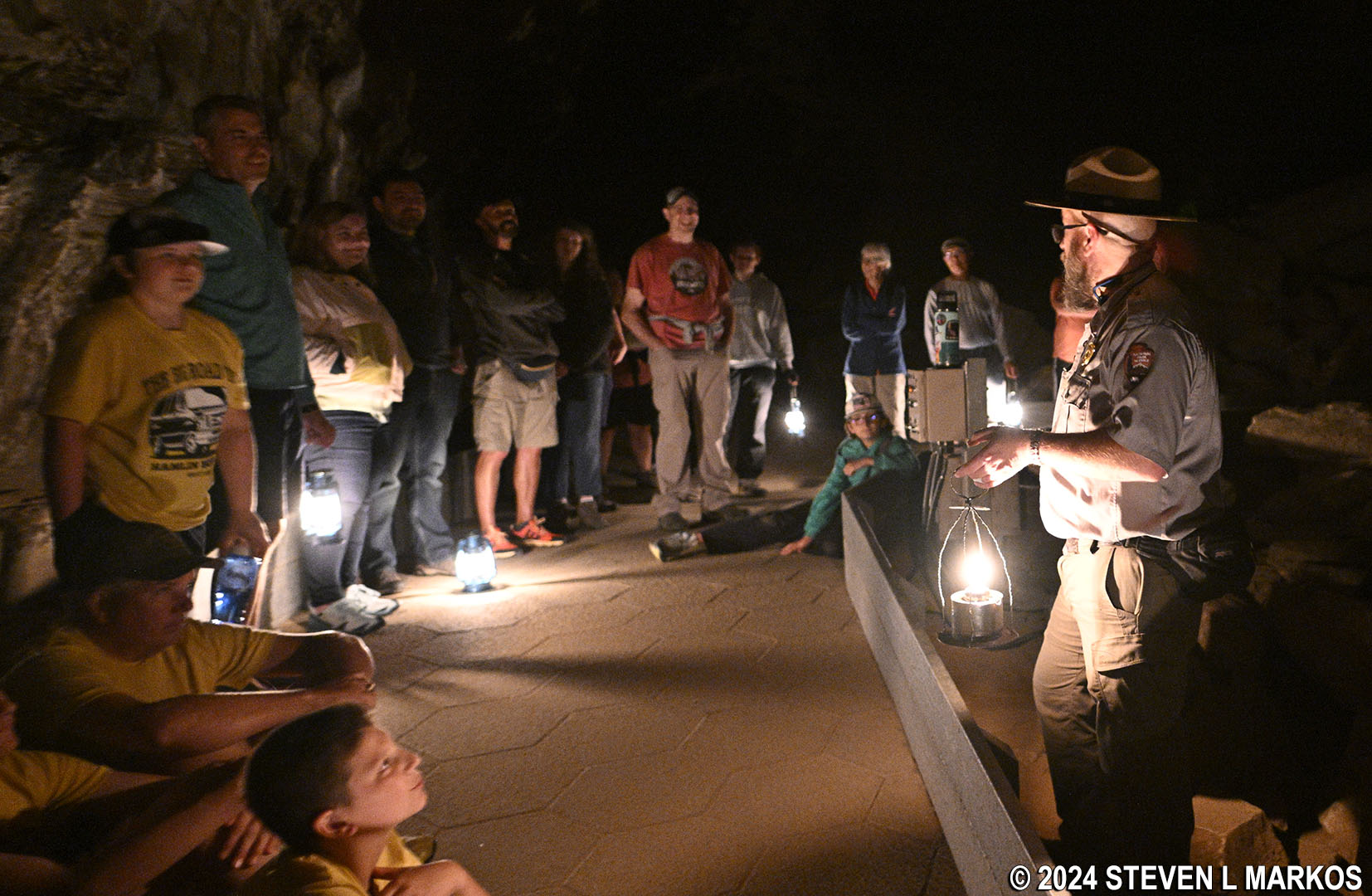
Inside Mammoth Cave on the Star Chamber Lantern Tour
For reviews of all Mammoth Cave National Park tours, how to get tickets, what to wear, and rules for the tours, see the Cave Tours web page here on National Park Planner. Keep in mind that not all tours are offered year-round, and the schedule of what tours are available changes often. Be sure to check the National Park Service’s official Cave Tours web page for the current schedule.
OVERVIEW
The Star Chamber Lantern Tour allows visitors to see Mammoth Cave just as all early tourists did—by lantern light. The tour is held in the evening when all other tours have finished, allowing the electrical lights in the cave to be turned off. While you will be in a much darker environment, it is amazing just how well you can see the cave features with nothing but a lantern.
Participants must be at least six years old, and only participants 16 and older can carry a lantern. There is not a lantern for every person on the tour, so you don’t have to be bothered with carrying one if you don’t want to. The typical arrangement is one lantern per family group.

Ranger leads the Star Chamber Lantern Tour at Mammoth Cave National Park
Many tours of Mammoth Cave have overlapping routes, some to the extent that they are complete duplicates of other tours. The Star Chamber Lantern Tour covers most of the Gothic Avenue Tour, skipping only a few of the interesting speleothems (stalactites, stalagmites, etc). However, you don’t miss that much, so I certainly do not recommend taking both tours.
All visitors to Mammoth Cave National Park should take one lantern tour. If you have already done the Great Onyx Lantern Tour or the Violet City Lantern Tour, then skip the Star Chamber tour. Violet City covers all of the Star Chamber tour except the trip to Gothic Avenue, while the Great Onyx tour is in another cave altogether and does not overlap with any tours at Mammoth Cave National Park. Keep in mind that the Violet City tour is extremely difficult; participants should be in good physical shape. Those seeking an easier option can choose either the Star Chamber or the Great Onyx tour.
Visitors to the park should also take one of the traditional history-based tours: Grand Historic Tour, Extended Historic Tour, Historic Tour. While the Star Chamber Lantern Tour passes through some of the same areas covered by these tours, it is not a substitute. For one thing, it does not venture into the lower sections of the cave where the Bottomless Pit, Fat Man’s Misery, and Mammoth Dome are located, and these are the coolest places in Mammoth Cave. All of the aforementioned historic tours visit these areas.
The Star Chamber Lantern Tour is 2.5 hours long and covers two miles. It is not overly strenuous. There are 170 stair steps on the tour, but these are mainly the stairs in and out of the Historic Entrance. However, like all tours that enter the cave through the Historic Entrance, the Star Chamber Lantern Tour starts off down a steep, .2-mile paved hill from the Visitor Center. It is even steeper on the way up, believe me. For a young person or those in great shape, the hill is probably inconsequential. But for those who are older, drastically overweight, or have problems walking up or down steep hills, it’s no picnic. At 59 years old, I dreaded the walk back up to the Visitor Center far more than anything inside the cave. There are benches along the path, and there is no shame in sitting down and resting. I will say that if you get to the bottom and realize that getting back up to the Visitor Center is going to be extremely difficult, you should not be going into the cave in the first place.

Steep path from the Visitor Center to the Historic Entrance of Mammoth Cave
TOUR HIGHLIGHTS
NOTE: While it is possible to see cave features with lantern light, the light is too low for photographs other than of people carrying lanterns. Therefore, most of the photos below were taken on other tours when the electric lights were on.
Saltpeter Mine
All tours that enter Mammoth Cave through the Historic Entrance pass the remnants of a saltpeter mining operation, though only the history-oriented tours stop to talk about it. Saltpeter (aka potassium nitrate) is used to make a variety of products, but in the early 1800s it was extremely important for the production of black powder. Output was ramped up once the War of 1812 started, and the mine owners made a lot of money. However, it was overproduced, and when the war ended in February 1815, prices for black powder fell from 97¢ per pound to 7¢, and the mines were shut down. This eventually led to the Mammoth Cave owners turning to tourism to make money. The earliest known cave tours started in 1816.
Potassium nitrate can be produced in a number of ways. One is by extracting calcium nitrate from bat guano (poop), which is commonly found in abundance in the dirt of a cave floor. To do this, the cave dirt is shoveled into large wooden vats. Water, which is brought down from the surface through wooden pipes, is added. After a week of soaking, a slurry forms, and this is pumped back to the surface where it is boiled until the nitrates crystalize and separate from the sludge. Materials high in potassium, such as wood ash or charcoal, are then mixed in with the nitrate to make saltpeter. In the early 1800s, most saltpeter mines shipped their product to the Dupont Company in Delaware where it was turned into gunpowder.
Remnants of the wooden vats and the pipes that once carried water between the surface and the cave floor are still standing inside Mammoth Cave. These artifacts are now over 200 years old, all preserved due to the low temperatures and low humidity of the cave.
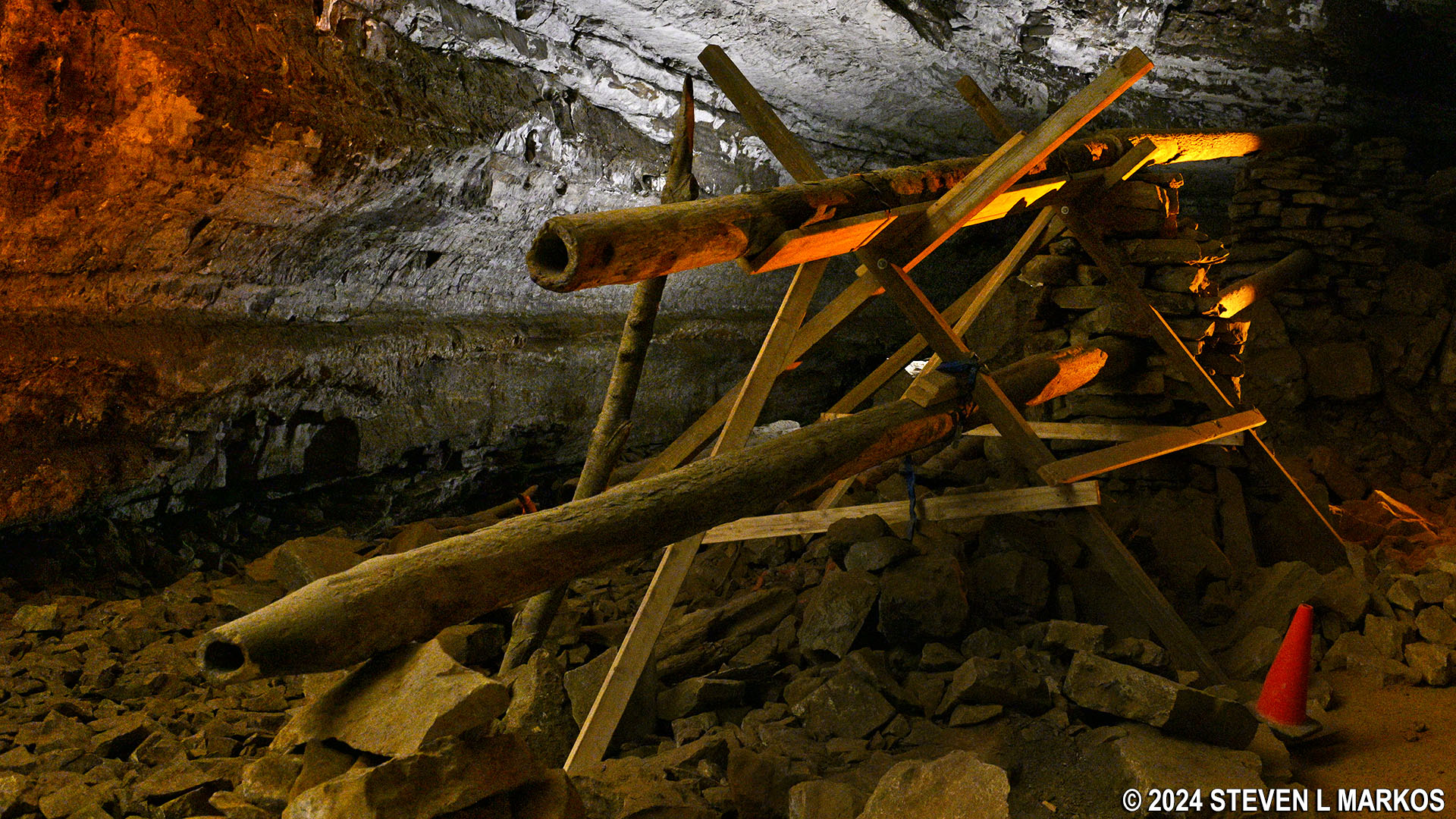
Remnants of wooden water pipes used in the Mammoth Cave saltpeter mining operation
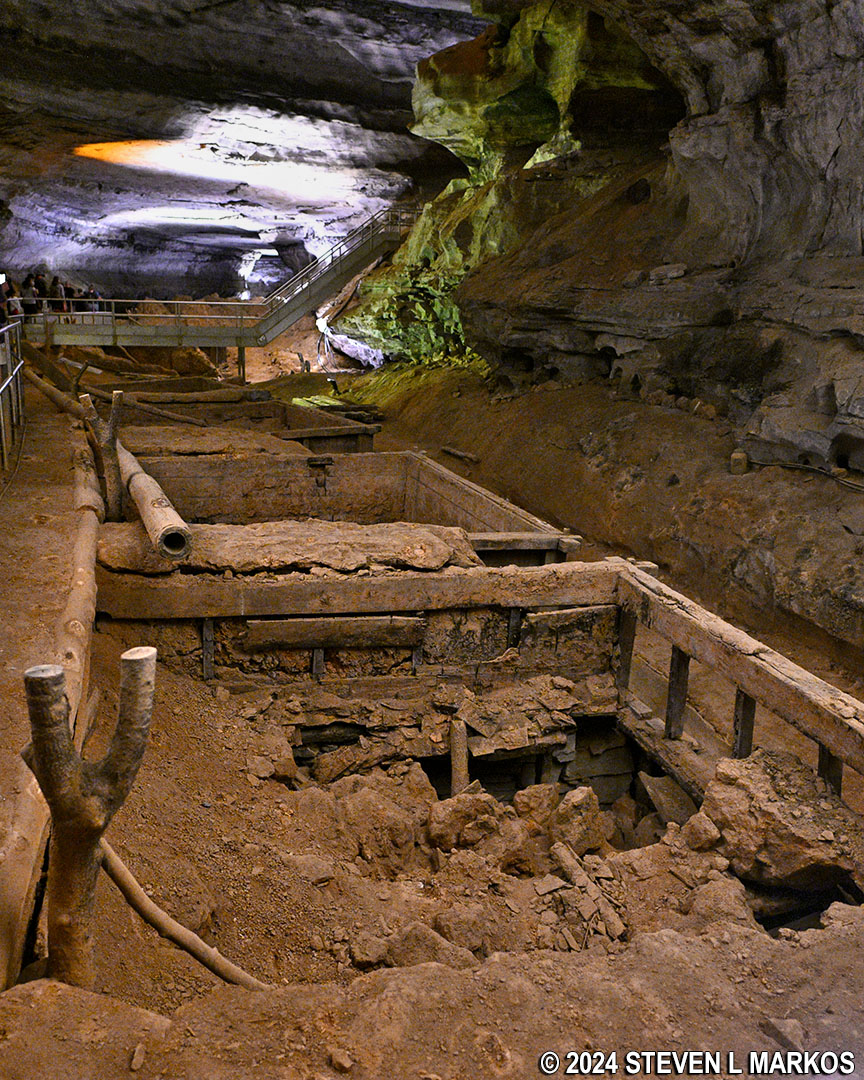
Remnants of wooden vats used in the Mammoth Cave saltpeter mine for holding cave dirt
Most of the work was done by slaves. A diorama of the saltpeter operation at Mammoth Cave is on display in the Visitor Center museum, and this accurately depicts the use of slave labor.

Diorama of a saltpeter mining operation on display inside the Mammoth Cave Visitor Center
Methodist Church
The Methodist Church is a stop on many of the Mammoth Cave tours. It gets its name from the Reverend George Gatewood, a Methodist preacher who supposedly held church services at this location in the 1830s, preaching from a rock ledge above the cave floor called Pulpit Rock. Before service began, all lanterns were collected to light the pulpit. Without a lantern, nobody could leave. Gatewood is known to have preached for up to six hours.
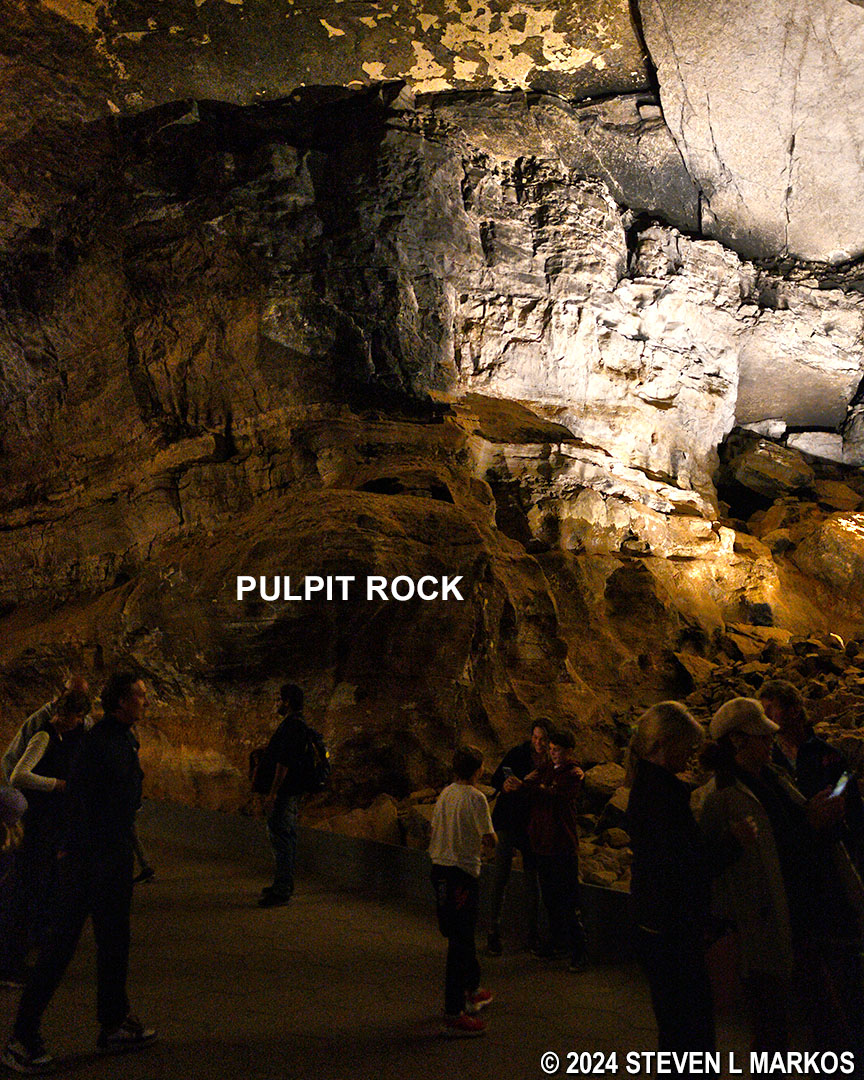
Pulpit Rock at the Methodist Church inside Mammoth Cave
Giant’s Coffin
The Star Chamber Lantern Tour continues down the main passageway of Mammoth Cave and stops at a large slab of rock called the Giant’s Coffin. It is 40 feet long and 20 feet tall, and it fell from the ceiling above. If it were possible to lift it up, it could be matched to the exact spot where it was originally located.
The slab was first called Steamboat Rock, but by the 1850s guides were calling it the Giant’s Coffin because the name was more theatrical, and theatrics sold cave tour tickets. The coffin was a popular feature on early tours. Guides could make it look as if the lid was being opened and closed by using their lanterns to cast shadows on the wall behind it. Because lanterns are used on this tour, the guide usually attempts to raise the lid just like in the old days.
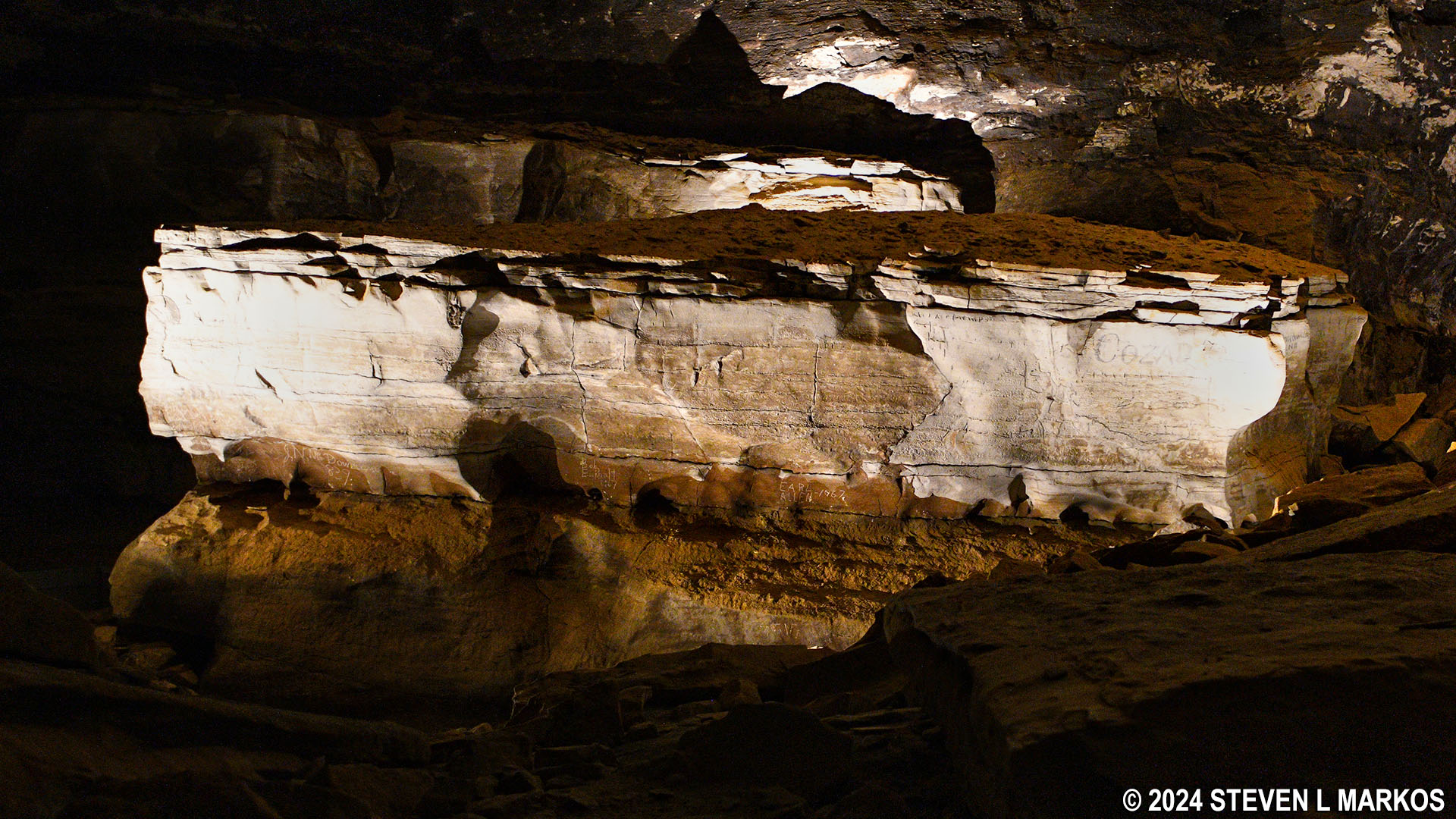
Giant’s Coffin in the main section of Mammoth Cave
Very little of Mammoth Cave near the Historic Entrance was spared of graffiti, even something like the Giant’s Coffin. Some of the graffiti is modern vandalism. Note the two signatures from 1967 in the photo below.

Modern graffiti on the Giant’s Coffin in the main section of Mammoth Cave
Tuberculosis Hospital Ruins
A little farther down the main passageway of Mammoth Cave from the Giant’s Coffin is the ruins of what was once a tuberculosis hospital. This was the brainchild of Dr. John Croghan, who in 1839 purchased Mammoth Cave for $10,000. While in Germany, he learned of a theory that tuberculosis could be cured by breathing drier air. He also noted that people who went into Mammoth Cave, either to work or on a tour, often told him that they felt much better breathing the air inside, which was typically drier than the air outside. This gave him the idea of setting up a tuberculosis hospital inside the cave during the winter when the humidity was at its lowest. Two living quarters made of stone and eight made of wood and canvas were built, and sixteen patients came to live in the cave for five months in late 1842 and early 1843. In the end, the experiment was a failure and the hospital was closed. A few patients actually died in the cave, and one is now buried in the Old Guide’s Cemetery that you can see when hiking the Heritage Trail. Today all that remains of the tuberculosis hospital are the two stone quarters, one of which is in poor condition.
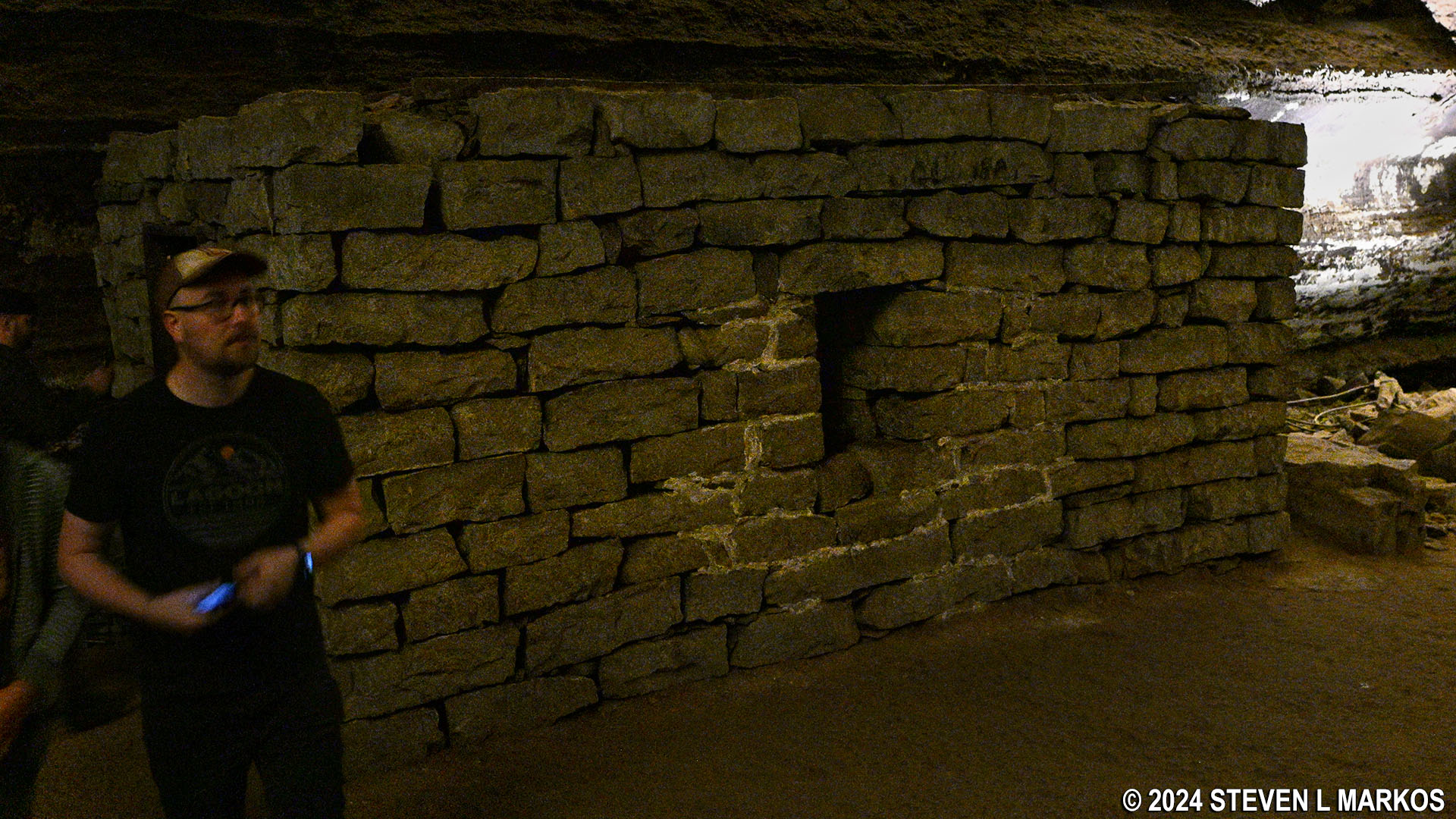
Remnants of the Tuberculosis Hospital inside Mammoth Cave
The Star Chamber
The Star Chamber is a section of Mammoth Cave where the once-white gypsum-covered ceiling has been darkened from the soot of cane reed torches used by prehistoric people who got this far into the cave to mine the gypsum on the walls, and later the more modern oil lanterns used by cave guides who brought paying tourists into the cave. Cave guides discovered that if they threw stones at the ceiling, the stone would knock off the outer layer and expose the white of the gypsum, and in the dark cave lit only by lanterns, these spots looked like stars. The guides also realized they could charge male tourists for the privilege of creating a star for their girlfriends or wives who were also on the tour. What guy is going to say “no thanks” with his wife or girlfriend standing right next to him?
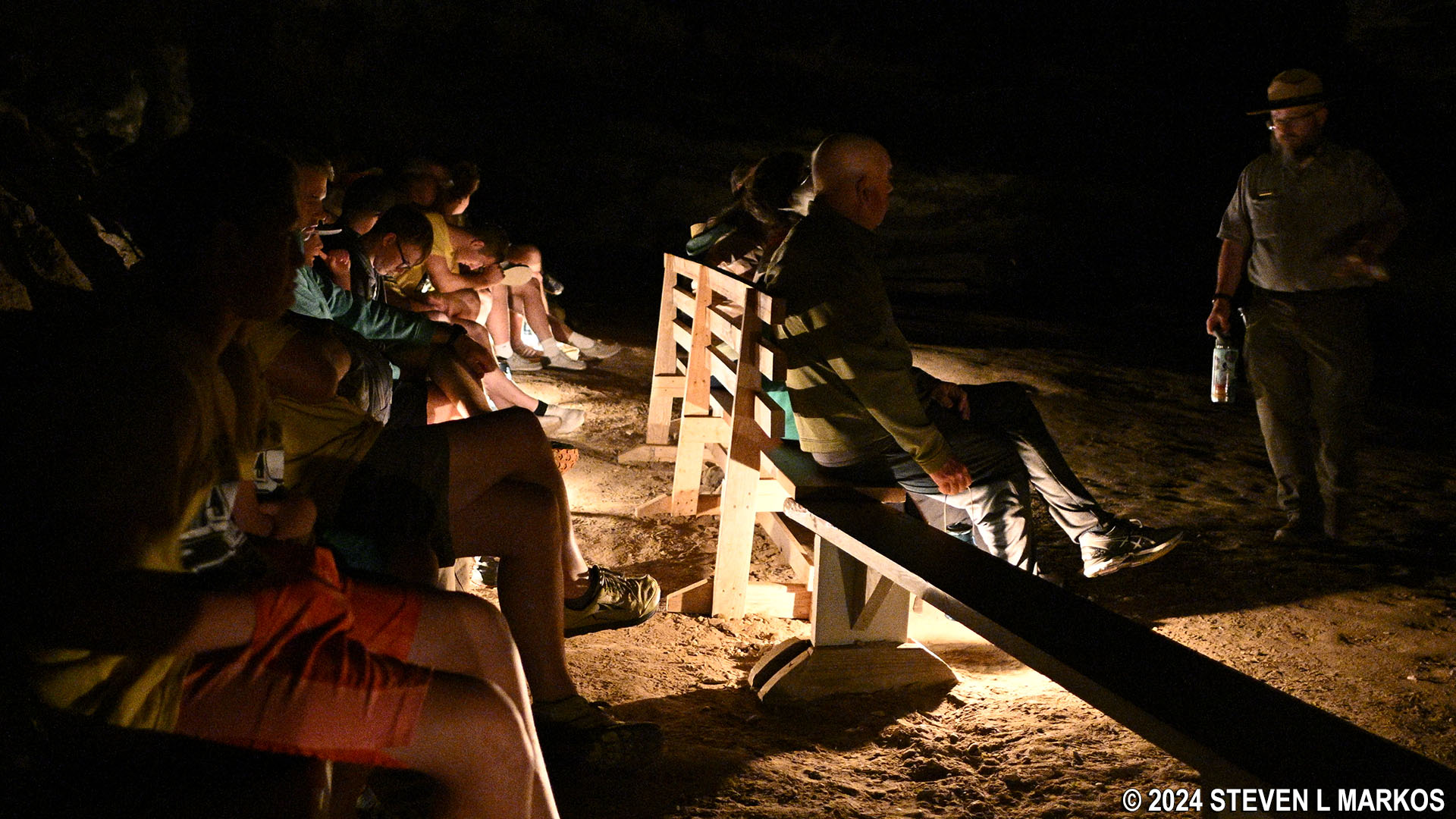
The Star Chamber Lantern Tour stops at the Star Chamber inside Mammoth Cave
Gothic Avenue
Once done at the Star Chamber, the tour returns back towards the Historic Entrance, only this time it makes a side trip to Gothic Avenue via a staircase near the Giant’s Coffin. The entrance to Gothic Avenue is called Booth’s Amphitheater, named after Edwin Booth, brother of Abraham Lincoln’s murderer, John Wilkes Booth. All of the Booth’s were famous actors, and supposedly Edwin recited a few passages from Hamlet at the Gothic Avenue entrance when egged on by the crowd during a visit in 1876.
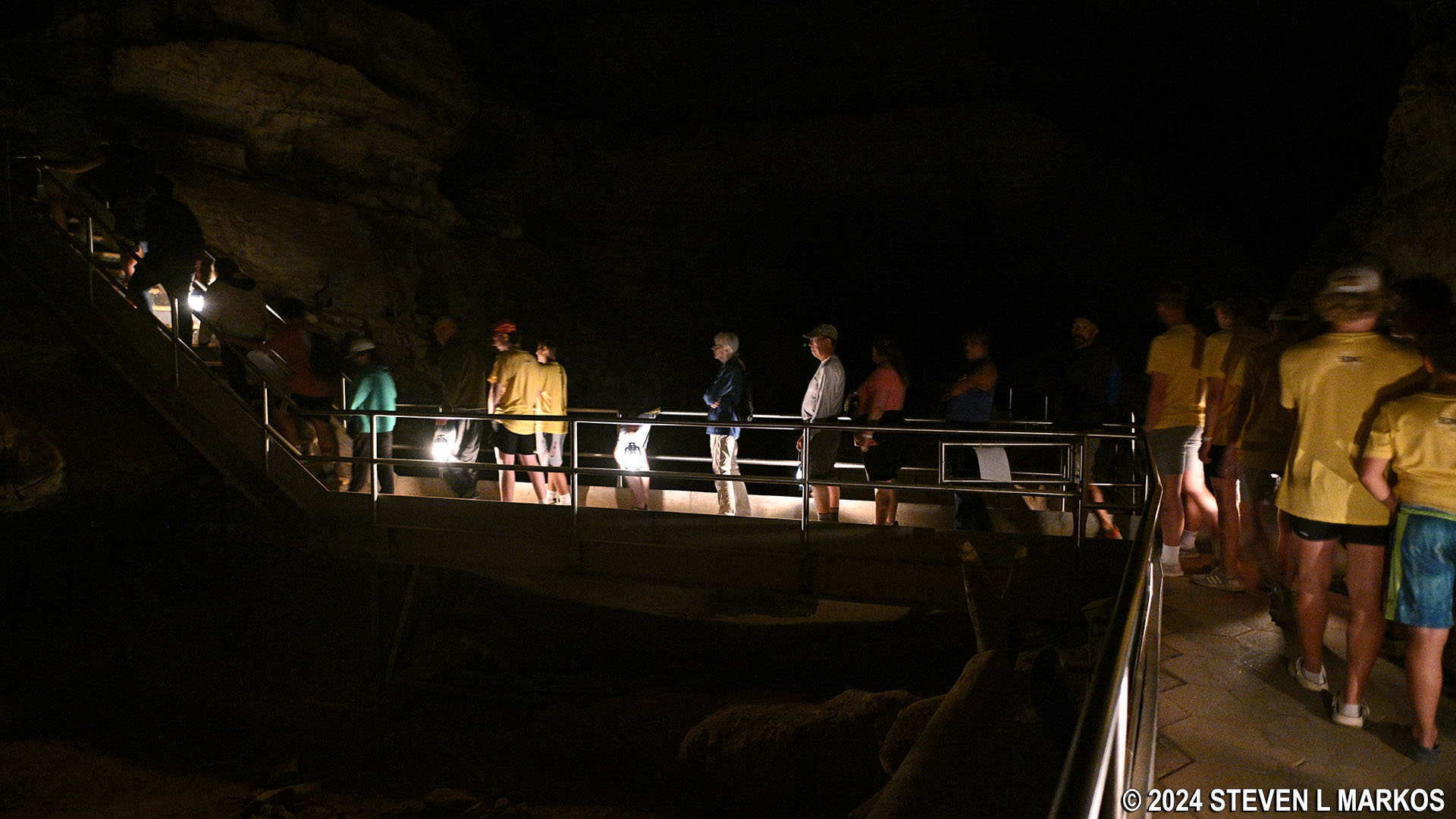
Staircase from the main passage of Mammoth Cave to Gothic Avenue
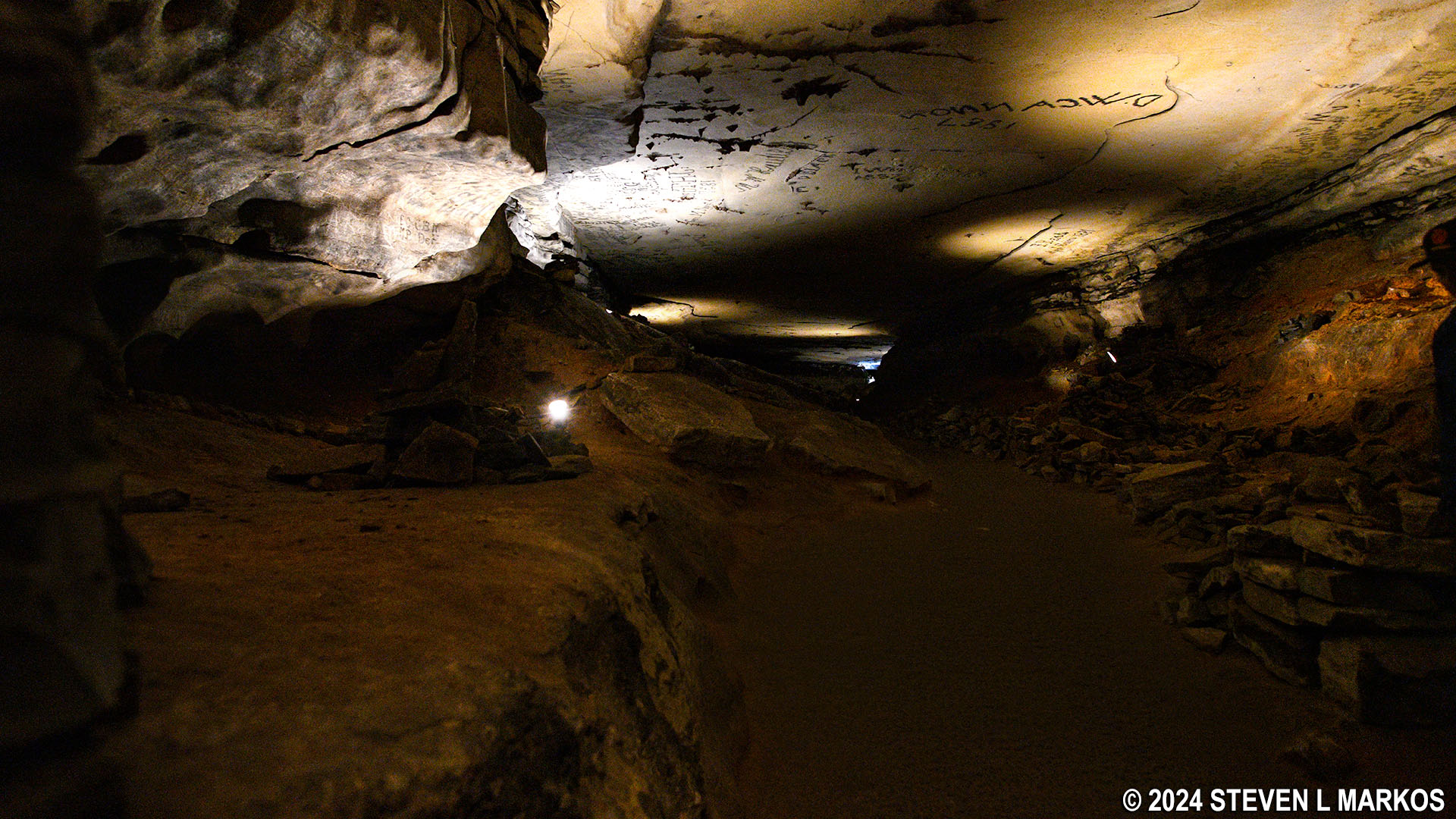
Mammoth Cave’s Gothic Avenue
Gothic Avenue gets its name from rock formations that resemble Gothic architecture. It is one of the few places in Mammoth Cave with stalactite and stalagmite formations that are visited on tours that start at the Historic Entrance. However, its most interesting feature is its graffiti-covered ceilings. In the early to mid-1800s, tour guides, who were often slaves, had various ways of making money. One was to allow visitors to write their names on the ceiling of the cave. This was done by using tallow (animal-fat) candles that created a lot of black, greasy smoke. The candles were attached to long poles, and the people writing their names did so by creating a series of black dots. The earliest signatures on the ceilings or walls using the candle technique are from 1811. There is supposedly a signature scratched into a rock from 1798. It is estimated that there are at least 10,000 signatures in the cave.

Ranger points out graffiti on the ceiling of Gothic Avenue during the Star Chamber Lantern Tour at Mammoth Cave National Park

Graffiti-covered ceiling of Gothic Avenue inside Mammoth Cave
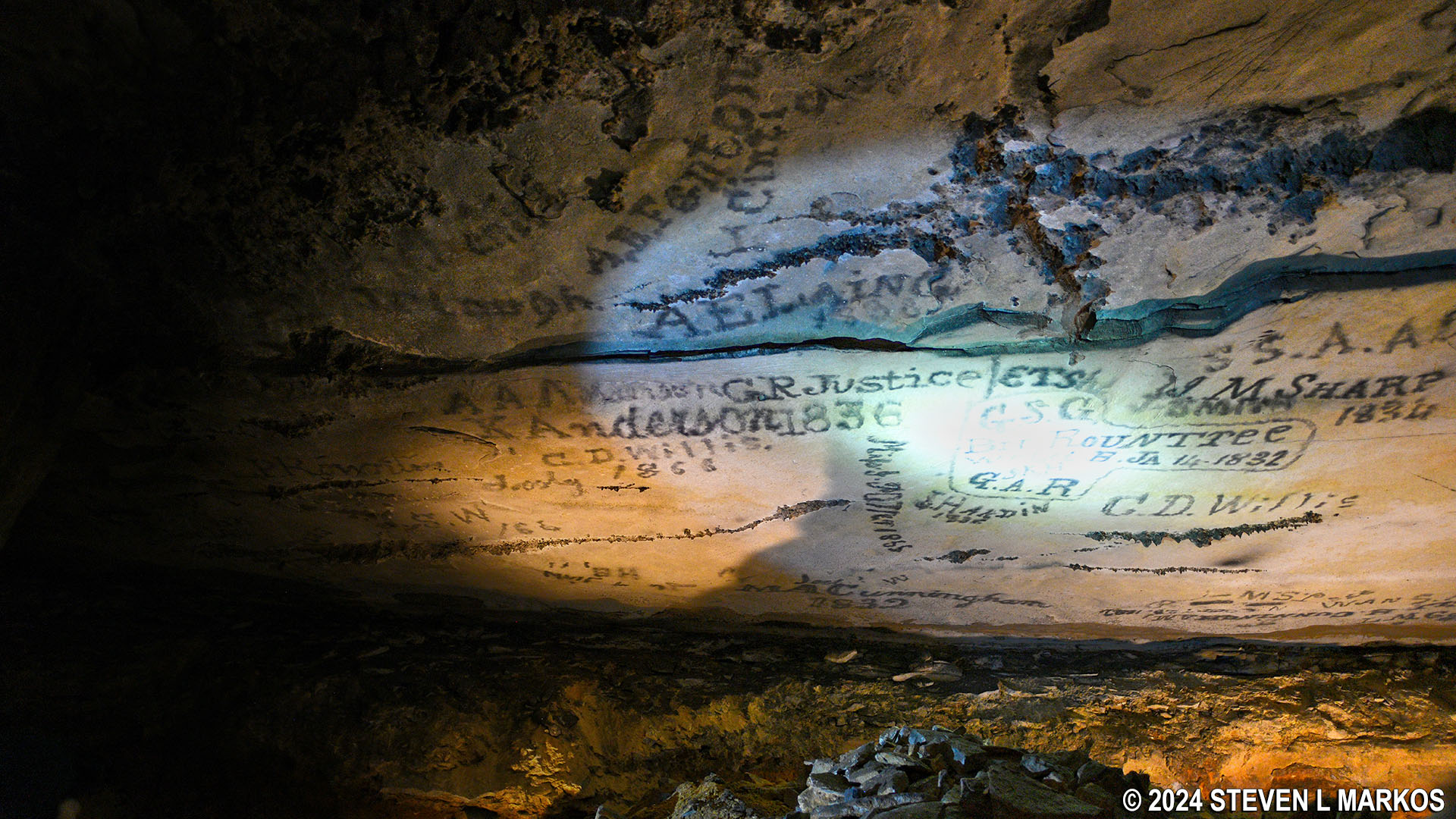
Graffiti-covered walls and ceiling of Gothic Avenue inside Mammoth Cave
Because the candle wax would drip into the face of the person doing the writing when looking up at the ceiling, a mirror was placed at the person’s feet. Of course, if looking in a mirror, the writer had to create letters in reverse in order for the signature to be correct on the ceiling. Not everyone realized this, and there are more than a few signatures that are backwards. A slave guide who could not read or write might not have any idea that the person was creating letters backwards and would thus never say anything. Either that or he just didn’t care. Once the mistake was realized, the guide could sell the author another candle.
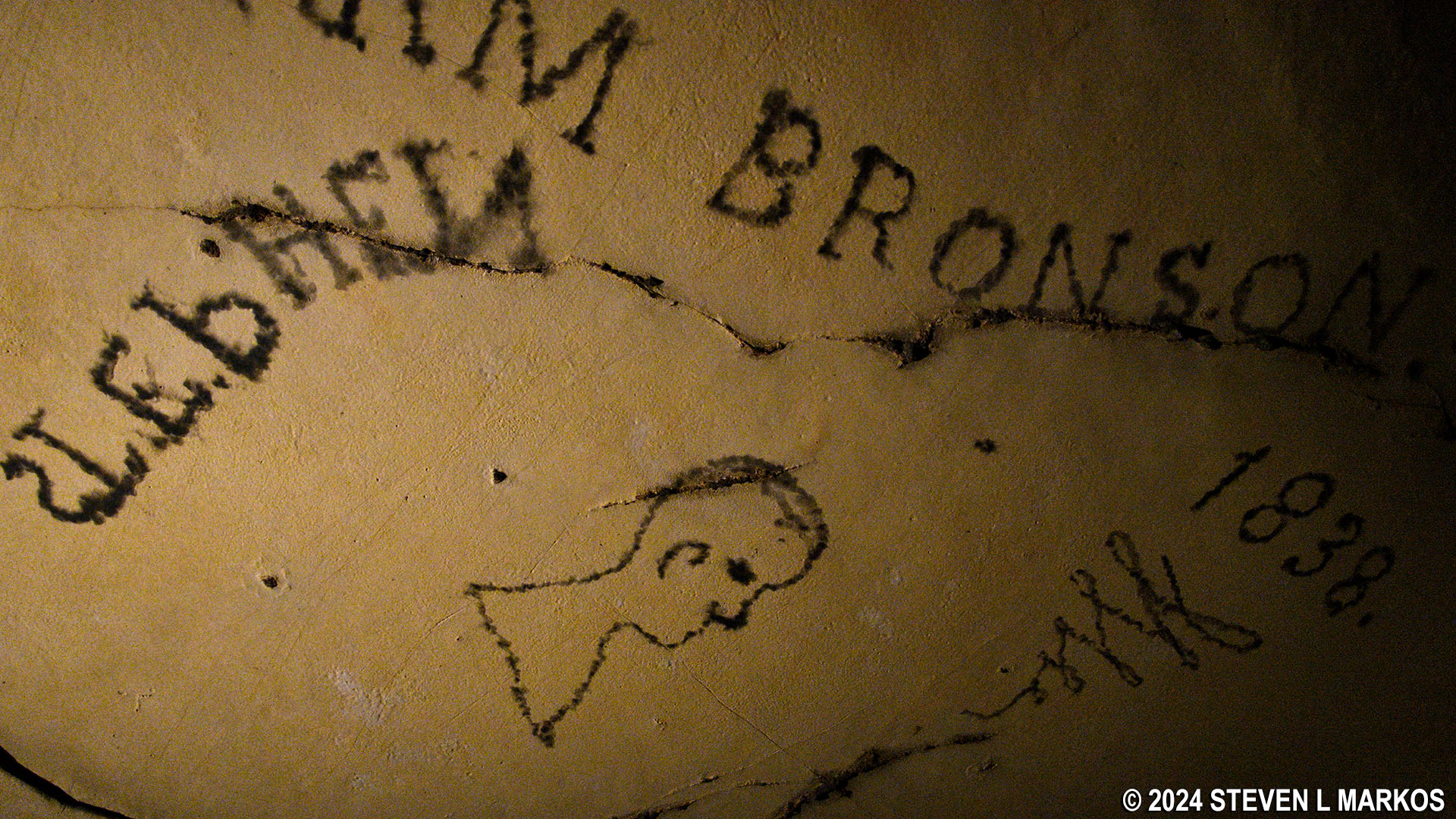
Backwards signature on the ceiling of Mammoth Cave’s Gothic Avenue
In 1888, signatures were outlawed in Mammoth Cave by a Kentucky state law. Defacing the cave was a $50 fine. Guides, of course, found other ways to make money. In addition to providing tours, they were responsible for creating the tour routes and clearing the rocks along the path. As the story goes, the guides started charging visitors to take the rocks and stack them into large piles to create what became known as monuments, effectively having guests pay them to do their work. Guests could write their names or anything else on the rocks. As word spread about building monuments, groups began coming to the cave with signs already made for the occasion. There are monuments to states, cities, colleges, fraternities and sororities, and individuals, and many of these still stand today. The largest, the Kentucky Monument, reaches the ceiling. At one time there was a monument for every state in the United States.
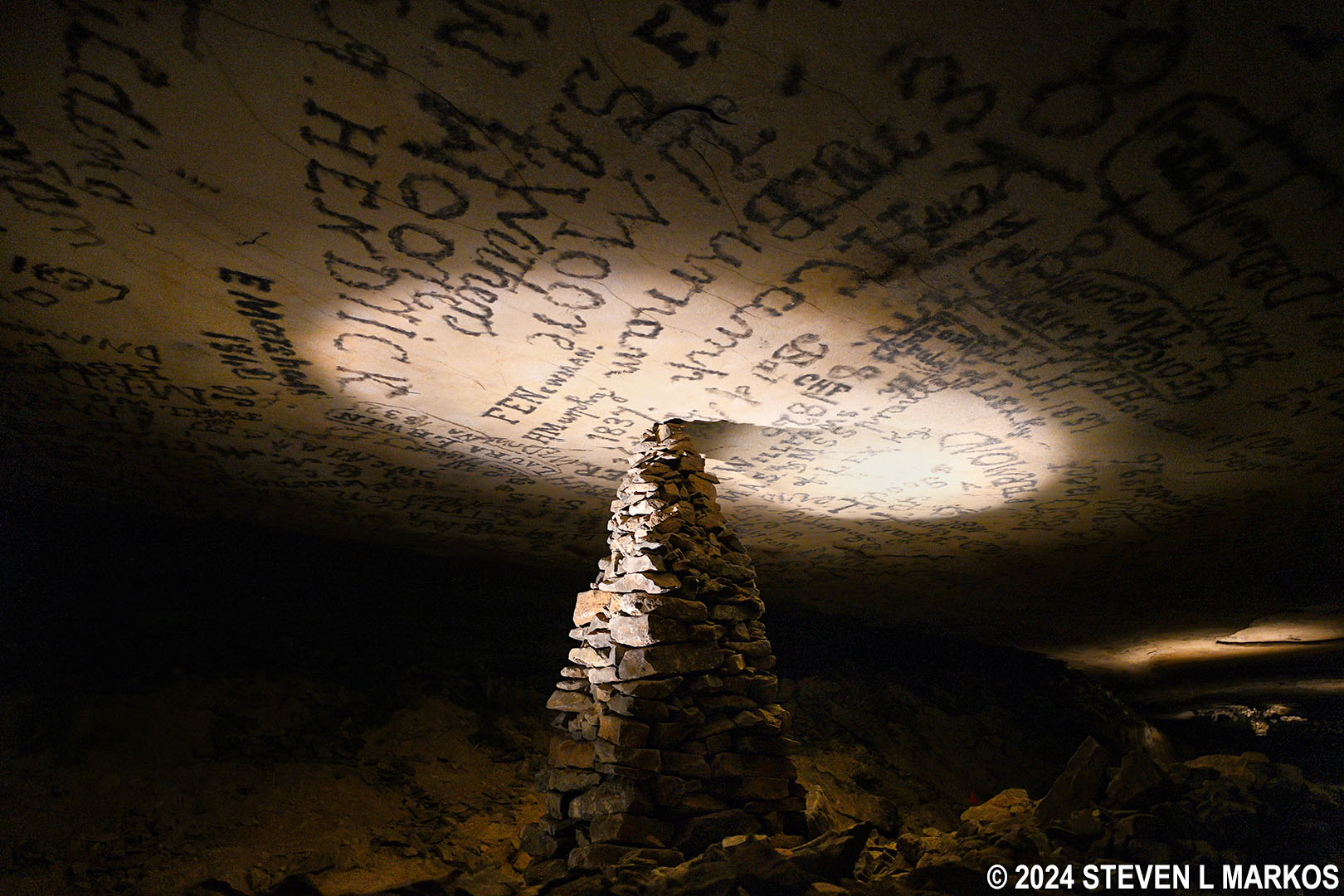
Kentucky Monument in Mammoth Cave’s Gothic Avenue
The Star Chamber Lantern Tour continues a little bit farther down Gothic Avenue to one of its most famous natural rock formations, the Bridal Alter. There have been at least a dozen weddings held here (none in modern times). The Bridal Alter is a completed formation, meaning that it is no longer growing. Speleothems, the collective name for stalactites, stalagmites, and other calcite formations most people associate with a cave, require slow, dripping water to form. A cap of sandstone covers most of Mammoth Cave, keeping water out, which is why there are so few speleothems. However, cracks do occur and water does sometimes get in. Not far from the Bridal Alter is an active formation that grows about one cubic inch every three to four hundred years.

Gothic Avenue’s Bridal Alter, Mammoth Cave National Park
Cave Exit
The Star Chamber Lantern Tour’s foray into Gothic Avenue ends at the Bridal Alter. The group returns to the main passageway of Mammoth Cave and then exits just as it came in—through the Historic Entrance.
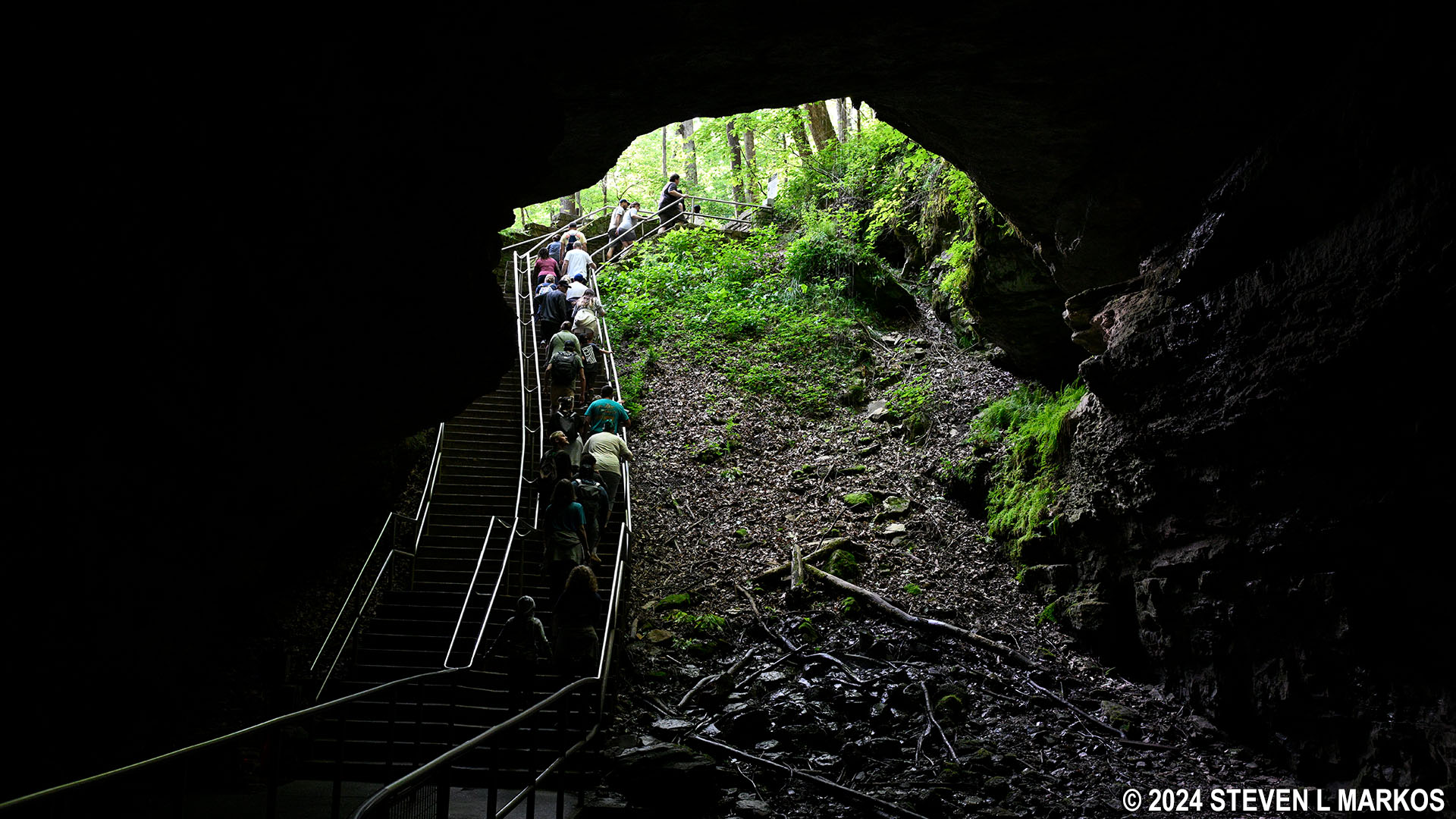
Visitors to Mammoth Cave exit via the Historic Entrance
With a few exceptions, use of any photograph on the National Park Planner website requires a paid Royalty Free Editorial Use License or Commercial Use License. See the Photo Usage page for details.
Last updated on October 11, 2024


