
Kayaking on the Little River in the Canyon Area of Little River Canyon National Preserve is for experienced to expert paddlers, depending on which section of the river you are going down. The first three miles, from Little River Falls to Lower Two-Mile—known as the Suicide Section—is for experts only, as the rapids are Class 4 to Class 6. Rapids from Lower Two-Mile and below are mainly Class 3 and 4, which are navigable by experienced kayakers, but you don’t have to be “world class.” The final take-out spot is at Canyon Mouth Park.
When kayaking the Canyon Area of the park, aside from considering whether or not to do it based on your skill level, the biggest concern is how to get into the water. As with most canyon parks—other than Zion National Park—facilities and roads are at the canyon rim. The bottom is far below, up to 600 feet in the case of Little River Canyon. I hiked every trail in the Canyon Area, and every time I got to the river I thought about how much fun a paddling trip would be. I also thought about how miserable a task it would be to get my equipment to the bottom of the canyon.
It was only on the Eberhart Trail and Powell Trail that I could see getting to the river at all, and even these are steep half-mile trails full of gullies and littered with loose rocks. Carrying a kayak down either of them is a task similar to Klaus Kinski’s character in the film Fitzcarraldo carrying a steamship over a mountain, but using the Eberhart Trail is going to be easier. Furthermore, you are launching two miles farther up the Little River when using the Eberhart Trail as a launch point than when using the Powell Trail. The trip from Eberhart to Canyon Mouth Park, the last take-out spot within Little River Canyon National Preserve, is 6 miles, whereas it is only 4 miles from Powell to Canyon Mouth.
However, if you put in at the Eberhart or the Powell trails, you will miss out on plenty of river that comes before these points. So where do you go so that you can begin your paddling trip farther upriver than these two trails allow? To get this answer, I headed to the Little River Canyon Center to ask a Ranger.
I was first told that people put in at Lower Two-Mile using the Lower Two-Mile Trail. “Impossible!” I said. To understand the difficulty of this, you would have had to have hiked down the Lower Two-Mile Trail. It is the steepest trail that I have ever been on. In fact, it is the steepest trail within any National Park on the east coast of the United States. To put its descent into perspective, the Eberhart and Powell trails reach the bottom of the canyon in .4 mile. The Lower Two-Mile Trail gets there in .1 mile. As they say, the shortest distance between two points is a straight line, and the Lower Two-Mile Trail is indeed a straight line to the bottom. Without hiking poles for balance, I can’t see getting down the trail other than by sliding on your rear. But obviously there are people who are more skilled than I, who can not only hike down this trail without problem, but who can also do it while carrying a kayak. However, even if you do launch at Lower Two-Mile, you still have missed the entire Suicide Section. So how do you get in up there?
“The easiest way to get into the river,” a Ranger told me rather nonchalantly, “is to go over Little River Falls.” You’ve got to be kidding me! But no, he wasn’t. In fact, the park video shows people doing this. As it turns out, while Little River Falls is 45-feet tall, it is divided by a rock barrier into two sections. The left-hand section (right in the photo below, partially covered by brush) is actually made up of two, 20-foot drops, though it is not evident when looking casually at the falls as would a tourist. Still, that is two 20-foot waterfalls to go over (some people even go over the main 45-foot section). According to what the kayakers say, going over the falls is the easy part. Next comes the Class 6 rapids.

Little River Falls the day after a torrential rain storm in mid-May, Little River Canyon National Preserve
Getting your kayak in the water above the waterfall is easy. Park at the Little River Falls Overlook just east of the Alabama Highway 35 bridge. Follow the paved path from the parking lot towards the bridge. On the left are two signs marking a trail down to the river. It is steep, but the National Park Service has built a stone staircase to make things easier.
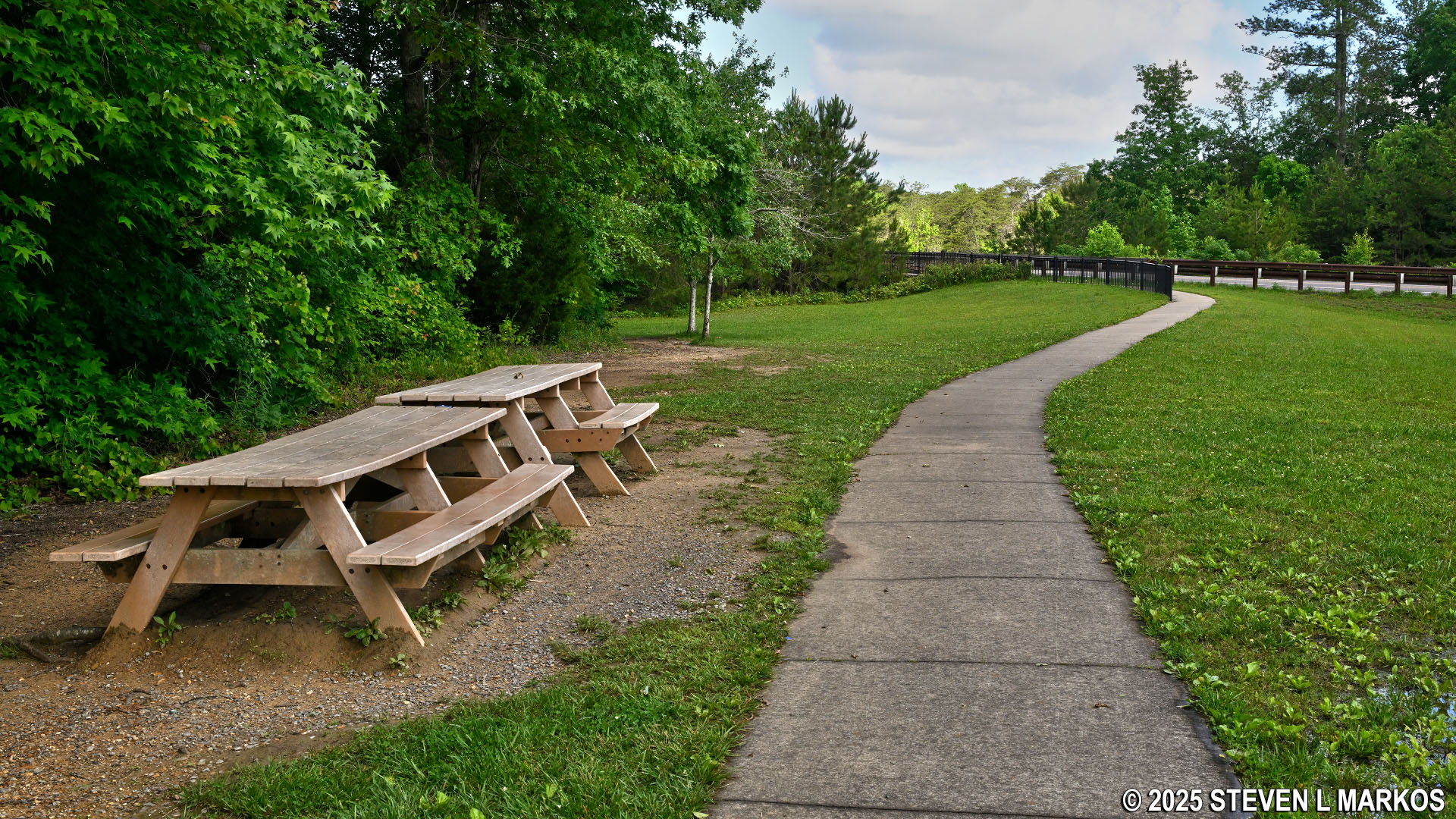
Path from the Little River Falls Overlook parking lot to the Highway 35 bridge, Little River Canyon National Preserve

Short trail down to the Little River just above Little River Falls, Little River Canyon National Preserve

Staircase down to the Little River just above Little River Falls, Little River Canyon National Preserve
Once at the bottom, make your way to the river. There are a couple of calm spots where you can launch before hitting the turbulent water. The waterfall itself is less than 100 yards from the launch point.

Little River 100 yards upstream from Little River Falls, Little River Canyon National Preserve

View from the river bank directly next to Little River Falls, Little River Canyon National Preserve
There is one other place to put in below Little River Falls for those wanting to kayak part of the Suicide Section but who are afraid to go over the waterfall, and that is at Little Falls (aka Martha’s Falls). Take the Little Falls Trail for .6 mile to another stone staircase that leads down to the river. Keep in mind that you will be skipping a half mile of the Suicide Section.

Rapids at the Little Falls section of the Little River during extremely high water levels, Little River Canyon National Preserve
Water levels for the Canyon Area of the Little River need to be much higher than for the Wildlife Management Area in order to float the river. The park brochure recommends a minimum of 400 CFS (cubic feet / second), but a Ranger recommended 500 minimum. Over 1500 CFS is too high and dangerous. To find water level information, go to https://waterdata.usgs.gov/nwis/uv?02399200. Scroll down to the SELECT DATA TO GRAPH section and choose DISCHARGE, CUBIC FEET PER SECOND. The graph at the top of the page will then show cubic feet per second. You can also call 800-525-3711. Press 4 for Flows, then 2 for Coosa River Basin, then 2 for Little River.
Keep in mind that the Little River is mainly a winter / spring destination, meaning there is usually only enough water for paddling trips from November through April, the rainy season for the area (the winter months are the best). Wet suits are recommended for much of the paddling season. Occasional summer downpours provide sporadic opportunities, but if you must plan your trip well in advance, the best bet for water is the winter time. According to a park Ranger, December is the wettest month in Alabama.
The park does not provide shuttle service, so you must arrange for pick-up or have a way back to your car at the launch point. For most people, this entails bringing two vehicles. I wouldn’t count on finding somebody to hire to drive your car to Canyon Mouth Park. It’s not that the people in Fort Payne are untrustworthy, it’s just that Little River Canyon National Preserve is in a rural area, and there aren’t a lot of people sitting around looking to drive cars from one end of the park to the other.
Distances and Estimated Run Times
Little River Falls to Lower Two-Mile (Suicide Section): 3 miles / 2-3 hours
Lower Two-Mile to Eberhart Point (Upper Two Section): 2.5 miles / 1.5-2 hours
Eberhart Point to Canyon Mouth (Chairlift Section): 6 miles / 3-4 hours
The following are videos showing what can happen when going over Little River Falls. The second guy in the first video who didn’t look like he had much luck fractured both ankles.
The guy in the second video lived. He ended up behind the waterfall.
With a few exceptions, use of any photograph on the National Park Planner website requires a paid Royalty Free Editorial Use License or Commercial Use License. See the Photo Usage page for details.
Last updated on June 5, 2025


