
Museum at Belmont-Paul Women’s Equality National Monument in Washington, D.C.
Belmont-Paul Women’s Equality National Monument is a museum dedicated to the women’s suffrage movement—particularly the contribution of the National Women’s Party (NWP)—that led to the passage of the 19th Amendment in 1920 outlawing sexual discrimination in regards to voting. The park gets its name from Alice Paul and Alva Belmont. Paul was the co-founder of the National Women’s Party. She had previously been a member of the National American Women Suffrage Association (NAWSA), the most prominent organization involved in the women’s suffrage movement. While the NAWSA wanted to get suffrage laws passed on the state level, Paul felt this was a waste of time since many conservative states would never pass such laws. Instead, her focus was on getting an amendment to the United States Constitution passed, as only three-fourths of the states had to ratify it, yet all states would now be bound by it. This prompted her to form the Congressional Union for Woman Suffrage (CU) in 1913 with colleague Lucy Burns. Due to this difference in philosophy, Paul and Burns split with the NAWSA the following year. In 1916 Paul formed another organization, the Women’s Party of Western Voters (NPWV). In March 1917, the CU and NPWV merged to become the National Women’s Party.
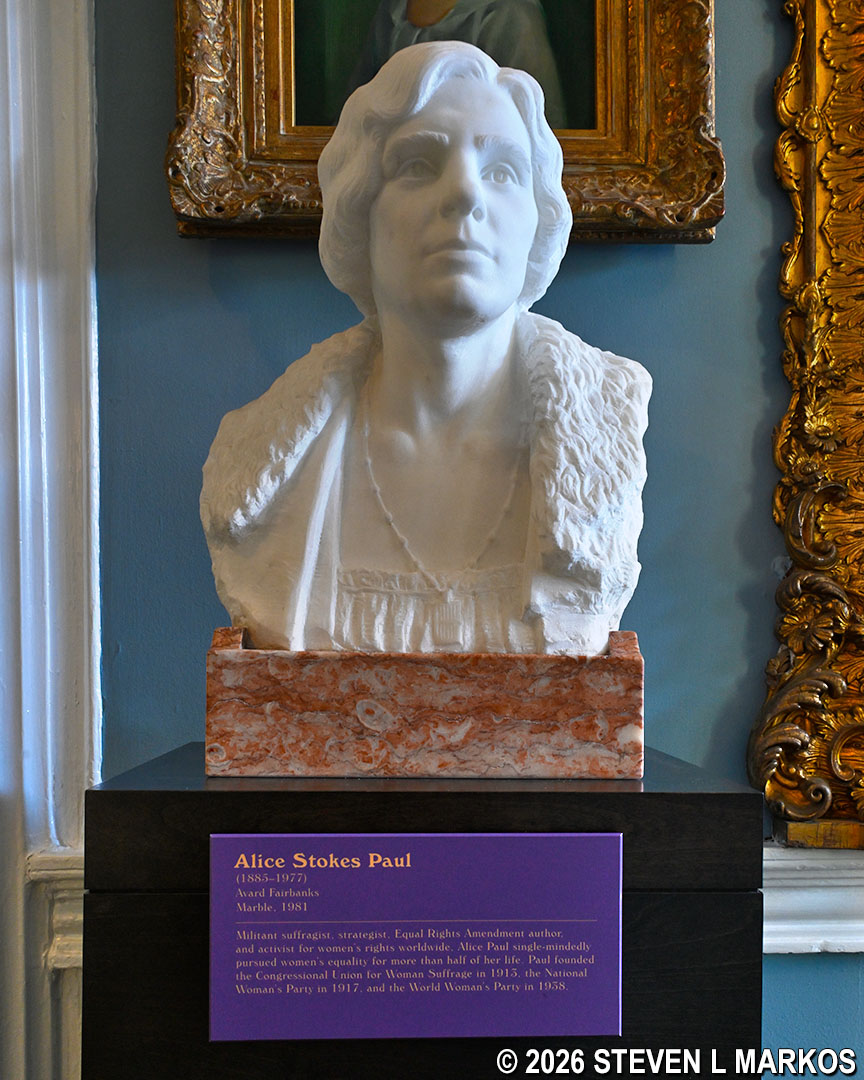
Bust of suffragist Alice Paul on display at Belmont-Paul Women’s Equality National Monument in Washington, D. C.
Alva Belmont was a rich socialite who was active in many women’s causes including the suffrage movement. She was also involved with the NAWSA, and she even formed her own organization, the Political Equality Association (PEA). When Paul left the NAWSA, Belmont left with her, merging her PEA with the CU (which as noted, subsequently became the NWP). Belmont was elected president of the NWP and held that position until her death in 1933. She purchased what was known as the Sewall House (named after the original owner, Robert Sewall) in 1929 specifically for use as a headquarters for the NWP. The house is now known as the Sewall-Belmont House.
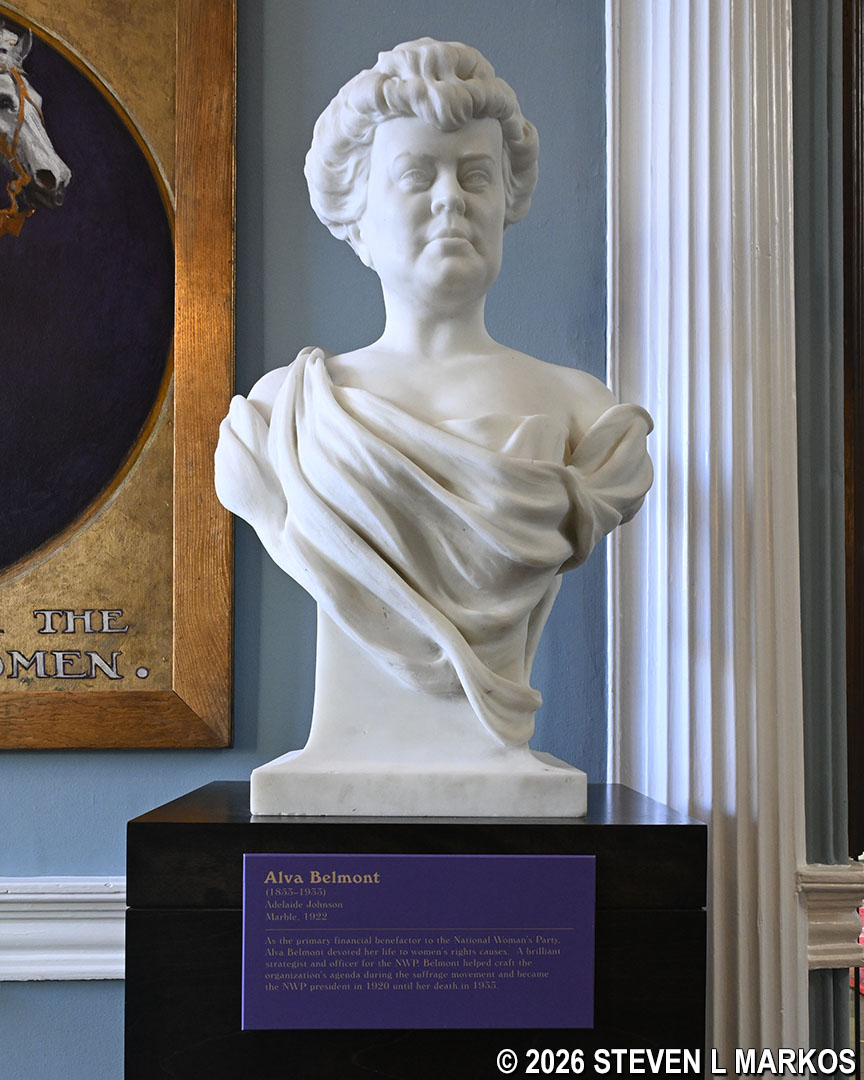
Bust of suffragist Alva Belmont on display at Belmont-Paul Women’s Equality National Monument in Washington, D. C.
The Sewall-Belmont House was operated by the NWP as the Sewall-Belmont House Museum and Library from the early 1970s until the National Park Service took over in 2016. During that time it was also a woman’s suffrage museum. In fact, most of the exhibits and artifacts now on display are from the Sewall-Belmont House days. The house was closed in 2021 for renovation, and it reopened in August 2023.
Belmont-Paul Women’s Equality National Monument is now open year-round on Fridays through Sundays from 10 AM to 5 PM. During Women’s History Month in March, it is typically open on Wednesdays and Thursdays as well. Keep in mind that times can always change, so be sure to check the National Park Service’s Operating Hours and Seasons web page for the current schedule.
Visitors to Belmont-Paul Women’s Equality National Monument can walk through the museum on their own or join a guide who will present a lecture on the suffrage movement while pointing out items of importance in the various exhibit rooms. The tour / lecture is currently held at 10 AM and 2 PM, and if you want to learn something without having to read much, I highly recommend attending. I arrived outside of these times, and a staff member still gave me a tour (a few others arrived as well, so there did end up being a small group). There is no guarantee of getting a tour after the set times, for there must be enough staff members on duty, but it does not hurt to ask. Truth be told, I got a tour because nobody was there for the 10 AM tour. Depending on who gives the tour, plan to spend up to an hour. If you walk through the museum on your own and read everything, you can do so in 30 to 45 minutes.
The entrance hallway of the house now serves as a welcome center, and there is an information desk and book and souvenir store.
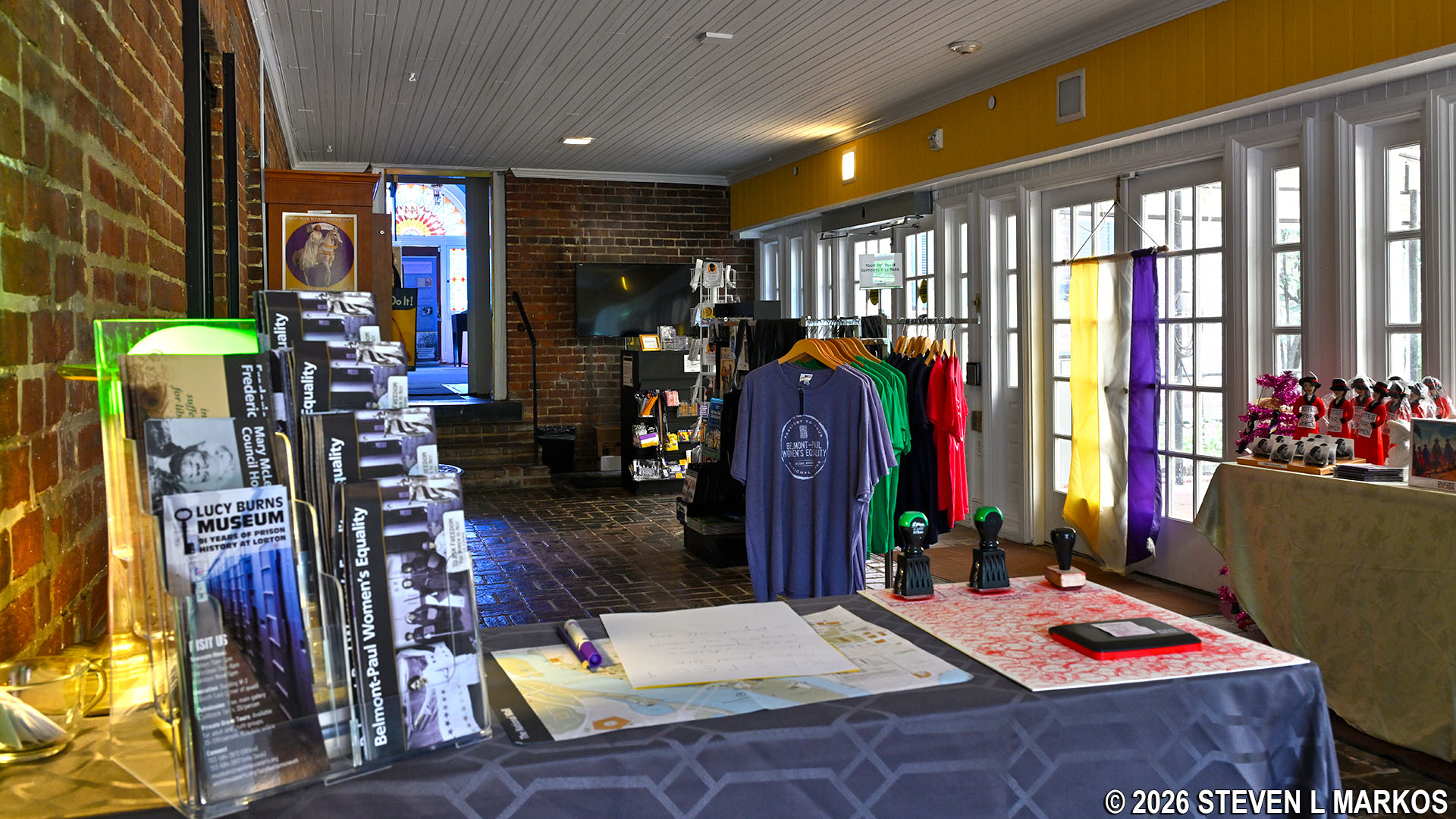
Information desk and souvenir store in the entrance hallway of Belmont-Paul Women’s Equality National Monument in Washington, D. C.
The museum itself consists of exhibits in what is referred to as the Hall of Portraits and four rooms that branch off the hallway. All rooms are on the main floor, though there are four steps from the entrance hall to the Hall of Portraits. Those in wheelchairs do have access to a wheelchair lift. The upper floor, while hosting exhibits in the Sewall-Belmont House Museum days, is now closed to the public. The lower level of the house is used for office space by the National Park Service.
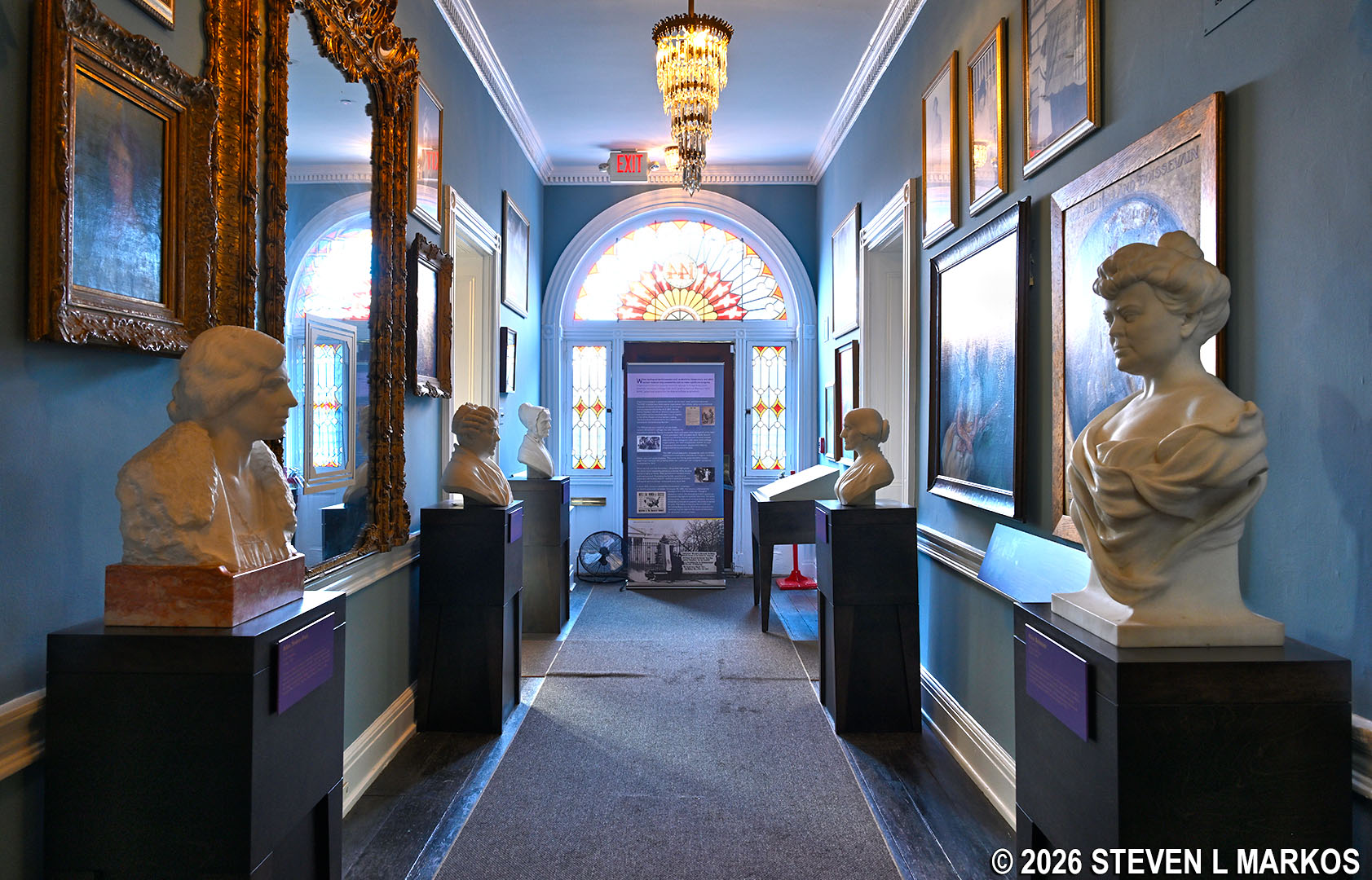
Visitors to the house begin their tour of the museum in the Hall of Portraits. On display are busts and short biographies of five prominent women involved in the suffrage and women’s rights movements: Alice Paul, Alva Belmont, Susan B. Anthony, Elizabeth Cady Stanton, and Lucretia Mott. On the walls are paintings of other important women in the movement, including two of Lucy Burns.
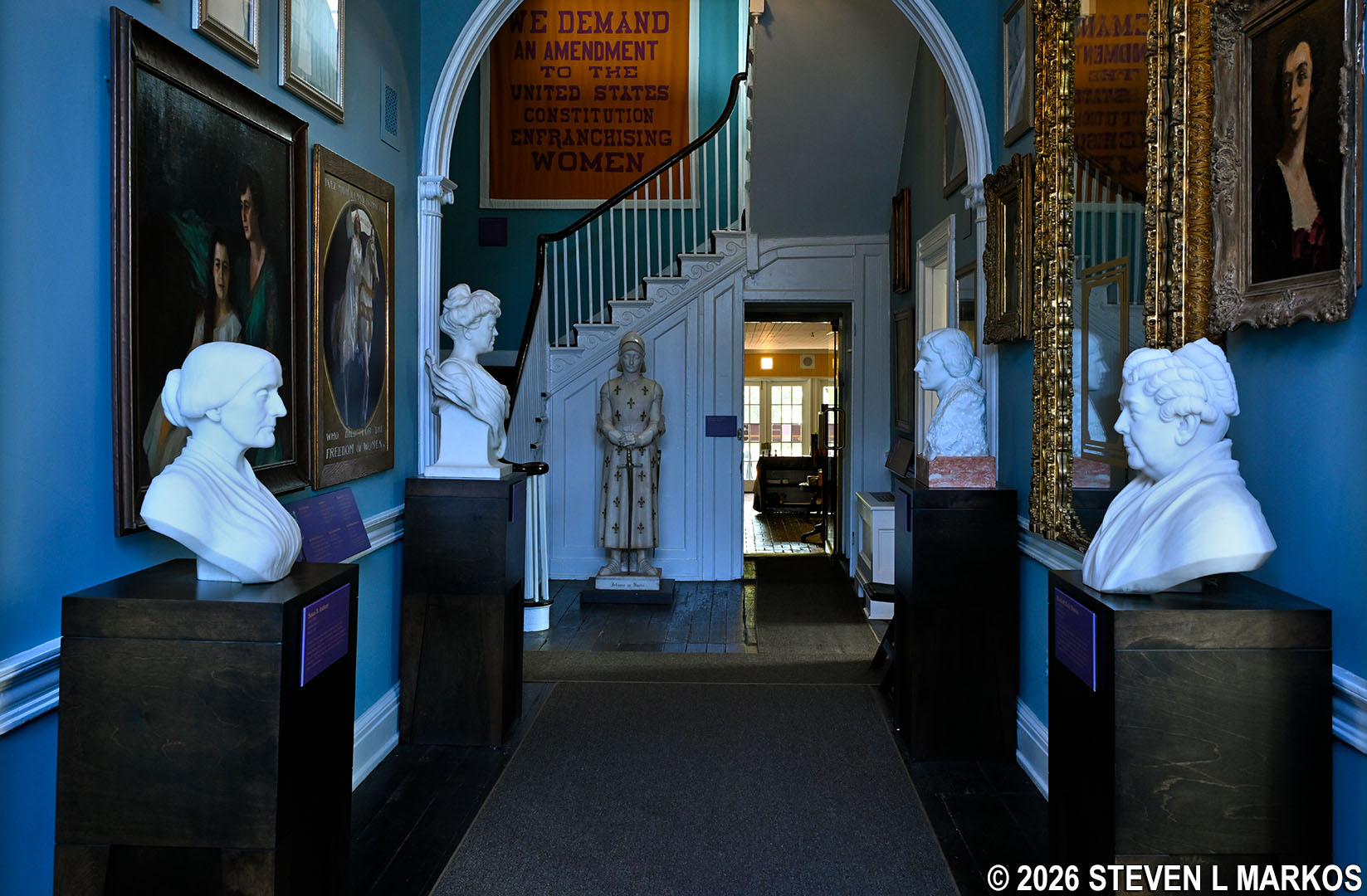
Hall of Portraits at Belmont-Paul Women’s Equality National Monument in Washington, D. C.
Elizabeth Cady Stanton is considered the founder of the women’s rights movement after she organized the First Women’s Rights Convention in Seneca Falls, New York, in 1848. She and Susan B. Anthony met in 1851, and together they founded numerous women’s rights organizations, including the National Woman Suffrage Association in 1869. The organization merged with its main competitor, the American Women Suffrage Association, in 1890 to form the National American Women Suffrage Association. Neither lived to see the passage of the 19th Amendment, as Stanton died in 1902 and Anthony in 1906. Stanton’s legacy lives on as the focus of Women’s Rights National Historical Park in Seneca Falls.
Lucretia Mott was a colleague of Stanton’s and was present as part of the group of women who first discussed a women’s rights convention at a tea part held on July 9, 1848, at the house of Jane Hunt. The convention was held just ten days later specifically so that Mott could attend before having to return to her home in Philadelphia.
The four other exhibit rooms branch off from the Hall of Portraits. One houses a collection of furniture acquired by the NWP. A desk belonging to Susan B. Anthony was donated to the CU in 1913, and when the organization became the NWP, members often featured it prominently in group photos and other propaganda. A chair belonging to Elizabeth Cady Stanton and a desk of Alva Belmont are among the other furniture items on display. Chairs and sofas in all other rooms are not original, and if you get tired, you are welcome sit on them.
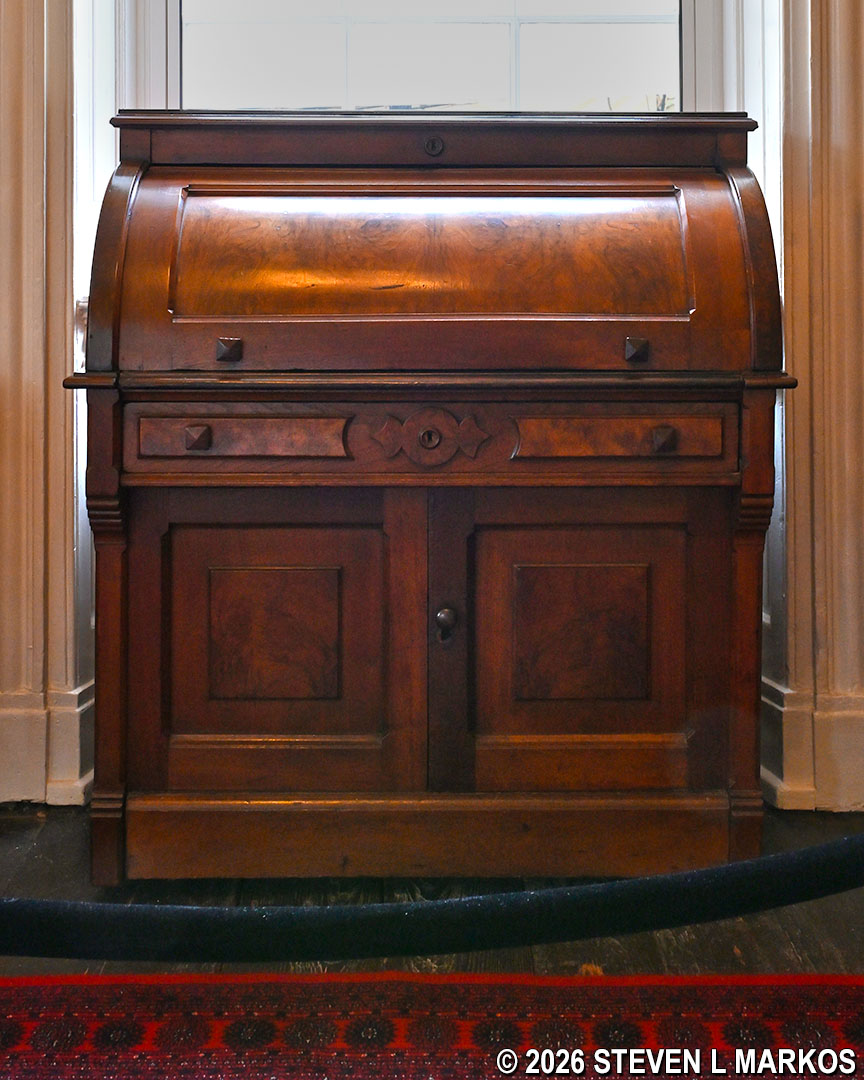
Susan B. Anthony’s cylinder roll-top desk on display at Belmont-Paul Women’s Equality National Monument in Washington, D. C.
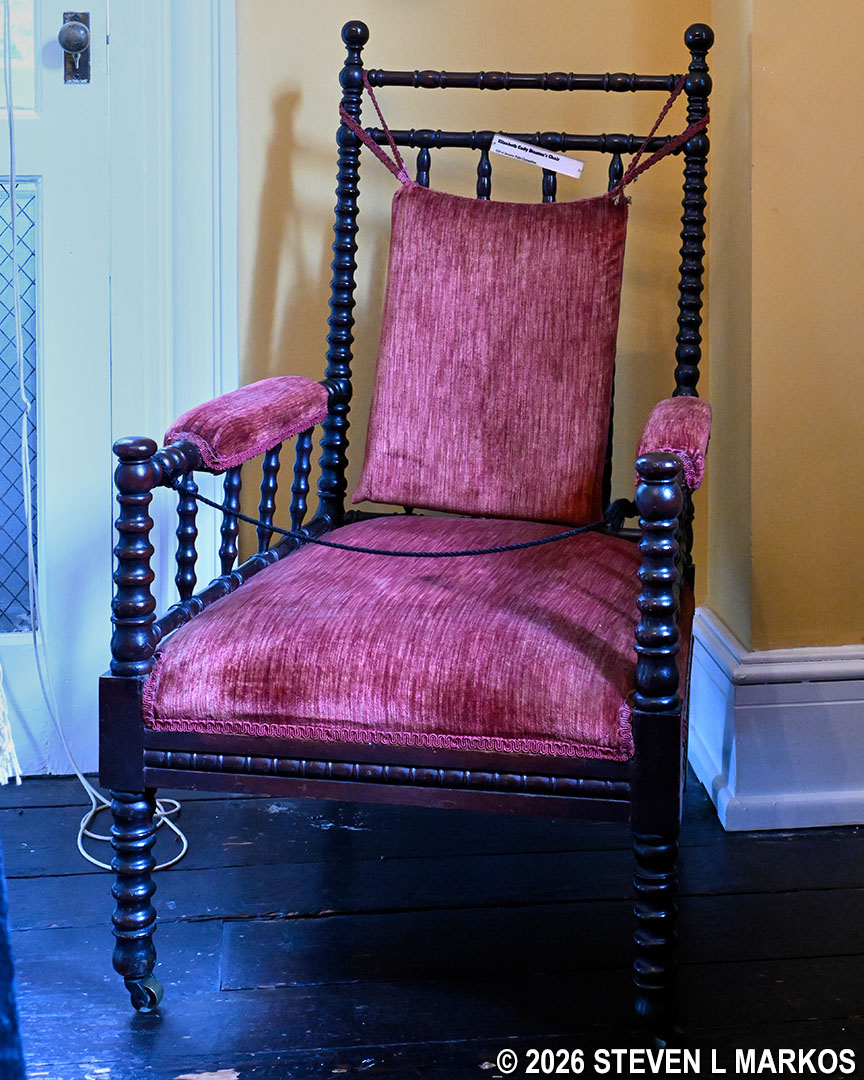
Elizabeth Cady Stanton’s chair on display at Belmont-Paul Women’s Equality National Monument in Washington, D. C.
Two of the rooms are dedicated to the suffragists’ fight to get the 19th Amendment passed. One exhibit features information and a few artifacts pertaining to the NAWSA’s first major march in Washington, D. C., on March 3, 1913, the day before Woodrow Wilson’s inauguration. Called the Women’s Suffrage Procession, the event was like a parade, complete with bands and floats. The goal was to travel down Pennsylvania Avenue to the White House, but the suffragists never got that far. Crowds of onlookers spilled into the streets blocking the roads, and a gang of hired thugs attacked the woman while police watched in amusement. The National Guard was finally called in to bring order back to the streets.
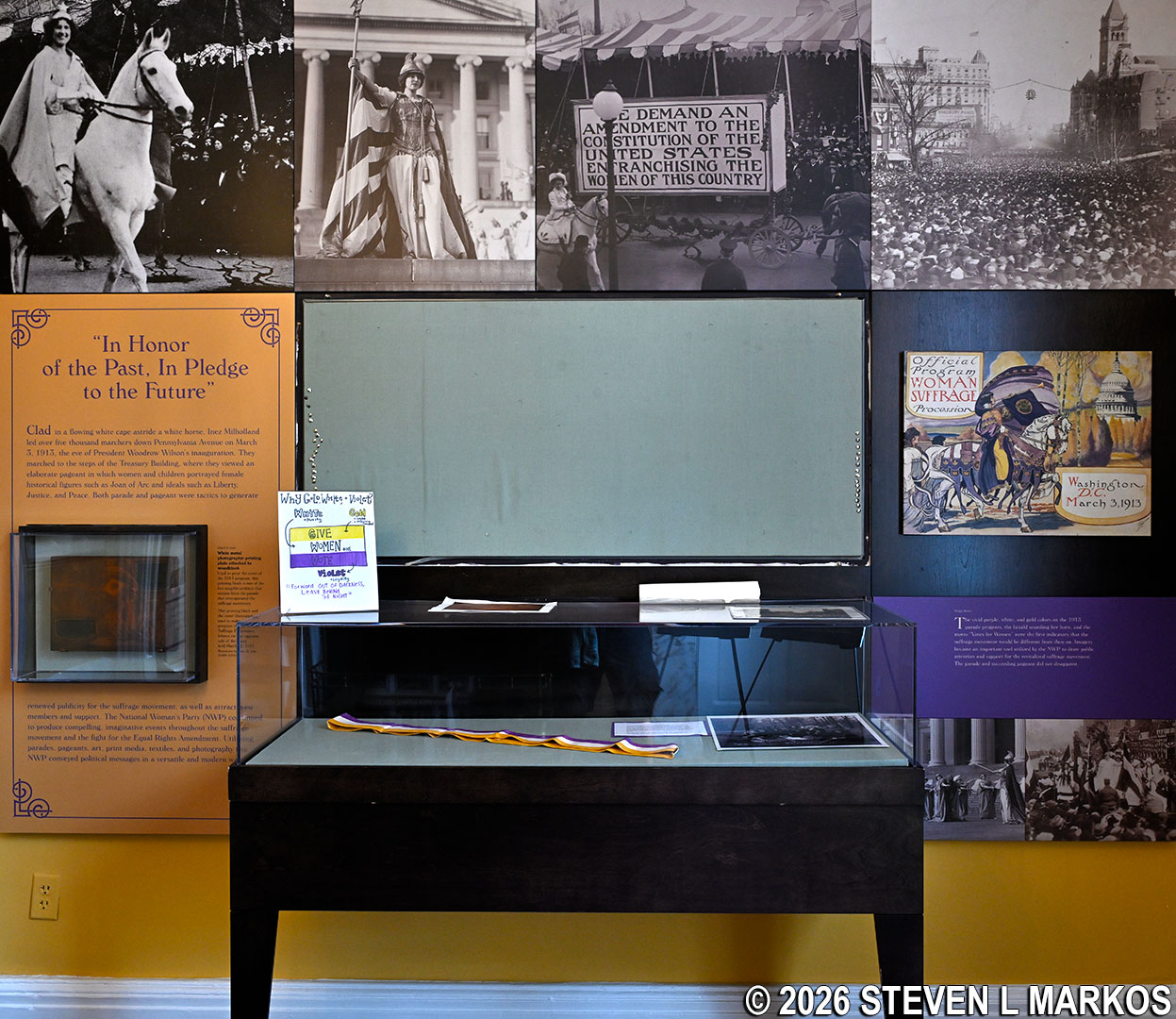
Exhibit on the National American Women Suffrage Association’s March 1913 Women’s Suffrage Procession in the museum at Belmont-Paul Women’s Equality National Monument
The NWP made history in January 1917 by marching all the way to the gates of the White House. At the time, no other protest group had done this. Another march in June, after the United States entered World War I, was seen as unpatriotic by many, and the crowd of onlookers turned on the women. Dozen were jailed on bogus charges such as blocking traffic. When news that the women were brutally treated in jail made the headlines, sentiment began to change, and pressure was put on President Wilson and Congress to support the 19th Amendment.
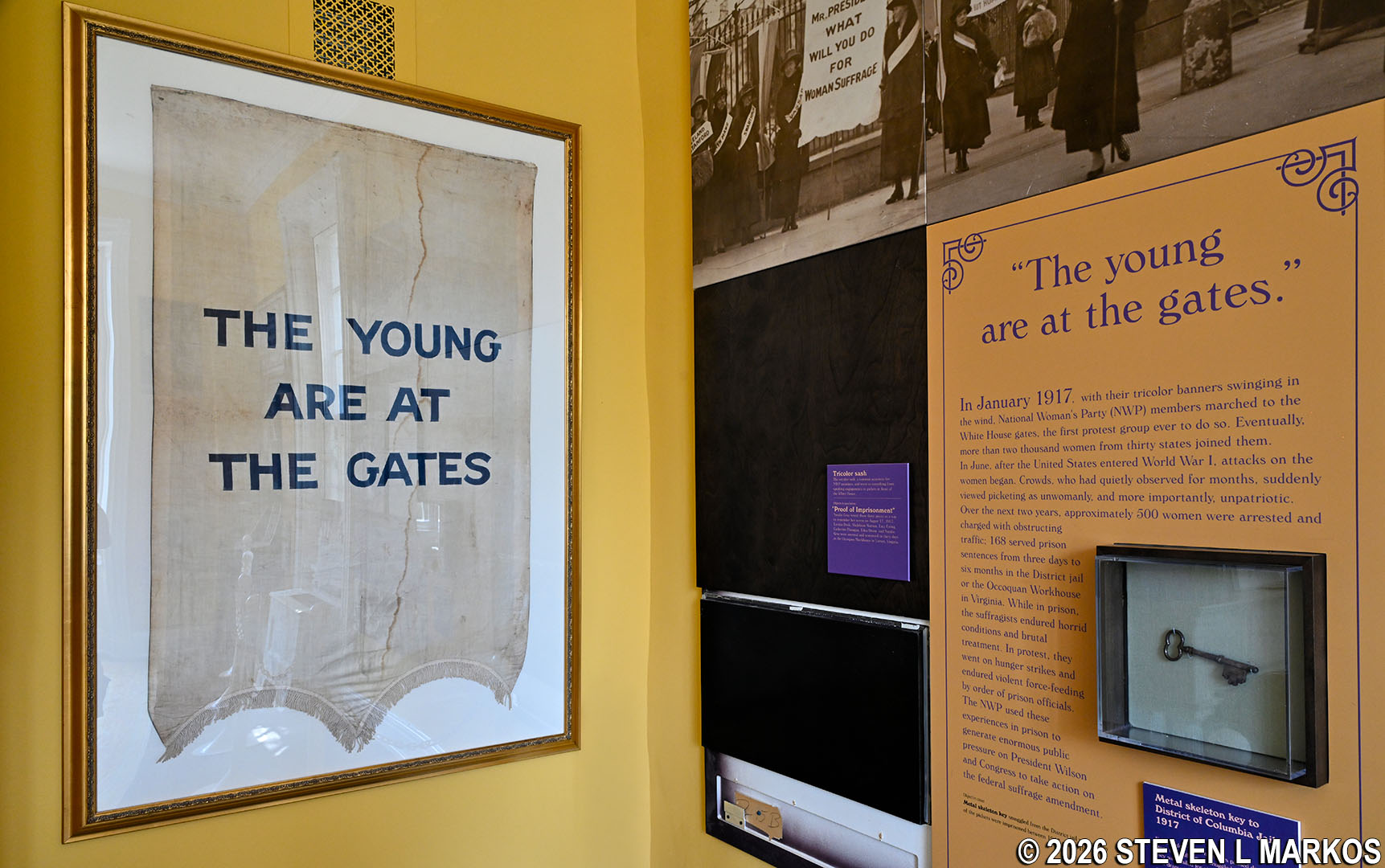
Exhibit on the National Women’s Party January 1917 march on the White House in the museum at Belmont-Paul Women’s Equality National Monument
There is also information about Mary Church Terrell and Ida B. Wells, two black women involved in the suffrage movement. In general, black women were discouraged from actively participating in protests, and those who did brought up the rear of any march. The reason was not blatant racial discrimination by the white suffragists. The leaders, who were all white, believed that they had enough people against them already, and with black women being featured prominently in their protests, even more people would be against them, particularly those in southern states (other than Tennessee and Kentucky, no southern state ratified the 19th Amendment anyway). Also on display is a portrait of Frederick Douglass, himself a supporter of women’s rights to vote.
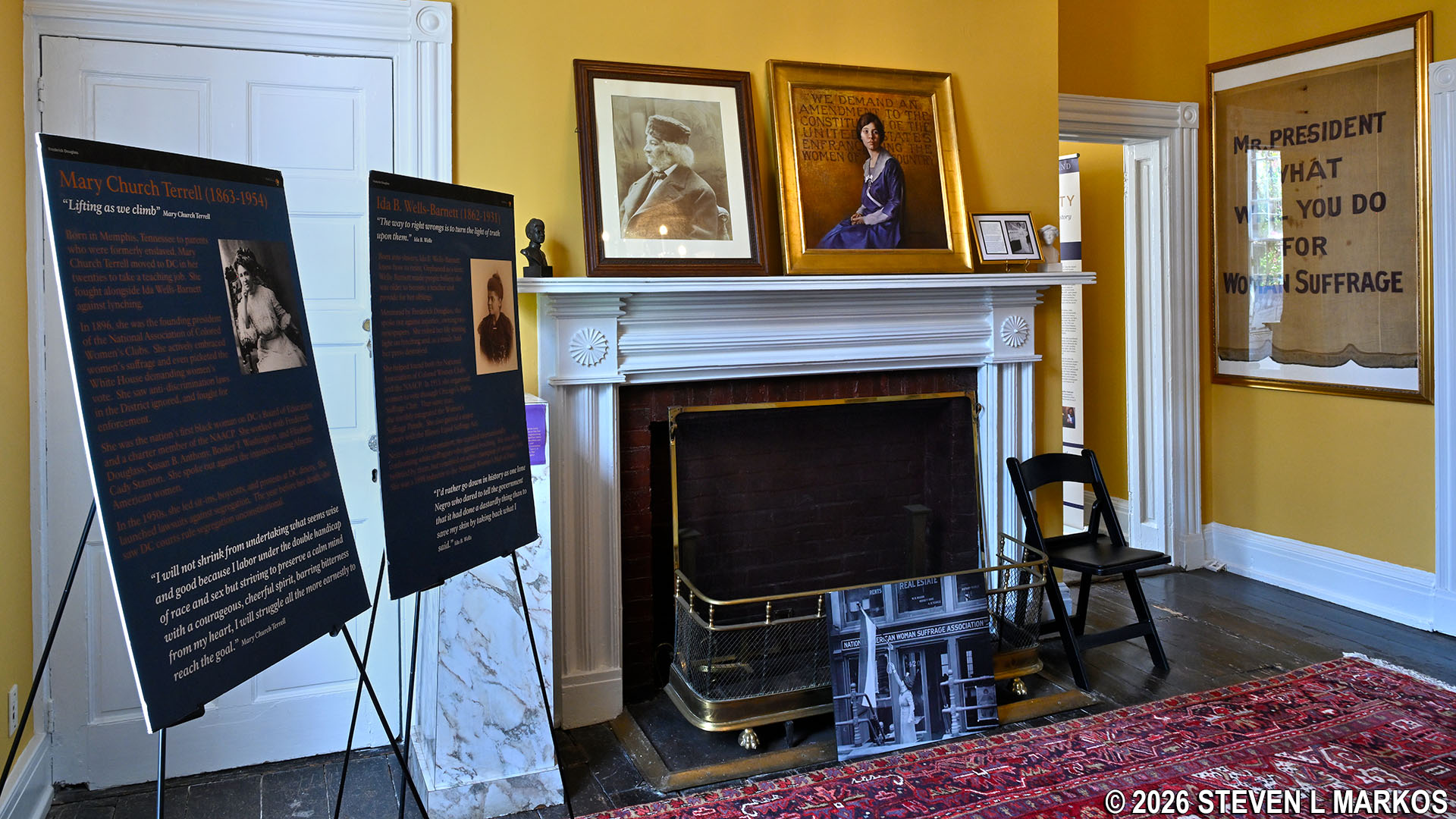
Exhibit on black women involved in the suffrage movement in the museum at Belmont-Paul Women’s Equality National Monument
The final room covers the NWP’s focus after the 19th Amendment was passed: an Equal Rights Amendment that would guarantee equal rights for all sexes. Such an amendment was actually presented to Congress in 1878, but nothing came of it. A new version drafted by Alice Paul and Crystal Eastman in 1923 was introduced to Congress, and again nothing came of it. It was introduced every year afterwards with no results, that is until 1972 when Congress finally voted for the amendment. It now had to be ratified by 38 of 50 states within seven years, and in 1979, the deadline was extended for three more years.
For those old enough to remember the early 1980s, the ERA suddenly became a hot topic in the media. This was the result of a last ditch effort to get the required number of states to ratify the amendment. The end result was a high point of 35, but five states rescinded their votes, making the total only 30 states by the 1982 deadline. Since then, eight more states have ratified the amendment, making the total 38 as required (Virginia voted for ratification in 2020). As of now, this is just a symbolic vote, though there is an effort to get Congress to change the deadline, with the argument being that it changed the deadline before, so why not now?
Ironically, it was women who doomed the amendment. Female religious leaders claimed it would lead to women being drafted into the military, gender-neutral bathrooms, same sex marriages, and a loss of alimony, child support, and widow’s benefits. Women did not want to be equal to men in all aspects of life. Besides, there were already laws prohibiting sexual discrimination in hiring and wages.
While not successful with the Equal Rights Amendment, the NWP proposed over 600 new laws, and roughly 300 of them were passed. One victory of note was getting sex added to the Civil Rights Act of 1964 as one of the protected classes. A list of some of these laws is on display in the room.
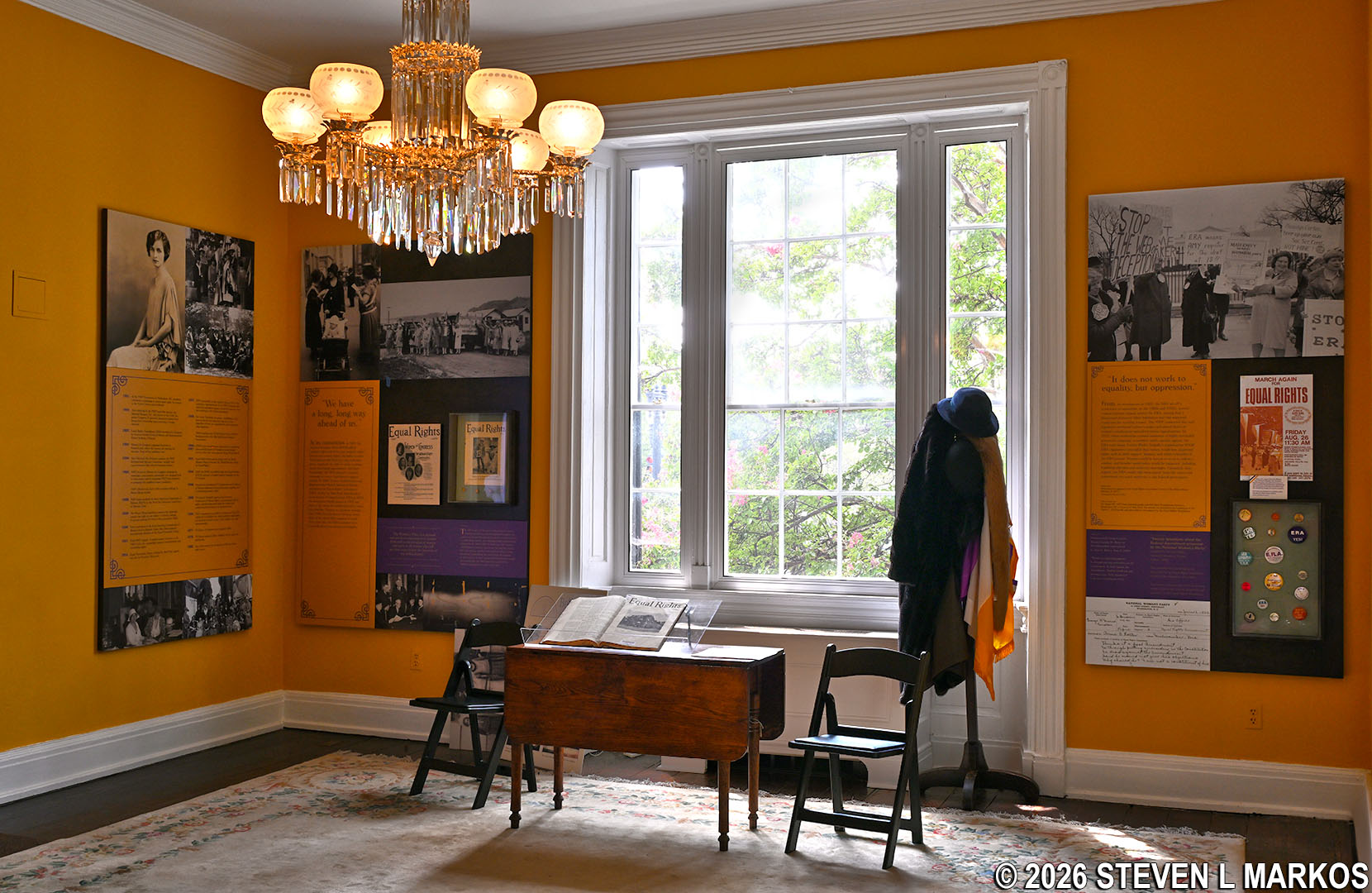
Exhibit on the Equal Rights Amendment and post-19th Amendment activities of the National Women’s Party in the museum at Belmont-Paul Women’s Equality National Monument
There is a fifth room in the Sewall-Belmont House that is open to the public, the Florence Bayard Hilles Feminist Library. The library first opened in 1943 in a carriage house on the property. Hilles, a founding member of the NWP, was put in charge of it. Today the library is located in the house, and while the books cannot be checked out, visitors are welcome to sit and read them during regular business hours.
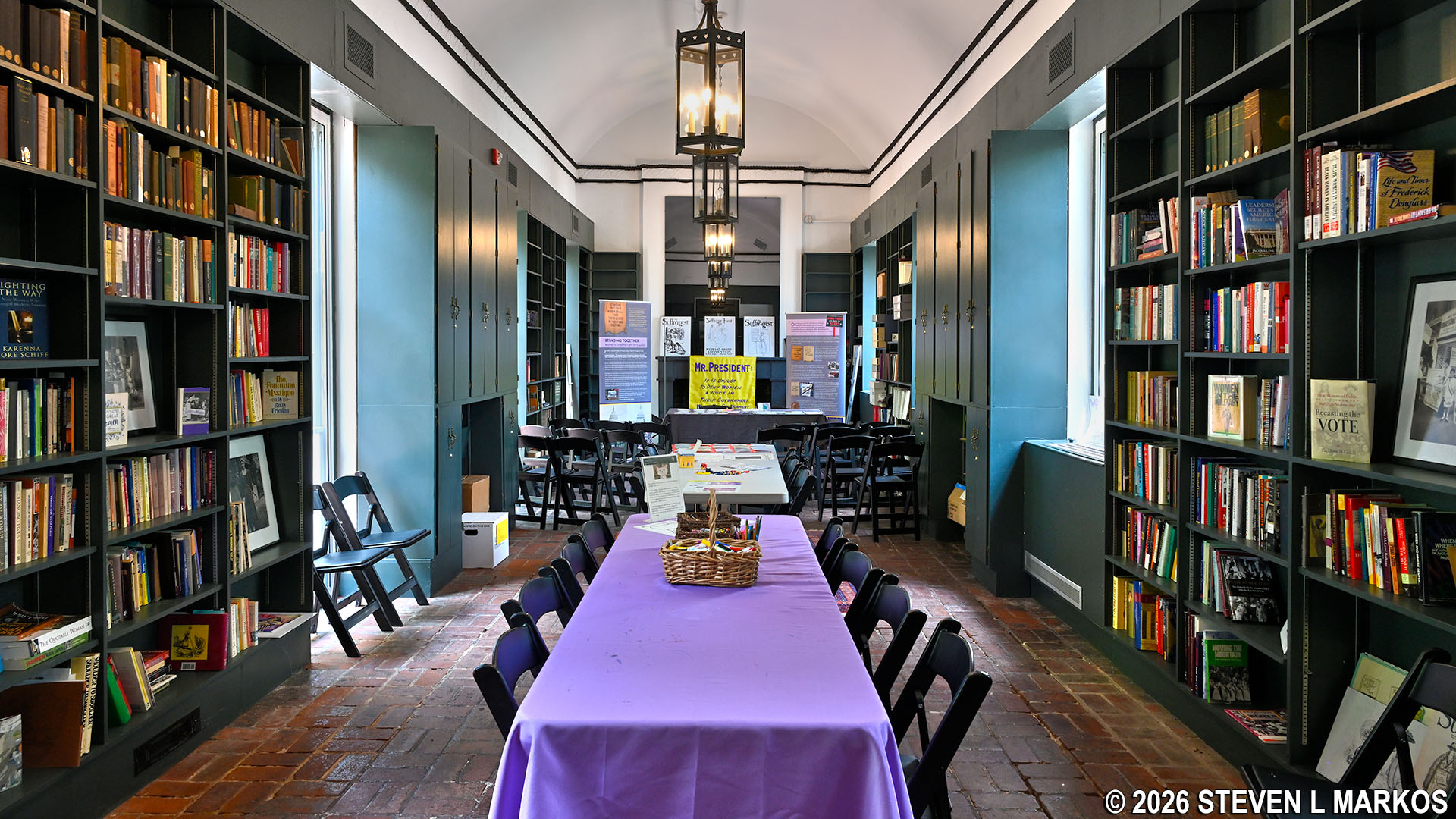
Florence Bayard Hilles Feminist Library at Belmont-Paul Women’s Equality National Monument in Washington, D.C.
With a few exceptions, use of any photograph on the National Park Planner website requires a paid Royalty Free Editorial Use License or Commercial Use License. See the Photo Usage page for details.
Last updated on July 23, 2026


