
PLAN YOUR TRIP
PARK OVERVIEW
Belmont-Paul Women’s Equality National Monument is located inside the Sewall-Belmont House in Washington, D. C. Be aware that this is not a house museum lavishly decorated with period furniture. It is in fact a museum dedicated to the women’s suffrage movement that led to the passage of the 19th Amendment in 1920 outlawing sexual discrimination in regards to voting. The house was purchased by Alva Belmont for use as the National Women’s Party (NPW) headquarters starting in 1931. It remained in the hands of the NWP, functioning in later years as a museum, up until 2016. At that point, dwindling membership and mounting costs of upkeep spurred the organization to seek federal government assistance to help preserve the building and it connection to women’s history. This led to the house being donated to the National Park Service for the creation of Belmont-Paul Women’s Equality National Monument, which was authorized by Barrack Obama per the Antiquities Act.
Prior to the National Park Service taking ownership of the property, the house was operated by the NWP as the Sewall-Belmont House Museum and Library in partnership with the National Park Service. It was still a women’s suffrage museum, and most of the exhibits in the house today are the same as from the Sewall-Belmont days.
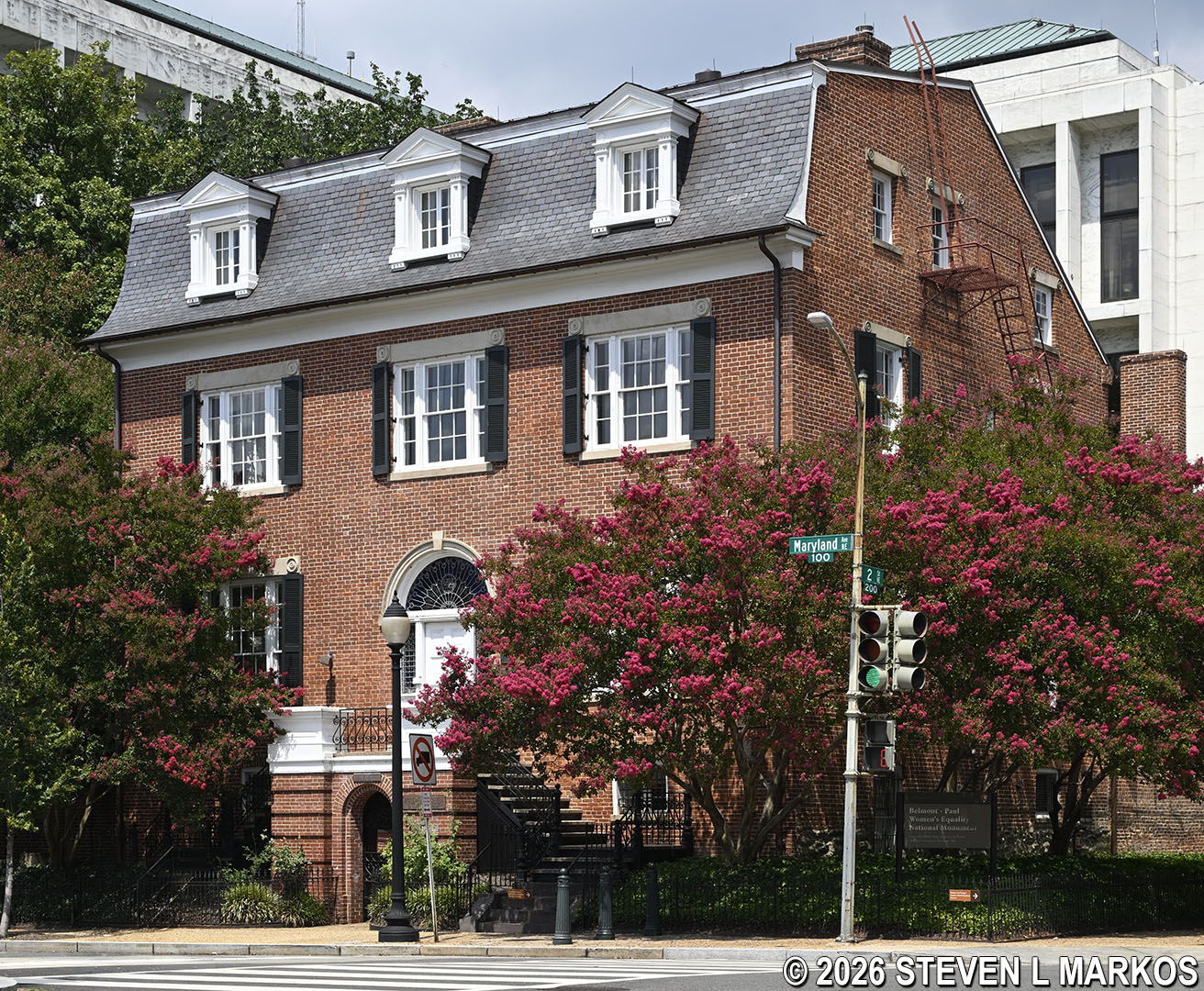
Sewall-Belmont House is now home to Belmont-Paul Women’s Equality National Monument in Washington, D.C.
The Sewall part of the name comes from Robert Sewall. He originally built a house on the property in 1800 for use as a rental property that he marketed to people moving to the newly established capital of Washington, D. C. During the War of 1812, the house was one of very few private residences torched by the British during their invasion of Washington on August 24, 1814. The British set out to only burn public buildings, but American soldiers took up position in the Sewall house and fired on the British. Sewall rebuilt a modified version of the house in 1820.
The Sewall Family owned the house up until 1922, though it had sat vacant and deteriorating since 1912. It was purchased and remodeled by Senator Porter Dale of Vermont. He and his wife lived in it for seven years before putting it up for sale in 1929. It was purchased by the very wealthy Alva Belmont, who at the time was the president of the NWP. Her first husband, whom she divorced, was William Vanderbilt, grandson of Cornelius Vanderbilt, and her second husband was Oliver Belmont, whose father, August Belmont, founded the Belmont Stakes horse race. Alva purchased the house specifically for use as the NWP’s headquarters, not as a residence. The building was remodeled once again, and in 1931, the NWP moved in.
Once the Sewall-Belmont House became part of the National Park system in 2016, the name was changed to Belmont-Paul Women’s Equality National Monument. Alice Paul was a co-founder of the NWP. She had previously been a member of the National American Women Suffrage Association (NAWSA), the most prominent organization involved in the women’s suffrage movement. While the NAWSA wanted to get suffrage laws passed on the state level, Paul felt this was a waste of time since many conservative states would never pass such laws. Instead, her focus was on getting an amendment to the United States Constitution passed, as only three-fourths of the states had to ratify it, yet all states would now be bound by it.
In 1913, Paul and colleague Lucky Burns formed the Congressional Union for Woman Suffrage (CU) to assist the NAWSA’s Congressional Committee, its lobbying organization. While Paul and Burns were both part of the Congressional Committee, the CU allowed them to use their more militant tactics such as marches and protests to get a voting rights amendment passed. The differences in philosophy between the CU and the NAWSA led Paul and Burns to split with NAWSA the following year. In 1916 the two formed another organization, the Women’s Party of Western Voters (NPWV). In March 1917, the CU and NPWV merged to become the National Women’s Party.
When visiting destinations in Washington, D. C., don’t be a dummy and drive downtown. Take the metro. There are two stations within a half-mile of Belmont-Paul Women’s Equality National Monument. Union Station (Red Line and Amtrak) is 0.4 miles away and the Capitol South Station (orange / blue / silver lines) is 0.6 miles away.
OPERATING HOURS
The Sewall-Belmont House was recently renovated, and now Belmont-Paul Women’s Equality National Monument is open year-round on Fridays through Sundays from 10 AM to 5 PM. During Women’s History Month in March, it is typically open on Wednesdays and Thursdays as well. Keep in mind that times can always change, so be sure to check the National Park Service’s Operating Hours and Seasons web page for the current schedule.
ENTRANCE FEE
There is no fee to visit Belmont-Paul Women’s Equality National Monument.
SCHEDULING YOUR TIME
Museum Tour
allow 1 to 1.5 hours
With a few exceptions, use of any photograph on the National Park Planner website requires a paid Royalty Free Editorial Use License or Commercial Use License. See the Photo Usage page for details.
Last updated on August 27, 2026


