
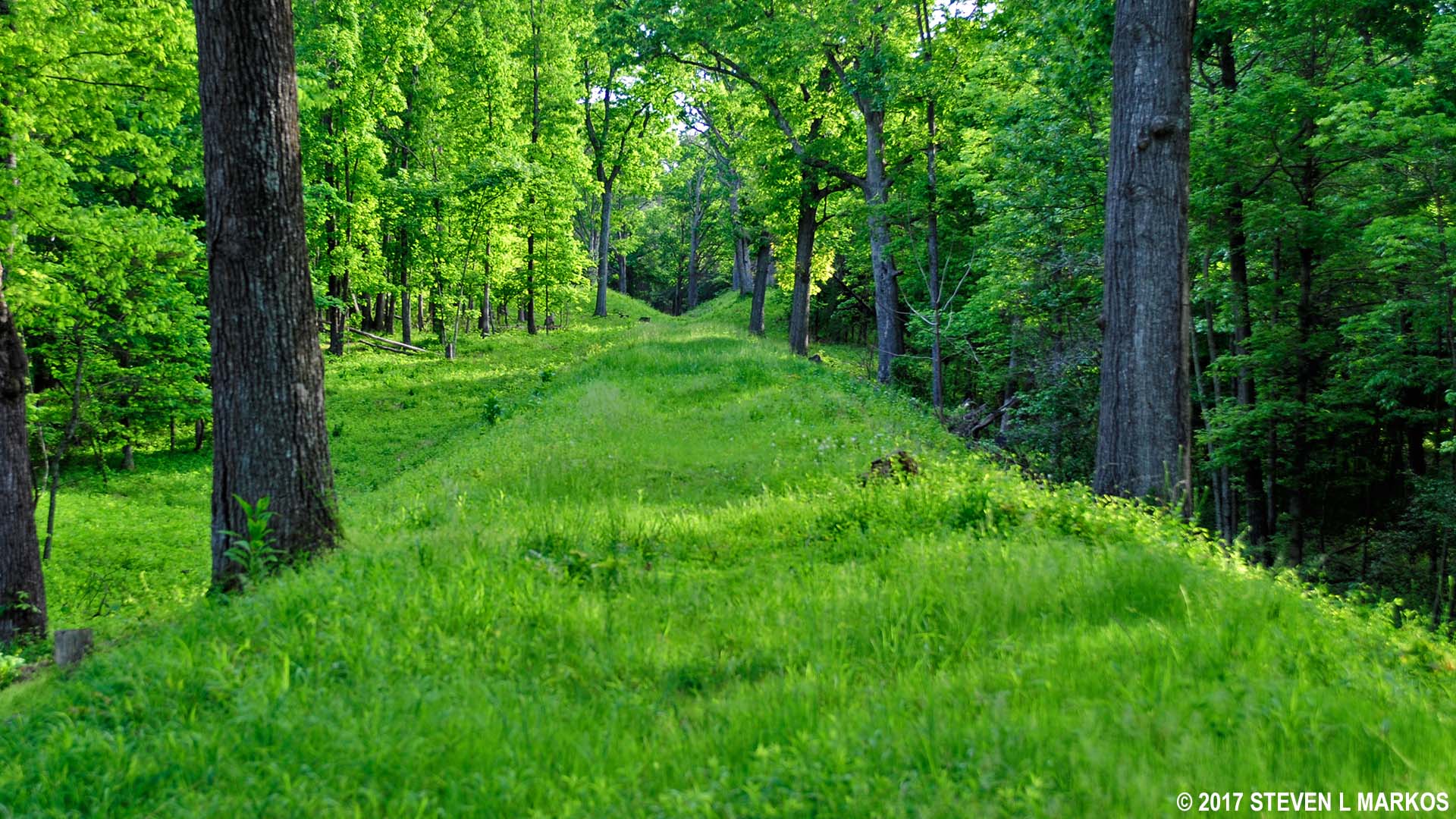
Top of the elevated railroad bed on the Unfinished Railroad Loop Trail in Manassas National Battlefield Park
SECOND MANASSAS BATTLEFIELD TOUR
STOP 6: UNFINISHED RAILROAD
Allow 5 minutes to one hour (if you hike the Unfinished Railroad Loop Trail)
See the Second Manassas Battlefield Tour web page for a tour map.
GETTING THERE
The Unfinished Railroad stop on the Second Manassas Battlefield Tour is located on Featherbed Lane, which is a dirt road, and not the smoothest of dirt roads. From the Sudley Church tour stop, continue north on Sudley Road and turn left after passing the church. It is a long drive down to the Unfinished Railroad parking lot, which will be on your left.
WHAT TO SEE
The Unfinished Railroad stop is one where you must do some hiking in order to truly understand the events that took place here because everything depends on the terrain. From the parking lot you cannot see anything other than one wayside exhibit.
HIKING TRAILS
The Unfinished Railroad Loop Trail is an easy 1.25-mile hike along level terrain. It is one of the more enjoyable hikes at Manassas National Battlefield Park.
EVENTS AT THE UNFINISHED RAILROAD
The Unfinished Railroad got its name from the fact that a railroad bed had been built, but no tracks were ever laid because the Manassas Gap Railroad ran out of money before completing the project, an Alexandria to Gainesville rail line. It is behind this elevated rail bed that Confederate General Stonewall Jackson positioned his troops to defend against Union attacks until the rest of General Robert E. Lee’s army arrived to provide reinforcements.
To keep the tracks out of the water in case of flooding, the railroad was built on an elevated platform created by digging ditches on either side of the route and piling the dirt in the middle. This artificial hill provided the Confederates with an excellent place to hide behind. Soldiers could spend days digging a trench and building a similar wall—here was one already completed. It would not only slow down attacking Union soldiers, but they would have to scale the hill before charging down the other side, which left them exposed to musket and cannon fire.
Jackson was able to use the railroad bed for a number of purposes. As mentioned, one was for defense. He actually had three lines of men behind the rail bed, some as far as 250 yards away. A second use was to cover the movement of men as they shifted left or right. Jackson was heavily outnumbered and his lines were stretched thin, so when Union troops attacked one spot, men not under attack were able to shift and help in the fighting without the Union realizing that the line had just gotten thinner in the area where the troops moved from.
Fighting at the Unfinished Railroad took place all throughout the day on August 29, 1862, the second day of the battle. Attacks on the area emanated from Matthews Hill, and all were meant to be diversionary attacks to keep Jackson occupied and unable to fend off a flank attack on his right, which never came due to the fact that General James Longstreet’s men arrived that morning and blocked the attack that was supposed to have been carried out by Union General Fitz John Porter.
The main problem the Union had with these frontal attacks was that none of them were backed up with reinforcements. On the occasions when soldiers were able to break through the Confederate line, they found themselves stranded and had to retreat to avoid becoming surrounded. A prime example of this was a 3 PM attack by Union General Cuvier Grover. After charging over the railroad bed and successfully infiltrating the Confederates all the way to their third line using a bayonet attack, Grover’s men had to retreat because the hole they created in the line was rapidly being closed behind them by more Confederate soldiers. They left nearly 500 wounded or dead men behind in thirty minutes of fighting. For such an attack to work there has to be a steady stream of troops to keep the door open. As mentioned, the real attack was to come on Jackson’s right near Brawner Farm, so Union General John Pope never really meant for his troops at the Unfinished Railroad to work themselves that deep behind enemy lines, and thus offered no form of support.
Next Stop: Deep Cut | Previous Stop: Sudley Church Area
With a few exceptions, use of any photograph on the National Park Planner website requires a paid Royalty Free Editorial Use License or Commercial Use License. See the Photo Usage page for details.
Last updated on June 17, 2025


