

Santa Barbara Bastion of Castillo San Felipe del Morro, San Juan National Historic Site
Castillo San Felipe del Morro Main Page
Construction on the first iteration of Castillo San Felipe del Morro (aka El Morro) began in 1539. The fort consisted of a rook-like circular tower with four interior embrasures (windows that cannon fired out of) and a lower battery directly in front of it, similar to the Water Battery that exists today. A drawing from 1591 also shows that a bayside and oceanside battery of some sort had been built along with a rudimentary hornwork at the rear of the fort to protect it from a land invasion. Because El Morro was designed to defend against an attack from the sea, less emphasis was put on the rear fortifications, and as a result, the fort was captured by the English in 1598. However, an outbreak of dysentery two months later forced the English to abandon Puerto Rico, leaving the Spanish in control once again.

1591 Drawing of El Morro
The British defeat prompted the Spanish to overhaul the fort, and starting in 1601 the rear hornwork was the main focus. Plaques currently on both the Austria and Ochoa bastions are dated 1606, though historical documents suggest construction continued slowly for fifteen more years due to budget constraints. The completed hornwork does show up on a 1625 drawing. (For an explanation of what is a bastion and a hornwork, see the Hornwork and Cavalier of Castillo San Felipe de Morro web page here on National Park Planner.)
Once the hornwork was finished, work began on what many historians believe was the first version of the Santa Barbara Bastion, the triangular fortification facing the ocean. A structure similar to what stands today appears on an architectural drawing done in 1742, so the Santa Barbara Bastion could have been built anytime between 1625 and 1742, with some evidence pointing to a 1676 completion date. It is difficult to pin an exact date of much of El Morro’s construction because there are decades between existing historical documents pertaining to the fort.
The new Santa Barbara Bastion replaced the original tower, but instead of tearing it down, the bastion was built around the tower, essentially enclosing it in what is known as the toe: the forward-most section near the ocean. This makes Santa Barbara unique among El Morro’s other bastions: Ochoa, Austria, Carmen, and Mercado. All of these are filled with earth and rubble—there are no interior rooms. By simply enclosing the 1539 Tower within the bastion, a ready-made interior was created.
The new bastion was much taller than the tower, but there was initially no platform over the top of it as there is today. Documents do point to the eventual construction of a platform, possibly by 1678. The red circle in the graphic below indicates the tower’s approximate location in the toe. The Original Tower is still accessible, and visitors to the fort can get to it from the Lower Plaza.
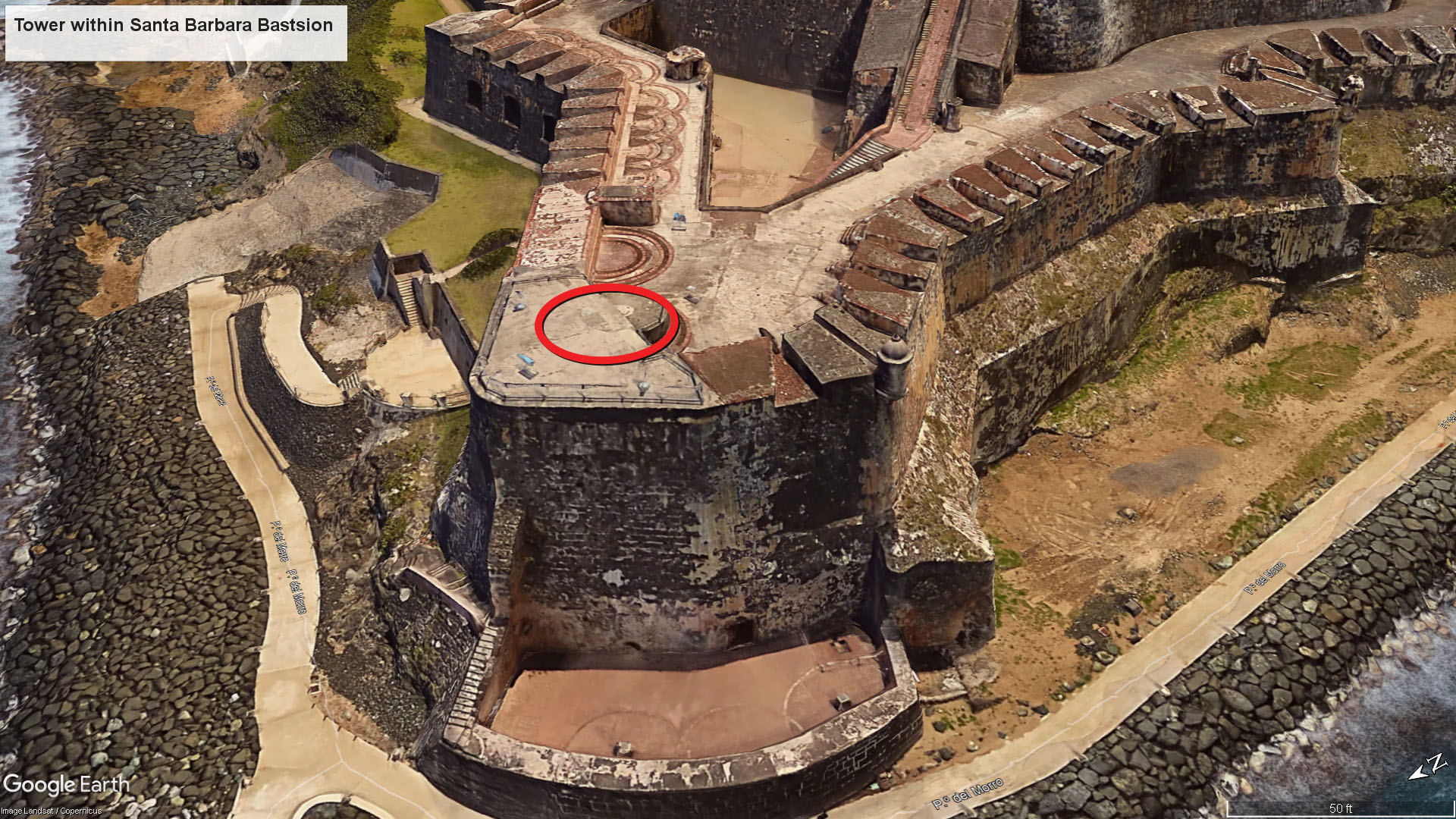
Approximate location of the 1539 Tower within the Santa Barbara Bastion of Castillo San Felipe del Morro
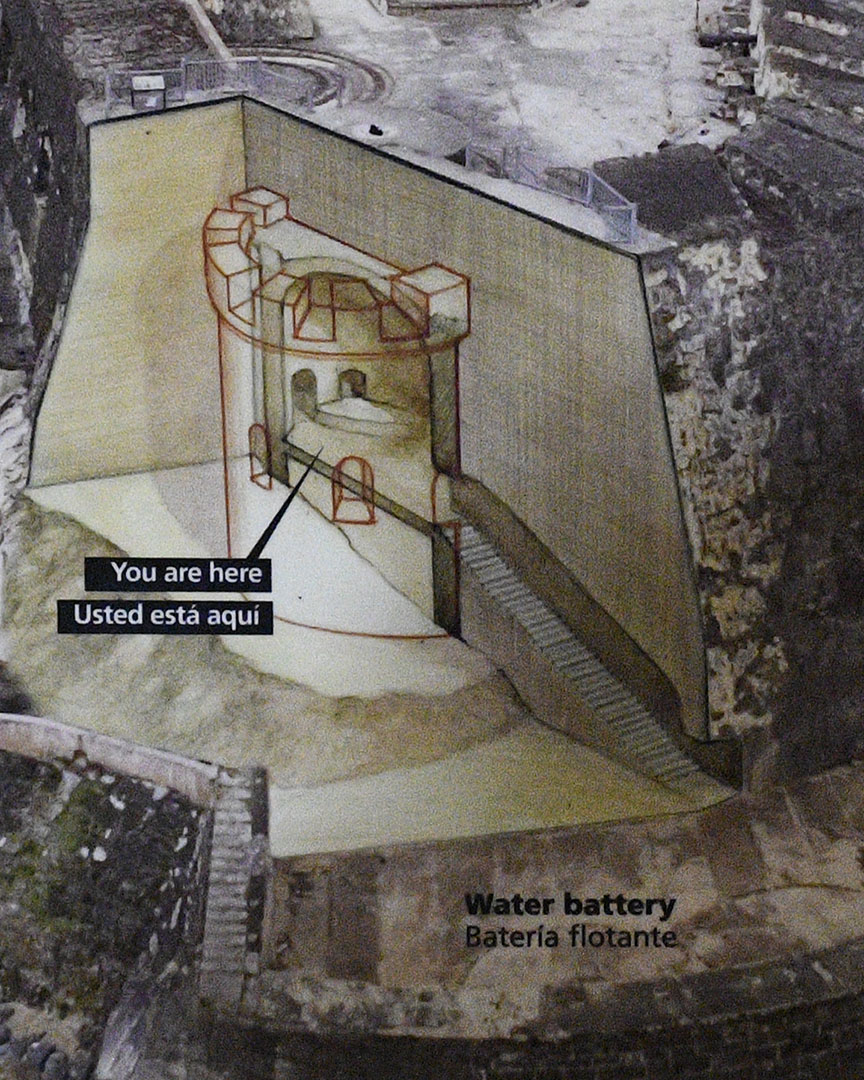
Graphic depicting the 1539 Tower within the Santa Barbara Bastion of Castillo San Felipe del Morro
A bayside battery also appears on the 1742 drawing. Called the Granados Battery, it is believed to have been built around 1700. It was not as tall as the battery that exists today, but neither was the toe. In the graphic below, the red line indicates the speculated top of the Granados Battery. The current battery was built on top of it.

Possible top of the Granados Battery of Castillo San Felipe del Morro’s original Santa Barbara Bastion
There was no oceanside battery as there is today. Instead, a wall ran from the Mercado demi-bastion (small structure attached to today’s Carmen Bastion) to the toe of the new Santa Barbara Bastion. Furthermore, the massive rear wall that now separates the oceanside fortifications from the landside fortifications was originally nothing more than a short retaining wall.
The Santa Barbara Bastion that stands today is the result of the second major overhaul of El Morro that was carried out by the Spanish between 1770 and 1790. It was at this time that the rear wall was built higher and thicker (now called the Great Wall) and the staircase from the Plaza de Armas was added. The walls of the toe were raised approximately 11 feet, as was the terreplein (artillery deck). Casemates were built on the Lower Plaza, and these supported a new oceanside battery and a wider terreplein for the bayside battery, which was raised to the same height as the toe. Today the entire terreplein of the Santa Barbara Bastion—toe and both batteries—is the same level.

Santa Barbara Battery of Castillo San Felipe del Morro

Staircase from the Plaza de Armas to the Santa Barbara Bastion and Lower Plaza of Castillo San Felipe del Morro, San Juan National Historic Site
The Lower Battery was removed and replaced by the Water Battery. The embrasure in the Original Tower that was converted into a doorway to reach the Lower Battery was filled in, and another embrasure was converted into a doorway for the Water Battery. New stairs were then installed. This doorway and stairs are still used today by visitors to get to the Water Battery.

Door in the Original Tower to the Water Battery of Castillo San Felipe del Morro, San Juan National Historic Site
A circular staircase was built on the oceanside battery, connecting its terreplein to the Lower Plaza directly below. The doorway on the battery is located at a circular structure on the terreplein. Visitors to the fort can take this staircase or the main staircase down to the Lower Plaza. (The photo below shows the structure, but the door is on the other side.)

Entrance on the Santa Barbara Bastion terreplein to a circular staircase that leads to the Lower Plaza of Castillo San Felipe del Morro, San Juan National Historic Site
Two sentry boxes were also added to the bastion, one at the bayside corner of the toe and one on the bayside battery.

Sentry box added to the toe of El Morro’s Santa Barbara Bastion, San Juan National Historic Site
The bayside battery that stands today is unaltered from its late 18th century appearance. It still sports its original parapet and embrasures, and a cannon from the 1700s is on display. A parapet is an extension of the fort wall that rises above the terreplein. Soldiers stand behind it for protection when firing muskets or cannon during a battle. The gaps in the parapet are the embrasures. Steps in front of the parapet allow soldiers to get up high enough to see or shoot over the wall.

Cannon on the Santa Barbara Bastion of Castillo San Felipe del Morro aims through an embrasure on the bayside battery, San Juan National Historic Site

Steps on the terreplein of Castillo San Felipe del Morro’s Santa Barbara Bastion allow soldiers to get a view over the parapet, San Juan National Historic Site
The oceanside battery, on the other hand, was altered by the Spanish in the mid- and late 1800s to accommodate the latest artillery. Unlike the 18th century cannon that were simply rolled into place on small carriages and could only shoot straight ahead through the embrasure, the modern guns were mounted on large, pivoting carriages that elevated them above the parapet so that they could easily be rotated left or right. The front of the carriage was attached to a pintle that held it in place, and the rear wheels sat on tracks (typically iron) embedded into the ground so that they rolled smoothly. The photo below is of a Rodman gun from the mid-1800s at Fort Moultrie in South Carolina, part of Fort Sumter and Fort Moultrie National Historical Park. While not the gun or carriage used at El Morro, it illustrates the general idea of how the pivoting carriages worked.

Rodman gun and carriage at Fort Moultrie in South Carolina
Ten of the new gun emplacements were installed on the oceanside battery. These used blocks of limestone instead of iron for their tracks. The pintles have been removed, but if you want to see what they looked like, the ones on the Ochoa Bastion are still in place.

Mid-1800s gun emplacement on the oceanside battery of El Morro’s Santa Barbara Bastion, San Juan National Historic Site
The toe of Santa Barbara has also been modified, both by the Spanish and the United States Army. Two large gun emplacements were installed in the mid-1800s (one has been covered by a World War I-era emplacement) and the embrasures were filled in. These may have accommodated large guns such as the Rodman (the Spanish did buy artillery from the United States). Both the pintles and the iron tracks have been removed.

Mid-1800s gun emplacement at the toe of El Morro’s Santa Barbara Bastion, San Juan National Historic Site
The very end of the toe was outfitted with a concrete gun platform by the U. S. Army during World War I. On it was installed a 4.72-inch Armstrong rapid-fire gun that remained in place until 1942. It was removed at that time to clear the path for searchlights and so that soldiers stationed in the observation posts had a better view. The platform was built to the same height as the parapet. This is the best place on the Santa Barbara Bastion to take photos because the parapet does not block the view.

World War I-era platform for a gun emplacement at the toe of El Morro’s Santa Barbara Bastion, San Juan National Historic Site
With a few exceptions, use of any photograph on the National Park Planner website requires a paid Royalty Free Editorial Use License or Commercial Use License. See the Photo Usage page for details.
Last updated on March 28, 2024


