

Cannon on the terreplein of Castillo San Felipe del Morro’s Austria Bastion, San Juan National Historic Site
Upon entering Castillo San Felipe del Morro (aka El Morro), you will be on the Plaza de Armas (main plaza). At either end is an archway. To get to the Austria Bastion, if facing the fort entrance, head towards the archway on your right. On the way up the ramp to the terreplein (artillery deck) is a gunpowder magazine (open to visitors) and a staircase that leads down to the Santa Barbara Bastion (closed to visitors), the bastion on the ocean side of the fort. There is also an empty room on the right. These are some of the only rooms inside any of the bastions at El Morro, for nearly all of the interiors are filled in with dirt and rubble.

Ramp to the top of the Austria Bastion of Castillo San Felipe del Morro, San Juan National Historic Site
The Austria Bastion makes up one part of El Morro’s hornwork, which are the structures you see as you walk across the esplanade (large field) from Norzagaray Street towards the fortress. Comprised of two bastions connected by a curtain (term for a wall between two defensive structures), these protected the fort from a land attack. There was a rudimentary hornwork when the fort was first built in 1539, but after it was captured and temporarily held by the British in 1598, the Spanish built an improved hornwork in the early 1600s. This was subsequently torn down and rebuilt in the 1770s, and this is the structure standing today.

Hornwork of Castillo San Felipe del Morro, San Juan National Historic Site
There have been very few modern modifications to the Austria Bastion since its 1770s iteration. An emplacement for a howitzer was installed by the Spanish in 1897 in anticipation of a war with the United States, but it was removed around 1940 by the U. S. Army, which after winning the war that did materialize—the Spanish-American War of 1898—occupied Puerto Rico. The lighthouse that now sits atop the Ochoa Bastion was originally on Austria. The Spanish moved it in 1876 and replaced it with a signal tower. The U. S. Army removed the tower around 1940 and installed a water tower in its place. This also no longer exists.
The tall structure lining the perimeter of the bastion is the parapet, a wall that provides protection for infantry- and artillerymen. The gaps in the parapet through which cannon fired are called embrasures. There are a few replica cannon on carriages at Austria that demonstrate how the guns would have been placed.

Cannon on the terreplein of Castillo San Felipe del Morro’s Austria Bastion, San Juan National Historic Site
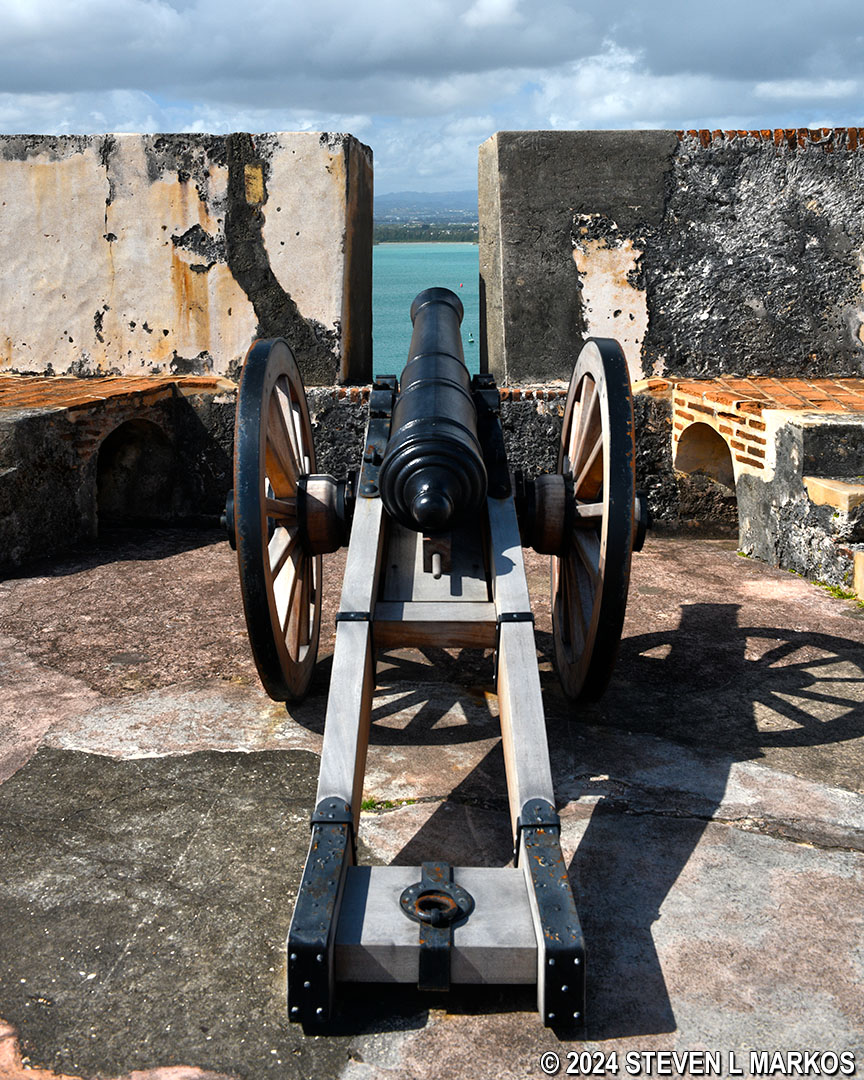
Cannon aims through an embrasure in the parapet at the Austria Bastion of Castillo San Felipe del Morro, San Juan National Historic Site
At the southern corner is a sentry box that visitors can walk into. This was restored by the U. S. Army in the late 1930s. The top had been removed in the 1860s.

Sentry box on the Austria Bastion of Castillo San Felipe del Morro, San Juan National Historic Site
When inside, look down to the right to see the ramp of the San Fernando Battery. It is possible to walk to the battery, otherwise the only way to see it is from a boat on the ocean. This battery appeared on a fort plan from 1742, but the exact date of its construction is unknown.

San Fernando Battery at Castillo San Felipe del Morro, San Juan National Historic Site
With a few exceptions, use of any photograph on the National Park Planner website requires a paid Royalty Free Editorial Use License or Commercial Use License. See the Photo Usage page for details.
Last updated on April 8, 2024


