

Visitor Center and Museum at Flight 93 National Memorial
OPERATING HOURS
The Flight 93 National Memorial Visitor Center and Museum is open year-round from 9 AM to 5 PM, except when closed on Thanksgiving, Christmas, and New Year’s Day.
AMENITIES
- Ranger-staffed information desk where you can pick up a free park brochure and other information
- Large museum
- Book and souvenir store
- Overlook of crash site
- Restrooms (in the adjacent Learning Center building)
LEARNING CENTER
The stand-alone building next to the parking lot for the Flight 93 National Memorial Visitor Center Complex is the Learning Center. This is not open to the public unless events such as lectures, classes, and seminars are being held. It also houses the visitor restrooms, which are accessible without entering the main part of the building.

Learning Center at Flight 93 National Memorial
FLIGHT PATH WALKWAY
Starting at the Visitor Center parking lot is a walkway made of black granite that passes through gaps in two concreate walls clad in marble and ends at an overlook platform. This walkway follows the flight path of United 93 just before it crashed into the field below at 10:03 AM on September 11, 2001.

Flight Path Walkway at Flight 93 National Memorial in Shanksville, Pennsylvania
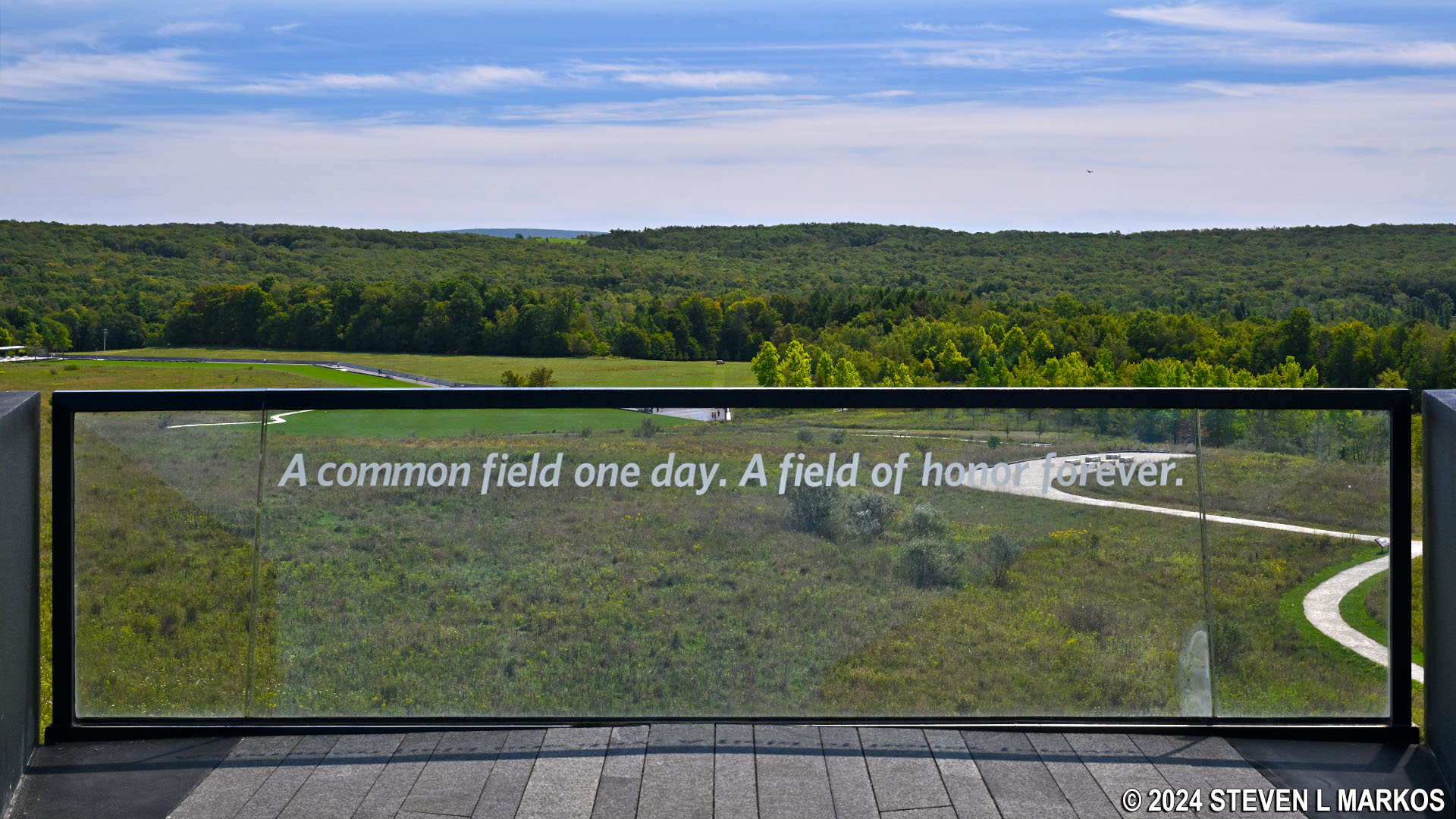
Observation deck at the end of the Flight Path Walkway at Flight 93 National Memorial

View of the Flight 93 crash site from the observation deck at the end of the Flight Path Walkway at Flight 93 National Memorial (boulder marks the impact site)
The Flight Path Walkway actually continues at the Wall of Names. It runs right in front of the wall, and if you look back up the hill towards the Visitor Center, you can see that it aligns precisely with the observation deck.

Flight Path Walkway continues at the Wall of Names at Flight 93 National Memorial
The Flight Path Walkway ultimately ends at the left side of the Wall of Names at the Ceremonial Gate. Made from hemlock beams—the same trees that line the field where United 93 crashed—the gate features 40 cut angles, one for each passenger and crew member who died (minus the terrorists, of course). Beyond the gate is the sandstone boulder that marks the impact crater created when the Boeing 757 hit the ground at 563 miles per hour.

Ceremonial Gate at the Flight 93 National Memorial Wall of Names
FLIGHT 93 MUSEUM

A major fire burned down Flight 93 National Memorial’s temporary headquarters on October 3, 2014. While this sounds like nothing more than a park administration problem, the memorabilia that was to go into the Flight 93 Museum was housed in this building. Much was lost, including the flag that flew over the U. S. Capitol building on 9/11, but luckily ninety percent of the collection was stored off site. While the cream of the crop was destroyed, there are still plenty of artifacts and other memorabilia on display.
The Flight 93 Museum is located inside the main Visitor Center building. The museum is comprised of five double-sided panels that jut from one wall of the building, each focusing on a different topic. The information from one panel to the next follows a logical and somewhat chronological progression of events that occurred on September 11, 2001. Topics include a timeline of overall 9/11 events including a condensed version of news footage from CNN; a timeline of how Al-Qaeda came into being and information on some of its other exploits; the number of flights in the air on September 11th; a timeline of United 93 from departure to crash; the layout of the airplane (a Boeing 757-222) and recordings of three phone calls made by United 93 passengers that were captured on answering machines when family members did not pick up the phone; the military response to the terrorist attacks; local law, fire, and medial department response to the crash in Shanksville; the FBI’s investigation and actual items found at the crash site; a collection of items left at the early makeshift memorials; and an interactive exhibit about all passengers and crew that gives biographical information, tributes, photos from their lives, and photos of personal items that survived the crash.

Visitors can listen to three phone calls made by passengers on United 93 (photo by Tom Wolf)

Collection of items left at the United 93 crash site memorials (photo by Tom Wolf)
The Flight 93 Museum is one of the best National Park Service museums that I have been to…and I’ve been to a lot of them. Despite knowing a good bit about United 93, there were plenty of new facts that I learned at the museum.
• My knowledge of United 93 largely comes from the excellent film by Paul Greengrass, United 93. The film jumps around between FAA headquarters, NORAD’s Northeast Air Defense Sector command center, and the passengers on the airplane. The story is told over the course of roughly two hours, and I never gave any thought as to how much time the events on the airplane actually covered. I just lumped everything into the two-hour ordeal. Therefore, I was very surprised to learn that from the time the terrorists took over United 93 until the time the passengers started discussing fighting back was just ten minutes. The actual assault took place about 30 minutes after the hijacking and lasted six minutes.

United 93 timeline exhibit at the Flight 93 Museum (photo by Tom Wolf)
• I knew that all four airplanes hijacked by the terrorists were supposed to take off and hit their targets about the same time so that the U. S. government had no time to intervein. I knew that the reason the passengers on United 93 were aware of what was going on was because the plane was so late in taking off. When they made phone calls from the airplane to family members, they were informed about the World Trade Center crashes, so they knew the terrorists were on a suicide mission. However, I did not know that it departed so late that it took off only four minutes before the first airplane hit the World Trade Center.
• An aspect of the tragedy that stuck me as extraordinary was that despite the airplane essentially disintegrating upon impact, entire books, pamphlets, and magazines survived intact. Passenger credit cards, including one of the terrorist’s, survived. It is amazing that such combustible items survived, particularly when a fireball engulfed the area upon impact.
• A video shot from one of the first helicopter’s to arrive at the crash site was an eye opener because the crater in the ground could be seen from the air, but there was no indication whatsoever as to what made it. It’s not like the tail of the airplane was sticking out of the ground or a wing was lying next to it. There were no bodies and no airplane—everything just vanished. If you arrived on the scene with no idea about what had happened, you’d just think that the land owner kept his property a mess. The largest piece of fuselage found was about the size of a front fender and door of a passenger vehicle.
• Despite the airplane disintegrating, the flight data recorder and cockpit voice recorder for United 93 were recovered. No flight recorder was every recovered from any of the airplanes that struck the World Trade Center towers or the Pentagon. Why? The flight recorders of the World Trade Center and Pentagon airplanes certainly survived but were mixed in and lost among the 100,000-plus tons of building debris that were removed from the areas. Manmade items at the Shanksville crash site were easier to find since there was nothing on the field other than items related to United 93.
SCHEDULING YOUR TIME
Because the Flight 93 Museum is about a current event that many people visiting the park lived through, visitors tend to spend more time here than they would at other National Park museums. If you want to read through all of the information, it takes about an hour to do so. Not everyone is that interested, but I can’t see spending less than a half hour if you want to do the museum justice.
With a few exceptions, use of any photograph on the National Park Planner website requires a paid Royalty Free Editorial Use License or Commercial Use License. See the Photo Usage page for details.
Last updated on October 11, 2024


