

Visitor Center at Washita Battlefield National Historic Site
OPERATING HOURS
The Washita Battlefield National Historic Site Visitor Center is open every day from 8 AM to 4:30 PM, except when closed on New Year’s Day, Thanksgiving, and Christmas. Keep in mind that times can always change, so be sure to check the National Park Service’s official Operating Hours and Seasons web page for the latest schedule.
AMENITIES
- Ranger-staffed information desk where you can ask questions and pick up a park brochure
- Book and souvenir store
- Park film
- Exhibit area
- Restrooms
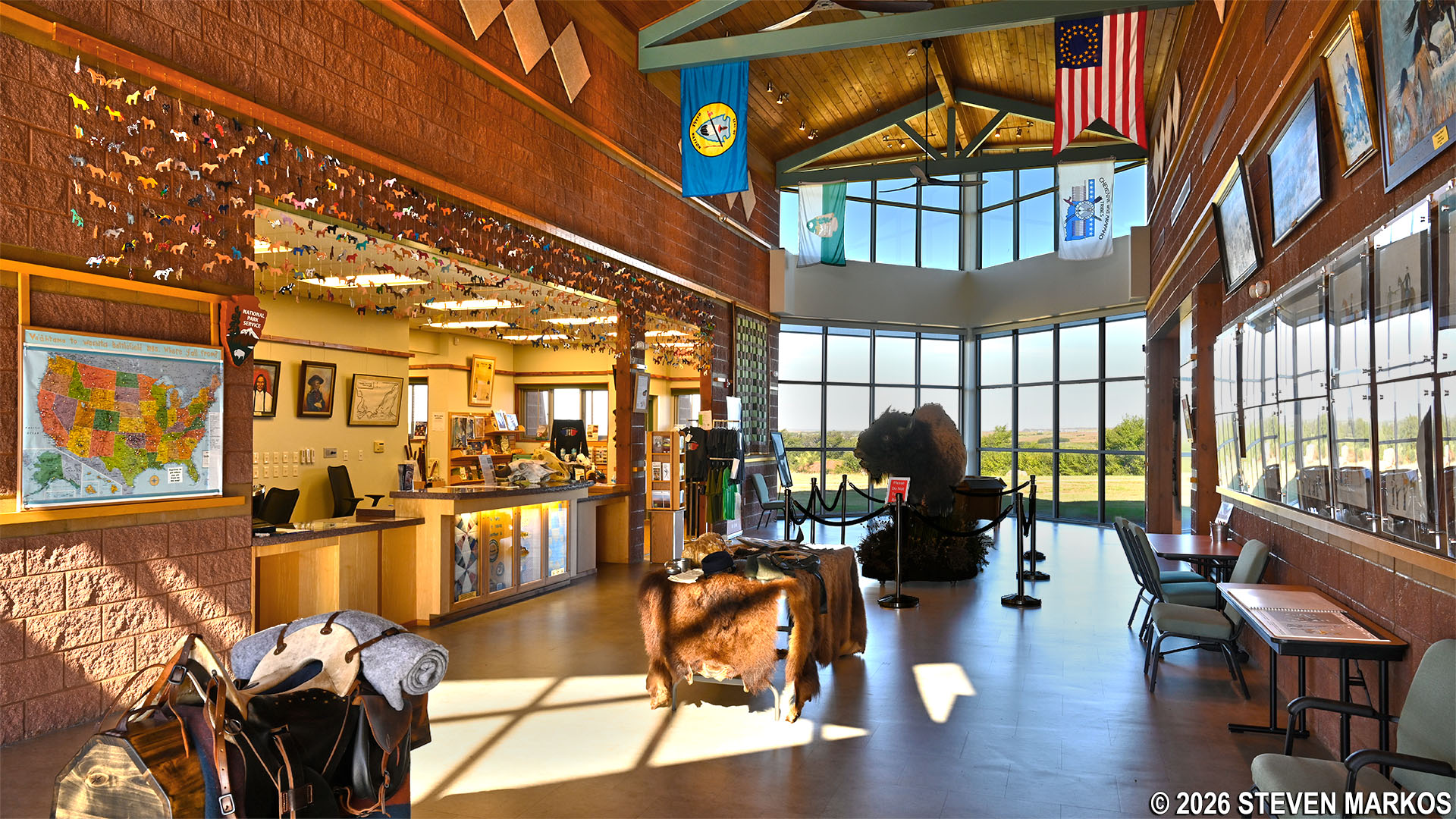
Information desk and souvenir store at the Washita Battlefield National Historic Site Visitor Center
PARK FILM
The 27-minute film Destiny at Dawn: Loss and Victory on the Washita plays on demand in the Visitor Center auditorium. It details events before and during the Battle of the Washita. Featuring live-action and interviews with historians, the film may be too intense for younger children. A few scenes show people falling down after being injured amidst the gunfire, but it does not show anybody actually being shot. There are also some images of blood. What may be more disturbing for young children and even some adults is the film’s retelling of the hundreds of horses that were rounded up and killed after the battle. If you feel that the film may be unsuitable for your family, there is a kid-friendly version that is available upon request.
EXHIBIT AREA

Exhibit area at the Washita Battlefield National Historic Site Visitor Center
The main exhibit area inside the Washita Battlefield National Historic Site Visitor Center is mostly comprised of information panels about events leading up to and after the Battle of the Washita. There are also several artifacts on display. It is basically a recap of the park film, so if you saw it and don’t have time for the museum, you should still have a good understanding of the events that took place on November 27, 1868, during the Battle of the Washita.
One of the first exhibits visitors will see upon entering is a large wall map of the Great Plains. It shows the migration paths of the many native tribes that were relocated to Indian Territory (primarily modern-day Oklahoma) after Congress passed the Indian Removal Act of 1830.

Indian migration exhibit at the Washita Battlefield National Historic Site Visitor Center
One exhibit of note covers the numerous treaties between the United States and the Native Americans. Almost 800 treaties were negotiated and signed with various tribes, but less than half were actually ratified by Congress, and even fewer were fully honored. During the 1850s and 1860s, four treaties were negotiated with the Cheyenne and Arapaho. Visitors can read a short summary of each of these at the exhibit.
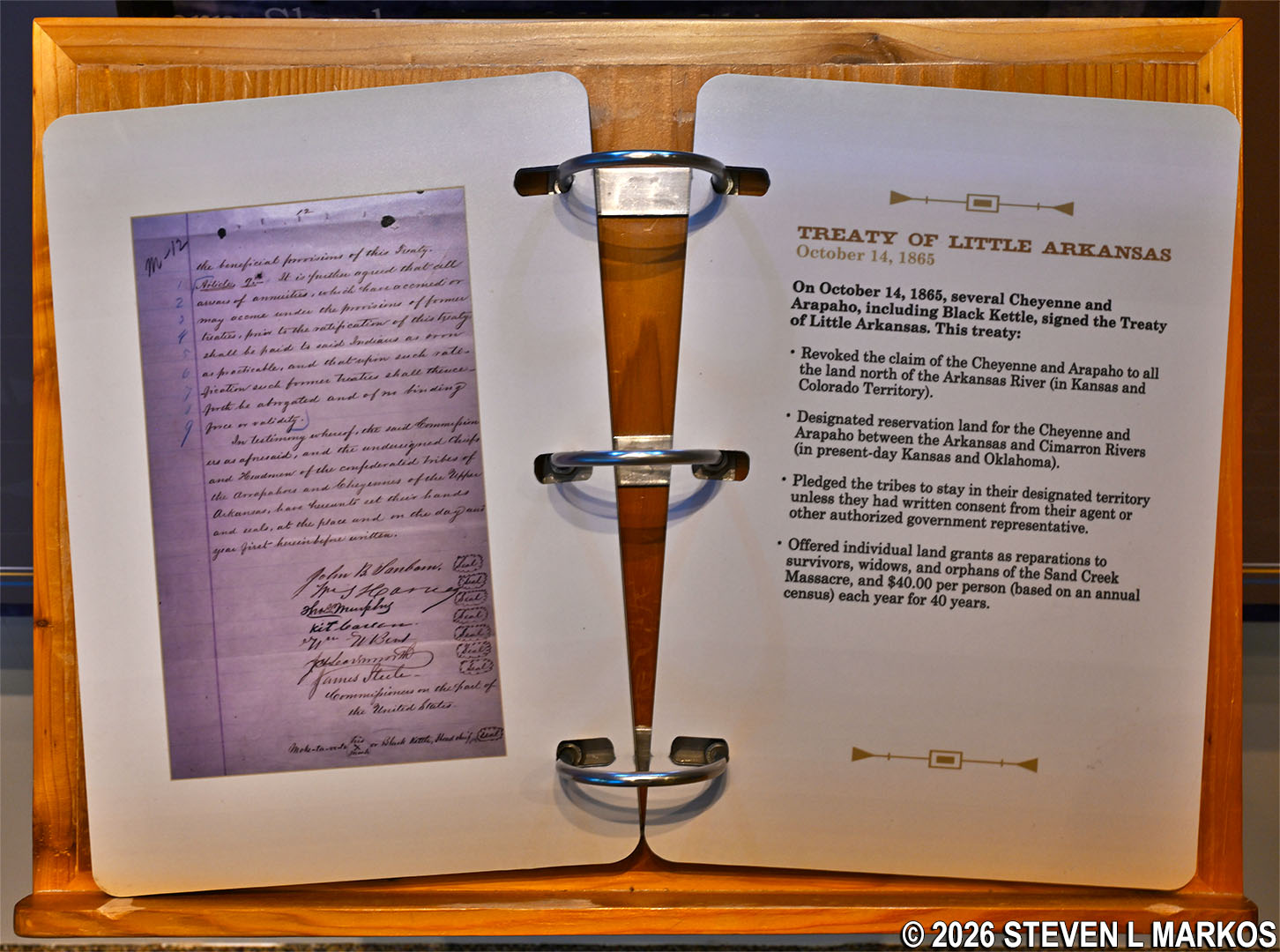
Indian treaties in the exhibit area at the Washita Battlefield National Historic Site Visitor Center
A month and a half before the Battle of the Washita, a caravan of settlers travelling across the Colorado Territory near Sand Creek was attacked by Cheyenne warriors. Twenty-one-year-old Clara Blinn and her two-year-old son were captured and taken to Cheyenne chief Black Kettle’s camp along the Washita River. While in captivity, she was supposedly discovered by Cheyenne Jack, a trader from Fort Cobb. She wrote a letter on November 7th pleading for help and asked Jack to sneak it out of the camp. She also sent a fragment of her dress with it for proof. Regardless of how the letter got out of the camp, it was delivered to Fort Cobb and subsequently printed in many newspapers.
Before help could arrive, Clara and her son were killed, though details of their deaths are controversial. Some accounts state that the two were shot by the calvary during the attack and that the bodies were found near the camp. Custer claimed they were found dead at a nearby abandoned Arapaho or Kiowa camp, perhaps killed in retaliation for the massacre. However, no explanation was presented as to why the Cheyenne would have given the Blinns to the Kiowas, and the Kiowas claimed they had no knowledge of the two. Regardless, the Blinns were found two weeks after the battle. Clara had been shot in the head and her son’s skull had been crushed. They were buried at Fort Arbuckle near present-day Davis, Oklahoma, then later reinterred at Fort Gibson. General Philip Sheridan, commander of the U. S. Army’s Department of Missouri, sent her dress fragment along with other items to her family in an Arapaho pipe bag. On display are the bag, the dress fragment, the letter she wrote, and a clipping from an old newspaper that printed the letter.

Arapaho pipe bag on display at the Washita Battlefield National Historic Site Visitor Center

Dress fragment and letter from Clara Blinn on display at the Washita Battlefield National Historic Site Visitor Center
A replica tipi in the exhibit area provides a great photo opportunity for children (although parents will probably get more enjoyment from having the photos than their kids will have while sitting still for them). The Cheyenne lived a nomadic lifestyle in the Great Plains, migrating with the bison they hunted for food. They often lived in tipis constructed from wooden poles and bison hides. The conical tipis were durable, able to withstand high winds, and easy to transport.

Replica tipi in the exhibit area at the Washita Battlefield National Historic Site Visitor Center
Along the back wall of the museum is a large mural depicting the attack on Black Kettle’s camp. Six small, illuminated panels display quotes from members of the 7th Cavalry and the Cheyenne. Each quote gives their personal insight into what was happening during the Battle of the Washita.

Mural of the Battle of the Washita at the Washita Battlefield National Historic Site Visitor Center
A buffalo robe and a wool blanket on display were taken from a tipi at Black Kettle’s camp after the battle was over. The robe features a design painted by a Cheyenne warrior, which is one of the traditional ways Native Americans showed deep respect for the buffalo.

Cheyenne warrior buffalo robe on display at the Washita Battlefield National Historic Site Visitor Center

Wool blanket, arrows, and clothing on display at the Washita Battlefield National Historic Site Visitor Center
A joint archeological survey of the battlefield was conducted in 1995 by the National Park Service and the Oklahoma Historical Society. Several ammunition artifacts discovered during the survey are displayed in a glass case.

Ammunition artifacts on display at the Washita Battlefield National Historic Site Visitor Center
During the winter of 1890, a military detachment patrolling the Cheyenne and Arapaho Reservation visited the Washita Battlefield. They thought that a marker commemorating the 7th Cavalry’s role in the battle should be placed at the site. Sergeant Thomas Clancy carved the date on a slab of sandstone and placed it atop a pile of rocks. The marker remained there until 1920, at which time it was removed for safekeeping. It is now on display in the Visitor Center.

1890 marker commemorating the 7th Cavalry’s role in the Battle of the Washita on display at the Washita Battlefield National Historic Site Visitor Center
The last section of the museum includes several small panels along the walls. These illustrate the life of the Indians after the battle and display quotes from people over the years about their views of what happened. A section of the panels also tells how Washita Battlefield National Historic Site became part of the National Park system.
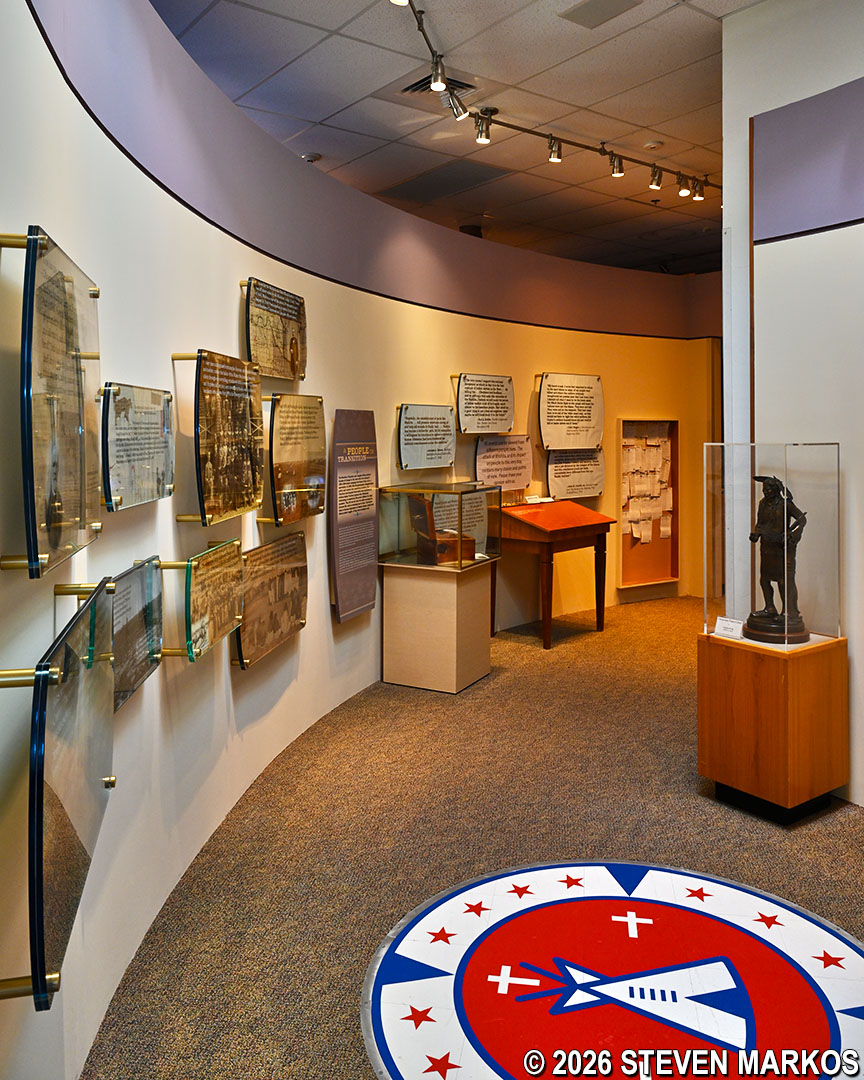
Exhibit area featuring quotes, Indian life after the battle, and a Native ceremonial cedar box at the Washita Battlefield National Historic Site Visitor Center

Information panels on the creation of the Washita Battlefield National Historic Site in the Visitor Center
There are also a few exhibits located throughout the Visitor Center lobby. Impossible to miss is the life-size bison. The Cheyenne have a deep historical and spiritual connection with bison, which were essential for their survival. Bison not only provided food, clothing, and tools, but they also symbolized freedom and harmony with nature for many Native tribes.

Life-size bison on display at the Washita Battlefield National Historic Site Visitor Center
Situated in front of the large window that overlooks the Washita River Valley is a topographic table map of the battlefield. It provides a timeline of the events leading up to and during the attack, as well as important locations on the battlefield and the movements of the 7th Cavalry soldiers.

Topographic table map of the Battle of the Washita at the Washita Battlefield National Historic Site Visitor Center
A touch table in the lobby features objects made from bison that the Cheyenne would have used in the 1800s. There are also items that represent what a 7th Cavalry soldier would have carried with him in the field during battle.

Touch table featuring replica items from the Battle of the Washita at the Washita Battlefield National Historic Site Visitor Center
Right before the auditorium entrance, there is a display case with surgical instruments from the 1860s. While not specific to the Battle of the Washita, it is quite interesting to see what doctors would have used at the time. Military doctors stationed at army posts had to be ready at a moment’s notice to go out into the battlefield.

Display case with surgical instruments from the 1860s at the Washita Battlefield National Historic Site Visitor Center
SCHEDULING YOUR TIME
Plan to spend up to an hour at the Washita Battlefield National Historic Site Visitor Center. This gives you enough time to watch the park film and read through everything in the exhibit area. Of course, if you are eager to head out to the battlefield, you can easily browse through the exhibits more quickly, or as stated earlier, skip them altogether.
With a few exceptions, use of any photograph on the National Park Planner website requires a paid Royalty Free Editorial Use License or Commercial Use License. See the Photo Usage page for details.
Last updated on January 26, 2026


