
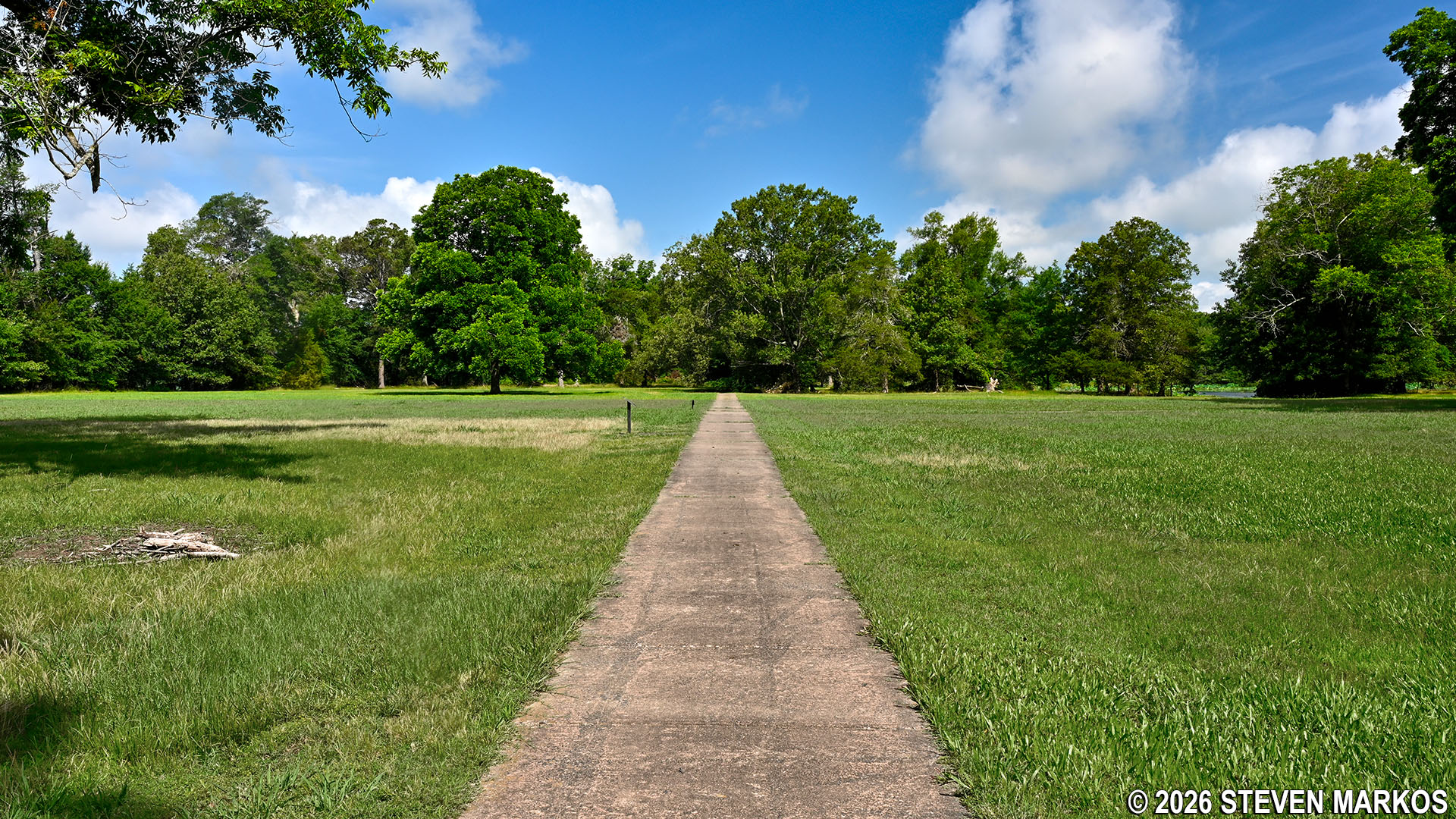
Paved path through the old American-era Arkansas Post Townsite established in the early 1800s, Arkansas Post National Memorial
TOURING THE OLD ARKANSAS POST TOWNSITE
Visitors to Arkansas Post National Memorial can take a walk through the old 1800s American-era townsite along paved paths. The terrain is flat, and by the time you’ve seen everything, you’ll have walked a little over a mile.
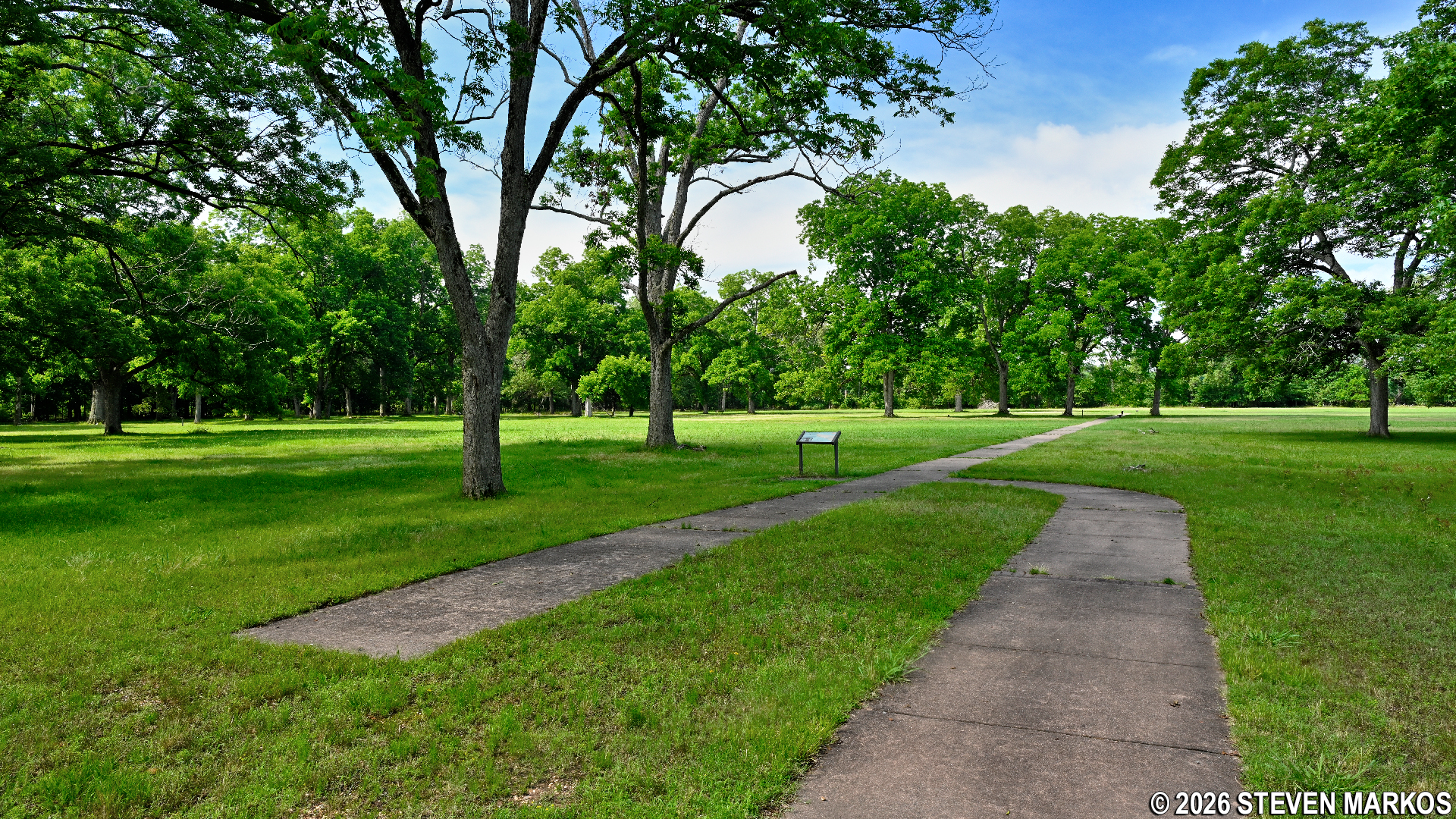
View of the Old Townsite at Arkansas Post National Memorial
Although no buildings remain today, wayside exhibits at some notable locations describe what once stood there. The paths are connected in a grid pattern before reaching Main Street, which leads to Front Street and a short nature trail.
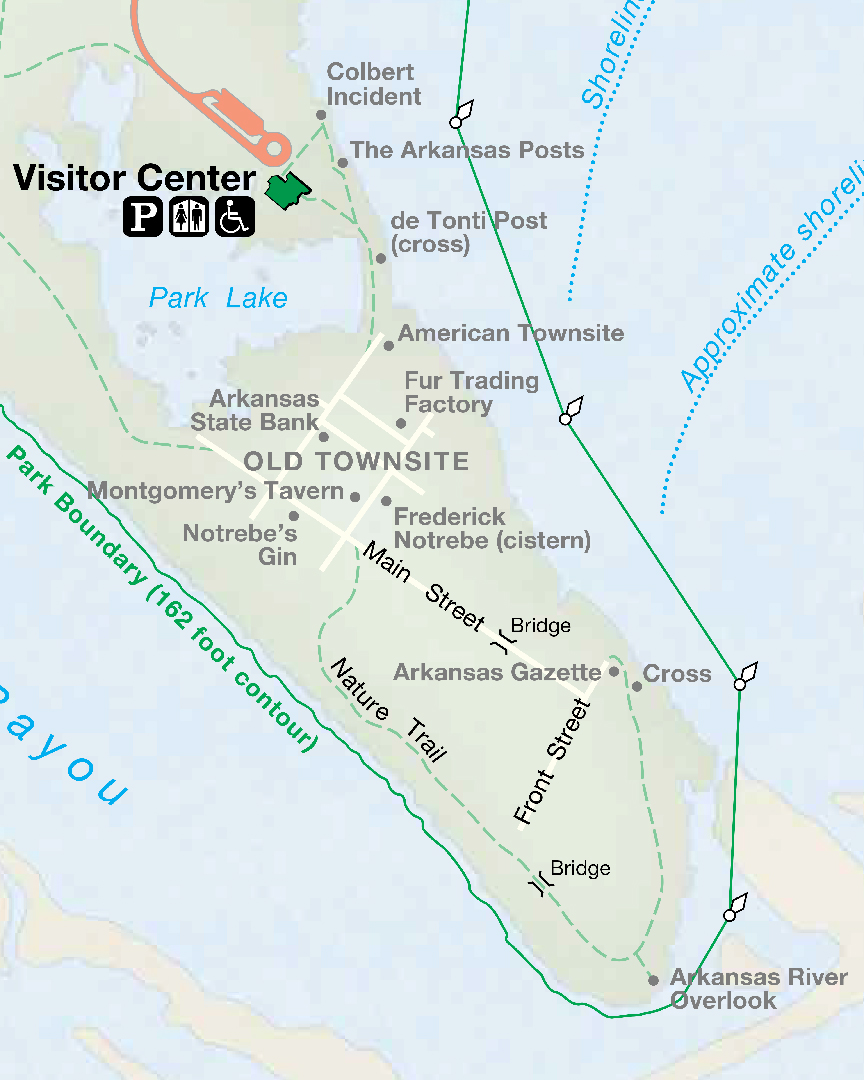
Map of the Old Arkansas Post Townsite
A Fur Trading Factory was built in 1805 (trading posts were also called factories at the time). It was one of the first federal trading posts west of the Mississippi River. Unfortunately, competition from privately owned trading houses forced its closure in 1810. Today, the factory site is underwater in Post Bend, which is the body of water on the east side of the park.
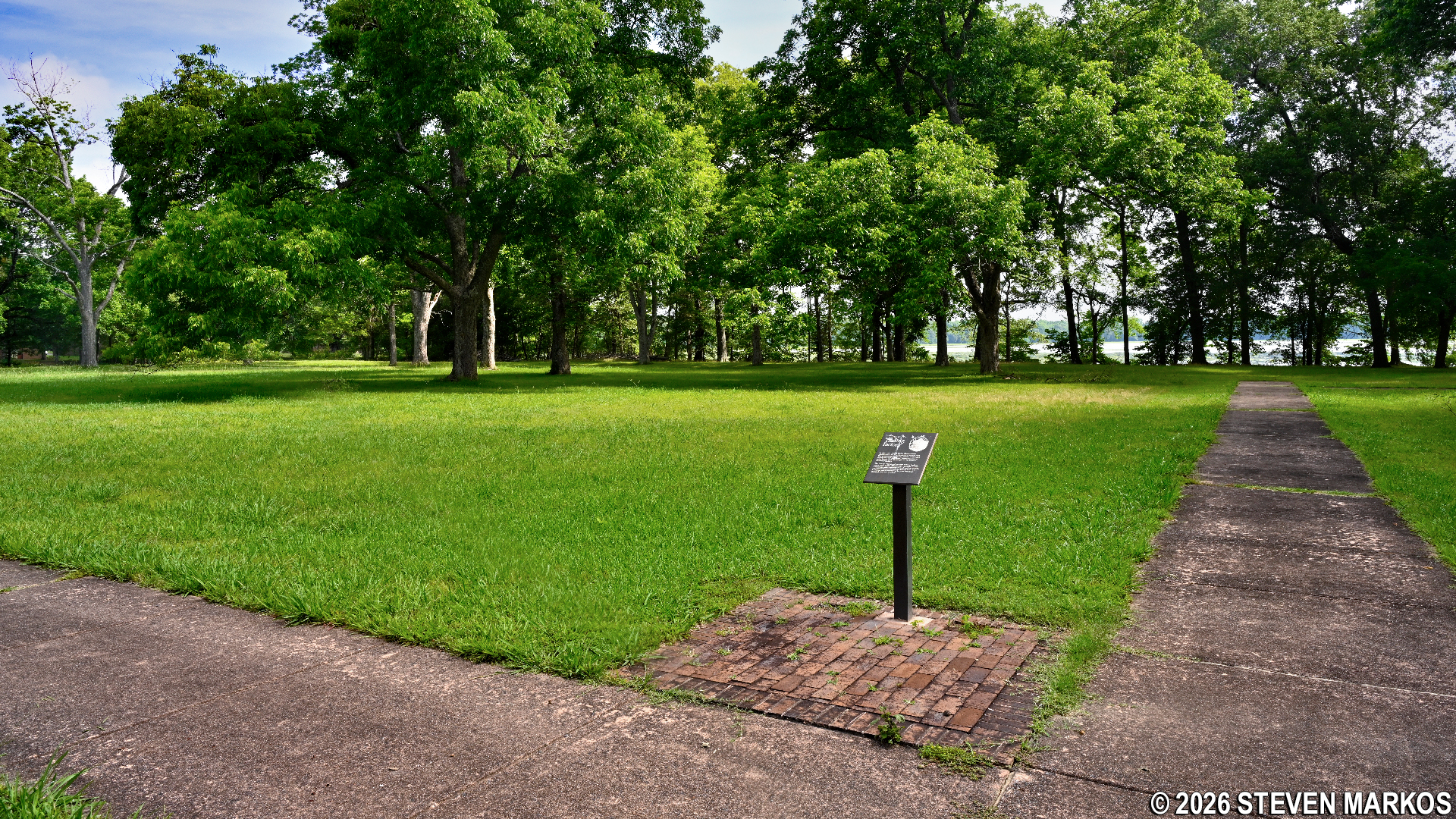
Wayside exhibit facing the site of the federal trading house at Arkansas Post National Memorial
The Arkansas Post Branch of the State Bank of Arkansas was built in 1840 (the bank was established in 1837, but its original location is unknown). At the same time, the post, which was a river town, was becoming much less prosperous due to increasing uses of the railroad. After operating for just three years, the bank had outstanding loans worth almost $92,000. The Arkansas Post Branch wasn’t the only state bank struggling, and in 1843, the Arkansas state legislature passed an act liquidating the entire state banking system. Afterwards, the building was used sporadically for elections and as a stable for horses.
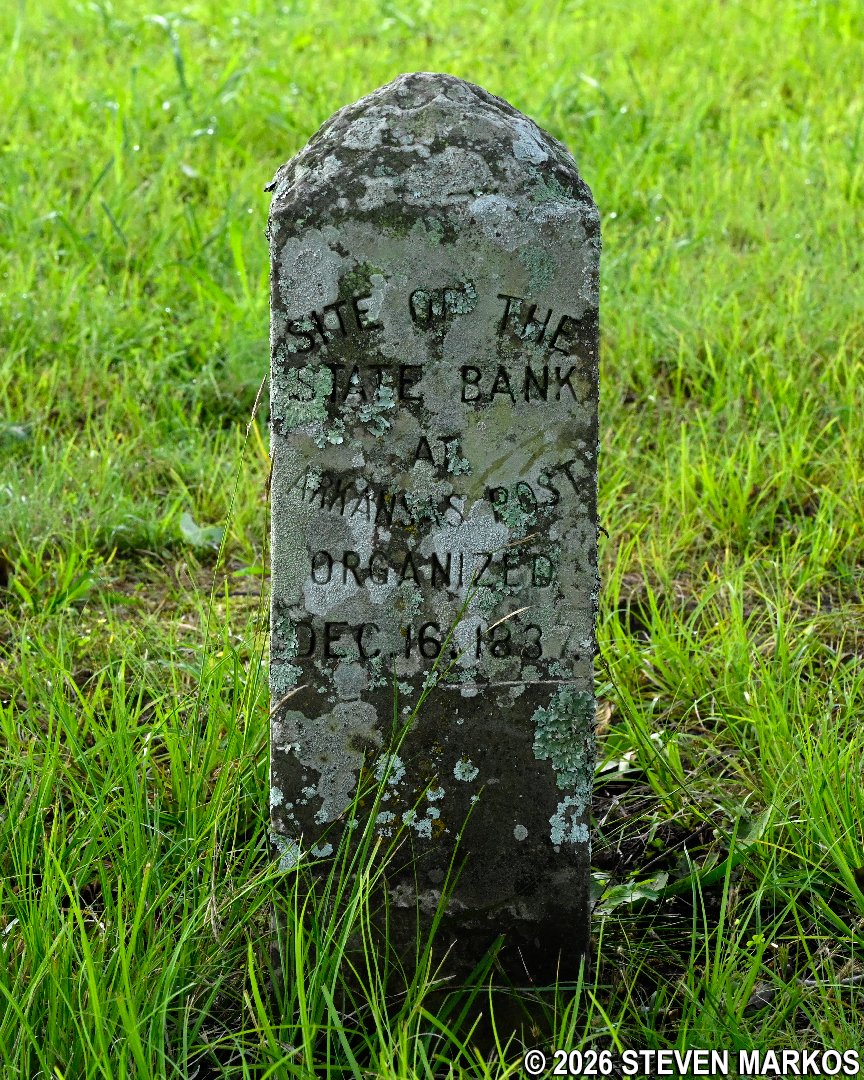
Stone marker placed to honor the site of the State Bank at Arkansas Post National Memorial
During the Civil War battle at Arkansas Post in early January 1863, the bank building is believed to have served as a hospital before the Union destroyed it during a naval artillery bombardment. An excavation of the bank building was conducted in 1970. The foundation was found, and today railroad ties mark the footprint of the building.
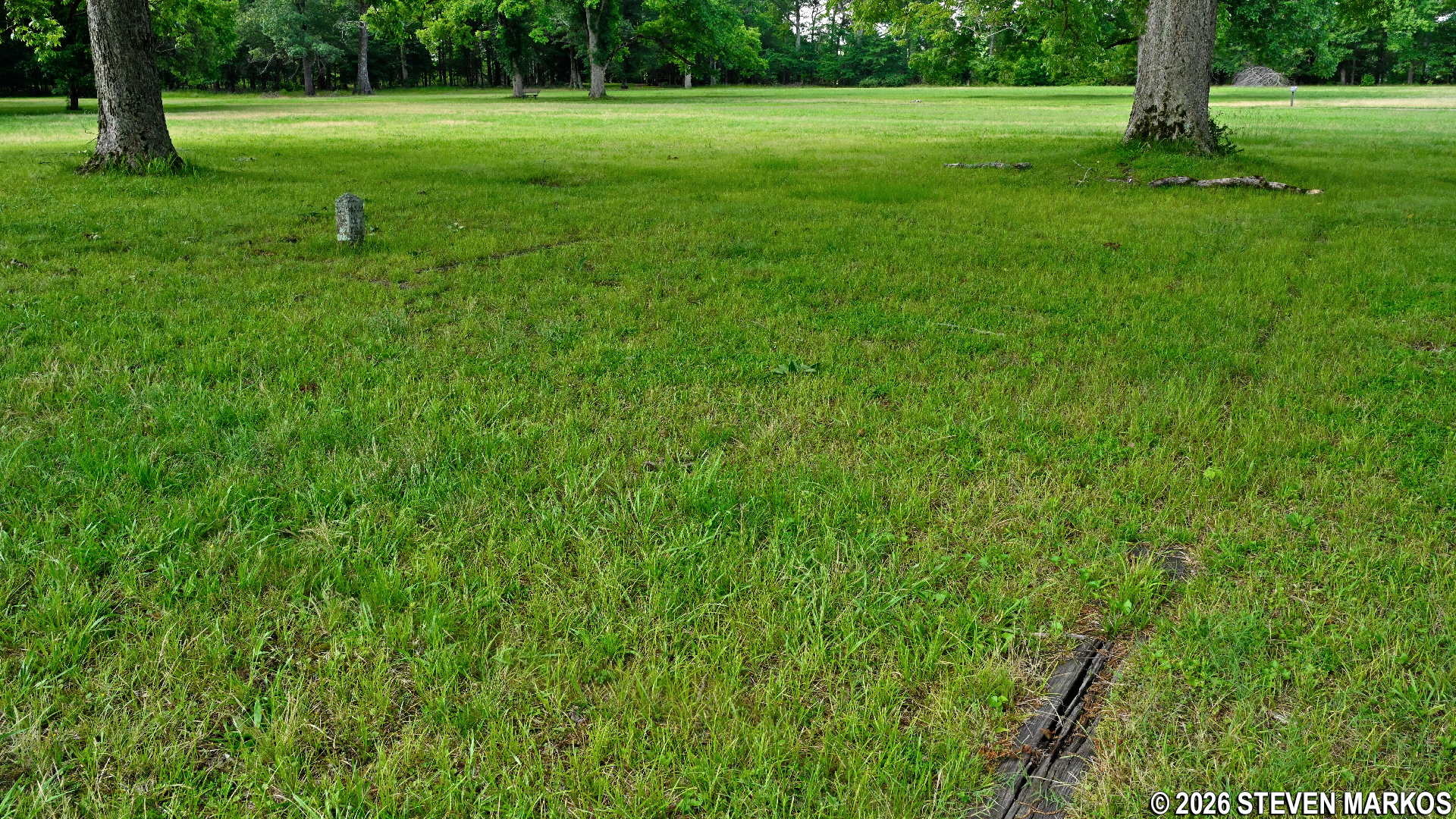
Railroad ties mark the location of the State Bank’s foundation, Arkansas Post National Memorial
Montgomery’s Tavern, operated by William Montgomery from 1819 to 1821, was built in 1804 as a commercial fur trading house. It also hosted public events, including elections and auctions. In 1820, the Arkansas General Assembly rented a couple of rooms in the tavern and held its first territorial government meetings there.
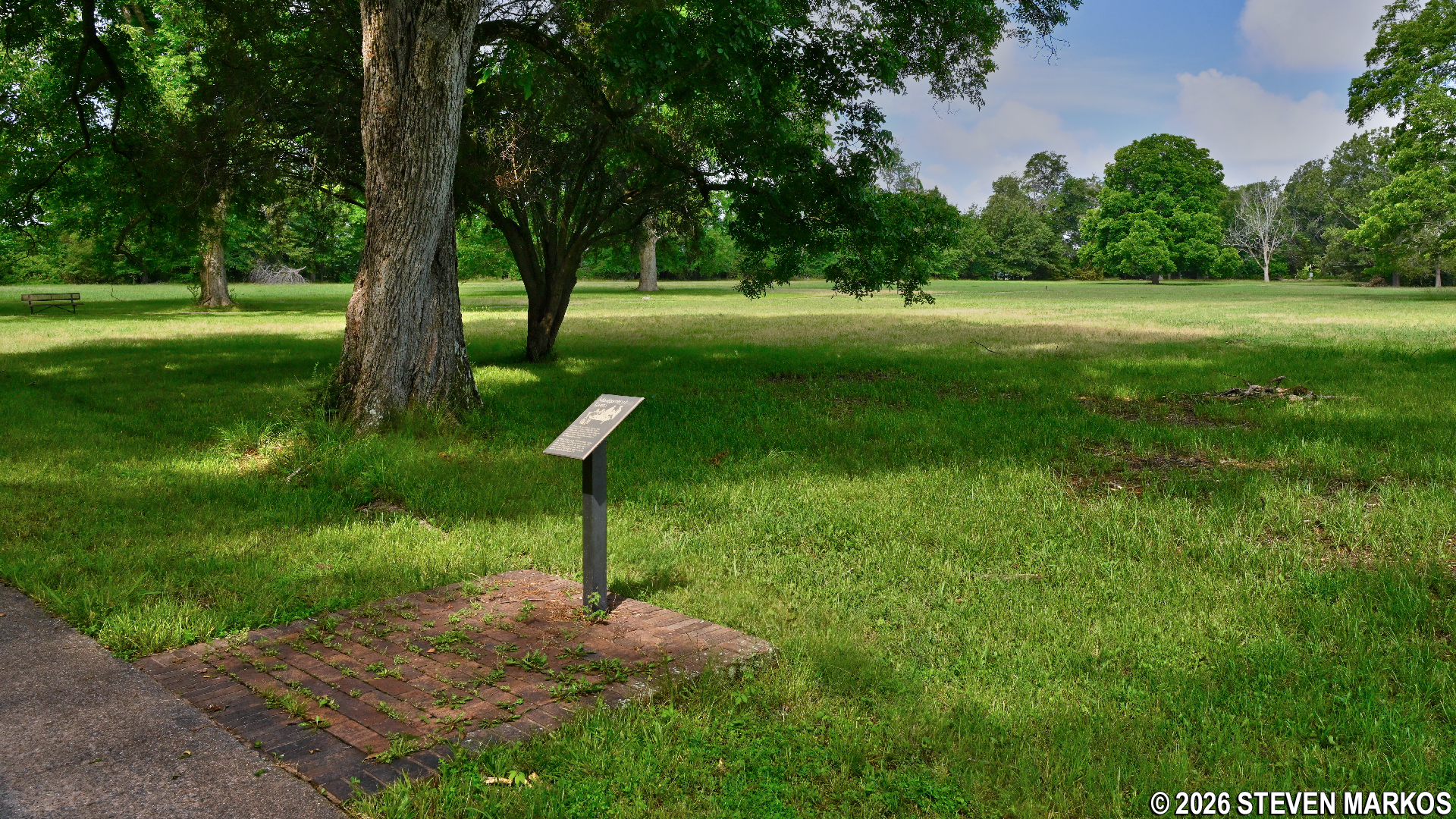
Site of Montgomery’s Tavern at the Old Townsite, Arkansas Post National Memorial
Colonel Frederic Notrebe, a former French soldier, settled at Arkansas Post in 1811. He lived there for nearly 40 years and became the town’s most prosperous entrepreneur. He began in the fur trade before expanding into cotton planting and processing. The only thing remaining at the site where his residence, store, and warehouse once stood is a 24-foot-deep brick cistern. The cistern and a nearby well are the only two original structures from the American townsite at Arkansas Post.
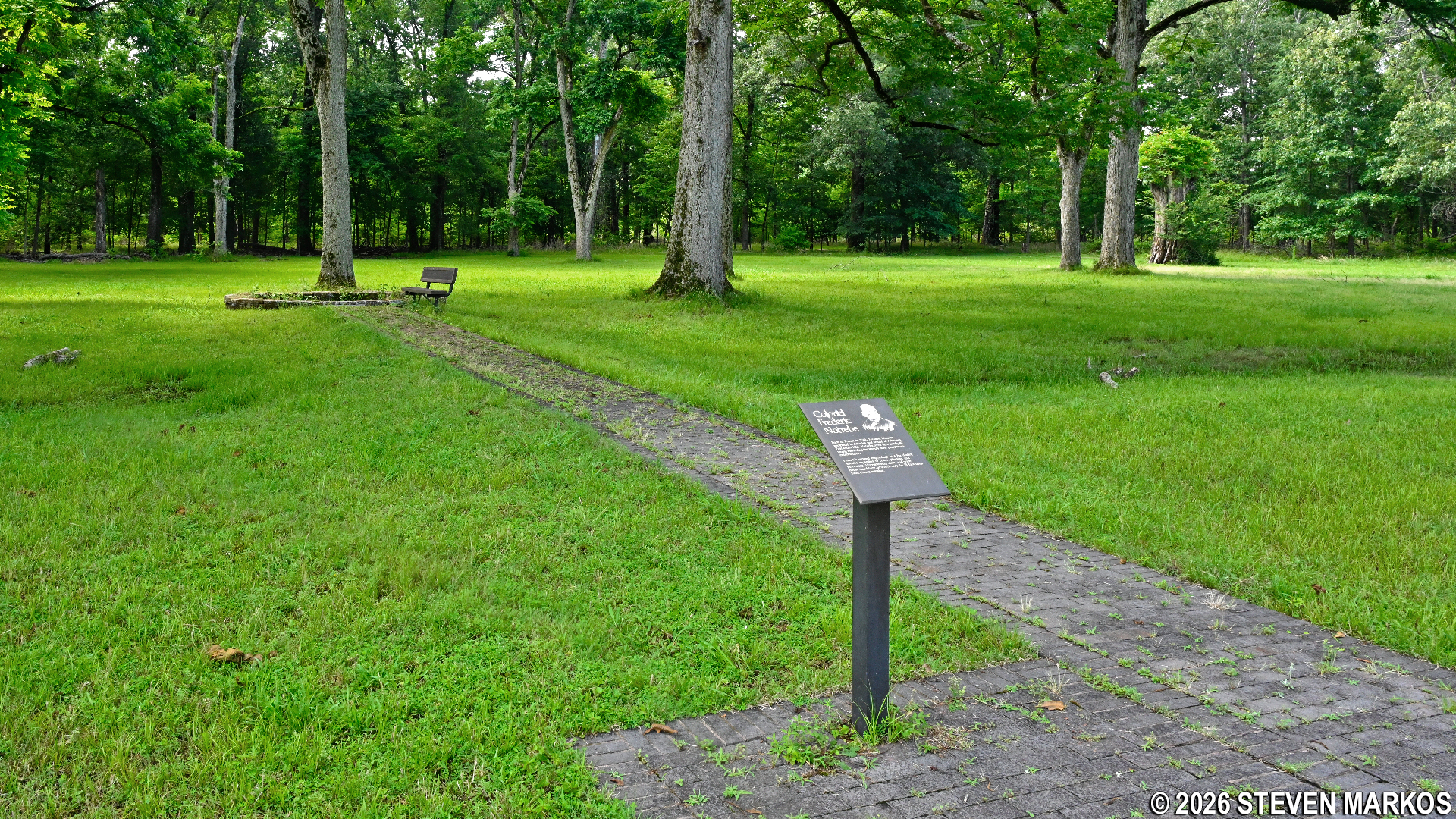
Path to Notrebe’s cistern at Arkansas Post National Memorial
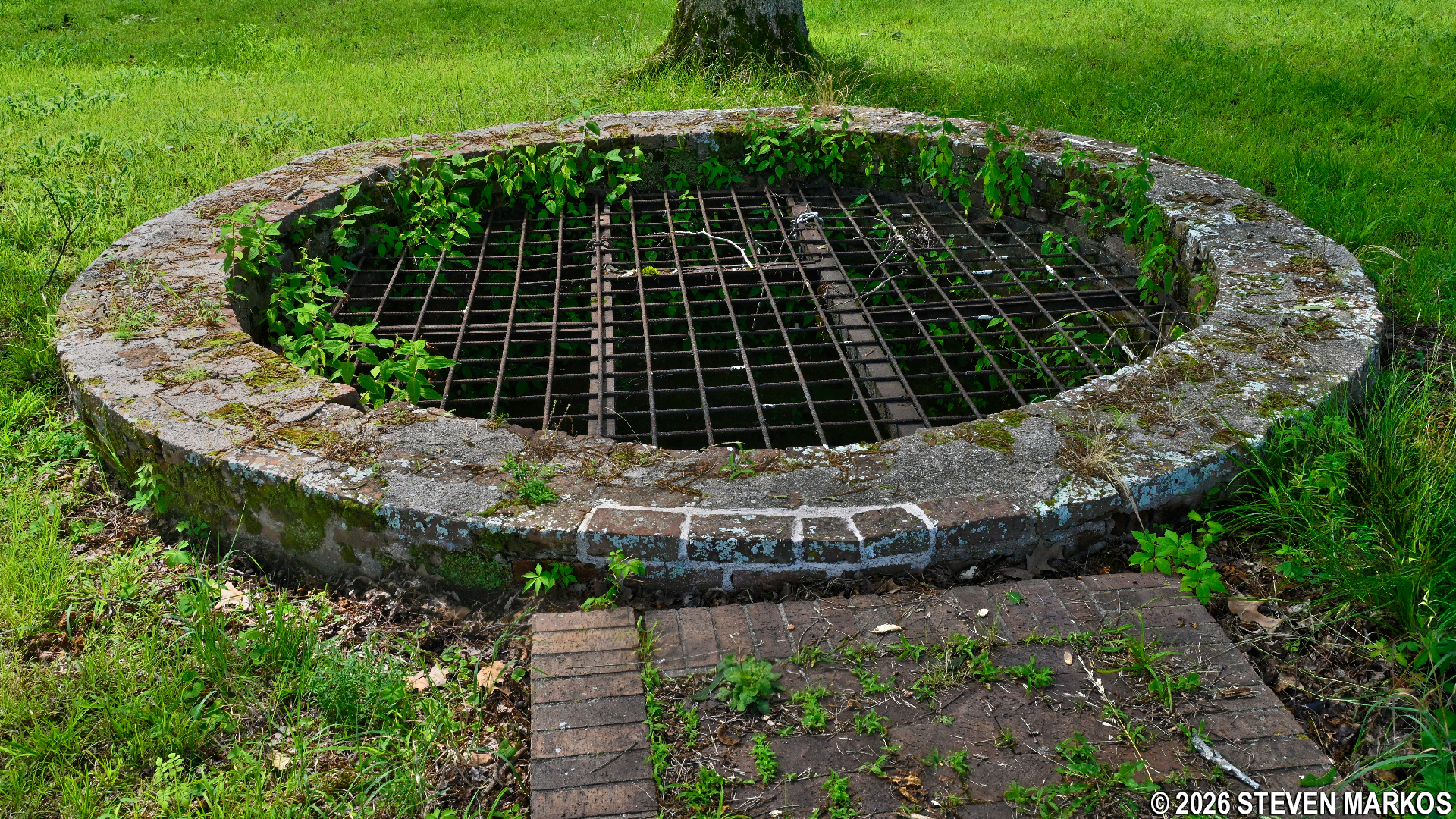
Notrebe’s cistern at the Old Townsite, Arkansas Post National Memorial
Across Main Street, Notrebe operated his cotton gin and press. Known for growing high-quality cotton, he also experimented with foreign strains, such as oriental “silk cotton.” He eventually had a virtual monopoly on the cotton market in eastern Arkansas. Notrebe also developed an improved cotton gin that reduced the risk of fire.
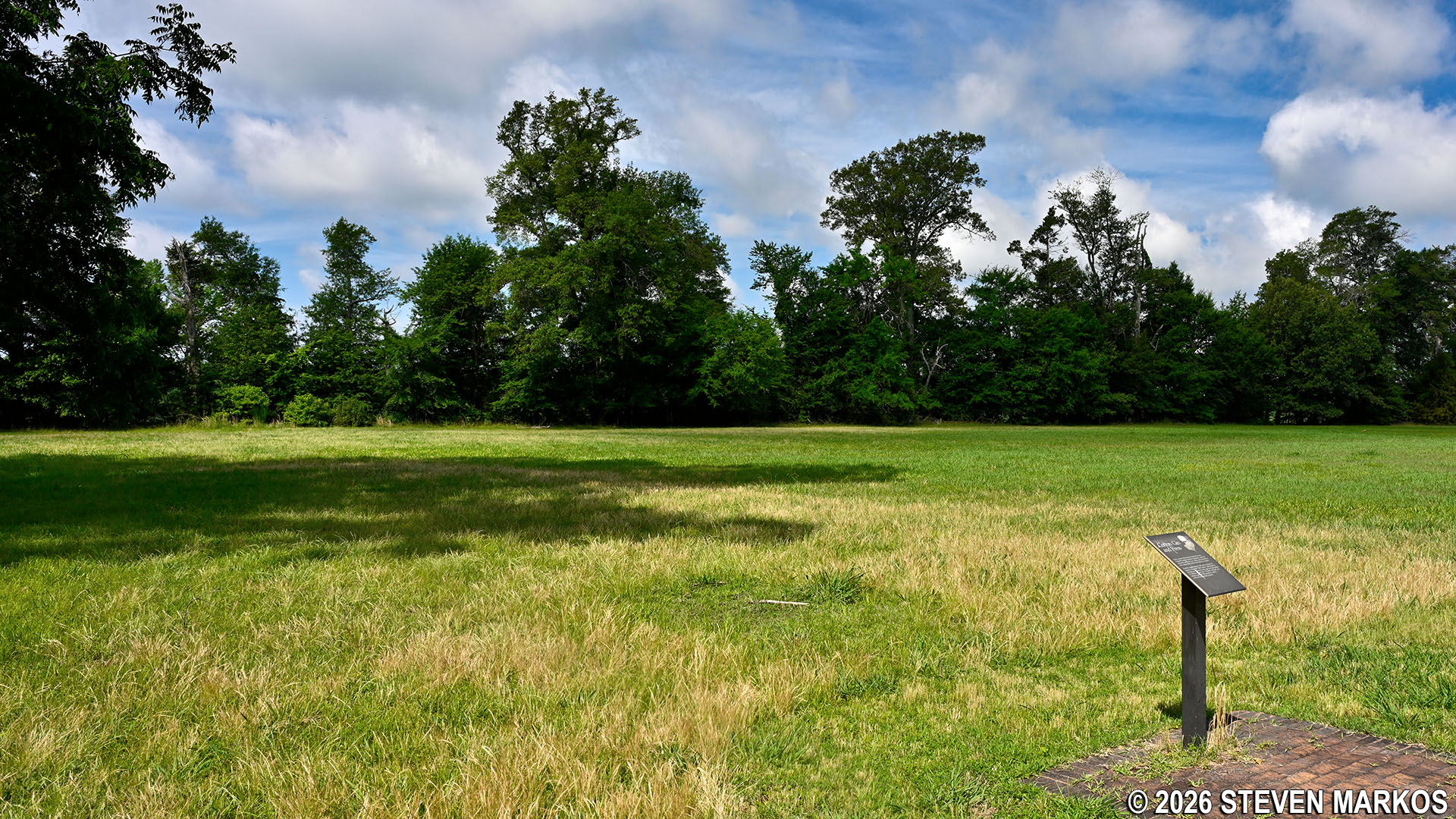
Site of Notrebe’s cotton gin and press at the Old Arkansas Post Townsite, Arkansas Post National Memorial
From the cotton gin site, head southeast on Main Street to connect with Front Street and the Nature Trail. There are no building sites marked along this stretch of the road, but there most likely were buildings during Arkansas Post’s heyday. Overall, there were roughly 40 to 50 houses and businesses built at Arkansas Post from the early 1800s until around the time of the Civil War in the 1860s.
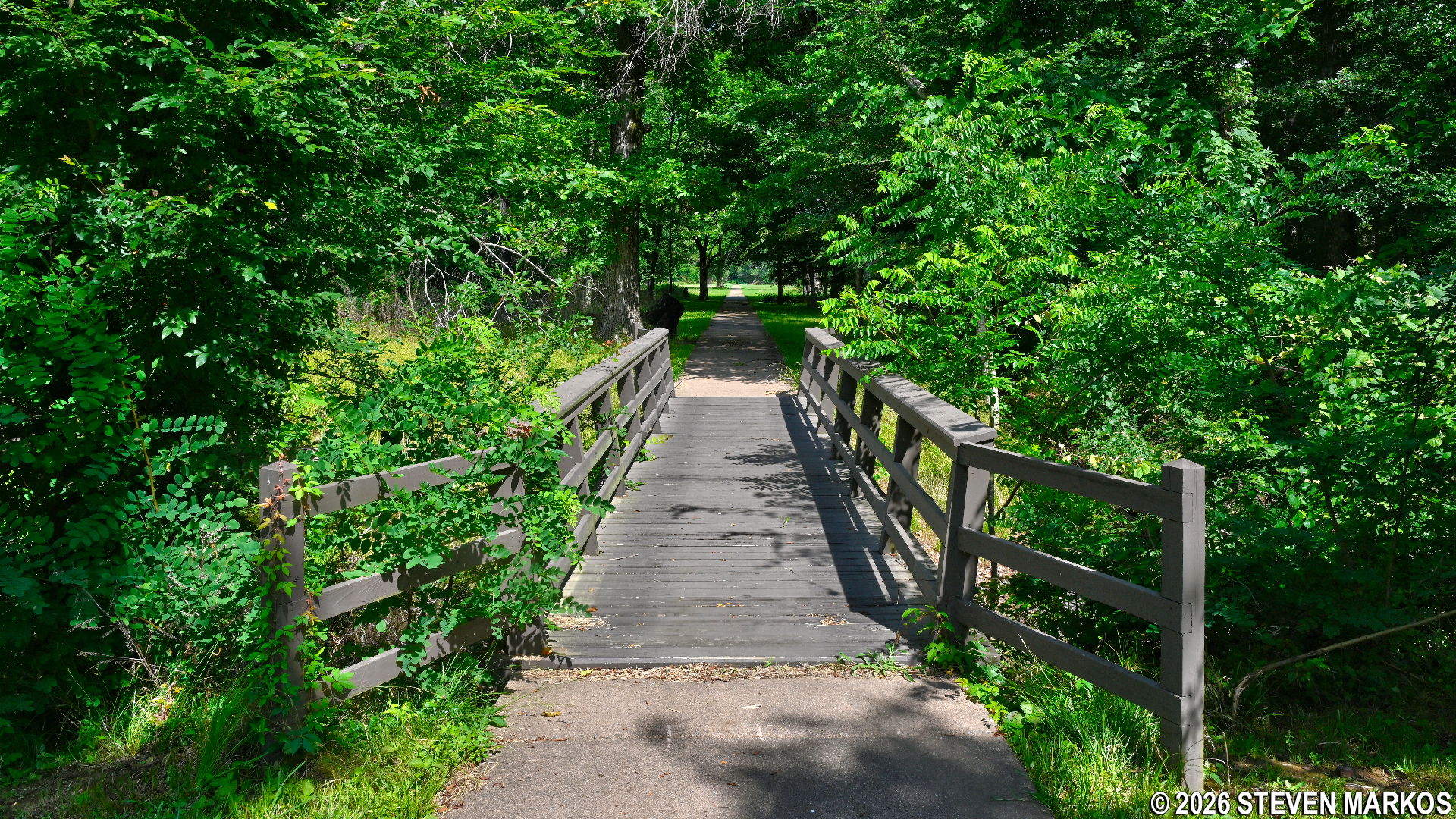
Bridge on Main Street before reaching Front Street at Arkansas Post National Memorial
At the northeastern end of Front Street is the site of the Arkansas Gazette’s original office. This is Arkansas’ first newspaper and the oldest continuously published newspaper west of the Mississippi River. The first issue was published on November 20, 1819, by editor William E. Woodruff.
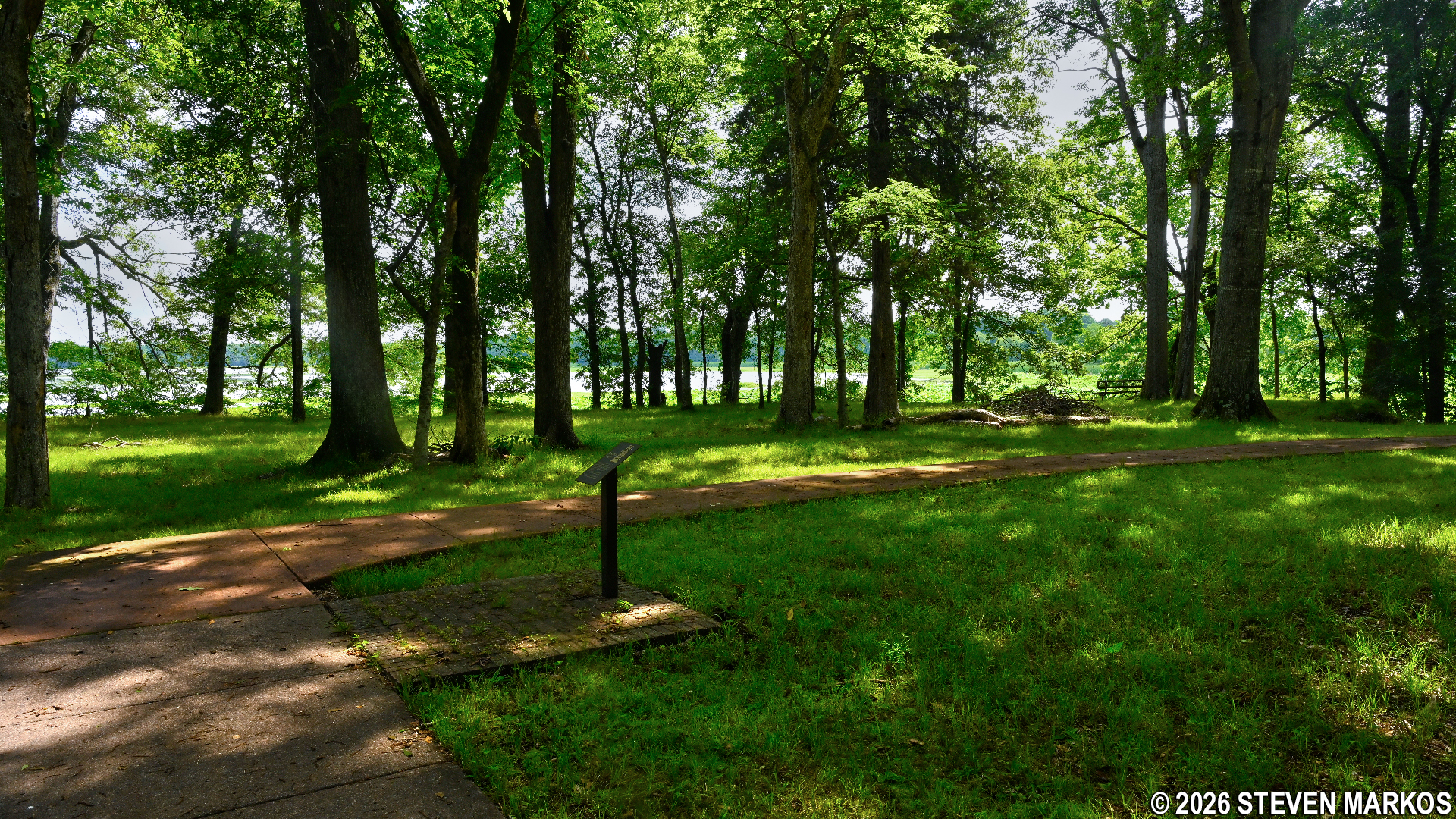
Site of the Arkansas Gazette’s first office, Arkansas Post National Memorial
NATURE TRAIL
At the southern end of the Old Arkansas Post Townsite is an option to hike a half-mile paved Nature Trail. Trailheads are at the northeast corner of Front Street at the Arkansas Gazette site and on the west side of the town at an intersection with Main Street a little south of Notrebe’s Cotton Gin site. What makes it a nature trail are wayside exhibits along the route that point out various types of plants and trees. At the far end is an overlook of the Arkansas River. The hike takes about 15 minutes. I went around the Nature Trail in the clockwise direction, starting from the northeast corner of Front Street.
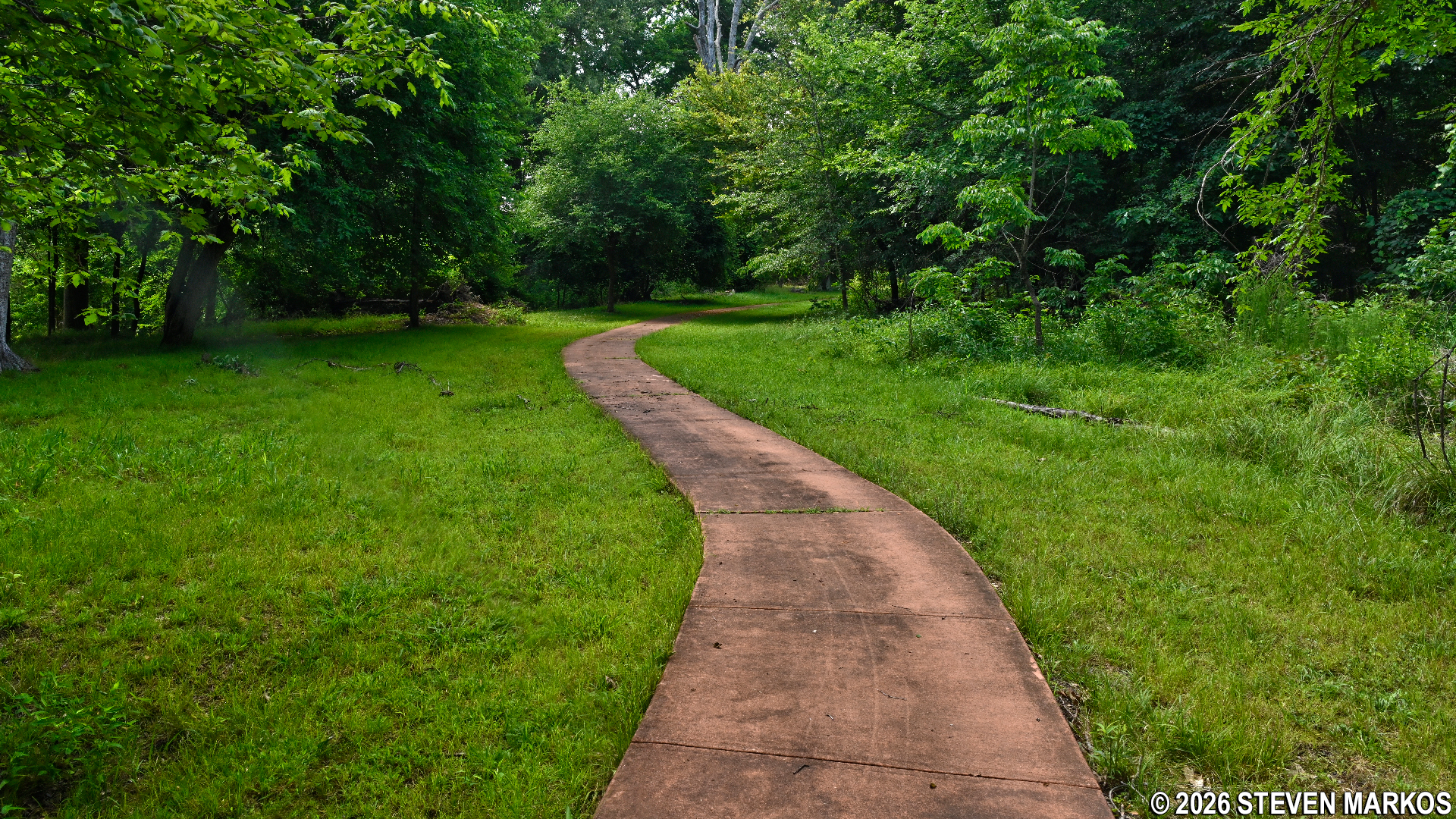
Path of the Natural Trail at the Old Arkansas Post Townsite, Arkansas Post National Memorial
About a tenth of a mile in, the trail comes to an intersection with the short spur trail to the Arkansas River Overlook. If you want to see the river, take a left. When done, return to the main trail and turn left to continue north to Main Street.
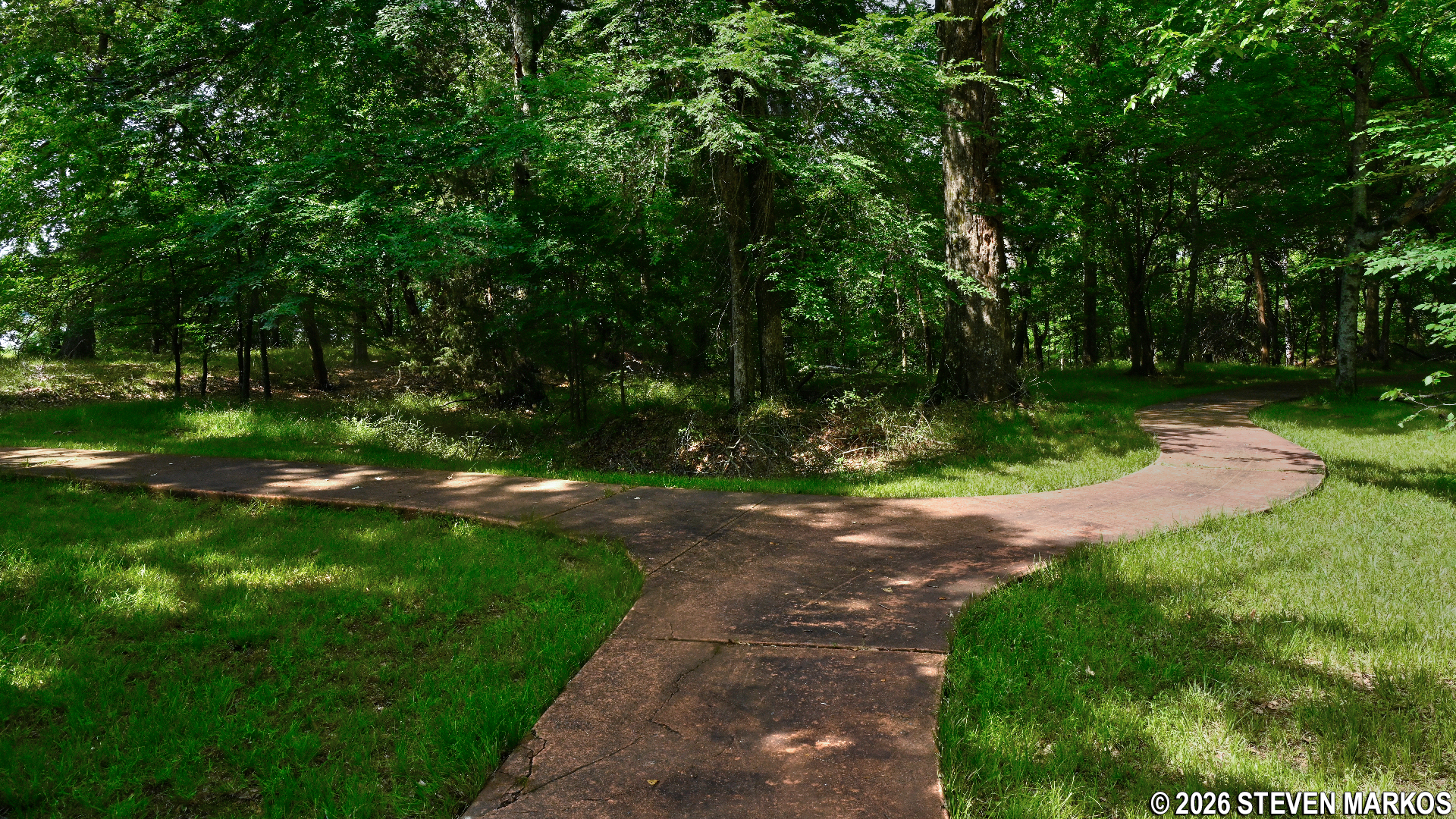
Intersection of the Nature Trail and the spur leading to the Arkansas River Overlook, Arkansas Post National Memorial
Unfortunately, the overlook was somewhat overgrown when I visited. You can certainly see the river—there is even a bench if you want to sit and enjoy the scenery—but it’s not the best view.
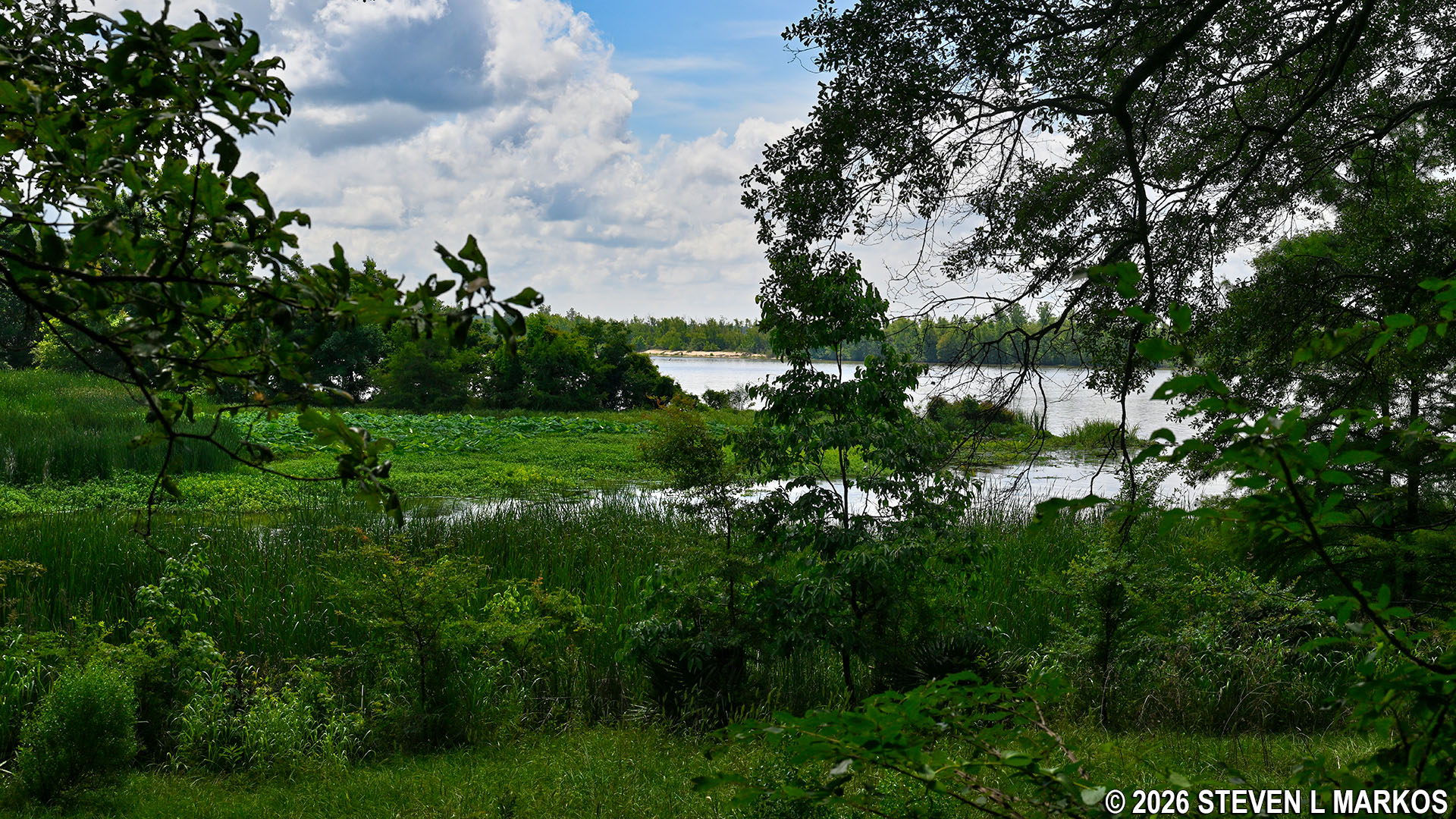
View from the Arkansas River Overlook at Arkansas Post National Memorial
Back on the trail, the path curves around to the west side of the townsite and crosses a bridge before coming to an intersection with the southwestern end of Front Street. Continue straight to keep on the Nature Trail.
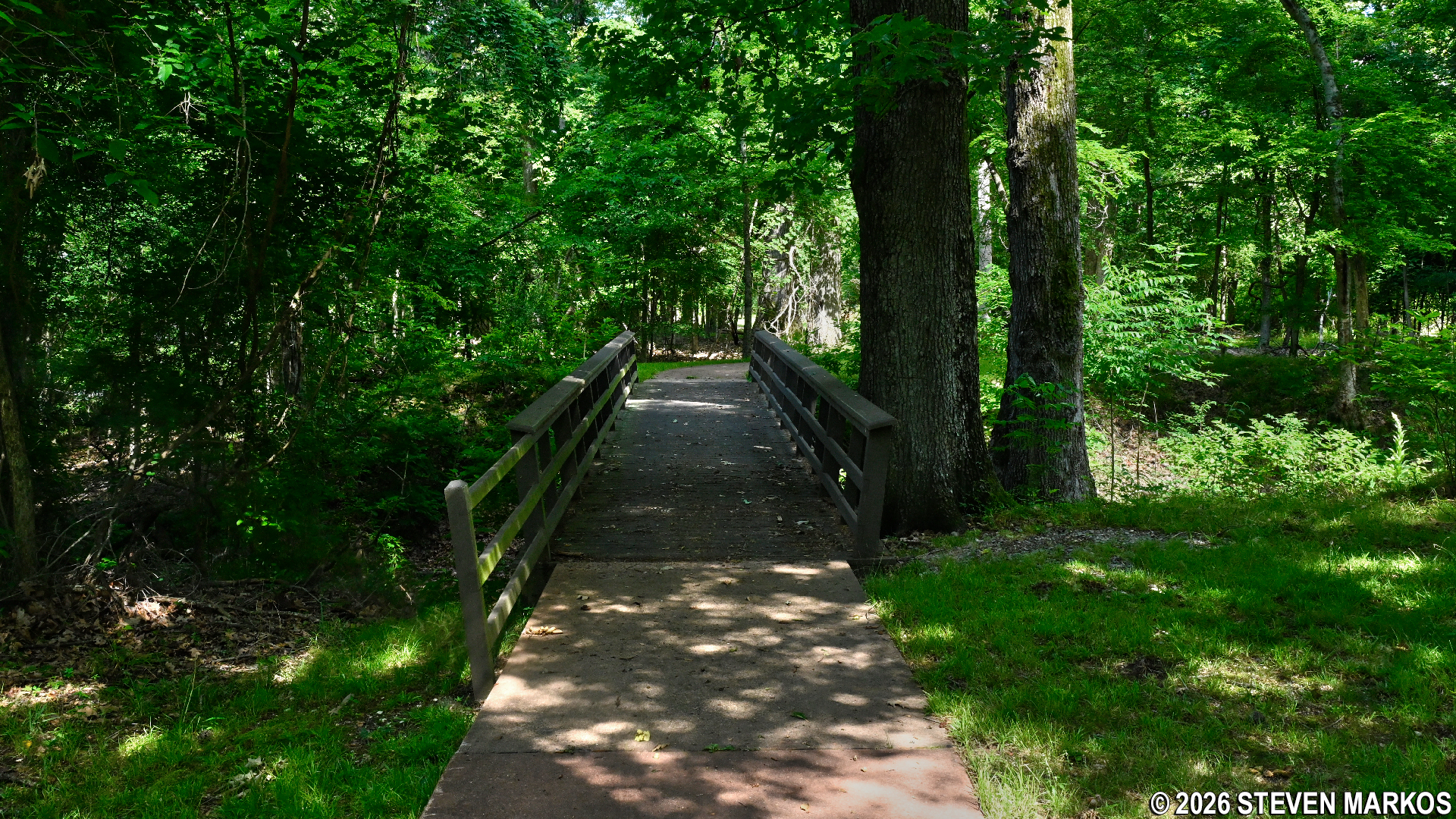
Bridge on the west side of the Nature Trail at Arkansas Post National Memorial
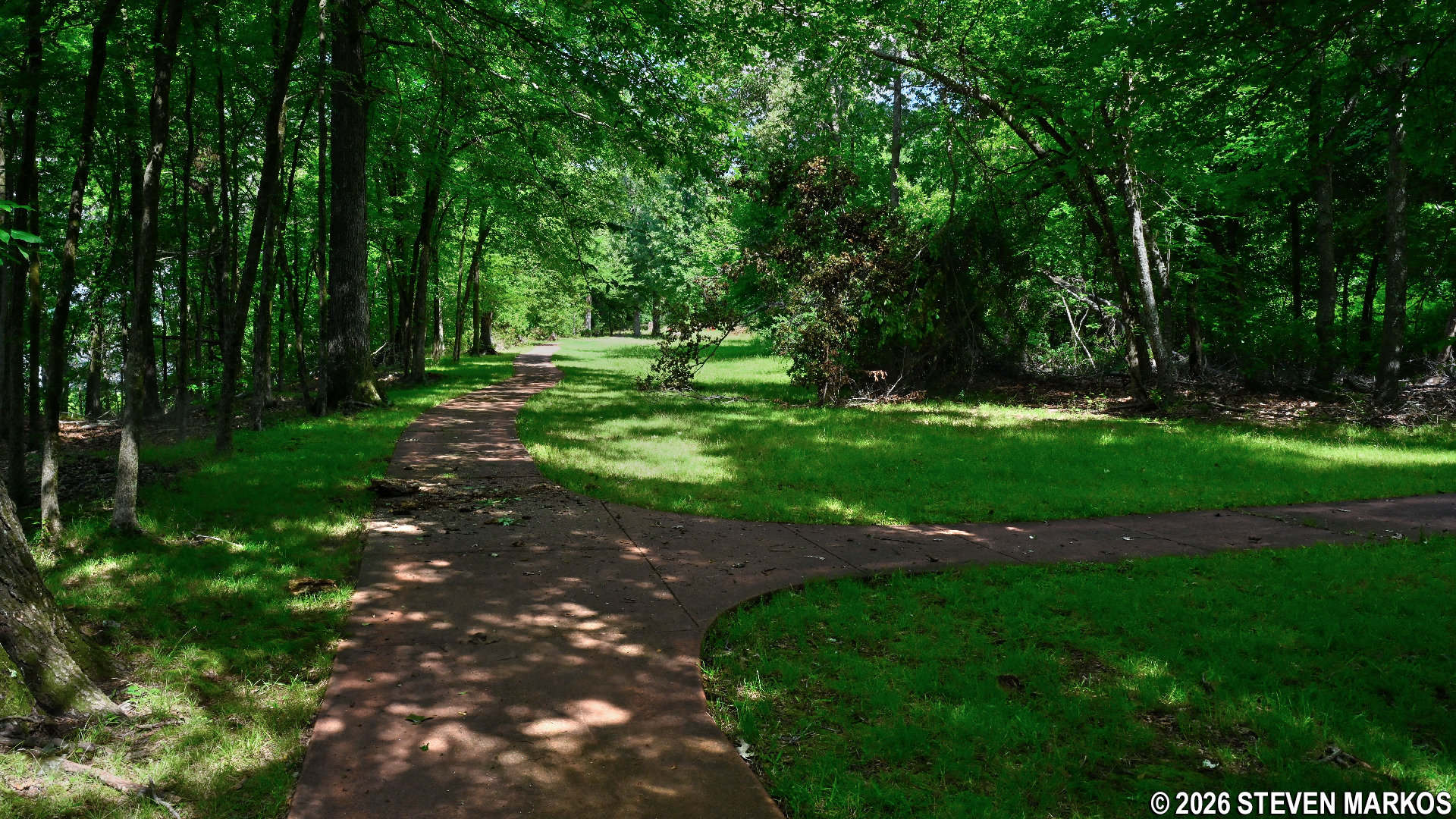
Southwestern intersection of the Nature Trail and Front Street, Arkansas Post National Memorial
Two-tenths of a mile later, the Nature Trail intersects with Main Street back at the Old Townsite. Be sure to check out any building sites you may have missed before returning to the Visitor Center.
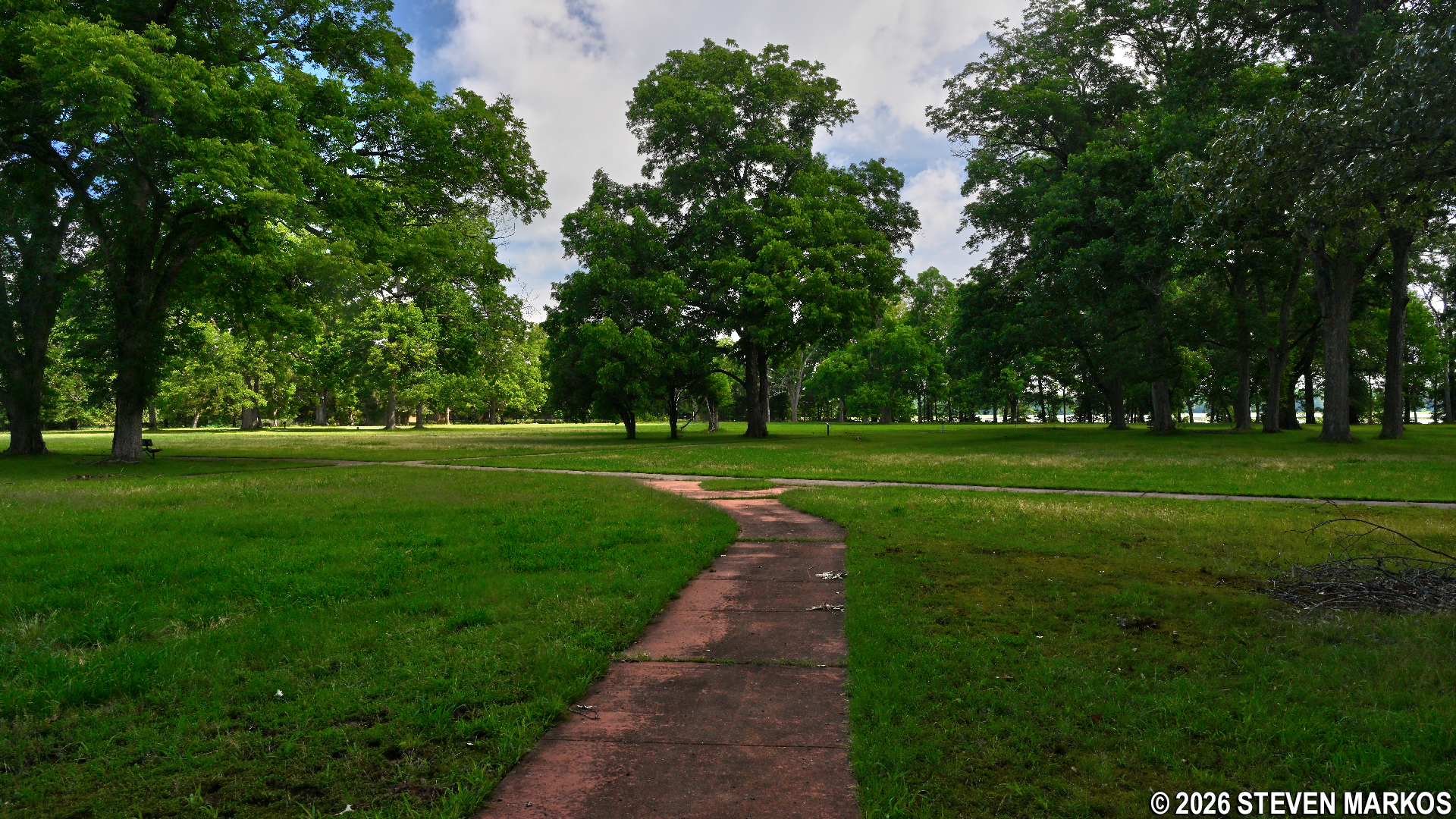
Intersection of the Nature Trail and Main Street at Arkansas Post National Memorial
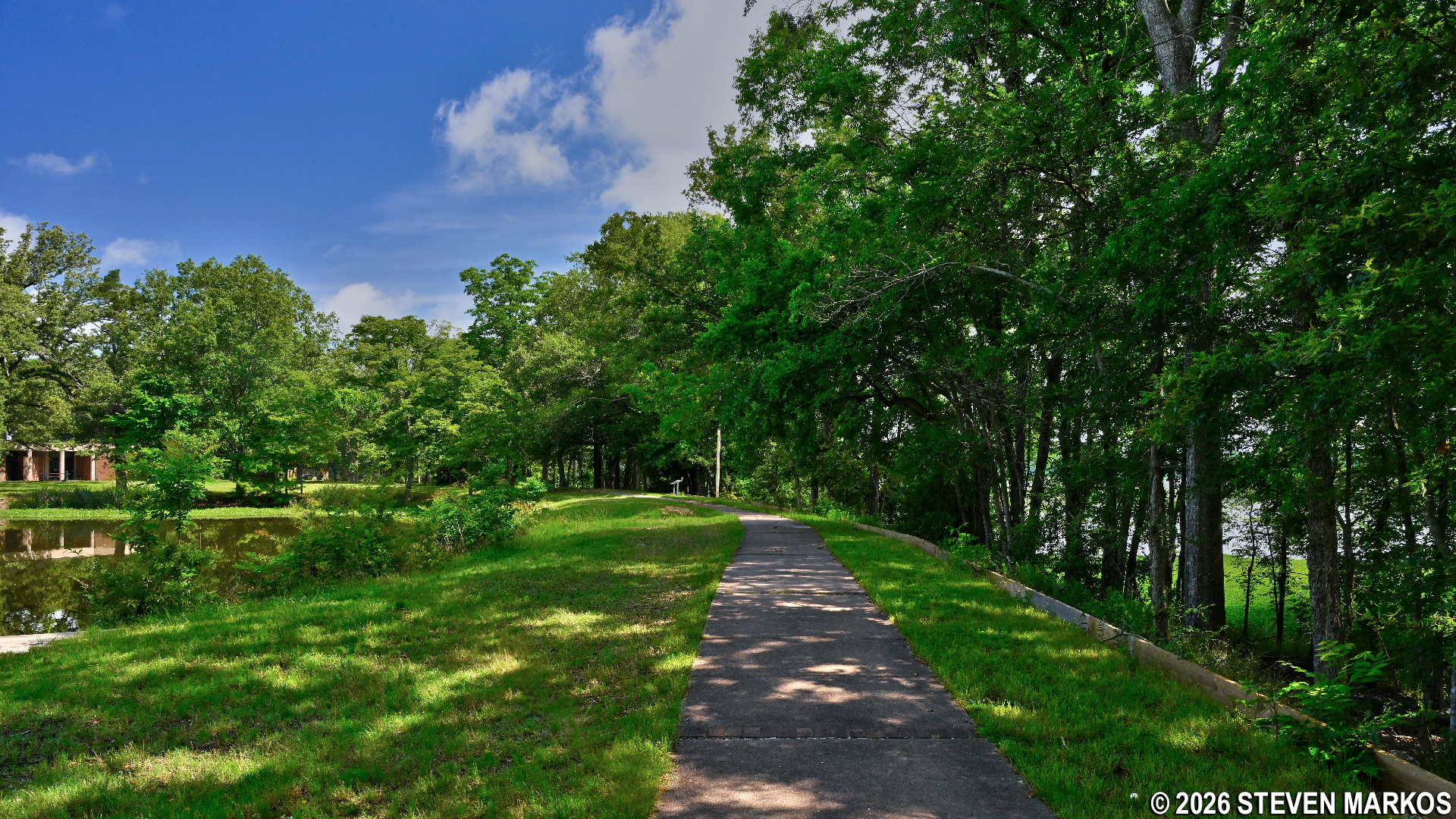
Path leading back from the Old Townsite to the Arkansas Post National Memorial Visitor Center
HISTORY OF ARKANSAS POST
In 1686, a group of Frenchmen, including Henri de Tonti, Jean Couture, and Peter Bisaillon, established a trading post about 18 miles up the Arkansas River from its confluence with the Mississippi River. The post, located near the Quapaw Indian village of Osotouy, was the first European settlement along the Arkansas. It sat in the heart of beaver country, but the European market wasn’t very interested in beaver pelts. This led to an overabundance of pelts, prompting the French monarch to place a moratorium on the beaver trade south of Canada. By 1699, the post was pretty much abandoned.
River commerce exploded after the establishment of New Orleans in 1718. At the same time, the French population in the area was also growing. In 1722, King Louis XIV authorized John Law to settle the area, and the following year, troops under the command of Lieutenant Avignon Guérin de La Boulaye arrived to protect the settlers and control river traffic. In 1731, the Arkansas Post was expanded after receiving a new commander, First Ensign Pierre Louis Petit de Coulange. He built a stockade with barracks, a prison, and housing for himself and future commanders. Outside the stockade walls was a small village.
In 1748, extensive flooding along the Arkansas River forced the Quapaw Indians, who were allies of the French, to relocate from their village at the mouth of the river. This left the route to the Arkansas Post unprotected, and in May 1749, the village was attacked and raided by a force of 150 Chickasaw Indians. Six men were killed, and eight women and children were captured. Survivors fled to alert soldiers. In the meantime, the Chickasaw looted and burned the village and then turned their attention towards the stockade. The soldiers attacked, and the Indians were forced to retreat. Despite repealing the attack, the French realized they could no longer defend themselves at the post and decided to relocate to higher ground at a bend known as Red Bluff (the general area where Arkansas Post National Memorial is located). This location was also closer to the Quapaws’ new village.
In 1752, the next commander, Captain Paul Augustin Le Pelletier de La Houssaye, built a fort and village with barracks, a prison, housing, a chapel, a storehouse, a hospital, and a latrine. He also erected an eleven-foot-high palisade wall around the fort. Its operational period was short because four years later, after the start of the Seven Years’ War (known as the French and Indian War in North America), the post was moved again. This time it was relocated 10 miles from the confluence of the Arkansas and Mississippi rivers in order to better respond to attacks and to protect the French supply lines.
The 1763 Treaty of Paris ended the Seven Years’ War after Great Britain defeated France. It also resulted in France ceding the area west of the Mississippi River to Spain, which included Arkansas Post. While under Spanish rule, most of the post’s population remained French, and they continued their friendly relationship with the Quapaw. Unfortunately, the war left Arkansas Post in dilapidated condition, and over the next several years, its soldiers and citizens struggled to combat Osage and Chickasaw war parties. At the same time, trading became more difficult as the British established their own posts on the east banks of the river.
Heavy flooding in 1777 and 1778 forced Arkansas Post to relocate for a fourth time. In 1779, the Spanish governor of Louisiana, Bernardo de Gálvez, granted permission to move the post back to its previous location at Red Bluff where it would be less prone to flooding. The Spanish also renamed the post Fort Carlos III. By then, the American Revolution had begun, and Spain joined American forces against Great Britain.
Only one battle was fought at Fort Carlos III during the Revolution. James Colbert, a former British captain, wanted to disrupt Spanish commerce on the river and capture the post. He began by attacking Spanish boats on the Mississippi River, and on April 16, 1783, his group slipped up the Arkansas River and headed for Fort Carlos III. Overnight, Colbert and his men stormed the village outside of the fort. They captured some residents, but others managed to escape and warn the soldiers. The Spanish withstood the siege, and after a brief exchange of small arms fire, Colbert retreated. Five months later, the war was over. (A small outdoor exhibit near the Arkansas Post National Memorial Visitor Center features a cannon similar to the ones used by the Spanish and wayside exhibits about Colbert’s raid.)
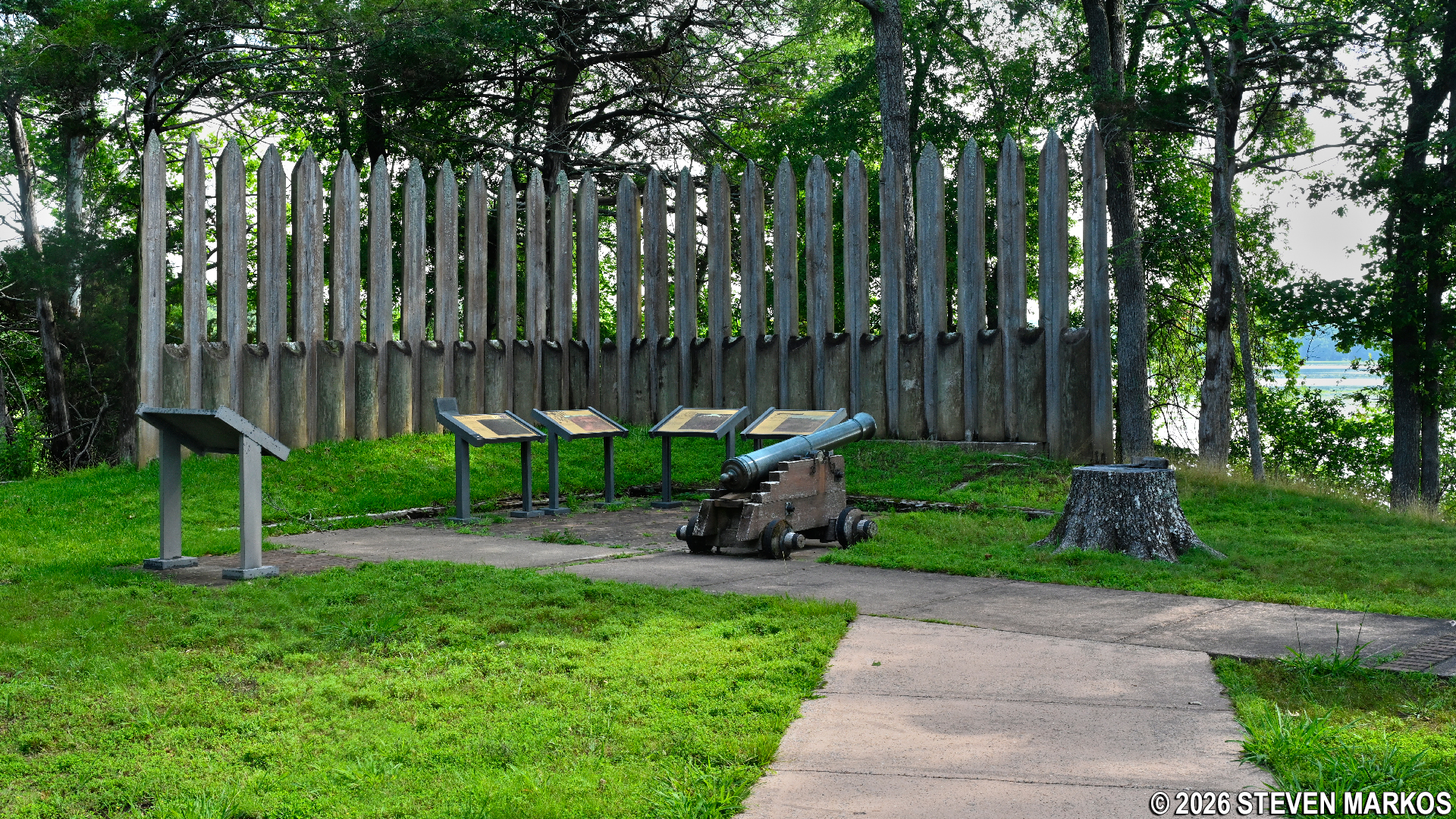
Exhibit on Colbert’s Attack during the American Revolutionary War at Arkansas Post National Memorial
By 1789, little remained of Fort Carlos III due to the rising river and destructive flooding. Luckily, the post village, built high enough above the water, still remained. Captain Juan Ignace Delino de Chalmette arrived in 1790, and he oversaw the construction of a new fort, complete with a commandant’s house, barracks for 50 men, and a warehouse and kitchen. The stockade surrounding it included two bastions mounted with four 6-pounder cannons and two swivel guns (pounder refers to the weight of the cannon ball that could be fired). He named it Fort San Estevan after the governor.
Beginning in 1793, a series of wars broke out between Spain and the new French Republic (founded in 1792 during the French Revolution). Between 1793 and 1798, Spain’s national debt increased eightfold, putting the country under severe financial pressure. To ease some of the strain, Spain signed the Third Treaty of San Ildefonso in 1800, agreeing to return the vast Louisiana Territory to France. Despite the change in ownership, the Spanish garrison continued to oversee Arkansas Post until it became part of the United States in 1803 as the result of the Louisiana Purchase (sale of the territory by France to the United States).
Now under the jurisdiction of the United States, Arkansas Post began to make a name for itself. In 1805, after the government built a federal trading house, the post became a major frontier stop for travelers who were heading west. In 1813, it was selected as the capital of Arkansas County (part of the Missouri Territory), and six years later, in 1819, it became the first capital of the new Arkansas Territory. The post established itself as the center of commercial and political life in Arkansas until the capital was moved to Little Rock in 1821.
Arkansas Post remained an active river town for the next two decades. A cotton gin and press, a warehouse, a few stores, a church, a jail, a tavern, a billiards parlor, and a branch of the State Bank of Arkansas were all established. Unfortunately, by the 1850s, the railroad’s growing popularity led to a period of decline as fewer and fewer commercial vessels traveled upriver.
When the Civil War broke out, Arkansas joined the Confederacy. The Confederate commanders decided to construct a massive defensive earthwork, known as Fort Hindman, at Arkansas Post to protect its control over the Arkansas and Mississippi rivers. The Union Army had similar plans, and capturing Arkansas Post was a required step to controlling the Mississippi. On January 9, 1863, roughly 30,000 Union troops attacked 5,000 Confederates at Fort Hindman. The battle lasted three days and ended with a Confederate surrender and the destruction of the fort.
By the time of the Civil War, Arkansas Post was already in serious decline. The Battle of Arkansas Post was the nail in its coffin. Most of the town’s buildings were destroyed during the Union land and water artillery bombardment. There was simply no reason to rebuild because of the shift from commercial river transportation to rail transportation. A few people and businesses actually moved a mile north of the historic townsite that is now part of Arkansas Post National Memorial, and there was a small farming community up until the time Arkansas Post State Park was established in 1929. By this time, most of the remaining residents had sold their land to the state for inclusion in the new park.
With a few exceptions, use of any photograph on the National Park Planner website requires a paid Royalty Free Editorial Use License or Commercial Use License. See the Photo Usage page for details.
Last updated on November 11, 2026


