

Graves inside James Fort believed to be of the Jamestown colonists who died in 1607
Of the 104 original Jamestown settlers, only 38 were left alive after the first year. According to survivor George Percy, “Our men were destroyed with cruel diseases, as swellings, fluxes, burning fevers, and by wars, and some departed suddenly, but for the most part they died of mere famine.” Not wanting to reveal to the Indians their dwindling numbers, all of the dead were buried inside James Fort, which had been constructed within a month after the men landed at Jamestown in May 1607.
During excavation of the western end of the fort, thirty graves were found. Archaeologists believe these are the bodies of the men who died during the first year of the settlement. None of the graves were laid out in rows or in any other type of orderly fashion, suggesting hasty burials. In 1611, a building was constructed on top of some of the graves, so they are obviously from before 1611. (In the above photo, graves located within the dirt area bounded by stones are the ones that were under the building).

1607 Burial Ground, the 1608 Church, barracks, and John Smith statue at Historic Jamestowne, part of Colonial National Historical Park
Of the thirty graves that were found and marked, only three were ever excavated. Two of the graves contained two bodies each, while a third contained the body of a teenage boy—an Indian arrowhead was found next to his leg. Historical records state that a young boy was killed by Indians during the first month on the island.

Wayside exhibit about the 1607 Burial Ground at Historic Jamestowne, part of Colonial National Historical Park
Another grave was found outside the fort, and it is believed to contain the body of Captain Bartholomew Gosnold, who John Smith said was the mastermind behind the entire Jamestown operation. Gosnold died three months after landing at Jamestown. He was in his mid-thirties, and the skeleton in the grave is of a man in his mid-thirties. A Captain’s staff (walking stick) was placed on the coffin, and Gosnold was the only captain to die in 1607. The fact that the body was buried in a coffin suggests that the person was upper class, as commoners were just thrown into a ditch. Historians speculate that Gosnold was buried outside the fort because the Indians knew him well, so there was no way to hide the fact that he was dead and thus no need to bury him in the fort. Gosnold’s remains can be seen at the Voorhees Archaearium.
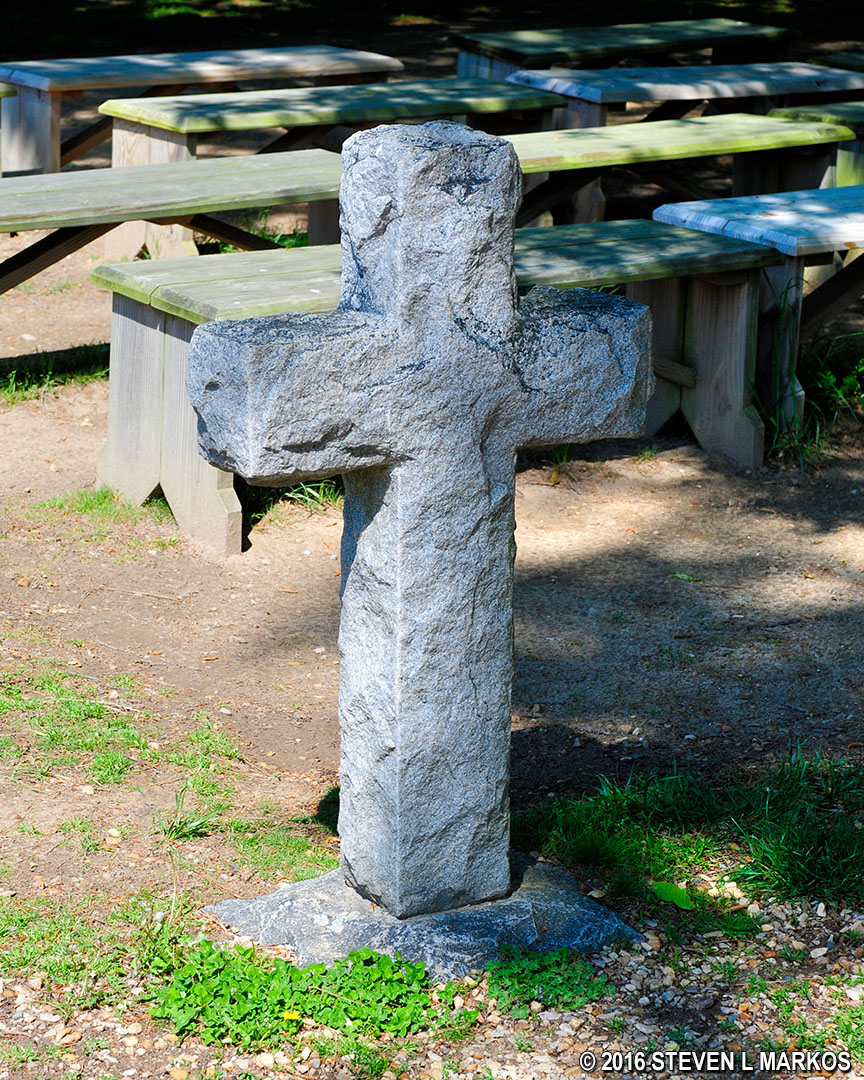
Marker for the grave thought to be of Bartholomew Gosnold, Historic Jamestowne, part of Colonial National Historical Park
With a few exceptions, use of any photograph on the National Park Planner website requires a paid Royalty Free Editorial Use License or Commercial Use License. See the Photo Usage page for details.
Last updated on July 7, 2024


