
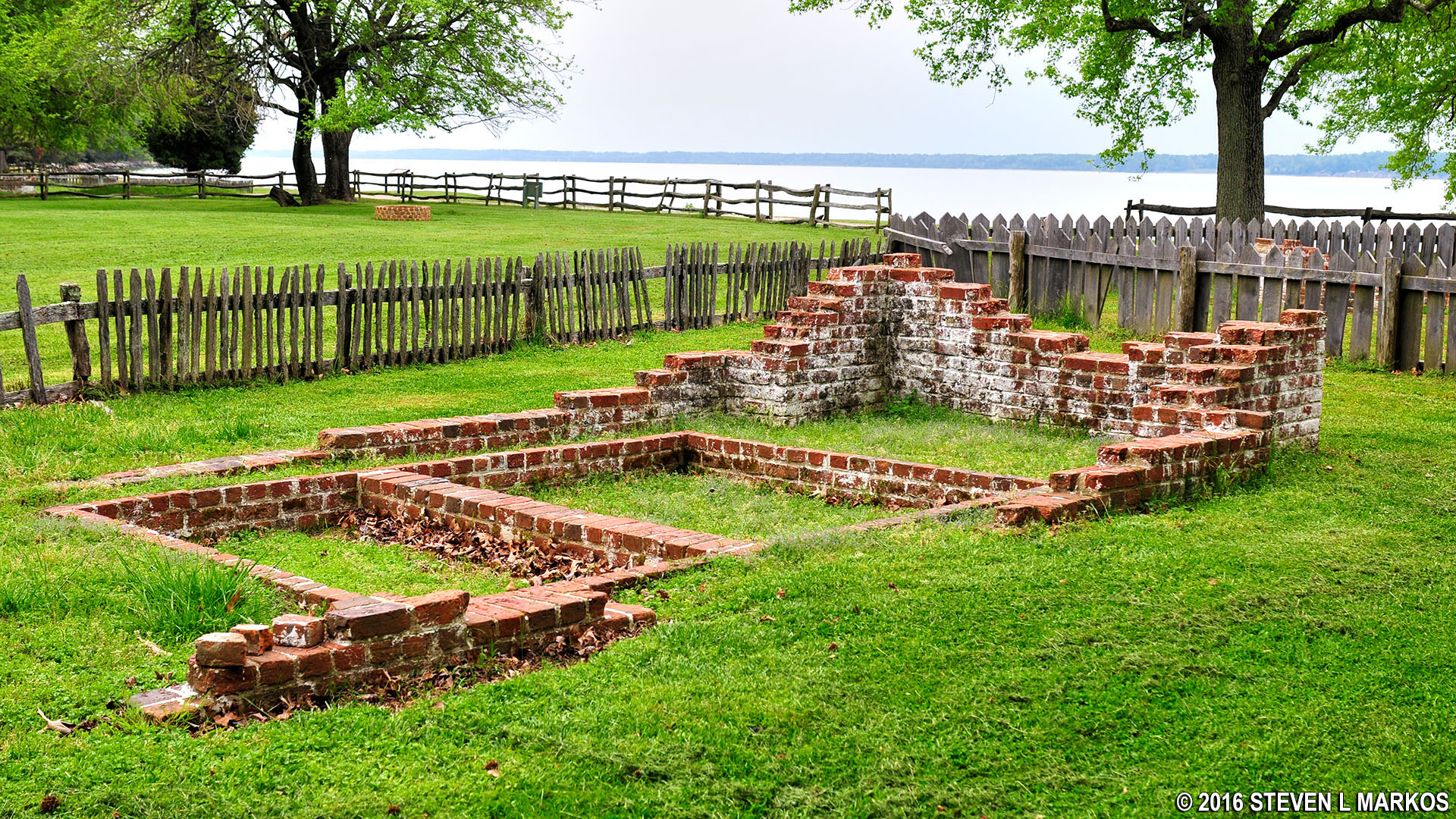
Foundation replica of a home in the New Town section of Jamestown, Colonial National Historical Park
When people think of Jamestown, they think of America’s first permanent settlement in 1607, Pocahontas, and Captain John Smith. However, Jamestown continued to grow all through the 1600s, so its story extends beyond the walls of the original James Fort. This history can be explored by taking a tour of New Town, which is part of Colonial National Historical Park.
The first colonists to sail to Jamestown were the investors in the Virginia Company—mainly upper class gentlemen—and their hired men. Once the settlement was established, additional colonists arrived, including women. By 1620, the population had grown to the point where the colonists left the fort to settle and farm larger tracts of land on the island. Called New Town, the first homes sprang up just outside the fort walls, and over the years the town grew farther and farther to the southeast. Jamestown prospered until 1699, when the capital of Virginia, which was Jamestown, was moved to Williamsburg. This sent the town into a rapid decline, and most people were gone by the mid 1700s. Eventually, only two families owned most of the island.
Unlike James Fort, which was located by archaeologists only in 1994, excavations of New Town started when the National Park Service acquired 1,500 acres of Jamestown Island in 1934. In fact, by the 1950s, the exposed foundations of former homes and businesses were beginning to show signs of damage, which prompted the NPS to figure out a way to stop the deterioration. The solution was to rebury the original foundations, cap them with a layer of concrete, and then build an above-ground replica using discarded bricks found during the excavations. Thus, the foundations you see today are from the late 1950s.

Sites to see at New and Old Town (click to enlarge)
A tour of Jamestown, both the New and Old sections, begins at the back of the Jamestown Visitor Center. As you depart, you will pass the home site of Governor George Yeardley (Governor of Virginia from 1618-1621) and cross the Pitch and Tar Swamp. Pine trees grew in the swamp, and the sap was harvested to create pitch: a black, tar-like substance used to seal the hulls of ships.

View of James Fort from the tar and pitch swamp on Jamestown Island, Colonial National Historical Park
After crossing the swamp you will come to the Tercentenary Monument, which was erected in 1907 to commemorate the three-hundredth anniversary of the founding of Jamestown. From here you can choose to visit Old Town on your right or proceed to tour New Town on your left. I suggest beginning at Old Town, since this is where Jamestown began, then walking the dirt path that takes you around the excavated section of New Town.

Tercentenary Monument at Jamestown, part of Colonial National Historical Park

View of the tour path to the New Town section of Jamestown from the base of Tercentenary Monument, Colonial National Historical Park
The path around New Town is a large loop approximately three-quarters of a mile long. A short-cut bisects the loop near the far end, creating a Figure-8 configuration, but be sure to skip past this in order to cover the entire area. The terrain is completely flat and the grounds are beautifully maintained, so on a nice day the walk is a pleasure, with or without the history of New Town at your fingertips. Many visitors check out Old Town only, so you may find yourself away from the crowds while strolling through New Town.

Grounds of the New Town section of Jamestown, Colonial National Historical Park
I suggest starting your tour of New Town along the James River. The tour path is actually an original road used by the people of Jamestown, aptly called the “Highway Along the River.” In 1633, by which time New Town was well established, the Virginia General Assembly made Jamestown one of five tobacco examining and grading locations. For a half mile down the river from Old Town, wharves and warehouses lined the shore to accommodate the loads of tobacco and the many ships that would transport it back to England and other ports of trade.

Highway Along the River in the New Town section of Jamestown, Colonial National Historical Park
As you walk around the town you will see the foundations of former homes and businesses, many of which are marked with wayside exhibits that tell their history. As mentioned early, none of these are the actual foundations but replicas of the originals buried below.

Wayside exhibit in the New Town section of Jamestown tells about Swann’s Tavern, Colonial National Historical Park
The only original New Town structure is the ruins of the Ambler Mansion, which was built around 1750. Once the capital of Virginia was moved to Williamsburg and people started leaving Jamestown, a few investors began buying up the vacated property. In 1739, Richard Ambler and his wife Elizabeth Jaquelin inherited nearly all of western Jamestown Island, which unknown to anyone at the time included the James Fort site. Elizabeth’s father, Edward Jaquelin, was one of the men who had been purchasing the property on the island as it came up for sale. The family started a plantation where wheat, corn, and tobacco were grown. The remainder of the island was owned by the Travis family, which also operated a plantation. Both families retained ownership of the island until 1831, when an investor named David Bullock bought the entire island, only to sell it off a few years later.
The Ambler Mansion was damaged during the American Revolution, the War of 1812, and the Civil War, but each time it was repaired. However, after a fire in 1895, it was left in ruins by the Barney family, who had purchased the island in 1892. They would go on to donate 22 acres that included the James Fort site to Preservation Virginia, which at that time went by the name Association for the Preservation of Virginia Antiquities.

Ambler Mansion ruins in the New Town section of Jamestown, Colonial National Historical Park

Ambler Mansion ruins in the New Town section of Jamestown, Colonial National Historical Park
The entire walk to and from the Jamestown Visitor Center and around both Old and New Town is roughly 1.75 miles. At a leisurely pace it takes about two hours, giving you time to read all of the wayside exhibits and to snap some photos. This is not to say that a visit to Jamestown only takes two hours, because you will most likely want to join a few of the Guided Tours and peruse the Visitor Center Museum and the Voorhees Archaearium.
With a few exceptions, use of any photograph on the National Park Planner website requires a paid Royalty Free Editorial Use License or Commercial Use License. See the Photo Usage page for details.
Last updated on July 12, 2024


