
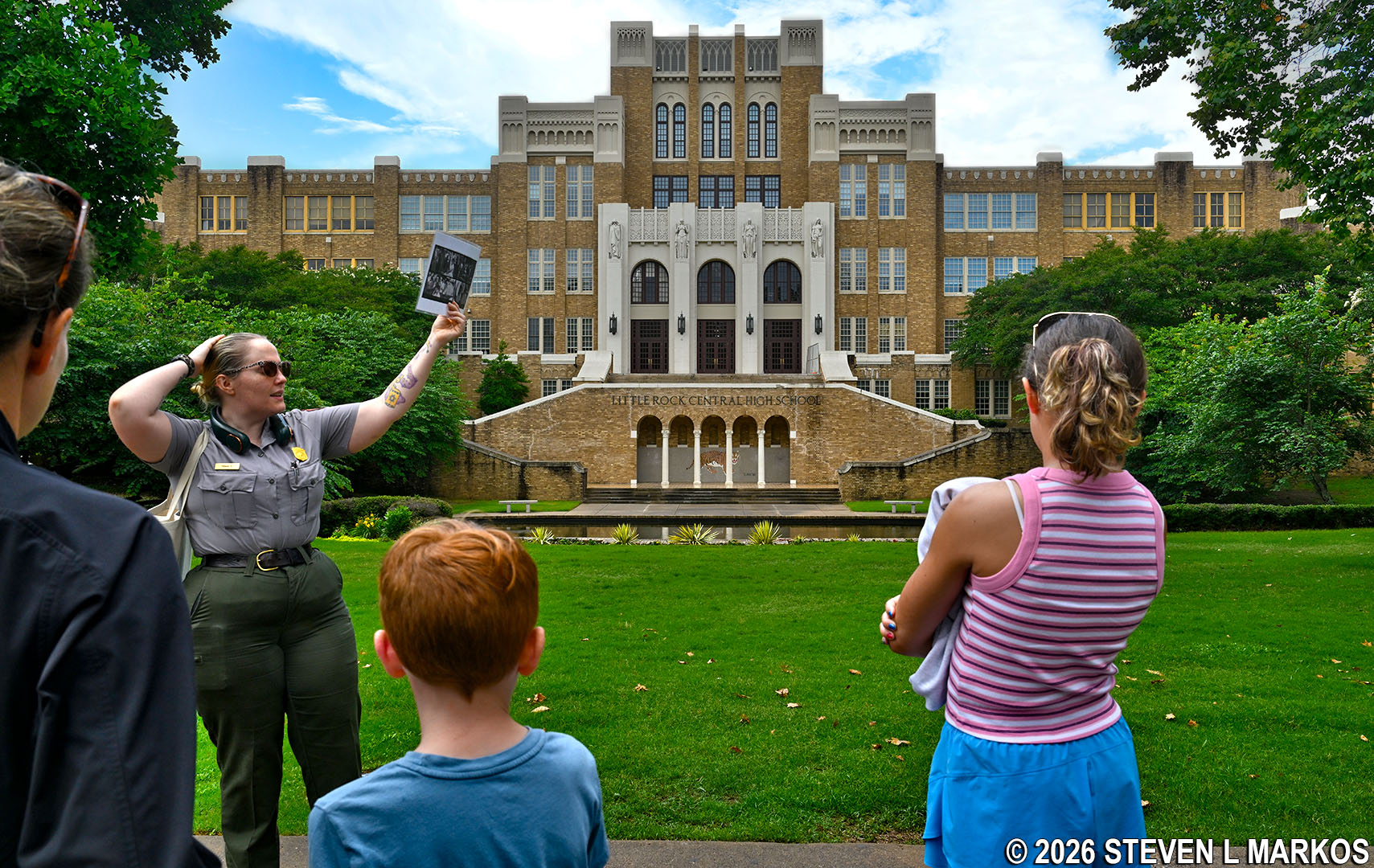
Ranger leads a tour / lecture at Little Rock Central High School National Historic Site
VISITING LITTLE ROCK CENTERAL HIGH SCHOOL
Little Rock Central High School opened in 1927, and it is still a functioning high school today. Because of this, it closed to the public at all times, even during the summer when school is out. However, visitors are welcome to walk the grounds at anytime during daylight hours. Don’t worry about being arrested for looking suspicious—unless you are looking suspicious—for the school security is very used to tourists.
There is also an option to join a free Ranger-guided tour of the sites associated with Little Rock Central High School National Historic Site. Tours are typically held Tuesdays through Saturdays at 1 PM. Available dates are published three months in advance on the National Park Service’s official Guided Tours web page, so be sure to check that out to see if a tour is being held or has not sold out when you are visiting. Sometimes they are not held due to other events or scheduling conflicts.
Advance reservations are suggested and can only be made by calling the Visitor Center at (501) 374-1957. You can also get tickets on the day of the tour if any spots are still available. This is usually not a problem except during Black History Month in February and towards the end of the school year in late April and early May when many school groups attend. If you have a group of more than 50 people, you must call in advance to make arrangements.
There is a downside to not making a reservation besides the obvious tour being sold out. If nobody registered and you show up ten minutes before a tour is supposed to be held, there might not even be a Ranger scheduled to give a tour. You’re out of luck. Other than that, and outside of the months listed earlier, spots are easy to come by—despite the National Park Service website’s statement to the contrary. The tour I attended on a Friday at the end of May when school was out had around a dozen people, and there are 50 spots available on each tour. However, if you know when you will be visiting, do the smart thing and make a reservation.
There are two versions of the tour, one for high school students and adults and one for elementary and middle school students. The adult version is the one given to the general public (and high school groups). It is two hours long, and on top of that, it’s more of a lecture than a tour, and a college-level lecture at that. This is not for those simply looking for a fun day at the park or stopping in just to get their National Park Passport book stamped before moving on to the next park. This is for people who want to learn something. The Ranger who gave the tour I was on was extremely knowledgeable and adamant about the subject matter. Keep in mind that if you have young kids with you, this is the tour they must attend, so they may very well lose interest. The tour for younger kids is only given to school groups.
The tour starts off in the Visitor Center auditorium, and it is here that the background of the 1957 attempt to integrate Little Rock Central High School is discussed. Once this part of the lecture is complete, if weather allows, the group heads outside and makes the short walk to the high school where the talk centers around the actual events that occurred when the black students attempted to enter the high school at the start of the school year. While the tour does not enter Central High, it does stop at the entrance of the school where there is a reflecting pool and benches dedicated to the Little Rock Nine (as the nine students who went to Central High in 1957-58 are called).
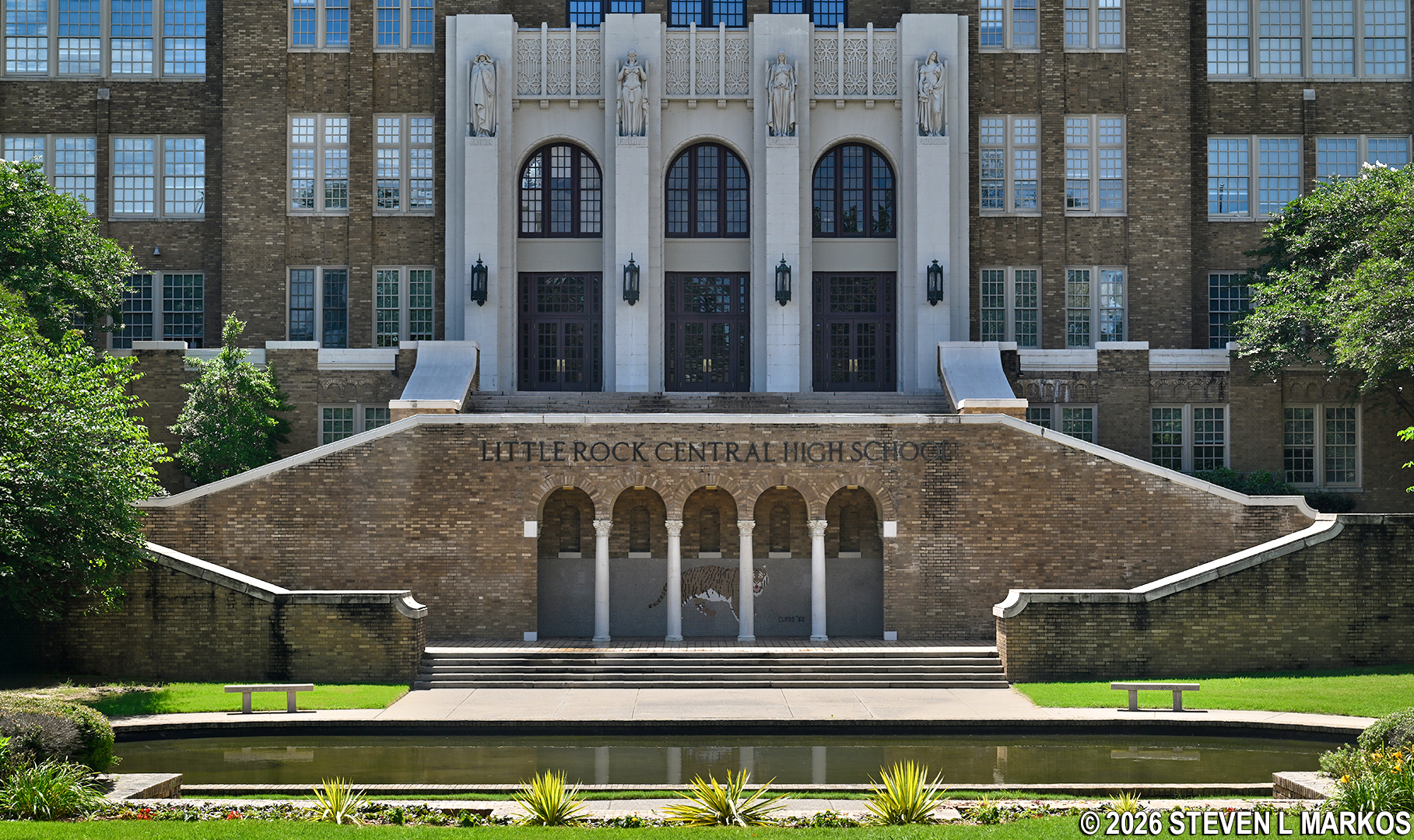
Little Rock Central High School in Little Rock, Arkansas
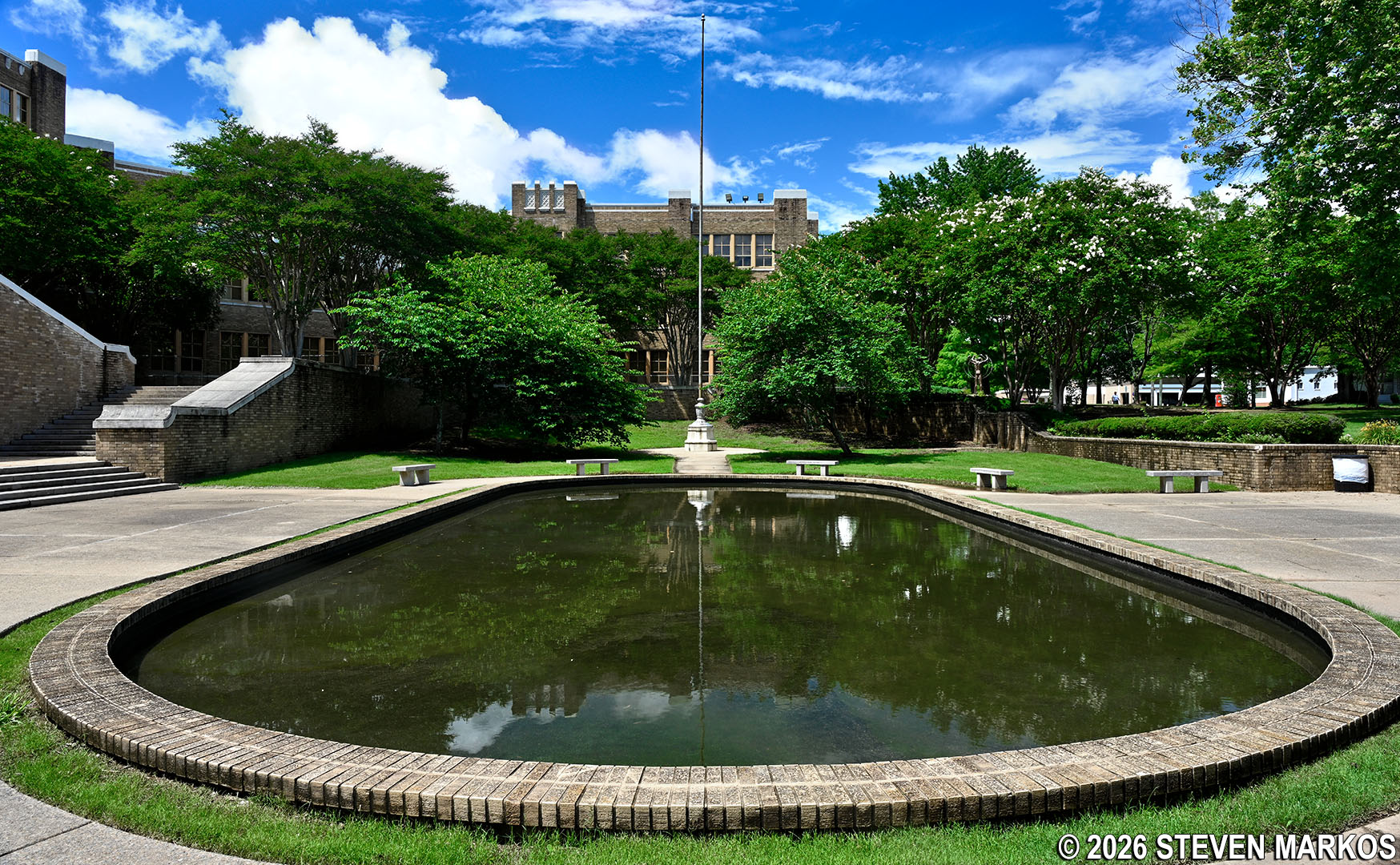
Reflecting pool at the entrance to Little Rock Central High School in Little Rock, Arkansas
While I did not attend a tour for the elementary and middle school students, the Ranger told me it is much shorter and not as detailed. If adults show up without a reservation and a school group tour is all that is available, they can join in as long as spots are available.
LITTLE ROCK INTEGRATION CRISIS OF 1957
Little Rock Central High School is the site of the Integration Crisis of 1957. This is when black students attempted to integrate into the school following the United States Supreme Count’s landmark decision in Brown v. Board of Education (May 17, 1954) that ruled racially segregated public schools were unconstitutional. This overturned a long-standing Supreme Court decision from 1896 (Plessy v. Ferguson) that ruled segregation was legal as long as races were treated equally and had access to facilities and social programs of equal quality.
Arkansas passed laws to begin a gradual integration of its schools starting shortly after the Brown decision. In fact, Arkansas high schools were integrated in Fayetteville and Charleston starting with the 1954-55 school year, and in Hoxie by the summer of 1955, all without much fanfare or disruptions. Which brings up the question as to why the integration of Little Rock Central High became such a flashpoint.
In Little Rock after the Brown decision, Daisy Bates, a prominent member of the black community and the president of the National Association for the Advancement of Colored People (NAACP) Arkansas State Conference of Branches, began recruiting black students who were willing to switch schools and attend the all-white Central High for the fall 1954 term. She found three girls who were willing to do so. However, the Little Rock Board of Education refused to accept black students, citing its desegregation plan that was to start in 1957 at Central High and gradually expand to include the lower grades. Realizing this was just a delay tactic, the NAACP filed a lawsuit against the school board. The court ruled for the school board and allowed it to continue its plan for integrating Central High as schedulked.
The Little Rock school board had many more tricks up its sleeve. The black high school, Dunbar High, was converted into a middle school in 1955, and a new high school, Horace Mann, was built for the black students in hope that they would not want to transfer to the older Central High. Construction was completed in time for the 1956-57 school year. In west Little Rock, construction on another school, Hall High, began in 1956. It was to be ready for the 1957-58 school year. Hall was located in an all-white area, and the thinking was that if Central High was integrated, white families could move to west Little Rock and attend Hall (two hundred families did move). The construction of these two schools was the real reason for Little Rock delaying its integration plans until 1957-58. With a new high school to keep the black students happy and a new high school for the white students who did not want to attend a segregated school, whatever happened at Central would not be as big of an issue.
In the spring of 1957, teachers at Dunbar and Horace Mann asked students who wanted to attend Central the following school year to sign up. Two hundred students did so, but the Little Rock school board insisted that there was not enough room for 200 new students, despite the fact that Central could hold 3,000 students and was less than half full. To legally lower the number of transfers, the school board used a number of tactics. New Pupil Placement laws had just been passed in January 1957 (in many southern states, not just Arkansas) that gave the school board the right to approve or disapprove transfers based on certain criteria. Race was not one of them, but grades and attendance records could be considered. Furthermore, the law prohibited transfer students from participating in all extracurricular activities, and not just as an active club or team member, but even from attending events such as football games. The students who signed up were also informed that if they retaliated against anything done to them by a white student, they would be expelled from the school district. And if that didn’t deter transfers, their names would be published, which would expose them and their families to threats of various sorts. With all that, the day before school was to start on September 3rd, only ten students still wanted to transfer.
On the night of September 2nd, Arkansas Governor Orval Faubus, who was up for reelection, made an announcement that threats had been made against the city and that violent gangs were on their way to stop the integration of Central High. In response, he was ordering the Arkansas National Guard to Little Rock to stop any such shenanigans, and preventing the ten black students from entering the school was the best way to quell the mobs. Of course, all of this was a fabrication, but it did attract local protestors and the news media from around the country, which is why the situation blew up into international news. And it is why Little Rock Central High is remembered and not all of the other schools that integrated, some peacefully and some under protest.
Due to the order by Faubus, the ten students did not go to school on the 3rd. The Little Rock school board also attempted to get a court order allowing it to delay integration. This was denied after an investigation found Faubus’s claims about hooligans were false. The school board then informed the students that they could come on the 4th but without their parents, reasoning that the black parents would start trouble if their kids were assaulted.
Daisy Bates and few other adults, including white ministers, agreed to escort the students to school. The students were called and instructed to meet near the school and proceed in a group from there. Unfortunately, one of them, Elizabeth Eckford, did not have a telephone and was not notified. Eckford rode a city bus alone to the school where angry protestors greeted her with racial chants and threats. Unable to enter the school due to the Arkansas National Guard blockade, she tried to escape the mob by making her way to another bus stop at the corner of West 16th and South Park streets, which is just a half a block from the high school. Eckford sat on a bench at the bus stop for over a half hour, enduring a barrage of hate from the protestors, with some even spitting on her.
The rest of the students were also denied entry by the Arkansas National Guard. The students were Ernest Green, Jefferson Thomas, Terrence Roberts, Carlotta Walls, Minnijean Brown, Gloria Ray, Thelma Mothershed, Jane Hill, and Melba Patillo. Due to threats against her family, Jane Hill decided not to attend Central. Despite her traumatic day alone, Eckford was still willing to transfer. Now there were only nine students left, and this group would become known as the Little Rock Nine.
After missing school for a few weeks due to legal battles over desegregation, on September 23rd, the group once again attempted to enter Central High. The National Guard had been removed by court order, so only local police were on duty to keep the peace. The students did get into the school, but within two hours they were secretly escorted out to avoid violence when the protesters rioted and stormed the building.
As mentioned, the events at Little Rock were being reported around the world. The communist government of the Soviet Union seized upon this negative publicity to promote the virtues of communism over capitalism. To some extent, this prompted President Dwight Eisenhower, who was against integration, to send in the 357th Airborne Battle Group (part of the 101st Airborne Division) and federalize the Arkansas National Guard. On the 25th, the Airborne soldiers escorted the Little Rock Nine into the building for their first full day of school. This was the first time since Reconstruction that federal troops were sent to enforce the civil rights of black citizens.
The Airborne troops remained in Little Rock until Thanksgiving. At that time a smaller contingency of the Arkansas National Guard was left to ensure the peace. However, neither group of soldiers was allowed inside the building, so while the Little Rock Nine made it to school every day, the had to endure harassment and violence on a daily basis brought upon them by the white students. Those who did not physically engage in the harassment stood by complacently.
Of all the Little Rock Nine, Minnijean Brown was the only one not to complete the school year. She was expelled from the Little Rock school system for fighting back against abuse. The only senior, Ernest Green, graduated at the end of the year.
To protest integration, the Arkansas General Assembly at the request of Governor Faubus passed laws that allowed any schools that were in jeopardy of being desegregated to be closed. As a result, all schools in Little Rock (Pulaski County) were closed completely for the entire 1958-59 school year. The remaining seven members of the Little Rock Nine went to school elsewhere (some in other states). Patillo, Ray, and Roberts graduated at the end of the year at their new schools. Mothershed and Eckford finished high school by correspondence courses. Walls and Thomas returned to Central when the schools were reopened for the 1959-60 school year; both graduated. That year there were only three other black students who went to Central.
Integration in Little Rock was not considered complete until 1972, which was when busing was instigated and the Pupil Placement laws were overturned.
With a few exceptions, use of any photograph on the National Park Planner website requires a paid Royalty Free Editorial Use License or Commercial Use License. See the Photo Usage page for details.
Last updated on September 20, 2026


