
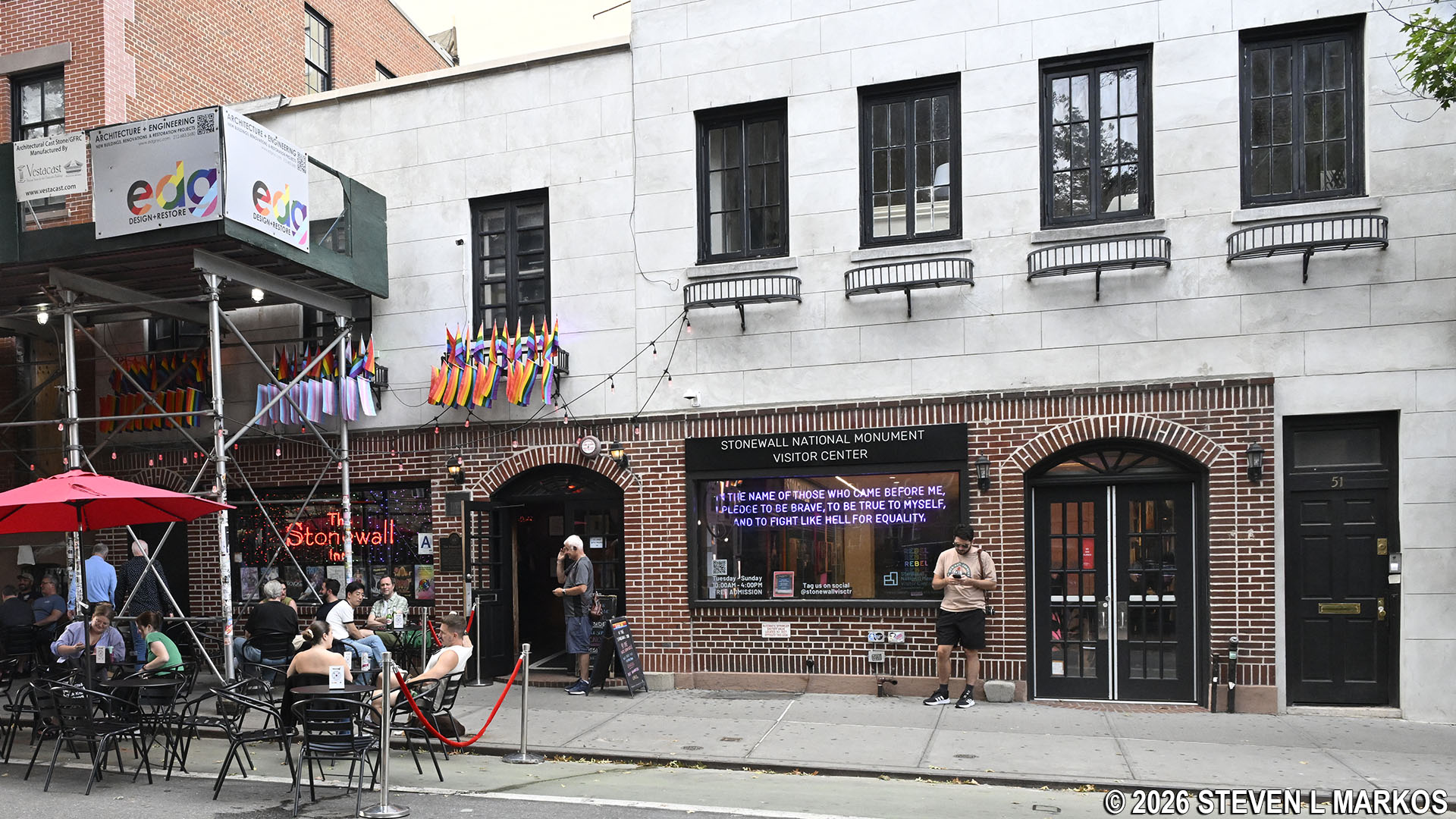
Former Stonewall Inn on Christopher Street, part of Stonewall National Monument
PARK OVERVIEW
Stonewall National Monument in New York’s Greenwich Village commemorates the June 28, 1969, riot / rebellion / uprising (depending on your point of view) and subsequent protests instigated by a police raid on the Stonewall Inn, a bar that catered mainly to gay men. The park was also created to shine a light on the LGBTQ+ community’s struggle for equal rights. It was authorized by Barrack Obama in 2016 per the Antiquities Act.
The park consists of the privately owned Stonewall National Monument Visitor Center (which has partnered with the National Park Service), Christopher Park across the street, and some of the streets in Greenwich Village. However, the Visitor Center is the only place with any visitor amenities, and Christopher Park is the only property owned by the National Park Service. It was donated to the federal government by the City of New York.
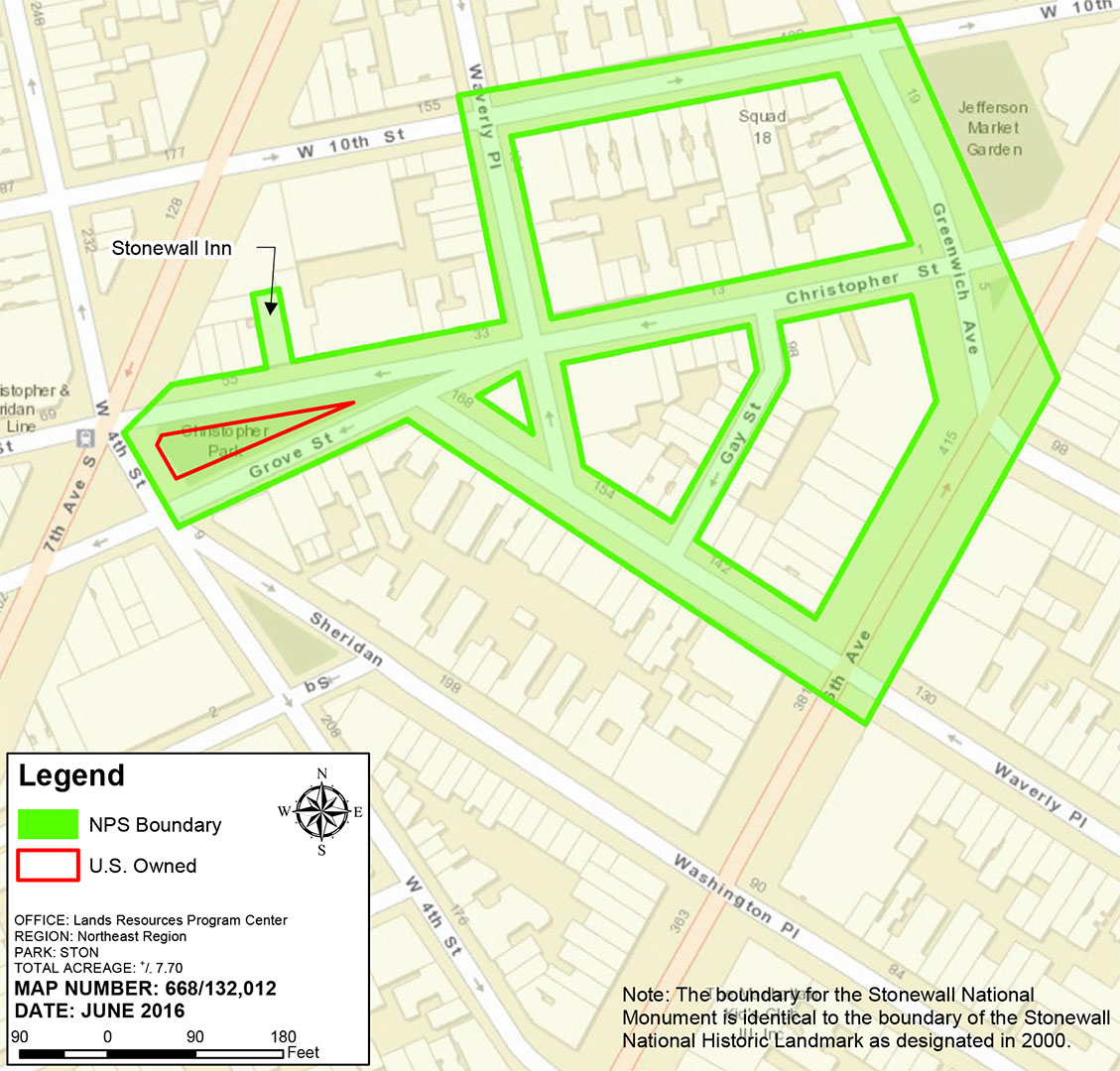
Map showing the boundary of Stonewall National Monument
The Visitor Center is located in one half of the former Stonewall Inn. While privately owned, National Park Rangers are on duty, and they do hold lectures and give neighborhood tours on weekends from May through October. For a schedule, visit the National Park Service’s official Calendar web page for Stonewall National Monument.
The Stonewall Inn began as Bonnie’s Stonewall Inn, a popular restaurant with no connection to the LGBTQ+ community. It opened in 1934 and closed in 1964 due to a fire. The building was purchased by Fat Tony Lauria of the Genovese crime family, and he opened it as a gay bar starting in 1967, retaining the name Stonewall Inn. It was common for Mafia members to own gay bars, and these were usually operated as private clubs to get around liquor license laws, which prohibited the sale of liquor in disorderly establishments. Having one gay person in the bar automatically qualified it as disorderly. The clientele, mainly gay men but on occasion lesbians, drag queens, and transgender people, had little room to complain about cover charges and high prices for watered-down drinks. In many cases, the liquor was stolen, so the profits were tremendous. Mafiosos were often tipped off about raids by their police connections, and they were able to warn the clientele in the bar to stop dancing and kissing just before the police arrived. The Stonewall Inn didn’t even have a liquor license, so payoffs to the police were mandatory.
The original Stonewall Inn consisted of two storefronts–51 and 53 Christopher Street—with a common brick wall between them. Two doorways were knocked through the wall allowing patrons to pass from one side to the other. The front door was at 53 Christopher Street, which is where a modern version of the Stonewall Inn now operates (left side if looking at the building from the street). Upon entering, there was a coat check and office. Patrons had to immediately pass through a doorway into 51 Christopher Street (today’s Visitor Center) where the main bar was located. There was also a dance floor and jukebox. A second doorway led back into 51 Christopher Street where another dance floor and a smaller bar were located. There were two bathrooms in the building, and these could be accessed from either side. The entire interior of both rooms was painted black to hide the damage done by the 1964 fire, there was no running water at the main bar, and there were no fire exits. The windows were painted black and backed with plywood. Even patrons of the time acknowledge that the Stonewall Inn was a dump, but it was a safe haven for them.
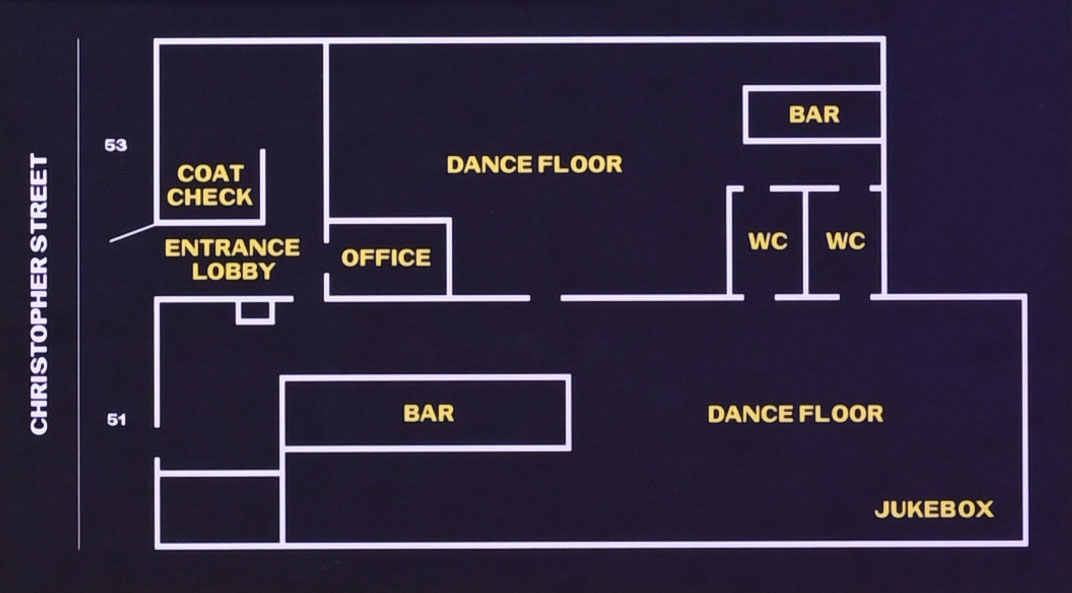
Layout of the Stonewall Inn in 1969
Raids on gay bars were common, and they were often carried out to appease the public or boost the ratings of a politician up for reelection, which was the case in the summer of 1969 (New York City mayor John Lindsay was up for reelection). The Mafia owners couldn’t stop these raids, but they did pay the police to raid the bars early in the evening on a weekday when the crowds were thin. In fact, the Stonewall Inn had been raided the previous Tuesday night without incident. However, the June 28th raid was significantly different. It happened around 1 AM on Saturday when the place was packed. And this time a crowd gathered outside—people out for the night who happened to be walking by; the homeless people who congregated at Christopher Park, mostly young gay, lesbian, and transgender people; and eventually the people inside the Stonewall Inn who were told to leave without being arrested. The crowd got bigger by the minute. A few bar patrons resisted the police and were roughly manhandled as they were dragged out of the building to the waiting police paddy wagons. This didn’t sit well with the crowd, and a full-fledged riot was now unavoidable.
Tired of being discriminated against and harassed, the crowd began throwing pennies at the police (copper pennies for cops), verbally taunting and abusing them, and eventually hindering the arrests. Fearing for their safety, the police officers fled into the bar while the crowd continued to hurl objects at the doors and windows, which by this time had turned from pennies to rocks, garbage cans, and even incendiary devices. A parking meter was torn out of the cement and used in an attempt to batter down the front door. There were many bar patrons inside as well, and they were as afraid as the police. If the crowd got in, in the melee that would certainly ensue, they could easily be mistaken for cops.
The fire department and five buses of riot police arrived on the scene before the rioters could enter the bar. By then the crowd had grown from a hundred or so at the start of the raid to somewhere between 1,500 and 2,000 angry people. The riot police chased the crowd down the street, but knowing the neighborhood, the crowd just ran around the block and showed back up behind the police. The riot, in some form, lasted until 4 AM. While nobody was killed, 13 people were arrested (mostly Mafia-hired employees working in the bar) and the Stonewall Inn was heavily damaged. Whether this was the result of rioters or the police busting up the place in spite is not known for certain.
In defiance of the police, the Mafia owners opened the Stonewall Inn the next night. Thousands of people came to see what had happened the night before, many of whom were involved in the riot. Other groups who were fed up with police harassment also stopped by, including Black Panthers and anti-Vietnam War demonstrators. The police, in much larger numbers, also came, and rioting eventually broke out once again. When the riot police showed up, the events of the previous night began all over. According to eye witnesses, the violence by the police on the second night was far worse than on the night of the Stonewall Inn raid.
Protestors in varying numbers gathered for the next three nights, with Wednesday, July 3, being the only night of significant violence and altercations with the police (it had rained the other two nights). There were quite a few injuries, and five people were arrested. However, the Wednesday events were nothing on the scale of the first two nights of protest.
Going back to the late 1950s, there were many rebellions similar to Stonewall in cities with LGBTQ+ communities as large as New York: San Francisco, Los Angeles, Philadelphia. So why did Stonewall become what is today recognized as the start of the Gay Liberation Movement? That question is not easily answered. The rebellions prior to Stonewall didn’t stir up activism despite there being over two dozen gay-civil-rights organizations at the time. In contrast, after the Stonewall uprising, the LGBTQ+ community in New York flew into action, and civil-rights groups such as the Gay Liberation Front, the National Gay Taskforce, the Radicalesbians, and the Gay Activist Alliance emerged. This enthusiasm sparked the formation of hundreds of civil rights groups around the country.
The Stonewall Inn closed shortly after the protests. The doorways between the two storefronts were bricked up, and the two halves were rented separately to various businesses over the years. The current Stonewall Inn opened in 1990, operating as New Jimmy’s at Stonewall Place until the owner changed the name to Stonewall. The business was purchased by new owners in 2006, and the name was changed to the Stonewall Inn. It continues to operate as a bar and entertainment facility catering to the LGBTQ+ community, and due to its history, it attracts a lot of tourists. From online reviews, it does not appear that the locals care much for it. Other than being in the same building as the original Stonewall Inn, there is nothing left of the original bar’s interior features.
OPERATING HOURS
The Stonewall National Monument Visitor Center is typically open year-round on Tuesdays through Sundays from 10 AM to 4 PM. Keep in mind that times can always change, so be sure to get the latest schedule on the Stonewall National Monument Visitor Center’s official General Information web page.
Christopher Park is open year-round, 7 AM to 8 PM from May through October and 7 AM to 5 PM the rest of the year. The park is gated, so it is closed at other times of the day.
ENTRANCE FEES
There is no fee to visit Stonewall National Monument. However, the Visitor Center is privately owned and receives no funding from the National Park Service. It is run by the nonprofit organization Pride Live. Donations, though not required, are greatly appreciated.
SCHEDULING YOUR TIME
Visitor Center
allow up to 1 hour
Christopher Park is a small park located across the street from the Visitor Center. Other than checking it out or perhaps taking a rest on the benches, it won’t be of much interest to the typical tourist. The rest of the park consists of city streets in Greenwich Village, and there are plenty of shops and restaurants in the area.
With a few exceptions, use of any photograph on the National Park Planner website requires a paid Royalty Free Editorial Use License or Commercial Use License. See the Photo Usage page for details.
Last updated on July 26, 2026


