

Newbold Trail at Home of Franklin D. Roosevelt National Historic Site
Length: .7 mile (one way)
Time: 15 minutes (one way)
Difficulty: Easy
The Newbold Trail is one of three traditional hiking trails that branch off from the Roosevelt Farm Lane, a former road that connects Franklin Roosevelt’s Springwood estate at Home of Franklin D. Roosevelt National Historic Site with Eleanor Roosevelt’s Val-Kill cottage at Eleanor Roosevelt National Historic Site. The Farm Lane is 1.8 mile long, one way, so if you hike it and don’t have a ride waiting at one end, you have a 1.8-mile return trip ahead of you. Instead of hiking out and back on the Farm Lane and seeing the same things twice, the side trails provide hikers with a chance to cover new ground during one leg of the journey. They are ultimately all just walks in the woods and do not pass anything interesting or remotely scenic, plus they add about a half mile to the trip, so if your goal is just to get to and from the parks as quickly as possible, stick to the Roosevelt Farm Lane. Also keep in mind that bikes are allowed on the Farm Lane but not on the side trails.
Note that while all of the side trails have directional signage at their intersections with the Roosevelt Farm Lane, the trail names are not mentioned on the signs. The signs do have painted squares on them, and the colors represent the different trails. Yellow is the color for the Newbold Trail. You will also find yellow paint splotches on the trees along the trail. These are known as blazes, and they serve as Hansel and Gretel breadcrumbs that hikers follow to stay on the correct path.

Roosevelt Farm Lane Trail Map (click to enlarge)
I visited Home of Franklin D. Roosevelt National Historic Site in late August, and there were mosquitoes on most of the trails. As long as I kept walking, they didn’t bother me, but when I stopped to take photos they were on me within 30 seconds. If you are the type of hiker that stops often to admire the scenery, take photos, or take breaks, consider using mosquito repellent when hiking any of the trails in the park during late spring, summer, and early fall.
From the eastern end of the Roosevelt Farm Lane at Violet Avenue / Highway 9G, the Newbold Trail comes .3 mile from the start. The intersection with the Bennett Trail, another of the side trails, is just before it (within sight distance). From the western trailhead at Albany Post Road / Highway 9, which is where you will be starting from if you are at Springwood, the Newbold Trail is 1.5 mile away.

Eastern intersection of the Newbold Trail and Roosevelt Farm Lane, Home of Franklin D. Roosevelt National Historic Site
I started my hike on the Roosevelt Farm Lane from Springwood early in the morning so that when I got to Eleanor Roosevelt National Historic Site I had time to explore the park. I had to hike back to Springwood, and I decided to take the side trails, first jumping on the Newbold Trail and heading west, and then continuing on the Bracken Pond Trail. This trail report is written from that perspective.
There is a short-but-steep hill right at the start of the Newbold Trail, but once at the top it levels out for quite a while. Overall, the terrain is hilly, but most of the hills are of little note. The worst are perhaps moderate in difficulty, and you can get to the top or bottom in a matter of seconds. The steepest aren’t even taller than me.

Typical waist-high hill on the Newbold Trail at Home of Franklin D. Roosevelt National Historic Site
The Newbold Trail intersects with the northern end of the Bennett Trail, which is marked with blue blazes, only .2 mile from the Roosevelt Farm Lane. Stay straight to remain on the Newbold Trail.

Intersection of the Newbold and Bennett trails at Home of Franklin D. Roosevelt National Historic Site
Just a few minutes later is an intersection with a trail that is no longer on the map. There is a stone wall, and the un-mapped trail cuts through it. A directional sign attached to a tree indicates that the Newbold Trail continues to the right. I have no idea where the other trail goes.

Intersection of the Newbold Trail and an un-mapped trail that cuts through a stone fence, Home of Franklin D. Roosevelt National Historic Site
There are a few sections of the Newbold Trail that are overgrown, and I usually don’t report this since a clean-up crew could come through the area at any time and clear the trail. However, there were enough of these sections that I got the feeling this doesn’t happen often. The large majority of people hiking in this area stick to the Roosevelt Farm Lane, so the side trails don’t get much traffic. I can’t imagine that the National Park Service spends money to clear them on a regular basis. Due to the chance of picking up ticks in the grassy areas, I suggest wearing long pants. In fact, that is good advice for most of the trails at Home of Franklin D. Roosevelt National Historic Site. If nothing else, long pants will keep the mosquitoes off your legs, and that’s less skin you have to coat with chemical repellant.

Overgrown section of the Newbold Trail at Home of Franklin D. Roosevelt National Historic Site
The first leg of the Newbold Trail heads north, but it abruptly turns to the west (left) at a T-intersection after .3 mile. There is a trail to the right, and according the to map, this leads to a former parking area.

Sharp left turn on the Newbold Trail at Home of Franklin D. Roosevelt National Historic Site
The east-west segment of the Newbold Trail is .35 mile long. It is wider than the north-south section, and for the first .2 mile it is as flat as a pancake. I believe this is an old road, but even so, there are a few sections covered in grass that are a little overgrown.
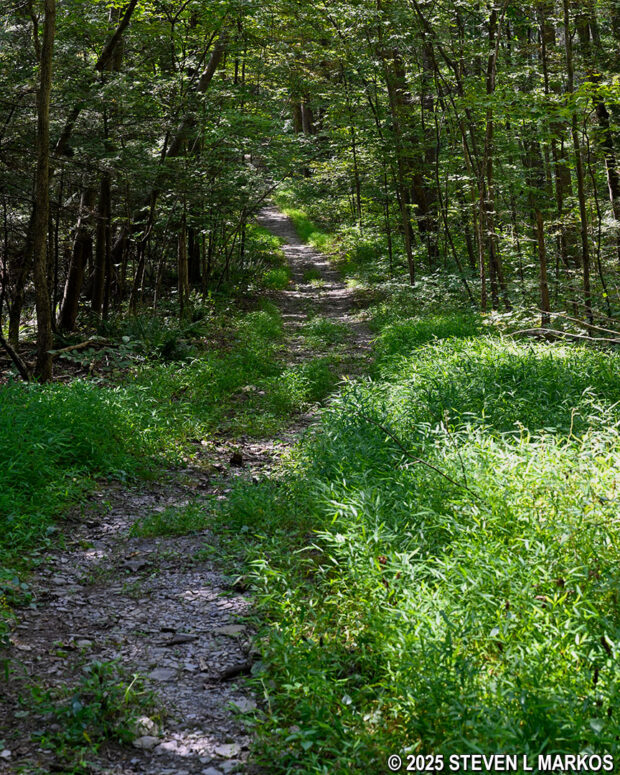
Wider path on the east-west section of the Newbold Trail at Home of Franklin D. Roosevelt National Historic Site
The last .15 mile of the trail heads downhill. It is a long, gradual descent, and even if you were coming the other way and heading uphill, it’s nothing more than moderate in difficulty.
The intersection with the Bracken Pond Trail comes .7 mile from the start. If you want to get back to the Roosevelt Farm Lane, keep straight. It’s just a stone’s throw away. Take a right if you want to continue your hike on the Bracken Pond Trail.
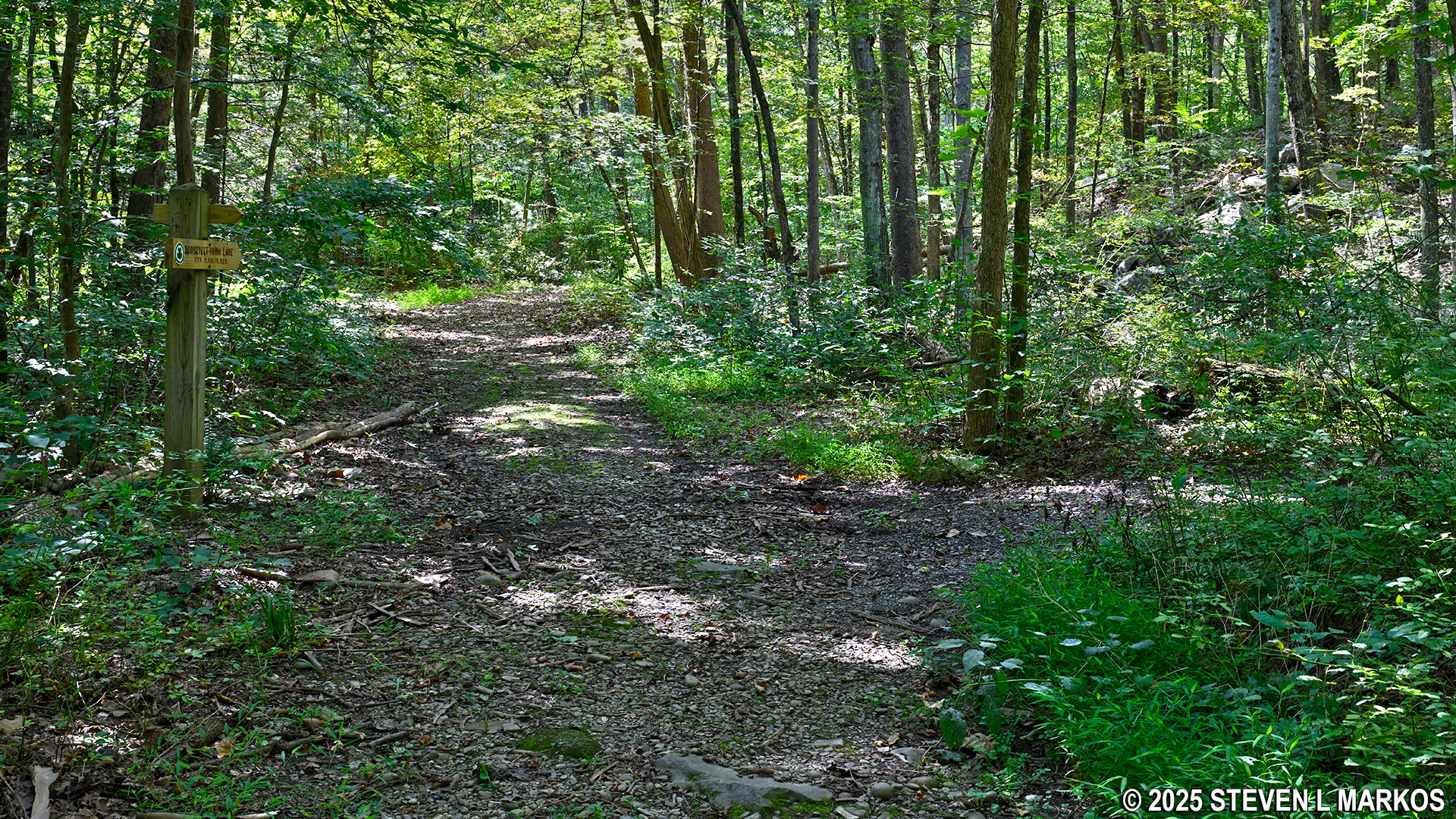
Intersection of the Newbold and Bracken Pond trails, Home of Franklin D. Roosevelt National Historic Site
With a few exceptions, use of any photograph on the National Park Planner website requires a paid Royalty Free Editorial Use License or Commercial Use License. See the Photo Usage page for details.
Last updated on April 4, 2025


