

1871 photo of Hazel Plain, the house of Benjamin Chinn
SECOND MANASSAS BATTLEFIELD TOUR
STOP 10: CHINN RIDGE
Allow up to 45 to 75 minutes for a visit
See the Second Manassas Battlefield Tour web page for a tour map.
GETTING THERE
The driveway to Chinn Ridge is located directly across from the Henry Hill Visitor Center entrance on Sudley Road.
WHAT TO SEE
There are wayside exhibits about Chinn Ridge at the parking lot, and you can take a short walk to the foundation of Hazel Plain, a house owned by Benjamin Chinn at the time of the Civil War. Chinn purchased the property and house in 1853 from a descendant of the Hooe Family. The property came into the Hooe Family by way of marriage: Howson Hooe married Ann Francis Harris in 1724, and her father had purchased the property in 1717. Whether the couple inherited or was given the property is not clear, but they eventually deeded it to Barnard Hooe, and he built a house in 1809. When his daughter inherited the property, she named the house Hazel Plain. The house stood until being torn down in 1950.
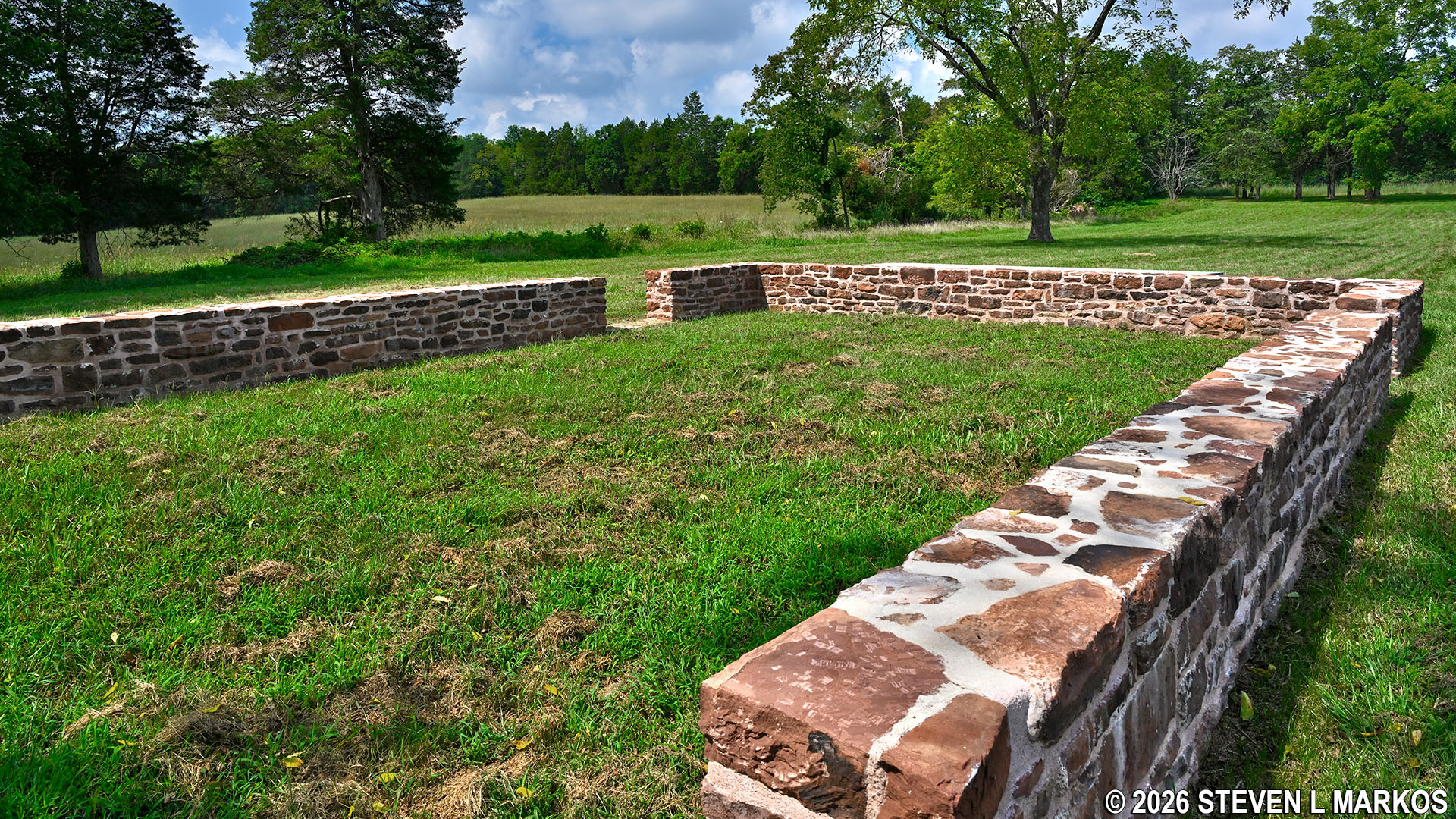
Foundation of Benjamin Chinn’s house Hazel Plain, Manassas National Battlefield Park
The Hooe Family Cemetery is located a short distance from the house foundation, but the walk is downhill. For those who cannot make the trip, there is room for two vehicles at a roadside pullout next to the cemetery.
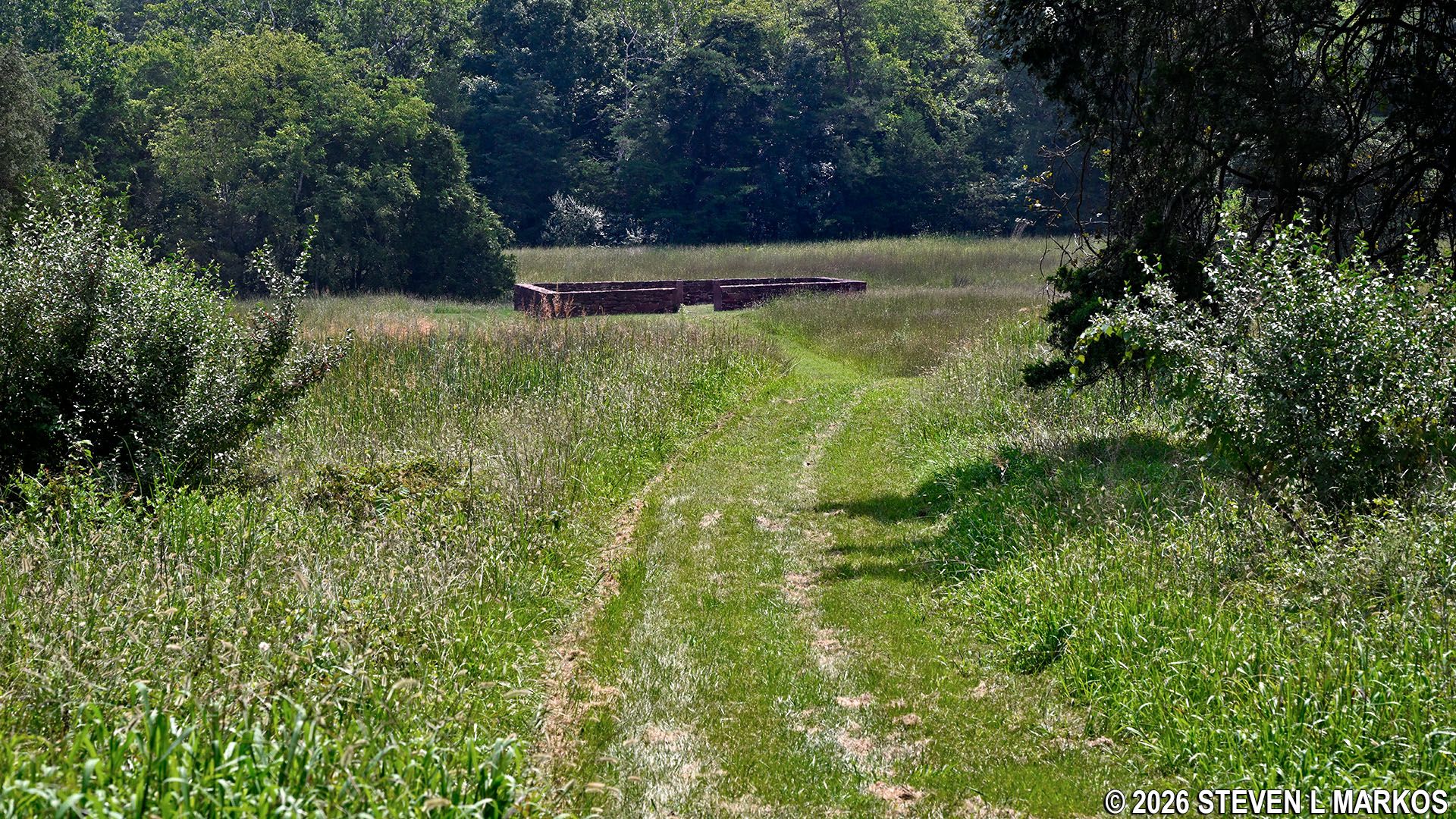
Path to the Hooe Cemetery at the Chinn Ridge stop on the Second Manassas Battlefield Tour, Manassas National Battlefield Park
Within the stone wall that forms the boundary of the cemetery is the tombstone of Bernard Hooe and a few fieldstones that mark forgotten graves.

Grave of Bernard Hooe, a veteran of the American Revolution, in the Hooe Cemetery at, Manassas National Battlefield Park
TRAILS
The Chinn Ridge Loop Trail is 1.5 mile long and covers the area that the Confederates marched through to reach Chinn Ridge. Unlike most other trails at Manassas National Battlefield Park, it does not have any historical exhibits along its path and mainly serves as a trail for exercise.
The Chinn Ridge Trail is an out-and-back paved path that runs along the ridge, a 1-mile round trip. An artillery exhibit marks the spot where the 5th Maine Battery set up four cannons to hold off the oncoming Confederate army. By this point, the battle was lost and the new Union objective was to slow the Confederate assault until darkness could bring an end to the fighting. If they could hold Henry Hill, what remained of the Union army could retreat back to Washington. Because of valiant stands by the men of the 5th Maine and other units on or near Chinn Ridge, by nightfall Henry Hill was still in Union possession, and the remaining troops were able to retreat that night.
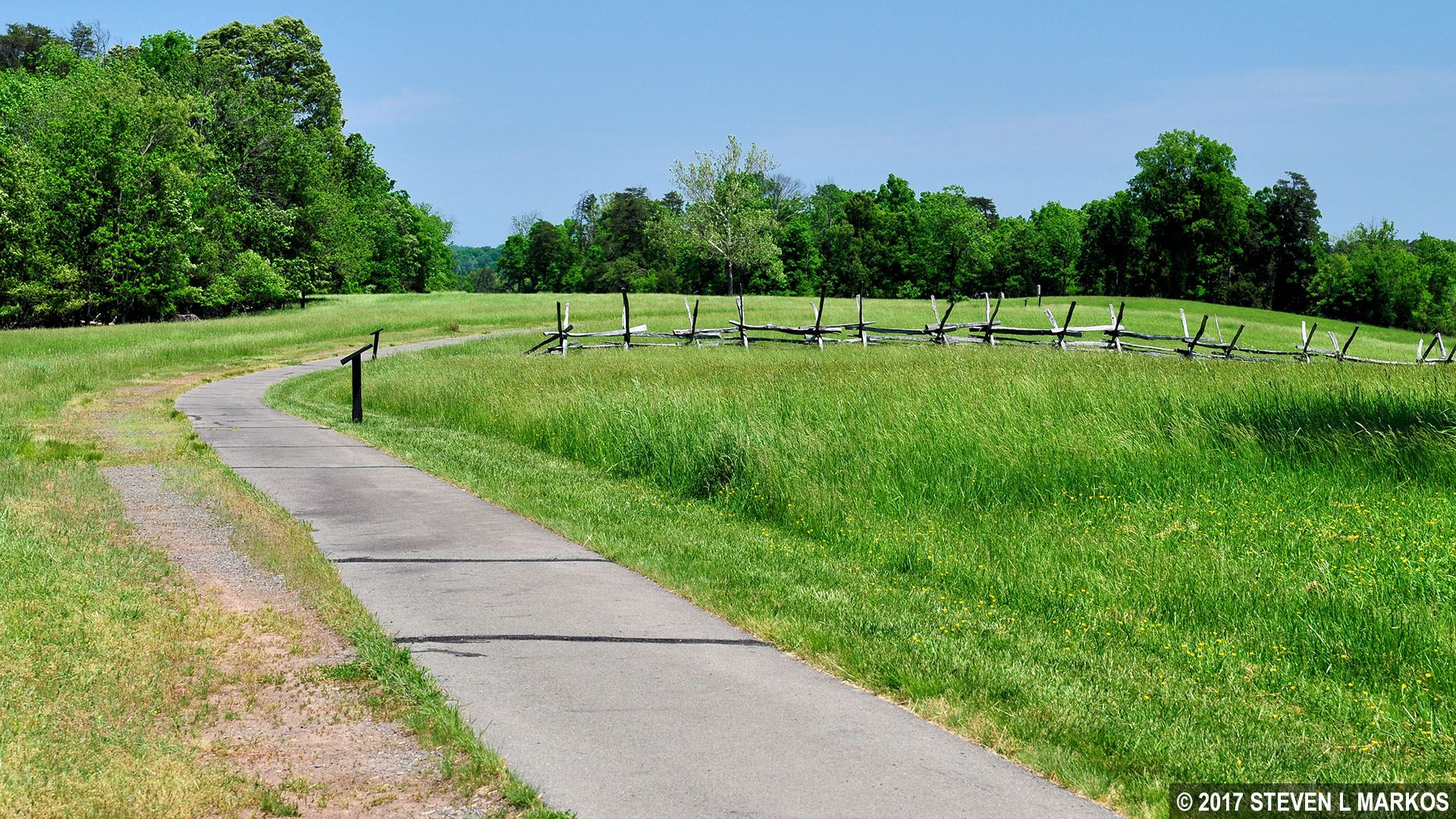
Paved trail along the top of Chinn Ridge in Manassas National Battlefield Park

Civil War-era cannon mark the position of the 5th Main Battery at the Chinn Ridge stop on the Second Manassas Battlefield Tour, Manassas National Battlefield Park
About halfway down the path are two monuments. One is a memorial to Fletcher Webster, the son of Daniel Webster, a famed Senator from Massachusetts and two time Secretary of State under presidents William Harrison / John Tyler (Harrison died a month into his term) and Millard Filmore. Fletcher was a colonel in the Union army; he died during the fighting on Chinn Ridge.
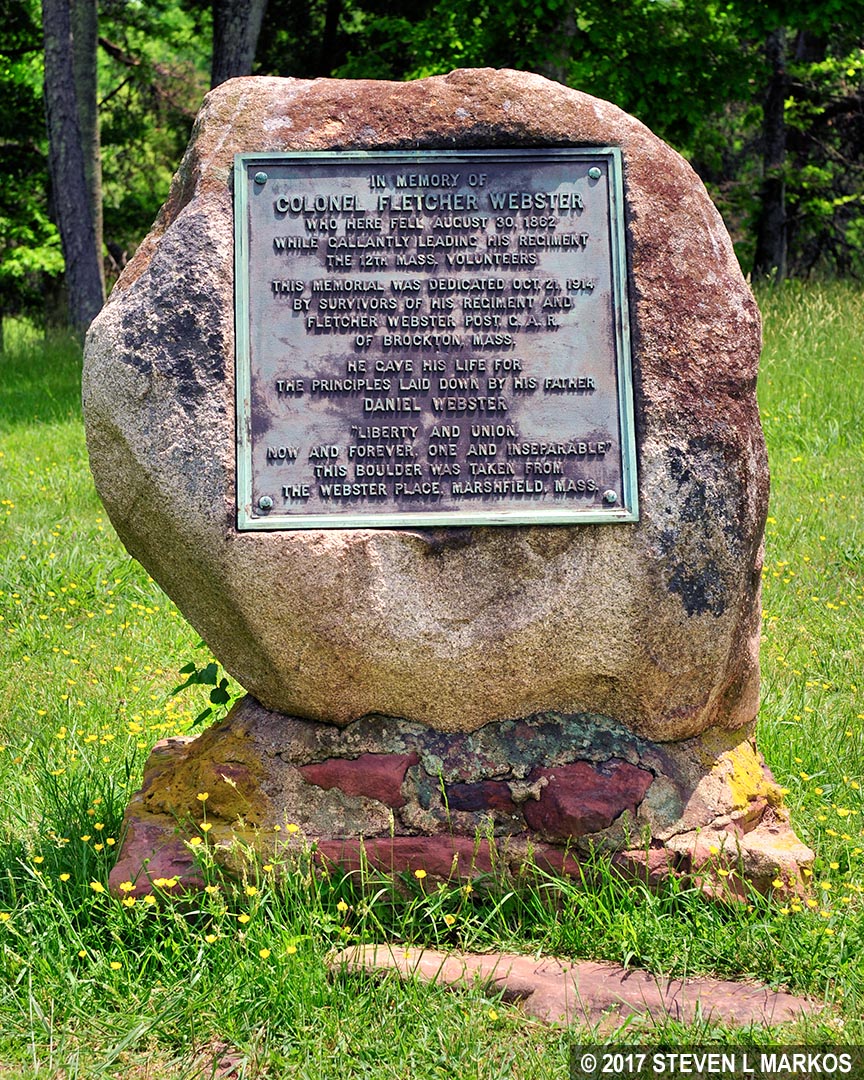
Fletcher Webster Memorial on Chinn Ridge, Manassas National Battlefield Park
The second monument is a memorial to the troops from Texas who fought in the Second Battle of Manassas. You will see this same Texas monument at various national battlefields, and all were erected in modern times, this one in 2012. Specifically mentioned on the monument is the Texas Brigade, a Confederate brigade under the command of John Bell Hood.

Texas Memorial dedicated in 2012 on Chinn Ridge, Manassas National Battlefield Park
The paved path continues for another quarter mile past the monuments, but all there is to see is a wayside exhibit about the Union retreat. A half-mile round trip does not warrant the effort. I suggest walking no farther than the monuments.

End of the paved trail along Chinn Ridge in Manassas National Battlefield Park
SCHEDULING YOUR TIME
Allow 45 minutes for a visit to the house foundation and the Hooe cemetery and a walk on the Chin Ridge Trail to the monuments. Add another hour if you hike the Chinn Ridge Loop Trail.
EVENTS AT CHINN RIDGE

Chinn Ridge battle map
By the late afternoon of August 30, 1862, Union General John Pope was now desperate to hold onto Henry Hill as 30,000 Confederate troops marched to take it from him. The next target for General John Hood and his Texas Brigade, the troops that spearheaded the attack on the Union left flank, was the 1,500 men of the Ohio Brigade commanded by Colonel Nathaniel McLean who were stationed on Chinn Ridge.
An initial volley of Union musket fire from the superior position on the ridge temporarily stopped the front line of the massive Confederate force, but three more brigades soon came into range, ending any chance for McLean and his men to hold out much longer. They retreated a hundred yards and then fired another round of bullets towards the Confederates. After managing to fight for fifteen more minutes, they retreated once and for all back towards Henry Hill.
By this time Pope knew that the battle was lost, so he set up a last defense at Henry Hill and hoped to hold out until night fell. A few other units of Union soldiers took a stand on Chinn Ridge, and while they stood no chance of winning, they were able to slow the Confederate advance. By the time Chinn Ridge was rid of Union soldiers (6:30 PM), only one division of Confederate troops—those under the command of General David Jones—had advanced far enough to make an attack on Henry Hill before nightfall.
EVENTS AT HENRY HILL
Note: While not a stop on the official Second Manassas Battlefield Automobile Tour, the last bit of fighting took place on Henry Hill.
Fighting at Henry Hill took place along Sudley Road south of the Warrenton Turnpike (today’s Highway 29). Four Union brigades lined the road, which like the elevated rail bed of the Unfinished Railroad, was raised up from the ground to give the troops a place to hide behind. The Confederate attack was led by Georgia troops under the command of Colonel Henry Benning. Union soldiers mounted a bayonet countercharge that surprised Benning’s men and engaged them in fighting just south of the Warrenton Turnpike / Sudley Road intersection.
As more Confederate troops came onto the scene, Union artillery opened up on them with canister—tin cans filled with dozens of iron balls that shot out like a shotgun blast. One shot of canister could kill or wound dozens of men. More troops from Georgia arrived and fought to within fifty yards of the Union line. The Confederates were eventually able break through and onto Sudley Road but were immediately confronted by more Union troops. It wasn’t until the edge of darkness that they were finally able to get around the Union left flank, but by then it was too late to continue. When fighting ended for the day, the Union still held Henry Hill, and later that night under the cover of darkness the soldiers retreated across Bull Run and back towards Washington.
The Confederates had won the battle just as they had the year before at the First Battle of Manassas, only this time the losses on both sides were extraordinary. The Union Army lost 10,000 men (dead, wounded, missing), while the Confederates lost 8,000.
If you purchased the Second Manassas Field Guide, the tour ends at the Henry Hill Visitor Center. However, the official National Park Service battlefield tour has two more stops and does not go to the Visitor Center. From the Chinn Ridge stop, the official tour continues to Portici, the site of a plantation house located at the southeast corner of the park.
Stop 11: Portici | Stop 9: New York Monuments
With a few exceptions, use of any photograph on the National Park Planner website requires a paid Royalty Free Editorial Use License or Commercial Use License. See the Photo Usage page for details.
Last updated on February 26, 2026


