
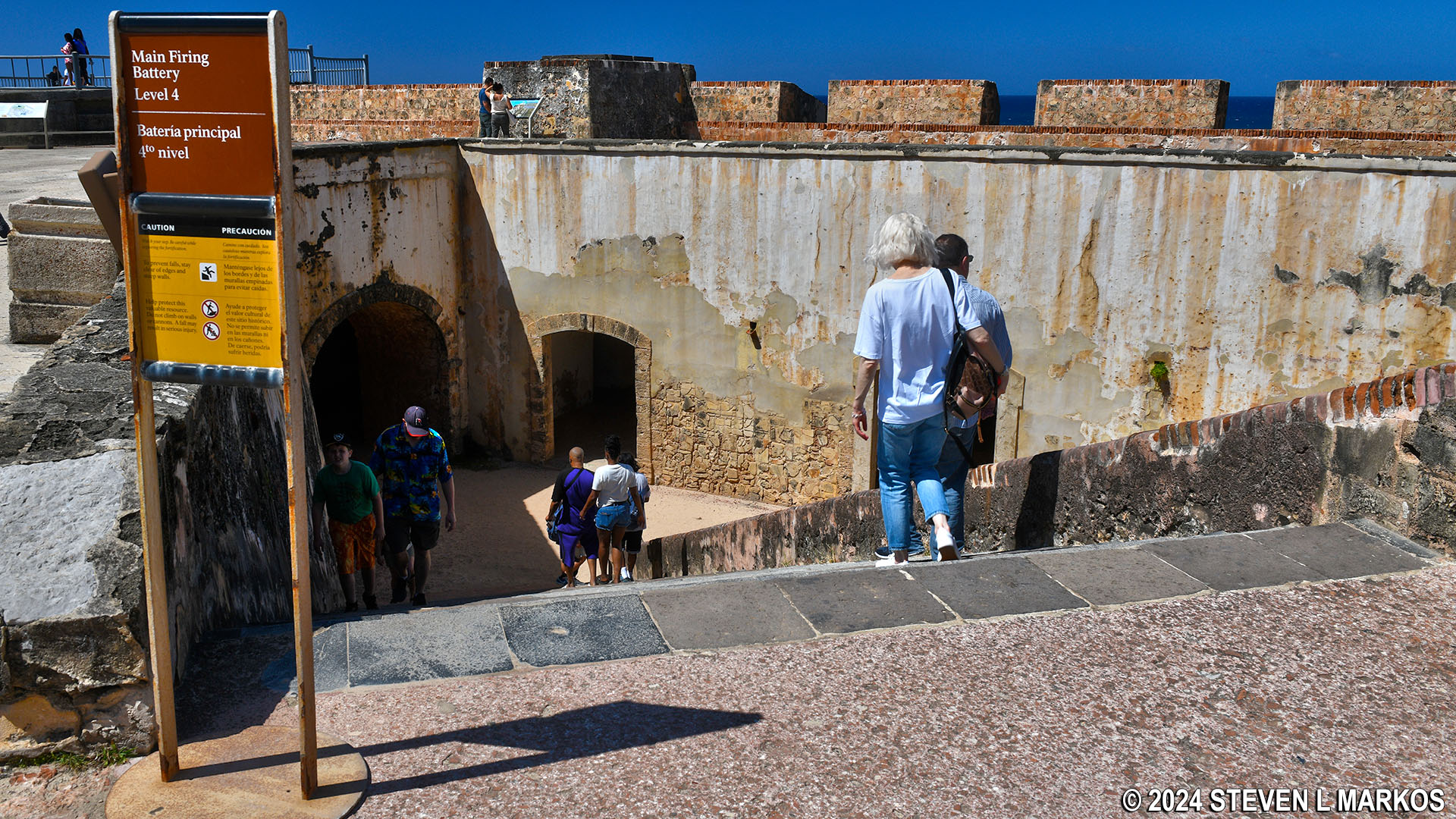
Stairs from the Santa Barbara Bastion terreplein to the Lower Plaza of Castillo San Felipe del Morro, San Juan National Historic Site
Castillo San Felipe del Morro Main Page
The Lower Plaza of Castillo San Felipe del Morro (aka El Morro) is the lower dirt floor surrounded by the batteries of the Santa Barbara Bastion. A staircase leads down to the plaza from the bayside terreplein (gun deck) of the bastion.

View of the Santa Barbara Bastion and Lower Plaza of Castillo San Felipe del Morro, San Juan National Historic Site

Staircase between the Santa Barbara Bastion terreplein and the Lower Plaza at Castillo San Felipe del Morro, San Juan National Historic Site
Along the plaza are rooms with arched ceilings called casemates. There are three extra-large casemates built under the staircase that leads from the Plaza de Armas (main plaza) to the Santa Barbara Bastion terreplein, and one small casemate under the staircase to the Lower Plaza. Along the ocean-side battery are eight casemates of uniform size, all with windows.

Casemates built into the staircases to the Santa Barbara Bastion and the Lower Plaza of Castillo San Felipe del Morro, San Juan National Historic Site

Entrances to the oceanside battery casemates (left) on the Lower Plaza of Castillo San Felipe del Morro, San Juan National Historic Site
Casemates are fortified rooms with arched ceilings that are typically designed to hold artillery. The arched ceilings, which are far stronger than flat ceilings, help support either an additional level of the fort (often more casemates) or, as in the case of the Santa Barbara Bastion, a rooftop terreplein.
While designed to hold guns, casemates are often used for storage, barracks, offices, chapels, latrines, etc. In fact, none of the Lower Plaza casemates at El Morro were used for artillery. The two largest under the staircase were used as a kitchen and a mess hall. Stone ovens still remain. One of the smaller casemates under the stairs was used as a latrine.

Ovens inside a casemate used as a kitchen on the Lower Plaza of Castillo San Felipe del Morro, San Juan National Historic Site
The casemates on the oceanside battery were all used as barracks, but cannon could be fired from inside during a battle. The windows are the embrasures: holes in a wall from which cannon fire through.

Typical casemate on the Lower Plaza of Castillo San Felipe del Morro, San Juan National Historic Site
The oceanside battery bends at an angle near its center, and at this point there is a door. Inside is a spiral staircase that connects to the terreplein directly above. When on the upper terreplein, look for a circular building. This is the upper level access to the staircase, and it is open to visitors. (In the photo below, the lower door is on the other side of the angled wall and in a similar position to the door shown in the photo.)

Spiral staircase between the Santa Barbara Bastion terreplein and the Lower Plaza at Castillo San Felipe del Morro, San Juan National Historic Site
There is also a short tunnel at the 11 o’clock position from the bottom of the Lower Plaza stairs that runs underneath the large terreplein covering the toe of the Santa Barbara Bastion (the forward-most section near the ocean). Inside is the entrance to one of the eight casemates on the oceanside battery, and inside of that casemate is the entrance to a tunnel that leads to the only structure of the original 1539 fort still in existence, a tower that is now encased within the toe of the bastion.

Short tunnel underneath the toe of the Santa Barbara Bastion of Castillo San Felipe del Morro, San Juan National Historic Site

Entrance to the casemate on the Lower Plaza that connects to the original 1539 Tower of Castillo San Felipe del Morro, San Juan National Historic Site
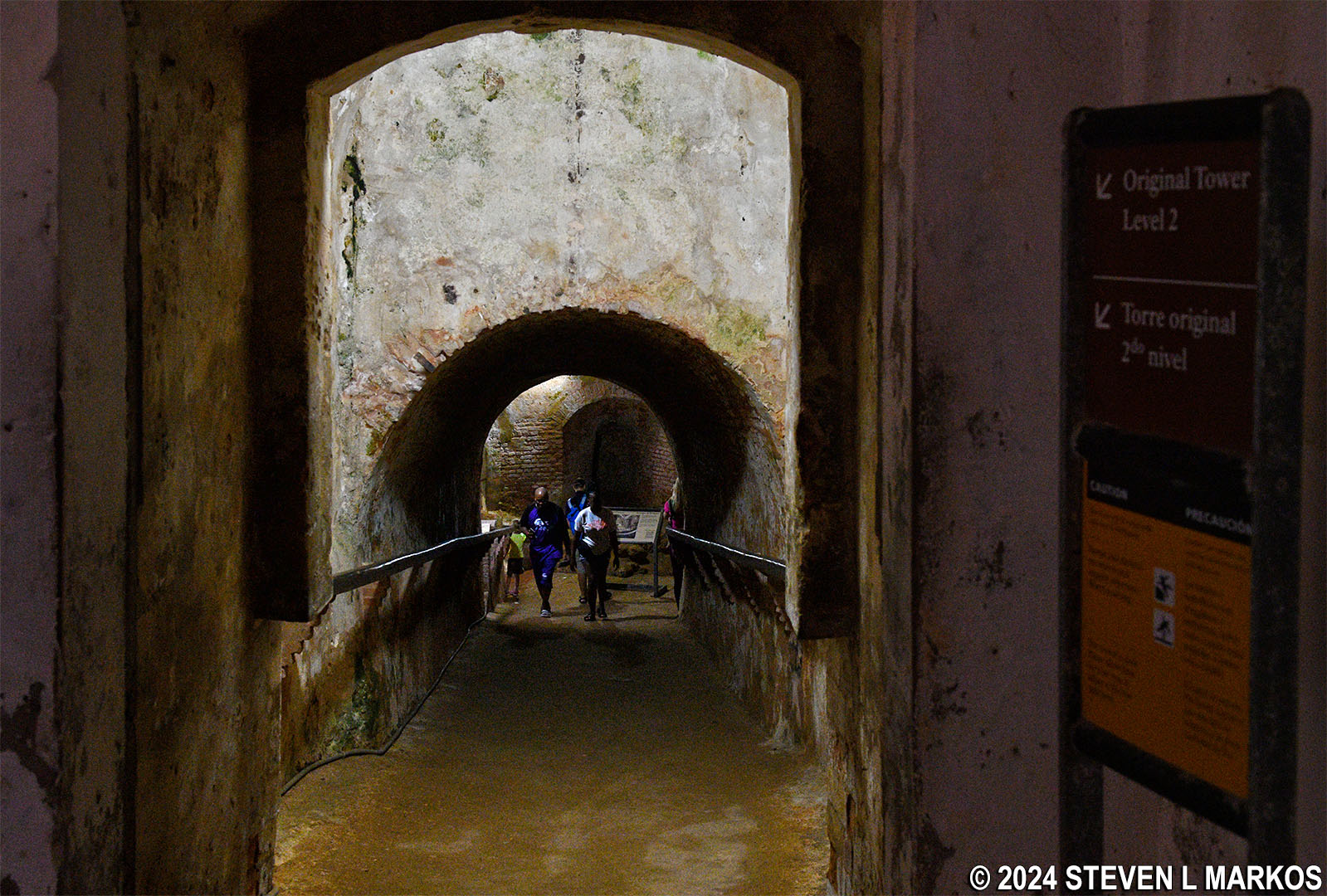
Ramp from the Lower Plaza casemate to the interior of the 1539 Tower of Castillo San Felipe del Morro, San Juan National Historic Site
The general configuration of the Santa Barbara Bastion existed by 1742 (per an architectural drawing) and was most likely standing by 1678 in some form. However, the bastion, along with most other sections of the fort, was overhauled in the 1770s and 80s. Much of this construction involved raising the terrepleins of the fort’s bastions. In some cases this included tearing down the old walls and rebuilding them, typically thicker as well as taller. The Great Wall, which is the main wall at the rear of the Santa Barbara Bastion that the ramp from the Plaza de Armas passes through, is an expansion of a smaller retaining wall. In fact, the stairs, ramps, and all of the casemates on the Lower Plaza were built during this 1770-80 construction period.
With a few exceptions, use of any photograph on the National Park Planner website requires a paid Royalty Free Editorial Use License or Commercial Use License. See the Photo Usage page for details.
Last updated on April 9, 2024


