

Elizabeth Cady Stanton House at Women’s Rights National Historical Park
32 Washington Street in Seneca Falls, New York
TOUR DETAILS
Visitors to Women’s Rights National Historical Park can tour the Elizabeth Cady Stanton House on their own or on a free Ranger-guided tour that is held twice a day when the house is open. For the current tour schedule, see the National Park Service’s official Operating Hours and Seasons web page for the park.

Ranger tour at the Elizabeth Cady Stanton House at Women’s Rights National Historical Park
RANGER-GUIDED HOUSE TOUR
Guided tours of the house begin on the front porch where the Ranger gives a short presentation about Elizabeth Cady Stanton and how she came to live at her Seneca Falls home. Today, the house is about half the size it was when Elizabeth lived there. An east wing, north wing, and several porches were removed throughout the years when different owners made renovations.
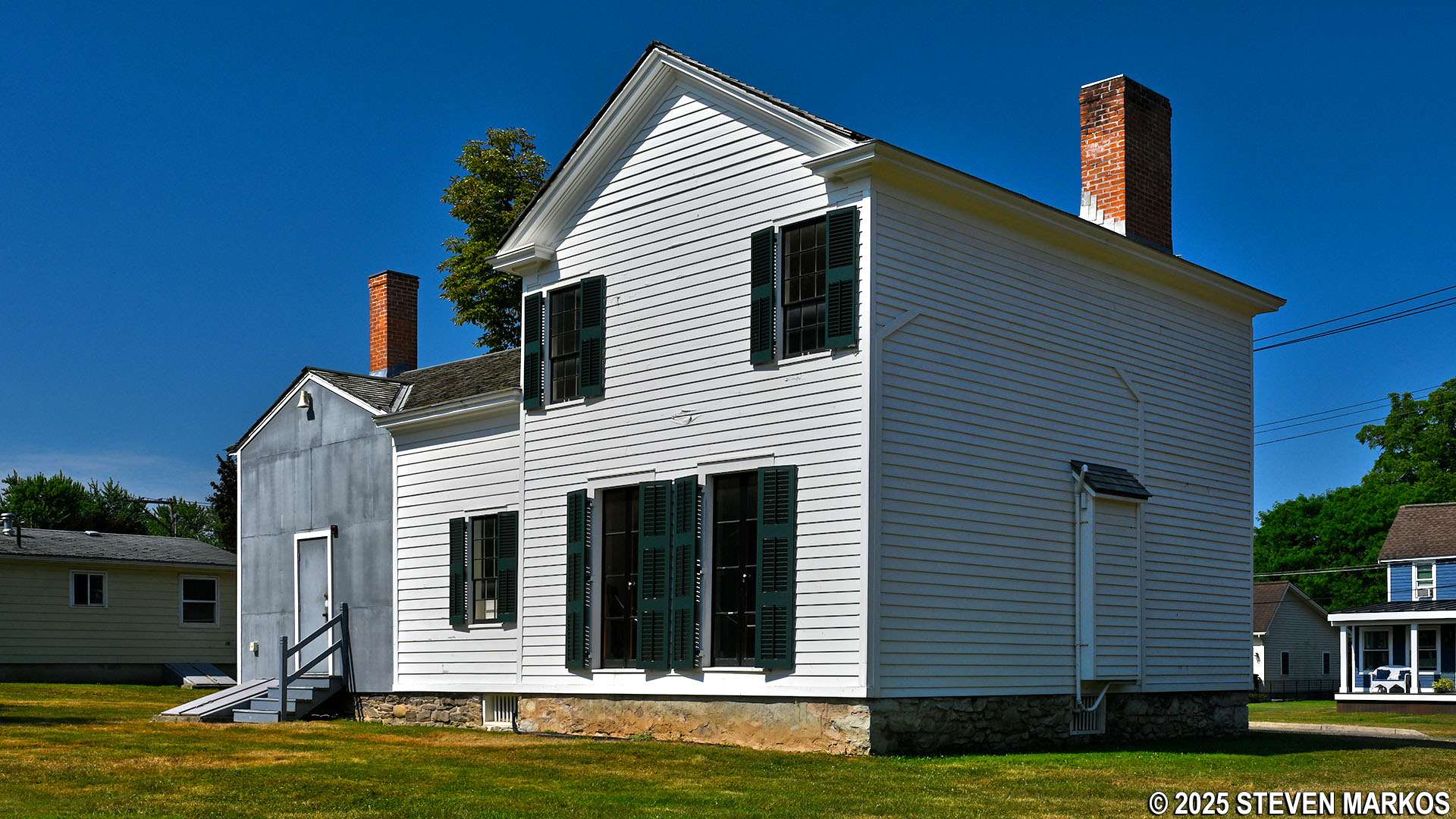
Back of Stanton House where additional wings used to be attached, Women’s Rights National Historical Park
After the outdoor presentation, the tour heads into the home, stopping first in the dining room. There is no original Stanton Family furniture in the house, so the furnishings on display are period pieces that portray what the rooms may have looked like in the mid-1800s. The wall paper in the dining room, however, while not original, is the pattern that was in the house when Elizabeth lived there. Remnants of the original wallpaper were found hidden behind old wall panels and used create new wallpaper.

Dining Room in the Elizabeth Cady Stanton Home at Women’s Rights National Historical Park
The tour continues across the hall into the double parlor. Parlors in the 1800s were typically used for entertaining guests, but the parlor in the Stanton House was regularly used by the family. Elizabeth was a huge fan of natural light and fresh air. It was said that every time her husband went away, she would cut a new door or window. This is evident with the two sets of glass-paned double doors that lead directly outside from the back of the double parlor.

Back Parlor in the Elizabeth Cady Stanton House at Women’s Rights National Historical Park
The front of the double parlor is where Elizabeth conducted much of her work for women’s rights. Susan B. Anthony became one of her close friends and visited often, even earning the nickname of Aunt Susie from Elizabeth’s children. Many other friends and advocates of the women’s rights movement were frequent visitors to the Stanton home.

Front Parlor in the Elizabeth Cady Stanton House at Women’s Rights National Historical Park
While the tour finishes in the front double parlor, visitors are invited to the second floor to get a glimpse of the few remaining bedrooms. When Elizabeth lived at the home, many of the bedrooms were located in the other wings that have since been removed, but the master bedroom, nursery, and servant bedroom are still upstairs.

Upstairs Master Bedroom in the Elizabeth Cady Stanton House at Women’s Rights National Historical Park

Servant Bedroom upstairs in the Elizabeth Cady Stanton House at Women’s Rights National Historical Park
HISTORY OF ELIZABETH CADY STANTON HOUSE
What is now called the Cady Stanton House was built in the 1820s, but not at its current location. Research and evidence collected over the years indicate that the house was most likely moved to 32 Washington Street in the mid-to-late 1830s. Around the same time, a south wing was also moved from an unknown location and attached to the house. Over the next few years, an east wing and a north wing were added to the house.
Daniel Cady, Elizabeth’s father, was a prominent lawyer and landowner in upstate New York. He purchased the house and property in March 1844 after the first family that occupied the home began to experience financial difficulties. Soon after, he learned that Elizabeth’s husband’s health was declining. Fearing what would happen to his daughter if her husband died, he offered to give her the house he had recently purchased. In 1847, Elizabeth took his offer and moved with her family to Seneca Falls. The house had been vacant for the last few years and needed repairs, so Daniel also gave Elizabeth $1,000 to help fix it up.
Described as a mansion by some family members, the house was quite large compared with similar properties in the area at the time, making it perfect for her ever-growing family. Over the next 15 years, the Stanton family welcomed four more children in addition to the three they had when they first moved to Seneca Falls.
In 1862, the Stanton Family sold their home and moved to Brooklyn, New York. The property had numerous private owners over the next 120 years until the Elizabeth Cady Stanton Foundation purchased it in 1982. The Stanton Foundation then transferred the property to the National Park Service on June 29, 1982, for inclusion in the newly created Women’s Rights National Historical Park. The park was officially dedicated the following month.
With a few exceptions, use of any photograph on the National Park Planner website requires a paid Royalty Free Editorial Use License or Commercial Use License. See the Photo Usage page for details.
Last updated on December 5, 2025


