
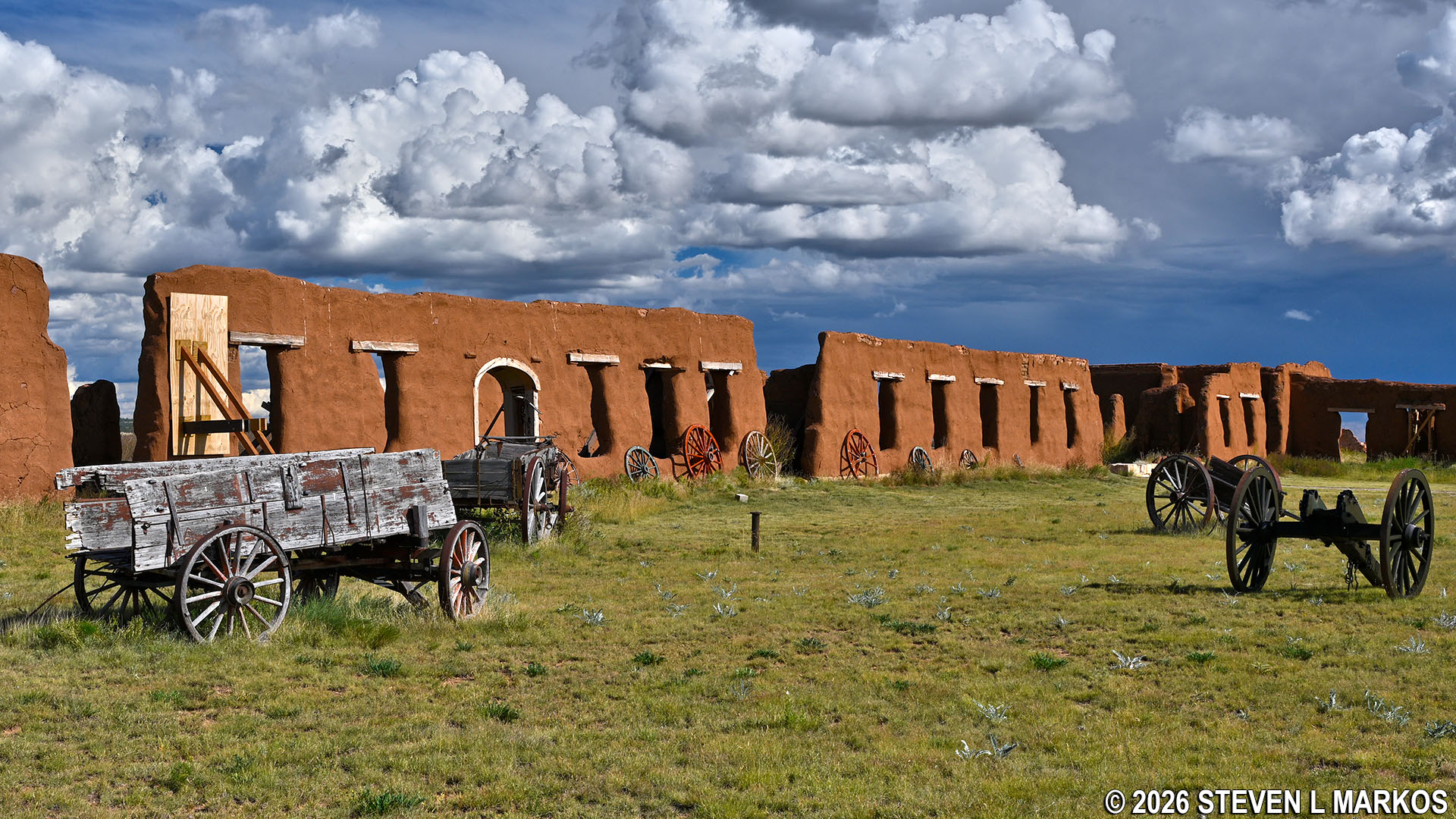
Ruins of the third Fort Union, Fort Union National Monument
After the Mexican-American War ended in 1848, parts or all of ten future states, including New Mexico, were ceded to the United States. With new communities and travel routes to protect from Indian raids in New Mexico, the Army set up garrisons within the settlements. However, when Lieutenant Colonel Edwin V. Sumner was ordered to take control of the territory and revise the defenses in April 1851, he decided to move the garrisons out of the settlements and closer to the Indians. He chose a location near to where two branches of the Santa Fe Trail converged and established Fort Union.
Construction on the first of three forts at Fort Union began in August 1851. It was a typical western frontier Army post comprised of a collection of buildings—enlisted-men’s barracks and officer housing, offices, warehouses, blacksmith shops, etc.—not a walled fort built for defensive purposes. The fort served as a base for military operations and a key station on the Santa Fe Trail for a decade. During this time, the troops stationed at Fort Union participated in several campaigns against the southern Rocky Mountain Indian tribes, including the Apache, Ute, Kiowa, and Comanche.
The first Fort Union was located at the base of a mesa and was therefore vulnerable to cannon fire from the hills above. Since the Indians didn’t have cannons, this was not a strategic concern at the time. However, it became a concern when the Civil War began in April 1861 and Confederate troops moved into the region.
The second Fort Union was built strictly for defensive purposes. A location was chosen about a mile away from the mesa, and construction began in August 1861. It was an earthen, star-shaped fort, typical of forts located in outlying regions and that needed to be built quickly and with limited supplies. Ditches were dug, and the dirt was piled up next to them to form walls up to eight feet tall. The ditches themselves served as dry moats that were often filled with debris to hinder enemies from reaching the fort walls. With men working nonstop, construction was completed in early 1862.
After Santa Fe was captured on March 13, 1862, by Confederates troops marching north up the Rio Grande Valley, soldiers from Fort Union joined with volunteer militias from Colorado and New Mexico and headed south to stop them from advancing farther. The two sides clashed at Glorieta Pass, a strategic location on the Santa Fe Trail, with the Union coming out victorious (Battle of Glorieta Pass, March 26th – 28th). This effectively ended the Confederate threat in the West, and as a result, the second Fort Union was no longer needed. It was abandoned shortly thereafter.
Construction began on the third Fort Union in November 1862 near the site of the second fort. No longer needed for defense, it was a collection of buildings like the first fort, but this time it was to serve as a major supply depot for the ever-expanding region.
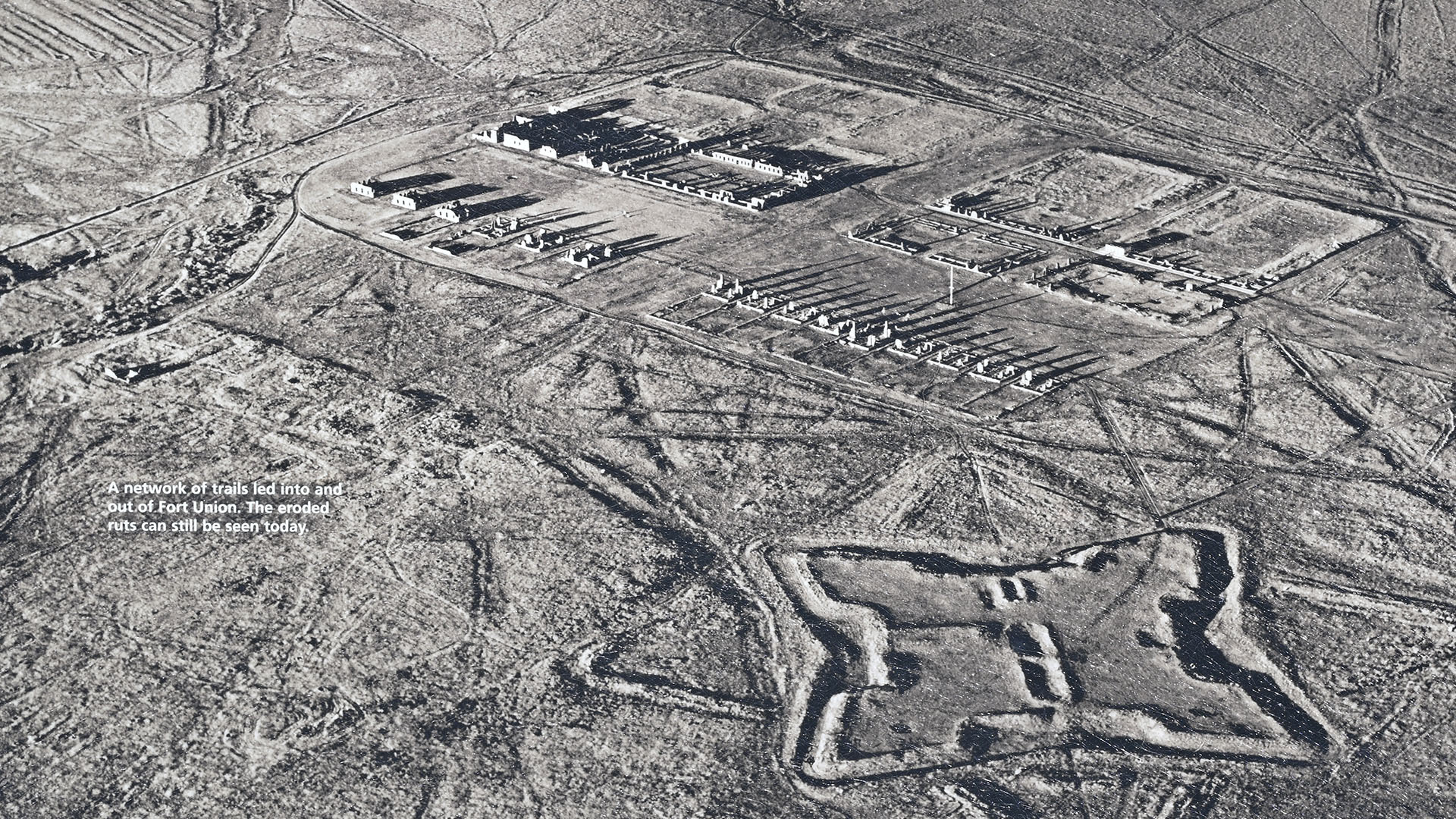
Historical aerial photograph shows the spatial relationship between the second (Star Fort) and third iterations of Fort Union
When completed in 1867, Fort Union was the largest military base within 500 miles in any direction. Not only did it include a military post, but it also had a separate quartermaster depot with warehouses, a chapel, a hospital, shops, offices, corrals and stables, and living quarters. An arsenal that was part of the first fort (and still in its original location) also remained operational.
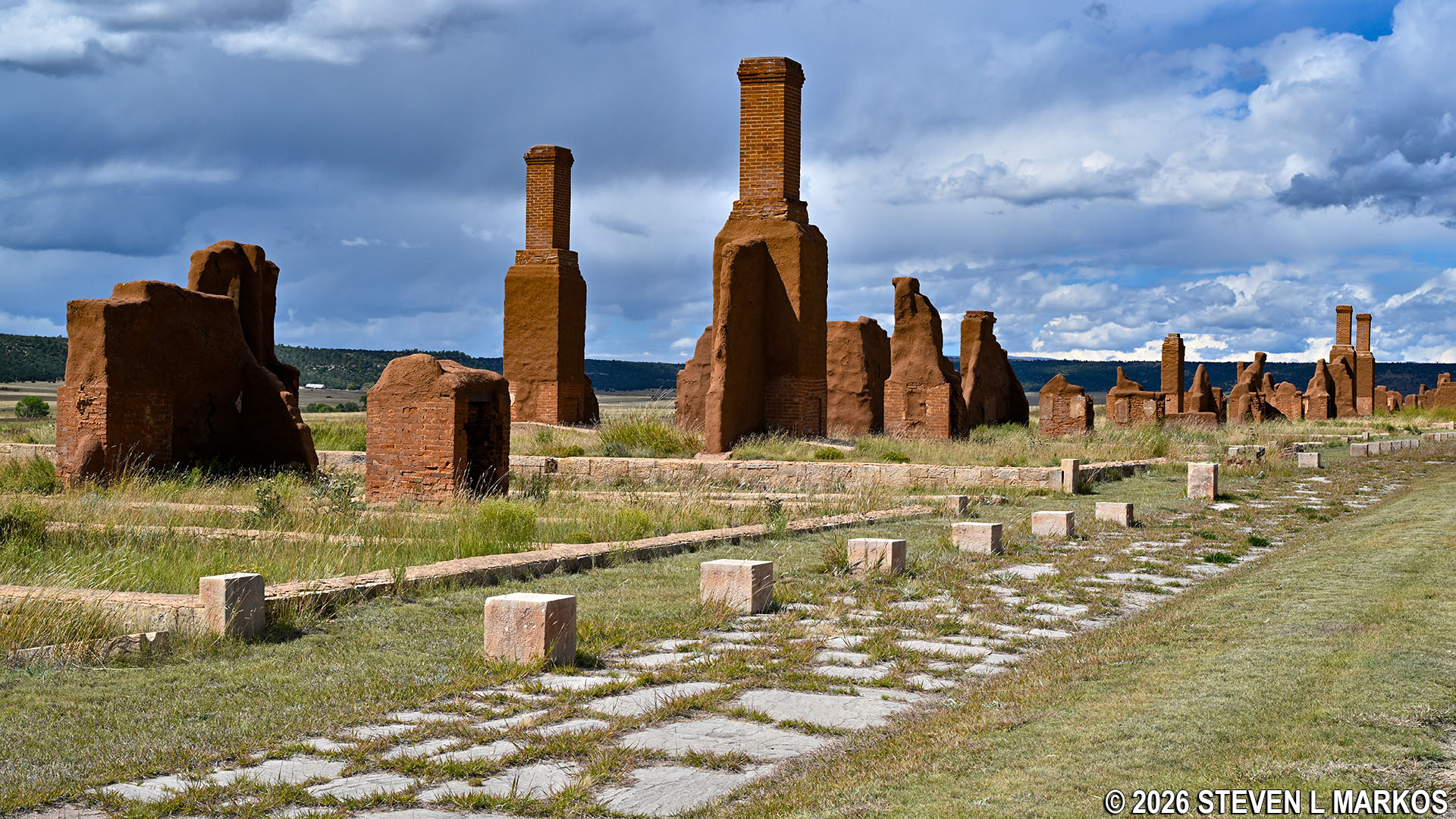
Ruins of the Officers’ Quarters at Fort Union, Fort Union National Monument
In July 1879, the Santa Fe Railroad arrived and gradually brought travel along the Santa Fe Trail to an end. This greatly reduced the number of people passing through Fort Union. Combined with the end of the Indian Wars, by 1891 the fort was no longer needed, and it was abandoned. Over the next 65 years, the adobe buildings slowly deteriorated into ruins.
A bill to establish Fort Union National Monument as part of the National Park System was submitted to Congress and signed into law by President Dwight D. Eisenhower on June 28, 1954. The park officially opened to the public on June 8, 1956. However, only the location of the second and third Fort Union are part of the park. The ruins of the first fort are still on private land. Which brings up an interesting story.
When Colonel Sumner established the original Fort Union in 1851, little did he know, he was actually on part of the Mora Land Grant, an 800,000-acre parcel of land deeded to 76 Hispanic settlers by the Mexican government before the Mexican-American War. Though now under American control, in the Treaty of Guadalupe Hidalgo, which ended the war, the United States agreed to honor the land rights of individuals. The Mora Grant claimants discovered the encroachment shortly thereafter and filed a lawsuit against the government. The case came before Congress in the mid-1950s.
Of course, the Army did not want to abandon the fort due to its importance, so stall tactics began. In fact, the federal government stalled for so long that the fort became obsolete. However, before this happened, figuring their claim to the land was not worth much, many Mora Grant claimants began selling their land for little money to the western version of robber barons. Benjamin Butler, a general during the Civil War, bought some of the land, including the Fort Union parcel, in the mid-1870s. He formed the Butler-Ames Cattle Company, which became the Union Land and Grazing Company in 1885. When the Army left Fort Union in 1891, Butler took full title to that part of his land purchase. It is from the Union Land and Grazing Company—which is still in business today and operating as the Fort Union Ranch—that the 721 acres of Fort Union National Monument were obtained.
With a few exceptions, use of any photograph on the National Park Planner website requires a paid Royalty Free Editorial Use License or Commercial Use License. See the Photo Usage page for details.
Last updated on April 8, 2026


