

Fort Union Tour path alongside the ruins at Fort Union National Monument
The grounds of Fort Union National Monument are open year-round from 8 AM to 4 PM except when the park is closed on New Year’s Day, Thanksgiving, and Christmas. Keep in mind that times can always change, so be sure to check the National Park Service’s official Operating Hours and Seasons web page for the latest schedule.
Visitors to the park are welcome to tour Fort Union on their own. A crushed-gravel path that is wheel-chair accessible leads through the ruins. Walking the path to every stop on the tour covers roughly 1.75 miles, and it is easy walking across flat terrain. You will be completely out in the open the entire time, so if avoiding the sun is important to you, be sure to wear a hat and apply sunscreen.

Typical terrain covered on a walking tour of Fort Union National Monument
There are numbered posts along the tour route that mark points of interest. A free booklet with information about each stop is available inside the Visitor Center, so be sure to pick one up before starting your fort tour. For additional sources of information, you can speak with one of the Rangers or attend one of their informational talks that are given on weekends.
The tour of Fort Union begins directly behind the Visitor Center. To come to the tour stops in chronological order, follow the path to the left towards a covered wagon. A wayside exhibit at Stop 1 has a map of the fort grounds.

Stop 1 on the self-guided tour of Fort Union, Fort Union National Monument

Map of the Fort Union grounds and building layout (click to enlarge)
On the way to Stop 2 is a replica of a supply wagon used on the Santa Fe Trail. Fort Union was the largest supply depot in the southwest during the mid-1800s, and Santa Fe-bound wagon trains—typically between 20 and 30 wagons—arrived at the fort several times each week. A small platform behind the wagon allows visitors to step up to the back and see the types of supplies that were typically carried on the journey.

Replica supply wagon along the tour path at Fort Union National Monument

View inside the replica supply wagon along the tour path at Fort Union National Monument
Stop 2 on the tour is at the northeastern corner of the second Fort Union, a Civil War-era defensive structure known as the Star Fort. Over 200 men worked day and night using picks and shovels to build the earthen fort after Confederates invaded New Mexico in July 1861. Construction began in August, and the fort was completed in early 1862. The second fort is the only surviving earthen star fort west of the Mississippi River and one of the most intact Civil War-era forts of its kind remaining anywhere in the United States.

Stop 2 on the tour of Fort Union, Fort Union National Monument
A short path leads a couple of hundred yards through the interior of the Star Fort. The small, rounded mounds you see are the walls of the former fort. When built, they were seven to eight feet tall, but after 160-plus years of erosion, most would go unnoticed or mistaken for small hills if not pointed out.

Eroded walls of the Civil War-era fort at Fort Union, Fort Union National Monument
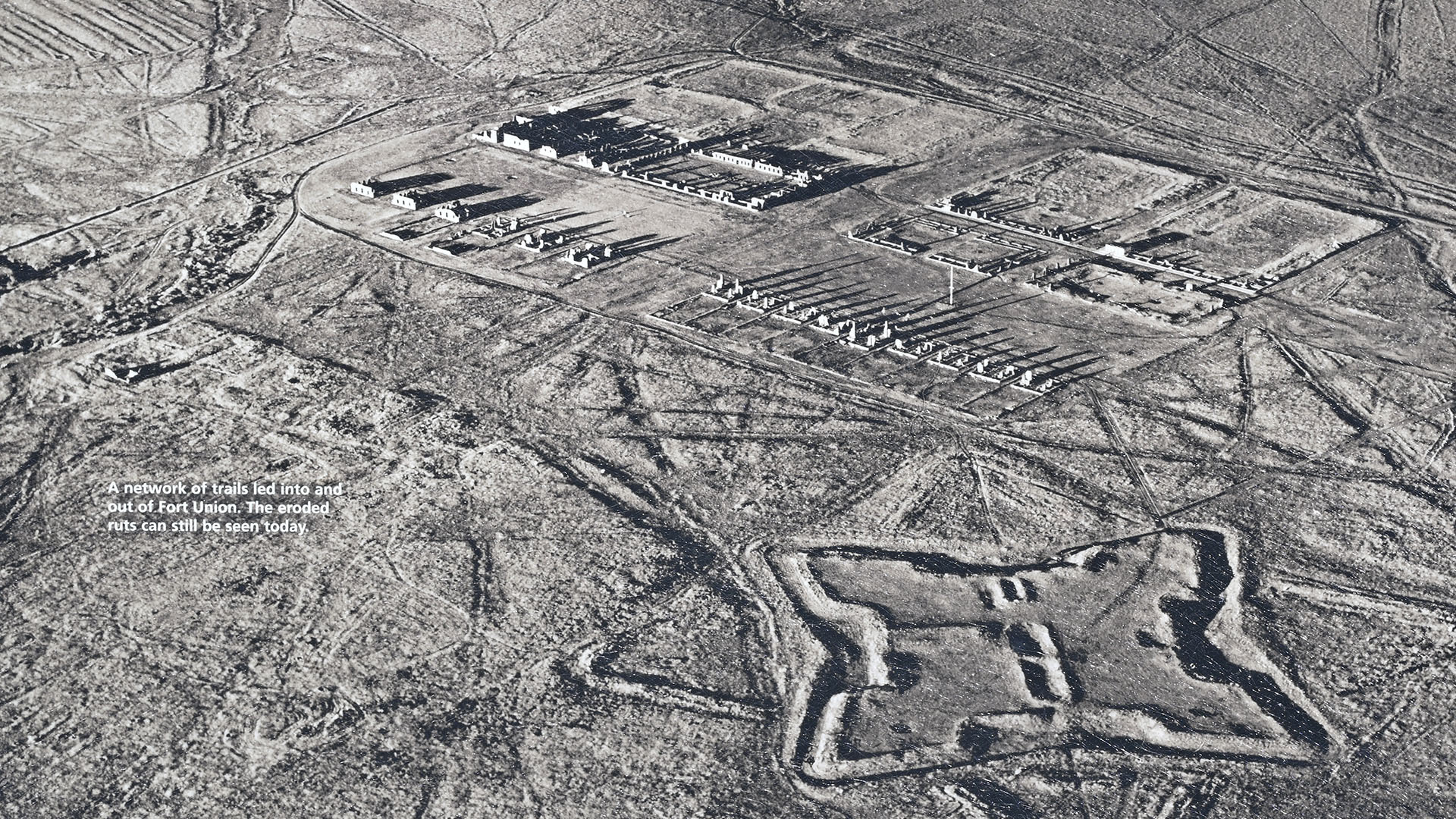
Historical aerial photograph shows the spatial relationship between the second (Star Fort) and third iterations of Fort Union
At the end of the path through the Star Fort (and at the start of the tour at Stop 1) is a 12-pounder Napoleon cannon from the Civil War. Pounder refers to the weight of the cannonball that the cannon could shoot.

12-pounder Napoleon cannon at the second Fort Union, Fort Union National Monument
Stop 3 on the tour is located just after returning from the side trail at Stop 2. Looking towards the west, the remains of the first Fort Union lie a mile away. For those who cannot see that far, a wayside exhibit at the stop contains a drawing of what the fort looked like when it was in operation between 1851 and 1861. Most of the first fort ruins are on private property and are not part of Fort Union National Monument, but there is a section owned by the government about a mile west of the main unit on NM-161 (you pass it on the way to the park). In truth, there’s not much to see at this detached unit of the park other than some wayside exhibits, so you are better off viewing the first fort from Stop 3.

Overlook of Fort Union on NN-161 sits on land that was part of the first fort at Fort Union, Fort Union National Monument
The first Fort Union was built to protect travelers on the Santa Fe Trail and the surrounding settlements against Indian raids. It was a typical western frontier Army post comprised of a collection of buildings—enlisted-men’s barracks and officer housing, offices, warehouses, blacksmith shops, etc.—not a walled fort built for defensive purposes like the Star Fort. In fact, it was located at the foot of a mesa and was therefore vulnerable to cannon fire from the hills above. However, Indians didn’t have cannons, so this was not a strategic concern at the time. It became one once the Civil War broke out, which is why the second Fort Union was built away from the mesa.

View of the first Fort Union from Stop 3 on the tour of Fort Union National Monument
By 1863, it was clear that there was no longer a Confederate threat in the West, so construction on a significantly larger third Fort Union commenced. It was built like the first fort, but this time it was to serve as a major supply depot for the ever-expanding region. When completed in 1867, it was the largest military base within 500 miles in any direction. The fort consisted of three independent facilities: a military post, a quartermaster depot, and an existing arsenal built at the time of the first fort.
Stops 4 and 5 on the Fort Union tour are at the officers’ quarters, also known as Officer’s Row. Each of the nine houses had two apartments with a shared kitchen and dining room. The middle house, which was larger than the others, was for the post commander. The rest of the quarters were assigned by rank. There would often be shifting between the duplexes whenever new officers of a higher rank arrived.

Ruins of houses that once made up Fort Union’s Officer’s Row, Fort Union National Monument

Ruins of the post commander’s quarters at Fort Union, Fort Union National Monument
Looking west at Stop 6, you can see the ruins of Fort Union’s arsenal, which was actually built at the time of the first fort. The arsenal was under the command of the same man, Captain William R. Shoemaker, from its founding in 1851 until it closed in 1882. Shoemaker originally felt the arsenal’s location was too remote, but since its buildings were of excellent construction and his private home, complete with a duck pond, was located nearby, he kept the original location despite the fort being rebuilt twice much farther away. Since the arsenal was where highly explosive gunpowder and ammunition were stored and where new weapons were tested, being away from the military post and storehouses of the depot was not a bad idea. The arsenal was also where broken weapons were fixed and ammunition boxes and other weapons accessories were made.

Ruins of the first Fort Union and the Fort Union arsenal as seen from Stop 6 of the tour of Fort Union, Fort Union National Monument
As you walk northwest past Stop 6, you are leaving the Fort Union Military Post and entering the Fort Union Supply Depot. These two sections of the fort operated separately from each other and even had their own commanding officers. The Depot was comprised of housing, offices, storehouses, corrals, and a mechanic’s area where repairs to equipment were done. Both military personnel and civilians worked here.
The first three buildings are the ruins of the houses assigned to quartermaster officers and their families (quartermasters are in charge of a fort’s housing, food, and supplies).

Quartermaster Officers’ Quarters at Fort Union, Fort Union National Monument

Interior of a Quartermaster Officer’s home at Fort Union, Fort Union National Monument
Across from the Quartermaster Officers’ Quarters is a short path on the right that leads to a sundial and a meridian marker that were installed at Fort Union in 1871.

Sundial and Meridian Marker at Fort Union, Fort Union National Monument
The original horizontal gnomon on the sundial (the piece that casts a shadow) was lost and has been replaced twice. Unfortunately, all the vertical gnomons are missing, but you can still see the etched numbers.

Sundial at Fort Union, Fort Union National Monument
Next to the sundial is a stone marker placed in 1871 by the Army Corps of Engineers to commemorate important locations west of the 100th meridian. In the mid-1800s, the 100th meridian was the dividing line between what was considered the east and the west, and Fort Union was certainly in the west. One side of the monument reads: US MERIDIAN AND LATITUTE MARK / EXPLORATIONS WEST OF THE 100th MERIDIAN / WAR DEPARTMENT. On the other side is a spot for the fort’s latitude and longitude coordinates, but for some reason this information was never added.

1871 Meridian Marker at Fort Union National Monument

1871 Meridian Marker at Fort Union National Monument
At the northwestern corner of Fort Union are the offices for the depot quartermaster and clerks. The Depot Quartermaster’s Office is the first building. A wayside exhibit in front explains how everything operated. The Post Quartermaster was in charge of the depot, which consisted of housing, offices, warehouses, shops, corrals, stables, and even woodpiles. A small group of civilian and military clerks handled all the invoices, receipts, vouchers, letters, and inventories at the depot in order to keep the operation running smoothly.

Ruins of Fort Union’s Quartermaster Office, Fort Union National Monument
The second building was the Commissary Office, which handled food distribution, and the last building severed as both offices and sleeping quarters for the military and civilian clerks who worked at the depot. The building was also the fort’s post office.

Ruins of the quarters and office of the Fort Union Depot clerks, Fort Union National Monument
After passing the depot offices, the tour route turns eastward and heads towards the fort’s storehouses. On the way is one of four cisterns built at Fort Union. The underground waterproof tanks were designed to collect and store rainwater and were extremely important given the Southwest’s dry climate. They have all been filled in with dirt and vegetation, but the brick outlines are still visible.

Remains of one of Fort Union’s four cisterns, Fort Union National Monument
Just up ahead at Stop 7 are the ruins of the warehouses (or storehouses) that allowed Fort Union to become such a major supply depot. The five buildings had the capacity to store thousands of tons of food and equipment to support troops operating in the Southwest. A typical shipment would include over 20,000 pounds of food. Fort Union supplied provisions to approximately 50 forts and camps across the region.

Storehouses at the Fort Union Depot, Fort Union National Monument

Row of storehouses at Fort Union, Fort Union National Monument

Interior of a storehouse at the Fort Union Depot, Fort Union National Monument
Behind these buildings today is nothing but a large field. However, when Fort Union was operational, this area was the Transportation Corral. Here were stables, corrals, feed houses, and teamster and civilian employee quarters.

Field behind the storehouses where the Fort Union Depot transportation corral was once located, Fort Union National Monument
Next to the storehouses is the Mechanics’ Corral where broken wagons were repaired and horses and mules were fitted with shoes and refurbished bridle equipment. On the left, there were carpenter and blacksmith shops, plus storerooms for wood, iron, and charcoal. The mechanics’ living quarters were in the middle (all civilian employees). A saddler shop, tin shop, paint shop, and wheelwright shop were on the left. There was also a steam engine house and two forges for the blacksmith.

Mechanics corral at the Fort Union Depot, Fort Union National Monument

Mechanics corral at the Fort Union Depot, Fort Union National Monument
Proceeding southeast past the Mechanics’ Coral leads back onto the Fort Union Military Post. One of the first ruins you will see is the privy. Also known as latrines, these deep pits helped keep diseases at a minimum and were considered an advanced sanitary practice at the time.

Remains of the privy at Fort Union, Fort Union National Monument
A short out-and-back trail passes the privies and leads to Stop 8 where you can still see some of the few remaining wagon wheel ruts of the Santa Fe Trail. (Due to the tall grass when I visited, the ruts were very hard to make out.) The Santa Fe Trail was established in 1822 to connect Independence, Missouri, to Sante, Fe, New Mexico. It was a significant transportation route for traders and settlers until the railroad arrived in Santa Fe in 1880. Tens of thousands of people traveled along this route as they made their way west, and the repeated use by heavy wagons left ruts in the earth that remain to this day.

Path to the Sante Fe Trail ruts at Stop 8 on the tour of Fort Union, Fort Union National Monument
Stop 9 is at the ruins of the enlisted men’s barracks and the guardhouse complex. On the eastern side of the trail (to your left) are the quarters for enlisted men who were married.

Path through the Enlisted Men’s Barracks at Fort Union, Fort Union National Monument

Ruins of the married enlisted men’s barracks at Fort Union, Fort Union National Monument
While officers were allowed to bring their wives and children with them to Fort Union, enlisted men were only allowed to marry with their commanding officer’s permission, and the wife had to agree to be a laundress. Because of this, the married enlisted men’s barracks were known as Suds Row (soap suds, get it?). The yard behind the buildings is where the washing was done. This was also the location of the military post corral. There is not much left of these houses other than their foundations, and there is nothing left at all of the corrals other than the empty fields where they once stood.

Ruins of the Suds Row barracks at Fort Union, Fort Union National Monument
On the other side of the path are the ruins (very sparse) of the barracks for unmarried men. These where originally four U-shaped buildings, each housing one military company. Inside were two squad rooms with 21 bunk beds apiece, a kitchen, a mess hall, a storeroom, an ordnance room for weapons, and even a small reading room.

Ruins of the enlisted men’s barracks at Fort Union, Fort Union National Monument
Mixed in with the barracks were the fort’s bakery, guardhouse, chapel, and prison, which is one of the best-preserved buildings still standing at Fort Union National Monument. When it was built in 1867, the stone prison was completely encased by adobe walls for insulation. There was a narrow walkway between the cells and the adobe, and a few small windows in the adobe let in light. The prison held soliders and civilians.

Fort Union’s prison, Fort Union National Monument
After Stop 10, the Fort Union tour path splits off to the left and leads to the last two stops. If you need to detour to the restrooms at the Visitor Center, just keep going straight. There is no need to return to this point afterwards. Stop 11 is just another stop at the Sante Fe Trail ruts and not worth backtracking to, and the hospital building, which is the large building off to the left, can be reached directly from the Visitor Center.

Split in the path that leads to the last two stops on the Fort Union tour, Fort Union National Monument
The last building to see on the Fort Union tour is the hospital. Completed in 1865, it was the largest and best-equipped hospital in the region. The complex consisted of three wings and housed an examination room, dispensary, medical supply storage, six patient wards, a kitchen, dining rooms, laundry, and a bathhouse. There were even living quarters for the hospital workers. Outside of Suds Row, the hospital was the only other place at Fort Union where a woman could work. Nursing was a male-dominated role at the time, but there were three matrons who assisted the post surgeon and supervised the wards.

Fort Union hospital building, Fort Union National Monument

Fort Union hospital building, Fort Union National Monument
The tour finishes back at the Visitor Center. Overall, I spent a little less than an hour and a half for the tour, and that included taking a lot of photos. A typical tourist should be able to complete the trip around Fort Union in a hour.
With a few exceptions, use of any photograph on the National Park Planner website requires a paid Royalty Free Editorial Use License or Commercial Use License. See the Photo Usage page for details.
Last updated on April 7, 2026


