

Grounds of the Kingsley Plantation on Fort George Island, Timucuan Ecological and Historic Preserve
The grounds of Kingsley Plantation are open Wednesdays through Sundays from 9 AM to 5 PM, except when the plantation is closed on Thanksgiving, Christmas Day, and New Year’s Day. Keep in mind that times can always change, so before making travel plans be sure to get the latest schedule on the National Park Service’s official Operating Hours and Seasons web page for Timucuan Ecological and Historic Preserve.
Exploration of the Kingsley Plantation grounds is done on your own, but you do have access to materials that explain the history of the plantation and describe the buildings you will see. You have a choice of either a website-based audio tour that you can listen to on your cell phone or a printed page with a brief description of the buildings. The audio tour gives much more information and is the recommended method, but it takes about an hour and a half to complete. The printed guide is recommended only for those with limited time.
The audio tour is free. Go to The Lion’s Story Teller web page using your cell phone browser and hit the PLAY button for each stop when you reach the appropriate destination. Be sure to pick up a free tour map at the Kingsley Plantation Visitor Center. If you forget the tour URL, you can get it at the Visitor Center as well. The Visitor Center is mainly a book store, but you can also get brochures and other information about the plantation. Restrooms are located here.
The Visitor Center is a little hard to find. When arriving from the parking area you will see two buildings connected by a walkway (kitchen house and plantation house). Enter the walkway and then exit out the other side. A pathway leads around the corner to the Visitor Center. This building is from the 1920s and was built by the investors who purchased Fort George Island in 1923 for a private resort club for military officers, the Army Navy Club. The plantation house was used for the clubhouse until the new building was ready. These investors were the same ones who eventually built the Ribault Club.

Covered walkway connects the kitchen house and main house of Kingsley Plantation on Fort George Island, Timucuan Ecological and Historic Preserve
The audio tour covers the Zephaniah Kingsley-era, 1814-1839. When Kingsley moved to the property, the place had been destroyed by the previous owner, John McIntosh. McIntosh was a leader in the Patriot Rebellion, a covert attempt by Americans to wrestle Florida from Spanish control that lasted from 1811 to 1814. The rebellion was a failure, and before fleeing back to the United States, McIntosh burned the plantation to the ground, destroying all outbuildings and severely damaging the main house. Thus, all of the building you see, other than the plantation house, were built by Kingsley, and even the house required a nearly complete renovation.
The audio tour contains much more than just facts. There are voice actors with roles of characters who lived on the plantation, so it’s almost as if you are listening to a documentary. For the typical tourist, there’s probably too much information, but it’s great for those who are interested in history and who want to learn something during their vacation. Being that the grounds were almost exclusively the domain of the slaves, it should come as no surprise that the tour focuses almost exclusively on slavery.
When I visited in mid-March there were a lot of gnats (aka no-see-ums), so be sure to wear long pants, as that eliminates a large area of skin for them to bite, and bug repellent does not seem to have much affect on them. For some reason they prefer legs instead of arms, maybe because they have learned that it is harder for people to whack them when they stay down around the ankles. You will find them mostly in the morning and evening, and they tend to like the open, grassy areas. You won’t see as many in the forest where the plantation’s slave cabins are located. I am told the gnats will eventually be replaced by flies and mosquitoes, so it seems that it is miserable all year round except maybe during the dead of winter.
PLANTATION HOUSE
The Kingsley Plantation House (aka Planter’s House), the oldest plantation house still standing in Florida, is open on weekends from 10 AM to 12 PM and from 2 PM to 4 PM. It is closed at lunch time. Rangers are inside to answer any questions. Times can always change, so before making travel plans be sure to get the latest schedule on the National Park Service’s official Operating Hours and Seasons web page for Timucuan Ecological and Historic Preserve.

Front of the Kingsley Plantation House at Timucuan Ecological and Historic Preserve
RIVERFRONT VIEW
The tour starts with a visit to the front yard along the Fort George River. Benches are available for you to sit and listen to the audio information while getting a good view of the scenery. Picnicking is allowed on the grounds of the plantation, though no tables are provided—bring your own blanket. This is probably the best spot for a picnic. It is interesting to note that the Kingsley plantation house is not very large or opulent, and this is thought to be because pirates were common on the river, and home owners didn’t want to draw any attention to their wealth.

Grounds of the Kingsley Plantation border the Fort George River, Timucuan Ecological and Historic Preserve
KITCHEN
Kitchens were always built separately from the main house to keep the heat out during the summer and because cooking was done on open flames and presented a fire hazard. Better for the kitchen to burn down than the main house. Information panels are on display, and the kitchen is furnished as it may have been back in the early 1800s.

Kitchen house and Anna Kingsley’s home at Kingsley Plantation of Fort George Island, Timucuan Ecological and Historic Preserve

Inside the kitchen house at Kingsley Plantation, Timucuan Ecological and Historic Preserve
The upstairs was used as the home of Anna Kingsley, Zephaniah’s Senegalese wife and former slave. Zephaniah purchased her in Cuba and married her soon thereafter when she was only 13-years old. He was a polygamist who eventually married three more of his slaves. Polygamy was customary in Senegal, and it was thus customary for the wives to have separate living quarters. You can read more about Anna Kingsley on the information panels inside the building. (By the way, Kingsley was a white guy from England.)

Information panels inside Anna Kingsley’s house at Kingsley Plantation on Fort George Island, Timucuan Ecological and Historic Preserve
BARN
Inside the Kingsley Plantation barn are information panels on slavery and the work done by slaves as it relates to the barn.
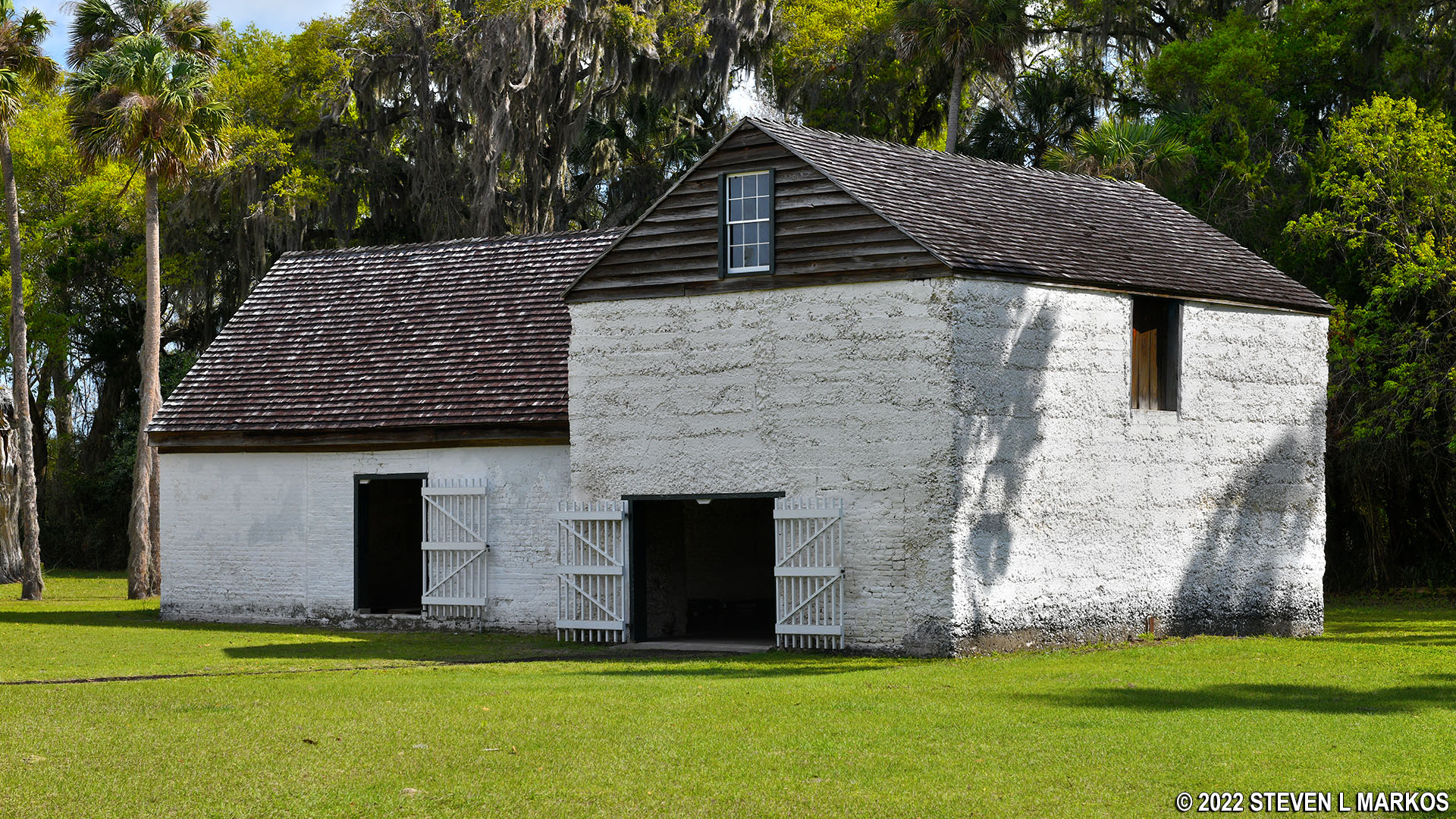
Kingsley Plantation barn at Timucuan Ecological and Historic Preserve

Exhibits inside the Kingsley Plantation barn on Fort George Island, Timucuan Ecological and Historic Preserve
GARDEN
Growing at the Kingsley Plantation garden are the traditional crops of the area, though what you will find all depends on the season—when I visited they were growing black plastic. Kingsley’s biggest crops were Sea Island Cotton and indigo. The harvesting and production of indigo die was the number one cause of slave deaths on an indigo plantation. This was due to the exposure to lime used to create the dye, though back then the connection between indigo production and a decline in health was not understood. Harvesting the plant with a machete also led to many accidents, some deadly.

Kingsley Plantation garden where traditional crops are grown, in season on Fort George Island, Timucuan Ecological and Historic Preserve
SLAVE CABINS
The highlight of the grounds tour at Kingsley Plantation is a stop at the old slave cabins. Notice the cabins are arranged in a curved pattern instead of in a straight line. It is theorized that this is the design created by Anna Kingsley when she ran the plantation. Slave quarters in Senegal were also arranged in a curved pattern (Senegalese owned slaves).

Ruins of the slave cabins at the Kingsley Plantation on Fort George Island, Timucuan Ecological and Historic Preserve
Unlike a typical wooden slave cabin, the Kingsley Plantation cabins were constructed from tabby, a concrete-like material made from sand and crushed seashells. As a result, these structures have survived, though most are in ruins. When new, the outside was covered in a lime putty to create a smooth surface, but all of this putty has eroded away. Any smooth finished walls you now see are restorations done by the National Park Service.

Slave cabin wall (foreground) at Kingsley Plantation has been sealed with lime putty, Timucuan Ecological and Historic Preserve
The tabby for the slave quarters uses whole shells in addition to shells that are ground into powder. The whole shells speed up the drying process, plus increase the volume. The kitchen house and the walls of the barn were also made with tabby, but tabby bricks. Bricks use only the powdered shells and create a smooth surface, versus the rough surface of the whole-shell tabby.

Whole-shell tabby was used to build slave cabins at Kingsley Plantation on Fort George Island, Timucuan Ecological and Historic Preserve

Fireplaces were in all cabins at Kingsley Plantation, and some still remain intact on Fort George Island, Timucuan Ecological and Historic Preserve

Foundation of a slave cabin at Kingsley Plantation on Fort George Island, Timucuan Ecological and Historic Preserve
One cabin has been restored by the National Park Service. The largest of all cabins, it was home to the “Driver,” the slave who was the overseer to the other slaves. Other large cabins most likely belonged to the skilled laborers or perhaps used by the slave community as a whole, maybe for a meeting place or as a community kitchen.

Restored cabin of the Driver at Kingsley Plantation, Timucuan Ecological and Historic Preserve
There is a trail that goes across the street and through the woods to a few more cabins. The trail comes out near the front of the plantation house at the garden.

Additional slave cabins at Kingsley Plantation are located farther down a short trail on Fort George Island, Timucuan Ecological and Historic Preserve
With a few exceptions, use of any photograph on the National Park Planner website requires a paid Royalty Free Editorial Use License or Commercial Use License. See the Photo Usage page for details.
Last updated on September 14, 2026


