

Timeline of events in Cherokee history
All photos in this article are from the museum at New Echota State Historical Site in Calhoun, Georgia.
By the early 1800s, the Cherokee Nation had been whittled down through a succession of treaties with the U. S. government. Once covering most of Tennessee, Kentucky, northern Alabama, northern Georgia, western South Carolina, western North Carolina, and western Virginia, the nation was now situated in northwest Georgia and the portions of Alabama, Tennessee, and North Carolina that bordered Georgia in the northwest. A traditional clan system was in place, and over the years various clans of the Cherokee Nation would sign treaties giving away land that they really had no authority over. Of course the U. S. government would enforce these treaties as long as it was in its interest, and as long as there were some higher level Cherokee signatures on the paper. To stem this problem, in 1819 the Cherokee created the Cherokee Council, an organized government for all of the clans, and New Echota, Georgia was chosen as the capital. In 1828 a law was passed that put to death anyone who signed a treaty without the approval of the Council.
The new government was patterned after the U. S. government, complete with a constitution and three branches of government, including a court system. By this time, most Cherokees had adapted to the European way of life. The richest members of the nation owned plantations with slaves, lived in mansions, and wore the latest European styles. Some of the richest men in the states at the time were Cherokees, though many of them were of mixed blood, either themselves marrying a European or having ancestors who had done so. The middle class Cherokees lived in log cabins and were farmers, just as their white counterparts. The poorer class worked for everyone else.
The lands of the Cherokee officially created a nation within a nation—the Cherokee Nation within the United States. The U. S. government had signed treaties making it so, but broke these treaties whenever they were not in the country’s interest. All came to a head in 1828 when gold was discovered in Dahlonega, Georgia, land that belonged to the Cherokee. White settlers poured into the area, completely disregarding any borders of Cherokee land. The state of Georgia began passing laws that made it illegal for Cherokee to mine gold on their own land.

Display about Georgia laws designed to make life for the Cherokee miserable.
The Creek Indians were also living in the area, and in 1829, Georgia passed laws that basically said the Cherokee and Creek land was now subject to Georgia laws and voided any legal system created by the Indians. In May of 1830, the U. S. Congress passed the Indian Removal Act and President Andrew Jackson signed it into law. This gave the Federal government the power to negotiate land sales with the southeastern Indian tribes in exchange for money and land west of the Mississippi. It was not designed as a forced removal, though eventually those Indians who refused to sell their land and leave were forcibly evicted.
In the meantime, Georgia continued passing laws intended to make life for the Indians so miserable that they would pick up and leave voluntarily. One law that was passed made it illegal for any white man to live within the Cherokee Nation without a permit, and this law had a profound impact on things to come.

Display about Georgia laws designed to make life for the Cherokee miserable.
Reverend Samuel Worcester had established a mission at New Echota. He worked as a teacher, missionary, and even the postmaster of the town. In defiance of the Georgia law mentioned above, Worcester refused to get a permit to live in New Echota and was arrested, along with ten other white missionaries who refused to leave, and sentenced to four years in prison (as were the others).

Information panel about Samuel Worcester
Nine accepted pardons, but Worcester and one other did not so that they could take their case to the U. S. Supreme Court (Worcester v. Georgia). In March, 1832, the Supreme Court ruled that the Cherokee Nation was a sovereign nation and that it was not subject to Georgia state laws. President Jackson ignored the decision and continued with his policy of removing the Indians, and Georgia went right on enforcing its laws over the Cherokee, even adding the Georgia Land Lottery to its plans, which would divide Cherokee land into parcels that lucky white settlers could win in a lottery.

Georgia Land Lottery display
Many Indian tribes knew that the eventual outcome of the Indian Removal Act would be their eviction to the western territories, and realizing that they did not have the military might to resist, most chose to negotiate a land sale contract, take their money, and head west, if for no other reason than to hopefully be rid of the “white man” once and for all. However, some tribes were not willing to move, most notably the Cherokee.
Some of the major Cherokee players at the time were John Ross, the Principal Chief (President), Elias Boudinot, Major Ridge, his son John Ridge, Joseph Vann, and George Lowery. Factions formed between the leaders, with the Ridges and Boudinot realizing removal was a foregone conclusion and thus pushing the idea of signing a treaty giving away the remainder of Cherokee land, but exacting some financial reparations for leaving without a fight. In addition, property owners would be paid a fair price for improvements made on the land, such as houses and other buildings. The value of the land itself would not be paid to the individual land owners.
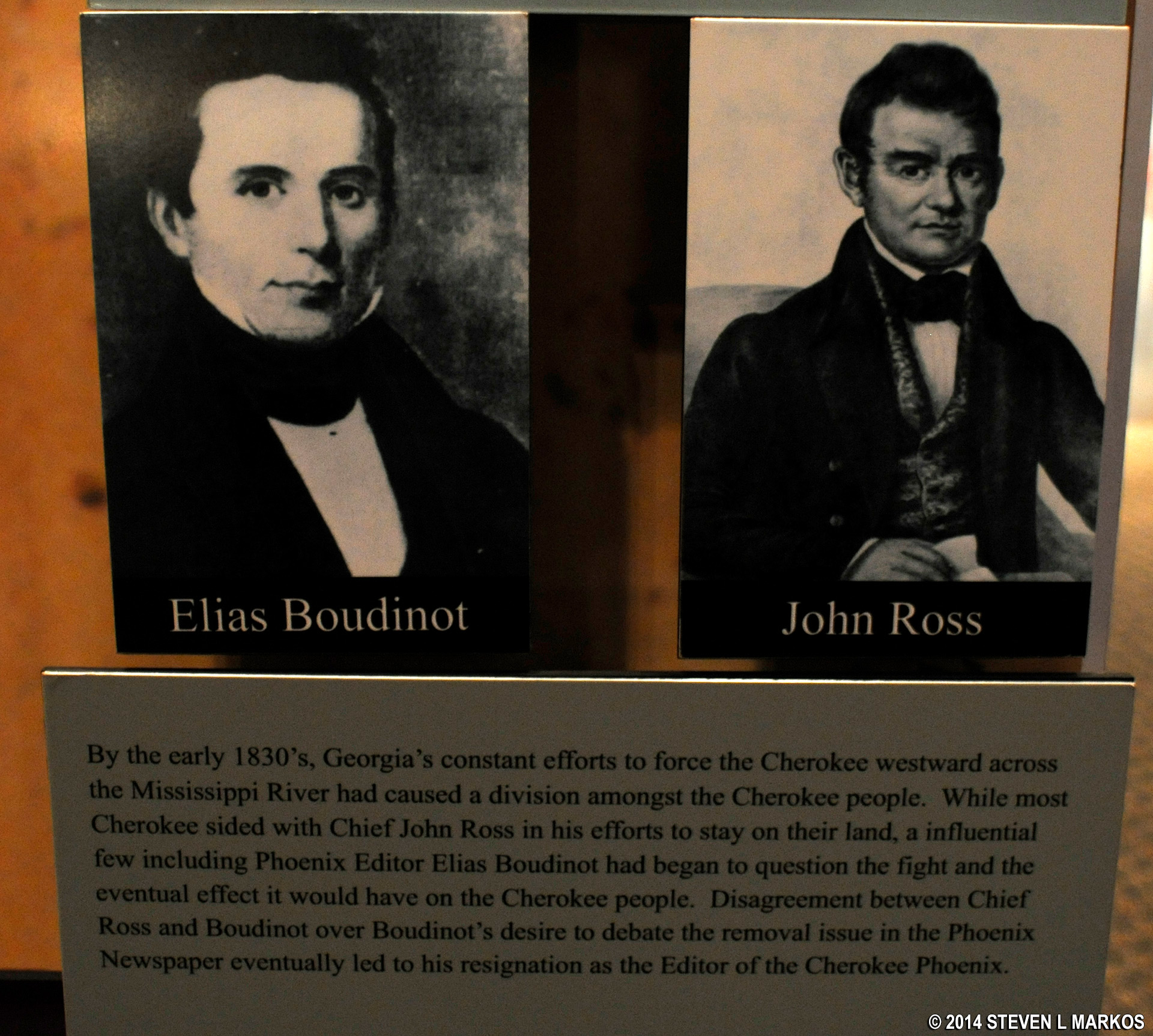
Information about Elias Boudinot and John Ross
The others, led by Ross, wanted to stay and fight. In December of 1835, the “Treaty Party,” as the Ridges, Boudinot, and a dozen or so more men who sided with them would become known, signed the Treaty of New Echota with the U. S. government. Ross argued that the treaty was invalid because it was not signed by the Cherokee Council, but as usual, as long as the U. S. government had some Indian names on a piece of paper, it was considered valid. The treaty was ratified by the United States in April, 1836. Per the treaty, the Cherokee had two years to move west to current day Oklahoma. Any that remained would be forcibly removed.
The Ridges, Boudinot, and 2,000 other Cherokees packed up and headed west. Jumping ahead in the story, in June, 1839, both Ridges and Boudinot were assassinated. No one was ever tried for the murders, but the gunmen were known to be part of the Ross faction. This led to retaliatory violence on both sides all the way through the 1840s.

Forced removal of the remaining 12,000 Cherokee
In May, 1838, two years after the Treaty of New Echota was signed, nearly 12,000 Cherokee remained in northwest Georgia and the surrounding area (a number of people that wouldn’t even fill a typical major league stadium halfway). President Martin Van Buren ordered federal troops to round up and eventually remove all of the remaining Indians. They were first placed in detention camps and forts, and many of the Trail of Tears National Historic Trail sites in the southern states are these forts. The plan was to immediately begin the journey west, but John Ross argued for a delay until late summer so that the temperatures would cool down. Of course this put the journey into the winter months, so it’s hard to say which season would have resulted in less deaths along the way. The journey has become known as the Trail of Tears.
A little known fact is that John Ross was given a contract by the US government to conduct the removal of the 12,000 Cherokee. He was paid $66/person, nearly $800,000, money earmarked to buy supplies for the journey. I had a lengthy conversation with a Cherokee historian who confirmed this. He also said that in addition to the contract, everyone had to buy the supplies from Ross’s brother Lewis. I asked him that if 4,000 Cherokee died on the journey to Oklahoma due to being ill-prepared, could it have been that Ross took a little too much profit? He lowered his head and nodded in confirmation, adding that this is something that nobody wants to discuss, and that to this day many Cherokee blame Ross for the deaths. Of course this in no way alleviates the U. S. government’s role in the tragedy.

Exhibit out John Ross’s deal with the U. S. government for the removal of the Cherokee
With a few exceptions, use of any photograph on the National Park Planner website requires a paid Royalty Free Editorial Use License or Commercial Use License. See the Photo Usage page for details.
Last updated on July 4, 2022


