
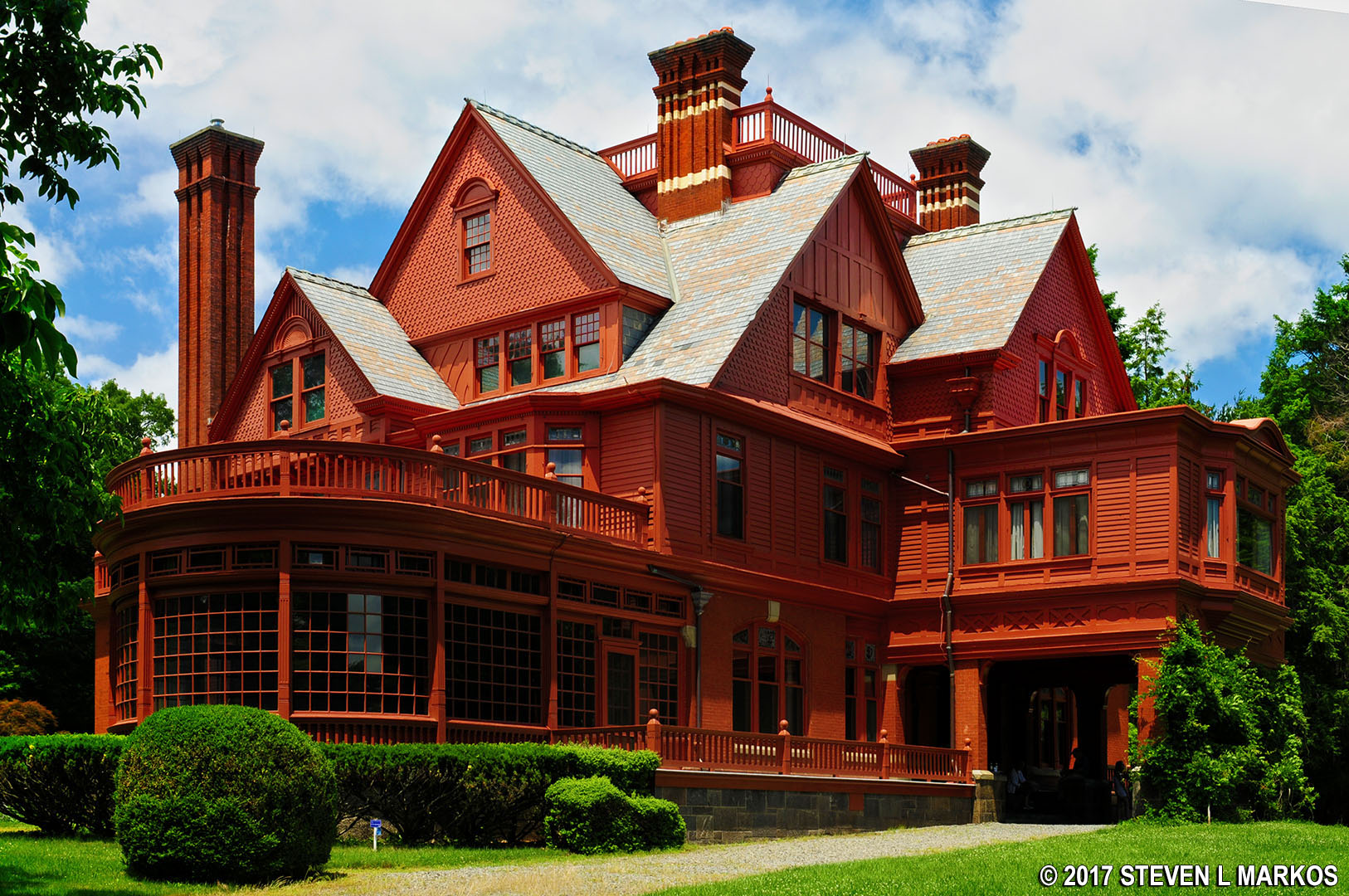
Thomas Edison’s Glenmont Mansion, part of Thomas Edison National Historical Park
In addition to the Edison Laboratory Complex, Thomas Edison’s last home, Glenmont Mansion, is part of Thomas Edison National Historical Park. Entrance into the house is by Ranger-guided tour only, which lasts a half hour. Because of stairs in the house, the tour is not suitable for those in wheelchairs or who have problems climbing stairs.
The mansion is located in the gated Llewellyn Park subdivision where people still live. The neighborhood was founded in the 1850s by Llewellyn Haskell. It is the first planned residential neighborhood in the United States. Today there are 160 lots, most hosting mansions, so Edison’s house is not the only estate you will see. However, stick to the roads and keep off of private property.
The only way to get past the security gate is to have a Glenmont Grounds Pass that is available at the Laboratory Complex Visitor Center (included with the standard park entrance fee). If the Visitor Center is not open, you cannot get a pass (it is typically open Thursdays through Mondays). Keep in mind that a grounds pass is not valid for a house tour. That requires a separate ticket. With a grounds pass, you can only get into the neighborhood to see Edison’s house and grounds.
Tours of the mansion are typically given on Saturdays and Sundays from mid-March through December at 11:30 AM, 12:30 PM, and 2 PM. Tickets must be reserved from one day to up to three months in advance at Recreation.gov. There is a $1 service fee. Tickets must be reserved before midnight for a tour the next day. If nobody were to get tickets online, nobody will be taking the tour the next day, as unclaimed tickets are no longer available at the Visitor Center on the day of the tour. As with a Glenmont Grounds Pass, tour participants must still pay the standard park entrance fee, which is done at the Visitor Center upon arrival.
For those taking a house tour, the National Park Service asks that you arrive at the Visitor Center at least 30 minutes prior to the tour time to pay the entrance fee and get your grounds pass. You must be at the mansion at least 15 minutes prior to the tour.
You can drive or walk to the house. The Edison estate has a number of outbuildings on the property including a gardener house and a greenhouse, and there is a parking area next to them. The walk is .75 mile one way, and once you reach the property you have at least a .1-mile walk across the front yard to the house—it’s a big place. It’s a level walk from the Visitor Center to the entrance of Llewellyn Park, but once in the neighborhood the terrain becomes extremely hilly. In fact, Glenmont is located all the way at the top of the hill.
Edison was not the builder of the house. The original owner, Henry Pedder, built the house in 1880 at a cost of over $200,000. He embezzled the money from his company and ended up going to jail. When the house was put on the market in 1886, Edison got it for $125,000 fully furnished. The 29-room house is built in the Queen Anne style, with all sorts of porches and balconies, high-pitched roofs, chimneys, and curved bay windows. It’s one of the few houses that is interesting to view from all angles. The property is 13.5 acres.

Back of the Glenmont Mansion, part of Thomas Edison National Historical Park
While a visit to the Laboratory Complex is more geared towards learning about Edison’s inventions than the man himself, a tour of Glenmont is really about the house, his wife Mina, the servants, the social events, and what it took to run the place. Edison is once again relegated to a supporting player at his own National Park.
Though Thomas Edison died in 1931, Mina lived until 1947. She deeded the house to Thomas Alva Edison, Inc. in 1943, which was then run by the Edison’s son Charles, with the understanding that the house would become a memorial to Edison after her death. In 1948, the Laboratory Complex was turned into a museum, but the house was not. The Edison Company used it for some company events. However, in 1955, Charles Edison donated the mansion and the lab to the National Park Service. Thus, there were no owners between the Edisons and the National Park Service, so the house remained much as it was in Edison’s time, and most of the furniture and decorative furnishings are original to the Edison family.
No photography is allowed inside the house, but the following are photos taken in 1933 as part of a Historic American Building’s Survey. All photos are credited as follows: Historic American Buildings Survey, C., Borchers, P. E., Harder, D. H., McDonald, A. R., Melragon, M., Waite, J. G. […] McCown, S., Boucher, J. & Borchers, P. E., photographer. (1933) Glenmont, Llewellyn Park, West Orange, Essex County, NJ. Essex County New Jersey West Orange, 1933.
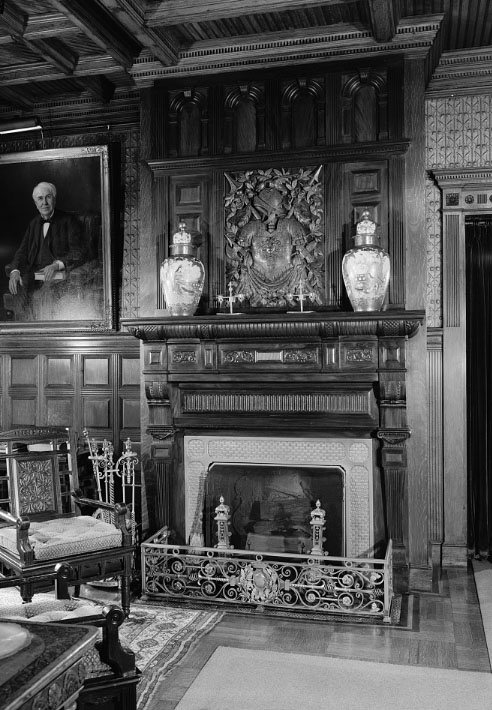
INTERIOR, DETAIL OF FIREPLACE

INTERIOR, FIRST FLOOR, VIEW FROM DINING ROOM INTO DEN

INTERIOR, FIRST FLOOR, DETAIL OF STAIRS

INTERIOR, SECOND FLOOR, FAMILY LIVING ROOM
Outbuildings on the property include a garage, barn, gardener’s cottage, and greenhouse.

Barn (c. 1880) at Thomas Edison’s Glenmont Estate, part of Thomas Edison National Historical Park
Edison’s garage is open to the public on Fridays, Saturdays, and Sundays (as staffing allows). Inside are some of Edison’s cars. It was not open when I visited.

Garage (1908) at Thomas Edison’s Glenmont Estate, part of Thomas Edison National Historical Park
The greenhouse is also open when the weather is nice. It is staffed by the Short Hills Garden Club and other park volunteers.

Gardener’s Cottage and greenhouse at Thomas Edison’s Glenmont Estate, part of Thomas Edison National Historical Park

Inside the greenhouse at Thomas Edison’s Glenmont Estate, part of Thomas Edison National Historical Park
Both Thomas and Mina are buried behind the Glenmont Mansion. These are the only graves.

Graves of Thomas and Mina Edison at Edison’s Glenmont Estate, part of Thomas Edison National Historical Park
With a few exceptions, use of any photograph on the National Park Planner website requires a paid Royalty Free Editorial Use License or Commercial Use License. See the Photo Usage page for details.
Last updated on September 21, 2026


