

Springfield Armory Museum, Springfield Armory National Historic Site
OPERATING HOURS
- Wednesdays through Sundays
- 9:30 AM to 4 PM
- Closed Thanksgiving, Christmas Day, New Year’s Day, Martin Luther King Jr. Day, and Washington’s Birthday
Times can always change, so be sure to get the latest schedule on the National Park Service’s official Operating Hours and Seasons web page for Springfield Armory National Historic Site.
MUSEUM EXHIBITS
Upon looking at the three-story Main Arsenal Building at Springfield Armory National Historic Site and knowing that a firearms museum was inside, I wondered how many days it would take to see everything. After all, the building houses the largest collection of United States military firearms in the world. The museum, however, only takes up the ground floor. The second floor is used by the National Park Service for office space, and the third floor is used for storing more weapons—only a fifth of the collection is actually on display. Even so, those truly interested in firearms and firearm history can easily spend two hours at the museum.
The Springfield Armory Museum is divided into two sections, with the smallest focusing on gun manufacturing and the technological advancements that were developed at Springfield Armory. Original machines are on display, and a few are accompanied by working miniature models. If you watch the documentary in the Visitor Center auditorium, you will see many of these machines at work.

Collection of machinery used in weapons production on display at the Springfield Armory Museum, Springfield Armory National Historic Site

Rifling machine used to cut grooves into the barrel of a firearm, Springfield Armory National Historic Site
The manufacturing exhibits cover the armory’s use of water power as its source of energy from when it first opened in 1795 up until the 1840s. Steam power took over by mid-century, and electricity was installed in the early 1900s. Other topics include weapons testing, women employees at the armory, and the change from handmade weapons to those mass-produced using machines and assembly lines.

Exhibit at the Springfield Armory Museum details the cutting progression of an M1911 pistol, Springfield Armory National Historic Site
The larger exhibit area, and what most people come to Springfield Armory National Historic Site to see, is the weapons section. However, this is not simply a collection of guns designed and manufactured at the armory. On display are muskets, rifles, machine guns, and pistols from around the world that were produced from the late 1700s up through 1968 when the armory closed. The reason such guns exist in the museum is because the armory’s collection initially served as a reference for its engineers. Small arms of all types were purchased so the men could study them and keep up with the latest developments.

Collection of German World War II rifles at the Springfield Armory Museum, Springfield Armory National Historic Site

Collection of German pistols at the Springfield Armory Museum, Springfield Armory National Historic Site
Springfield Armory began manufacturing weapons, mainly small arms, in 1795, with the first being knock-offs of the French Charleville flintlock musket. Springfield engineers would go on to design some of the United States military’s most iconic shoulder weapons such as the Springfield Trapdoor, the Springfield 1903, the M1 Garand, and the M14.

Exhibit on the M1 Rifle at the Springfield Armory Museum, Springfield Armory National Historic Site

Exhibit on the Springfield 1903 rifle at the Springfield Armory Museum, Springfield Armory National Historic Site
The Krag-Jørgensen rifle was also mass produced at the armory, though this was done by licensing the gun from the Norwegian inventors, Ole Krag and Erik Jørgensen. Called a Krag by the soldiers who carried it, this bolt-action repeating rifle was manufactured from 1894 through 1904 and used by the military until being replaced by the Springfield 1903.

Close-up of the Krag-Jorgensen bolt and ejection port, Springfield Armory National Historic Site
The M14 was the last rifle that was mass produced at Springfield Armory, but it was not the last weapon. A variety of specialty guns were also designed and manufactured during the armory’s final decade, including the M79 Grenade Launcher and the disastrous M73 Machine Gun that was mounted on tanks.

M79 Grenade Launcher on display in the Springfield Armory Museum, Springfield Armory National Historic Site
One of my favorite exhibits at the museum is the machine gun room. A large assortment of guns are on display, but none were actually designed or manufactured at Springfield Armory.
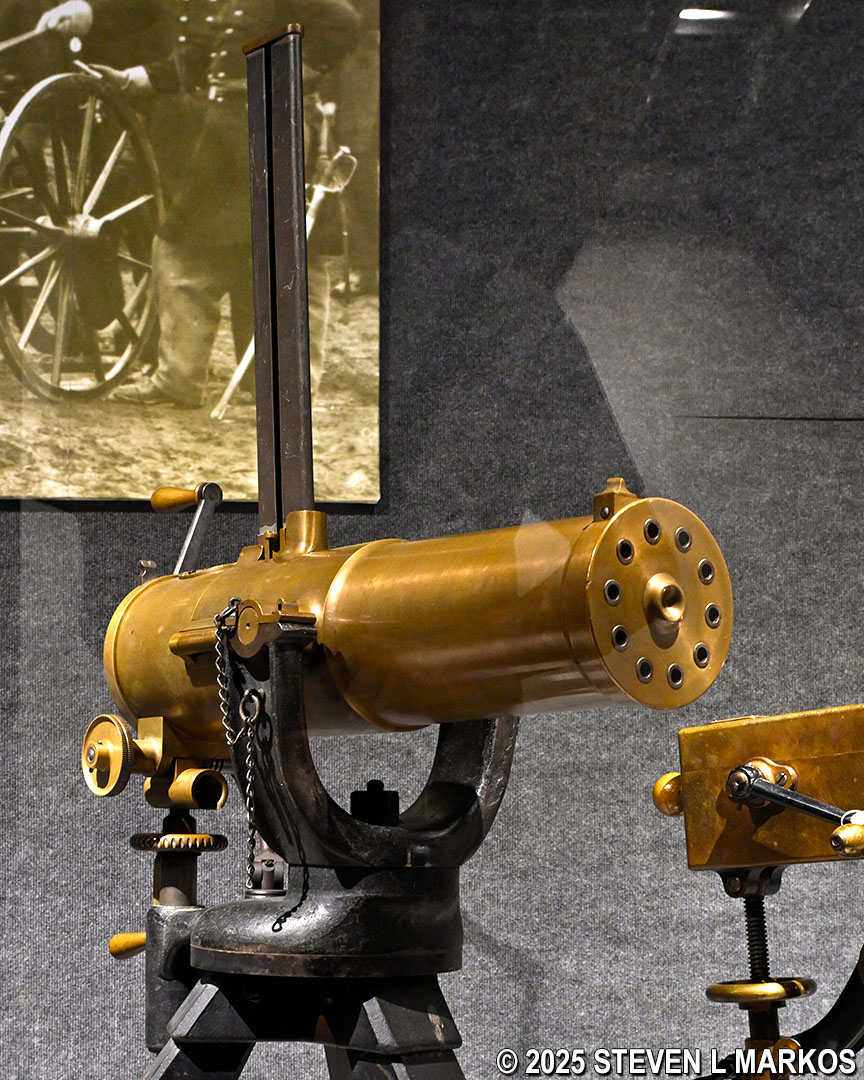
Gatling Gun Model 1877 manufactured by Colt on display in the Springfield Armory Museum, Springfield Armory National Historic Site

Prototype of the M61 manufactured by General Electric on display in the Springfield Armory Museum, Springfield Armory National Historic Site
Firearms were not the only weapons produced at Springfield Armory. Sabers, bayonets, knives, and machetes were also part of the armory’s inventory.

Collection of swords and knives produced at the Springfield Armory, Springfield Armory National Historic Site
There are plenty of short videos throughout the museum that use detailed animations to show how different types of guns work and how various machines were used to produce guns and gun parts.

Video on the operation of the Springfield 1903 rifle
There is one last exhibit of interest that is located in the lobby. A crate hangs suspended above the floor by a rope to show how the guns were hoisted to the top floors for storage. Just as today, the Arsenal Building was a weapons warehouse when Springfield Armory was in operation.

Hoist used to moved weapons to the tower of the Springfield Armory for storage, Springfield Armory National Historic Site
If you have visited Springfield Armory National Historic Site in the past and feel that there is no need to return, keep in mind that the museum also has rotating exhibits based on themes that change once or twice a year. Past exhibits include Springfield Armory Goes To Hollywood, At Camp in the Field: Life of the Civil War Soldier, and Push the Green Hand Ahead: Springfield Armory in World War I.

Prop gun used in The Outlaw Josey Wales compared to the real Colt Walker pistol
With a few exceptions, use of any photograph on the National Park Planner website requires a paid Royalty Free Editorial Use License or Commercial Use License. See the Photo Usage page for details.
Last updated on November 18, 2025


