
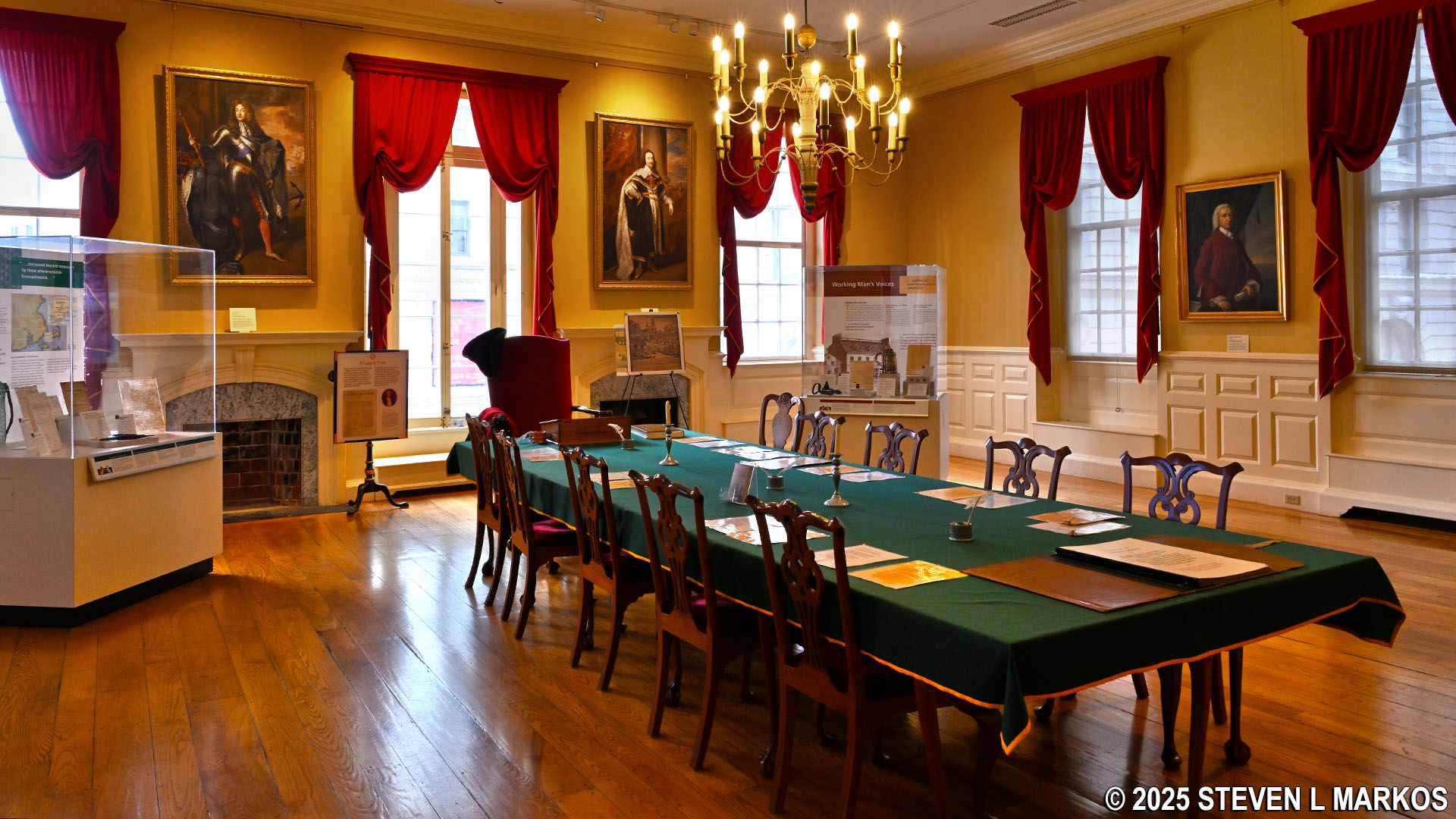
Council Chamber in Boston’s Old State House, Boston National Historical Park
The Council Chamber is on the second floor of the Old State House. This is where the Royal Governor would meet with his Council Members—twenty-eight for Massachusetts in the 1760s. The Council was one half of the colonial government’s legislative branch. Council members were nominated by the House of Representatives (the other half of the legislative branch) and approved by the Governor. They served mainly as an advisory board. The only sway Council members had over the Governor is that they determined his salary for the upcoming year based on his performance during the previous year.

View of the Old State House’s Council Chamber facing the interior entrance, Boston National Historical Park
To communicate directly with the people, the Governor would make speeches from the balcony of the State House, which is accessed through the Council Chamber. Under normal circumstances, only the Governor would give a speech from the balcony, but by July 1776, circumstances were no longer normal. On July 18th, the Declaration of Independence was read for the first time in Boston from the balcony, and it wasn’t read by the Governor. The British had vacated Boston four months earlier in March after an 11-month siege by Patriot militia, so the Patriots did not have to forcibly take over the State House in order to read the document.

View of the Old State House’s Council Chamber facing the balcony door, Boston National Historical Park
Shortly after the reading of the Declaration of Independence, the building was declared the state of Massachusetts’s first State House, though technically there was no state of Massachusetts. It wasn’t until 1780 when the former colony ratified its own constitution—the oldest written constitution in the world that is still in use by an active government—that the building officially became the Massachusetts State House. The state’s first elected governor, John Hancock, was inaugurated in this room.
Representatives Hall was also on the second floor of the Old State House. This is where the House of Representatives met. This branch of the legislature was comprised of 125 elected officials who could pass laws, but there was nothing democratic about it since the Governor had veto power, and his veto could not be overturned. While the Council Men were most likely on the Governor’s side in affairs since they were approved by him, many in the House of Representatives were against taxes and other hardships imposed on the colonies by the King of England.
In the past, one of the rooms on the second floor of the Old State House was furnished as Representatives Hall, but that room is now used as an exhibit area. The reason for this change is that the Old State House has been heavily damaged by multiple fires over the years, and the entire interior was gutted each time, so there really is no existing room that was used as Representatives Hall. After the first major fire in 1747, the building was renovated back to its original layout, which consisted of three large rooms with staircases and hallways between them. The center room, Representatives Hall, was a little larger than the other two. The third room at the back of the building (opposite the balcony) was the Court Chamber.
Another fire destroyed the interior in 1832, and this time it was redesigned in the Greek Revival style; it is this layout that largely survives today. Only the exterior of the Old State House, including the bricks, remain from the original building. Today’s Council Chamber is still close to its original size, plus it was the room where the balcony was located, and the balcony still exists. The other rooms on the floor are now much smaller and are in no way similar to how they were when used as government offices in the 1700s, so presenting them as Representatives Hall and the Court Chamber is somewhat false advertising. Furthermore, there is now only one central staircase.
None of the furniture in the building is original, for it was destroyed long ago. What is on display are modern reproductions made in Boston at the North Bennett Street School using the same techniques that were used in the 1760s. The school is a traditional-trades school where carpentry, cabinet making, jewelry making, locksmithing, and even violin making are taught.
With a few exceptions, use of any photograph on the National Park Planner website requires a paid Royalty Free Editorial Use License or Commercial Use License. See the Photo Usage page for details.
Last updated on September 28, 2026


