

Tomb of Joseph Barrell in the crypt of King’s Chapel, part of Boston National Historical Park
GENERAL INFORMATION
The 45-minute King’s Chapel Bells and Bones Tour takes participants to the crypt in the basement as well as the bell tower and second floor gallery of the church, which provides a great view of the nave and alter below. Without the tour you are limited to exploring the ground level only. Keep in mind that you do have to walk up and down stairs, for there is no elevator. There is a fee for the Bells and Bones Tour, and tickets are sold inside the church on the day of the tour. For the latest fees and the current schedule, visit the King’s Chapel Visit web page.
TOUR DETAILS
The crypt at King’s Chapel is right out of an Edgar Allan Poe story. It is in a dark and creepy basement, which is essentially the church’s storage room. There are exposed pipes, furnaces, old clothes, supplies, vacuum cleaners, etc. Before electricity, families had to bury loved ones by candlelight. We’re talking about a pitch-black room, so no matter how many candles are lit, it’s still creepy.

Basement crypt at King’s Chapel in Boston, part of Boston National Historical Park
Between 100 and 150 people are buried in the King’s Chapel crypt. There are twenty-one tombs, ten along each of the side walls and a large tomb against the back wall. All but one is a family-owned tomb (needless to say, wealthy families). The church kept records on which family owned a particular tomb, but did not keep records of who is buried inside. A few tombs still have family names on them, but most just have a number. Nearly everyone in the crypt has long been forgotten, but every now and then a relative shows up. Nobody demands that the tomb be unsealed so wreaths and flowers can be laid, they only just recall that their “great-great-grandparents were supposedly buried down here.”
The exception to the family-owned tomb is the Stranger’s Tomb, the aforementioned large tomb against the back wall. This was open to anyone who could pay for the burial. Long-time church employees such as maintenance men were also buried here.
Burials stopped around 1850 when Boston passed a sanitation law prohibiting burials in a building occupied by the living. Embalming didn’t become a standard practice until the Civil War, so in the early days rotting bodies were simply placed in the coffins. According to the church record, most of the tomb entrances were bricked over during the 1890s to keep down the dust (back then the floor was dirt).

Sealed Strangers Tomb in the crypt of King’s Chapel in Boston, part of Boston National Historical Park
The tombs are small rooms with wooden shelves on each side wall. New coffins could be placed on an empty shelf, thus allowing for the storage of many bodies. Two of the tombs—the Coolidge Family and the Strangers Tomb—had some of the bricks fall out in modern times, so it was possible to look inside. In both cases, all the shelves had collapsed, and now the floors were littered with broken coffins. The church staff believes this is most likely the state of all tombs in the crypt.
Though no longer allowed, participants on the Bells and Bones Tour used to be able to look inside the Coolidge tomb. I was on such a tour in 2015, and I wrote in my original review that looking into the tomb was the coolest thing I ever did at a National Park, but that it felt somewhat sacrilegious. Perhaps it was my writing that put an end to it.
So, what is in the tomb? At the back is an infant coffin lying on top of an adult coffin that remained intact, but these are lying on a pile of broken coffins. On the other side is a broken coffin with some bones hanging out. Oddly enough, there is not an entire skeleton, just a few bones, like what you’d find after coyotes had eaten the corpse. It’s as if the rest of the bones turned to dust, or perhaps they are smashed up underneath the broken wood. The guide had photos that showed what is thought to be an old wig that some guy was wearing when he was buried.
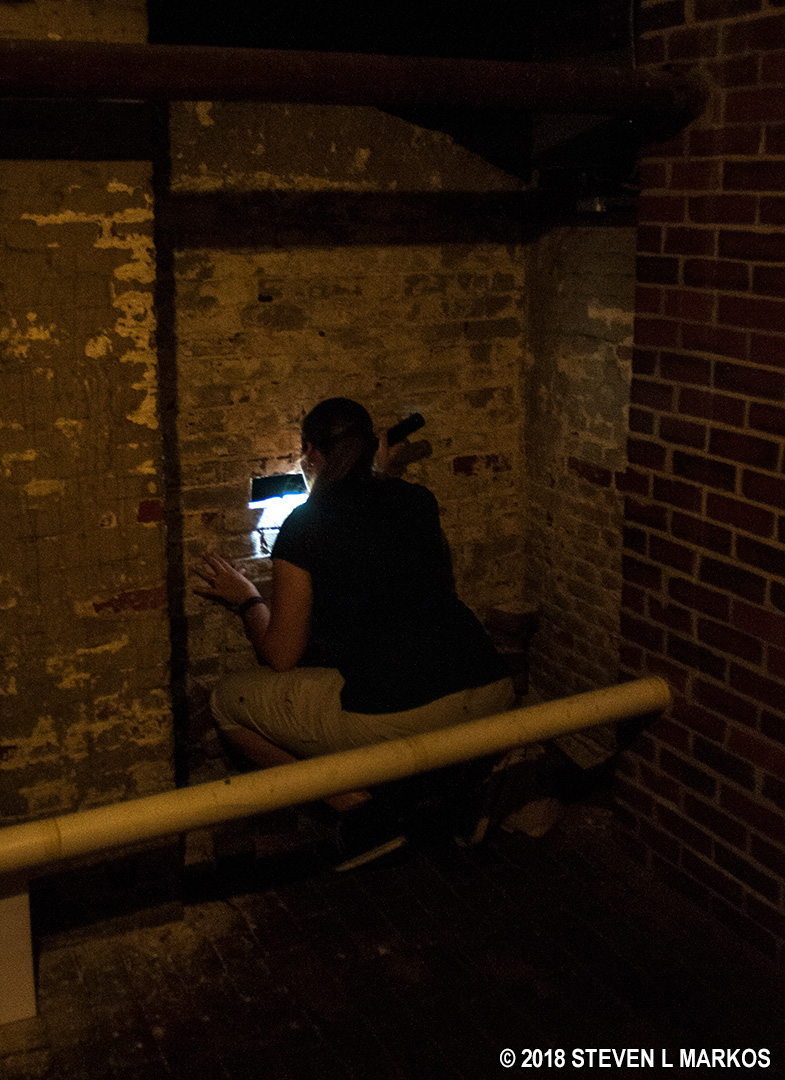
Participant on the Bones and Bells Tour takes a look inside a tomb in the King’s Chapel crypt, Boston National Historical Park
While the crypt is certainly the highlight of the tour for most people, don’t forget that it also stops at the bell tower, and as an added perk, the second floor gallery where you get an excellent look at the pipe organ installed in 1964 and a bird’s eye view of the nave and alter below.

View of the nave and alter from the second floor gallery of King’s Chapel, Boston National Historical Park

1964 Pipe organ at King’s Chapel, Boston National Historical Park
A bell was first installed at King’s Chapel in the 1770s. It was cast in England, but it cracked in 1816 and had to be replaced. Paul Revere, who by then had an iron casting business, was hired to make a new bell, the largest he ever made. It was also his last bell, for he died two years later at age 83 (granted, at his age he probably didn’t do the work himself, but it was his company that was hired). Revere claimed the King’s Chapel bell was the best he ever made. It still rings today.
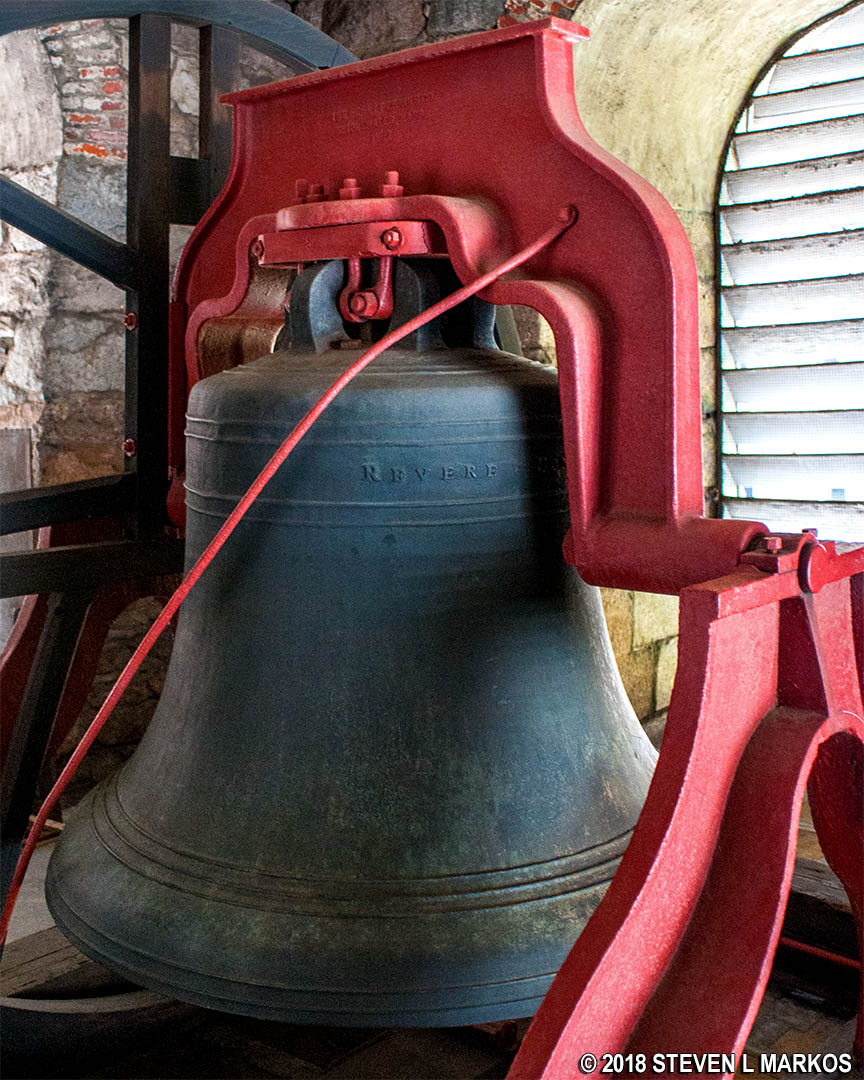
The Paul Revere name stamped onto the bell at King’s Chapel, Boston National Historical Park

Date of 1816 stamped onto the bell at King’s Chapel, Boston National Historical Park
If you enjoy the Bells and Bones Tour, be sure to check out the similar Crypt Tour at the Old North Church. Their crypt is much brighter and more well kept, so you can actually get some decent photos if you know what you are doing. You don’t get to look inside a tomb, but you do get to enter an empty tomb with some old coffins on display.
With a few exceptions, use of any photograph on the National Park Planner website requires a paid Royalty Free Editorial Use License or Commercial Use License. See the Photo Usage page for details.
Last updated on September 28, 2026


