
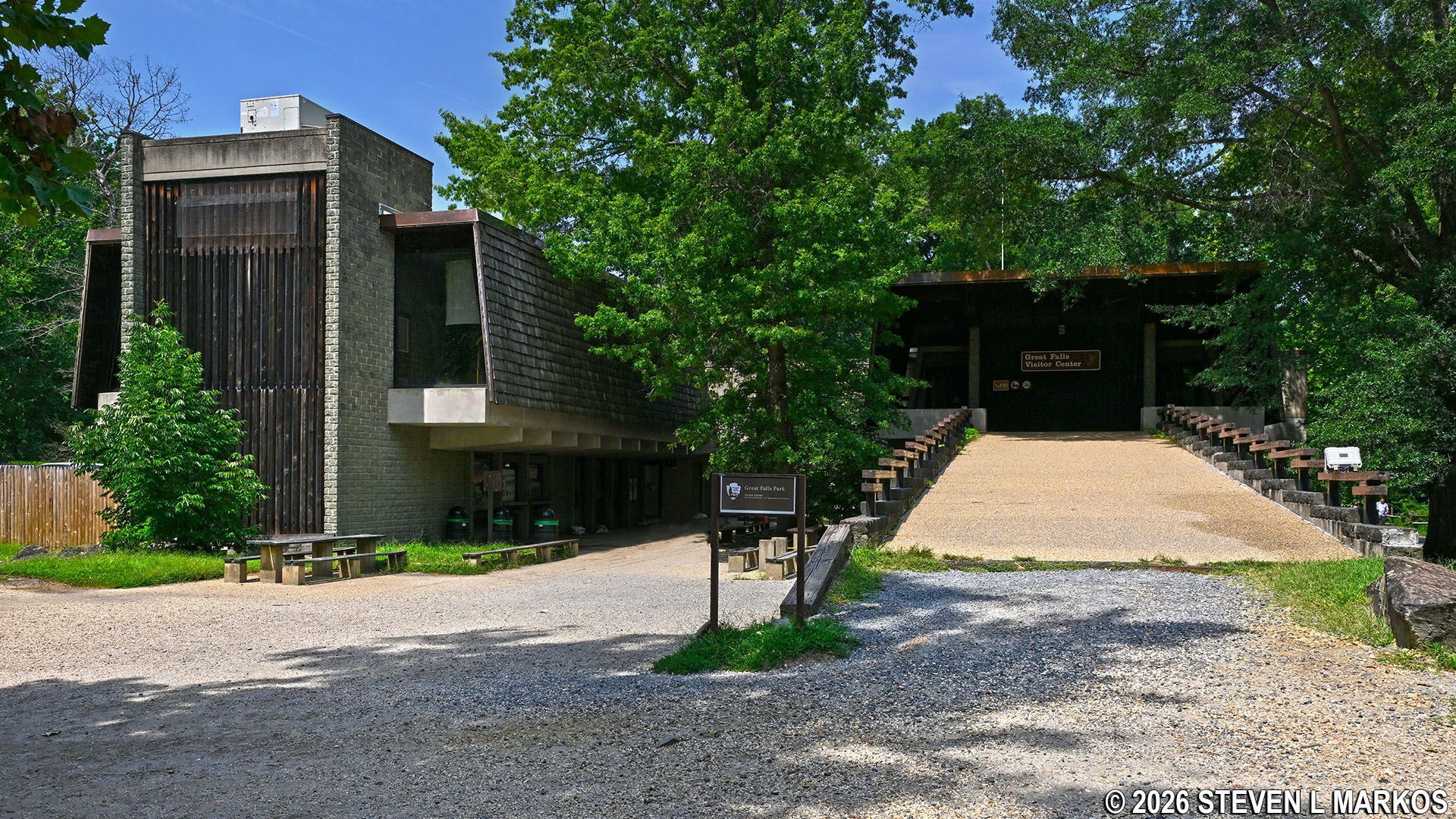
Visitor Center at Great Falls Park in Virginia
OPERATING HOURS
The Great Falls Park Visitor Center is open daily from 10 AM to 5 PM, except when closed on Christmas day. A concession stand located in the courtyard between the two buildings is open seasonally from March through mid-November. Keep in mind that times can always change, so be sure to get the latest schedule on the National Park Service’s official Operating Hours and Seasons web page for Great Falls Park.
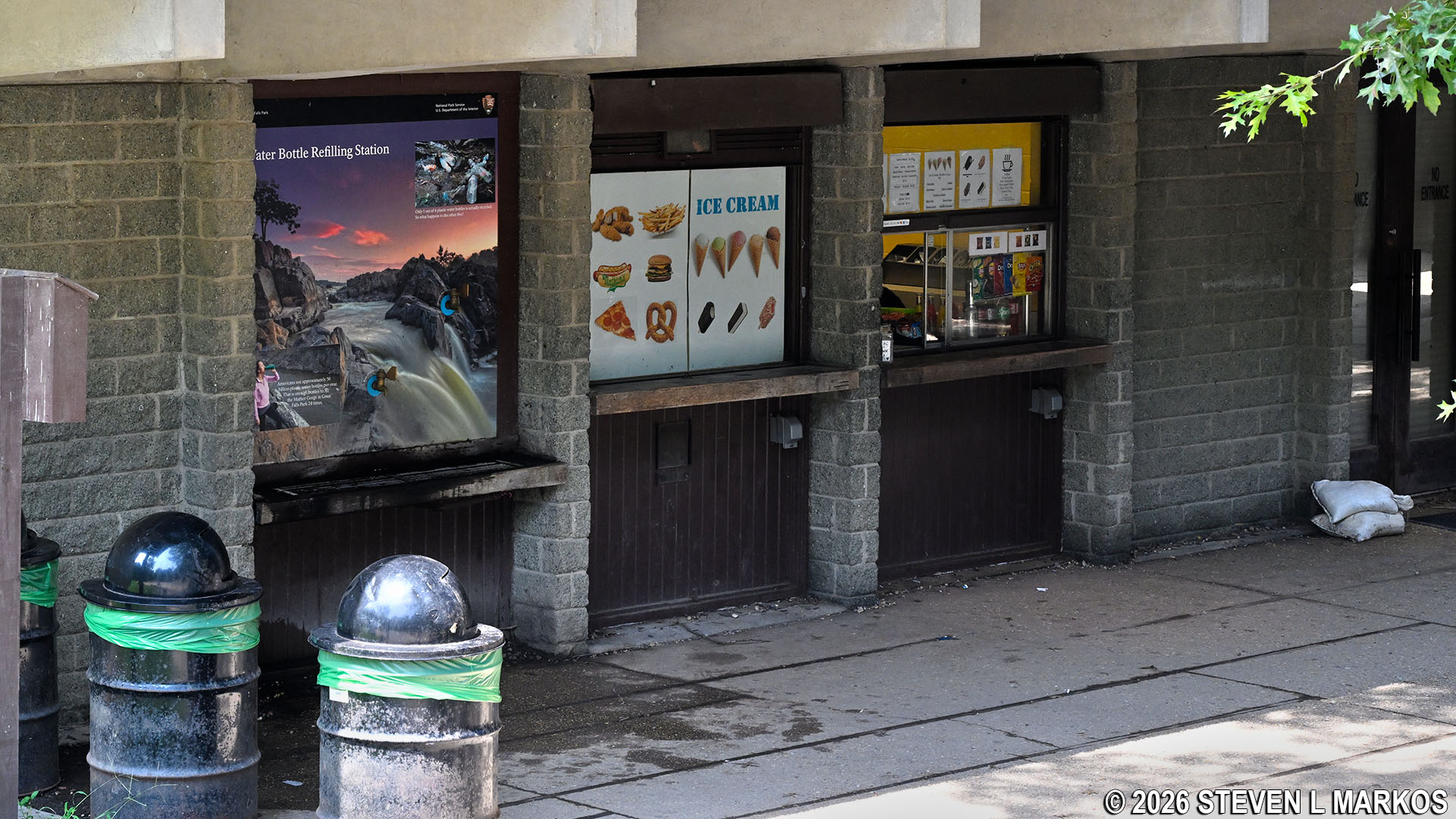
Concession stand in the courtyard between the two buildings of the Visitor Center at Great Falls Park in Virginia
AMENITIES
- Ranger-staffed information desk where you can ask questions and pick up a free park brochure and detailed trail map
- Exhibit area
- Auditorium where a park film is shown
- Book and souvenir store
- Concession stand on the lower level
- Rest rooms in the courtyard (open at 8:30 AM)
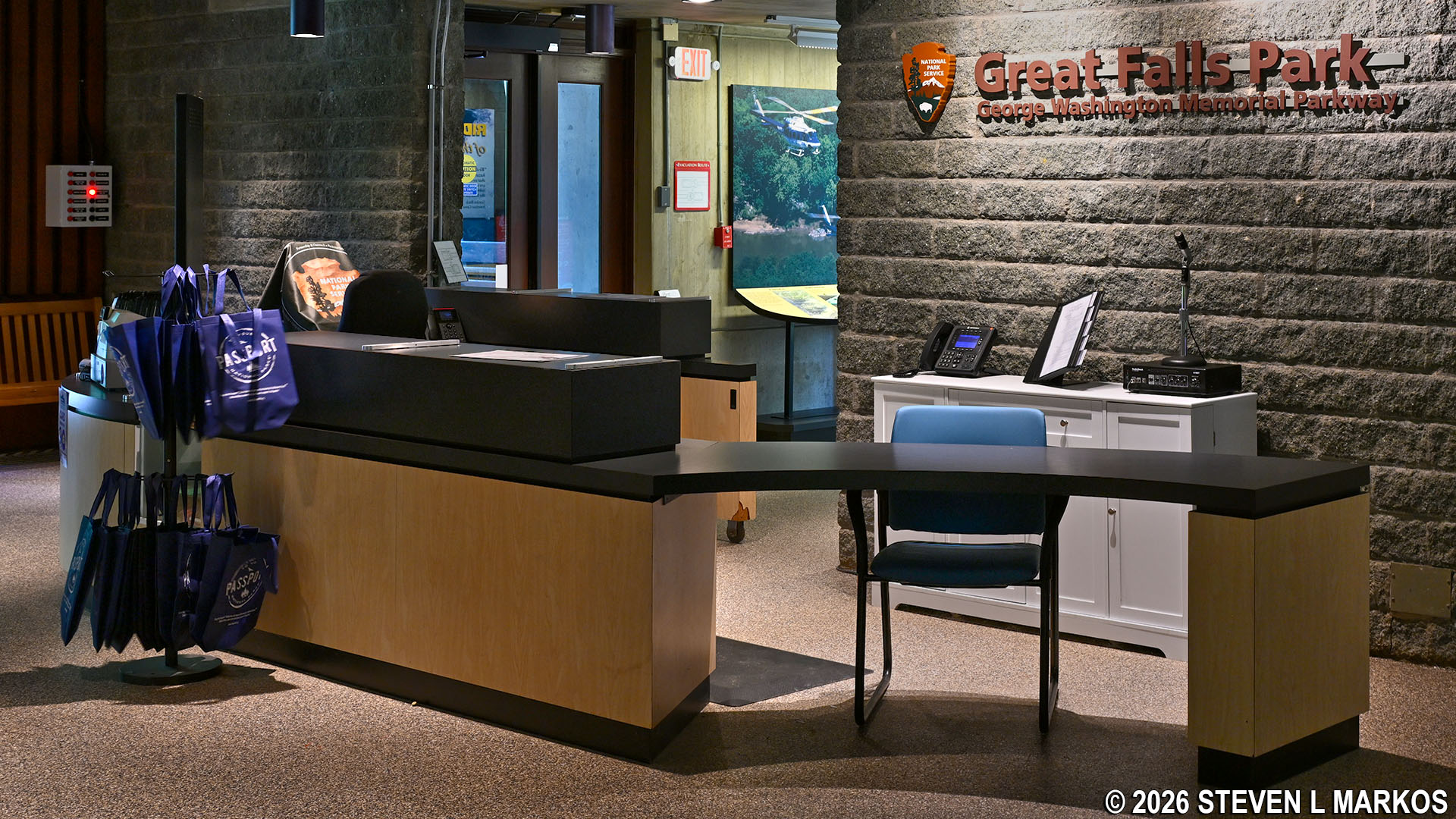
Information desk at the Great Falls Park Visitor Center in Virginia
PARK FILM
The twelve-minute film Great Falls: Visualizing the National is shown on demand in the Visitor Center auditorium. The film tells the story of George Washington and his post-war push to turn the Potomac River into a navigable waterway by creating a canal that would allow boats to travel around the Great Falls. The goal was to connect the Potomac to the Ohio River, thus uniting the east coast with what was then the western frontier. Washington formed the Potowmack Canal Company in 1785 for this purpose. There is no objectionable material, so the film is suitable for all ages.
EXHIBITS
Great Falls Park has an exhibit area that covers a variety of topics. The first section discusses the four different types of ecosystems that can be found in the park. Human occupation is covered as well, from the Indians to the first Europeans who settled the area. This takes up about a third of the exhibit space.
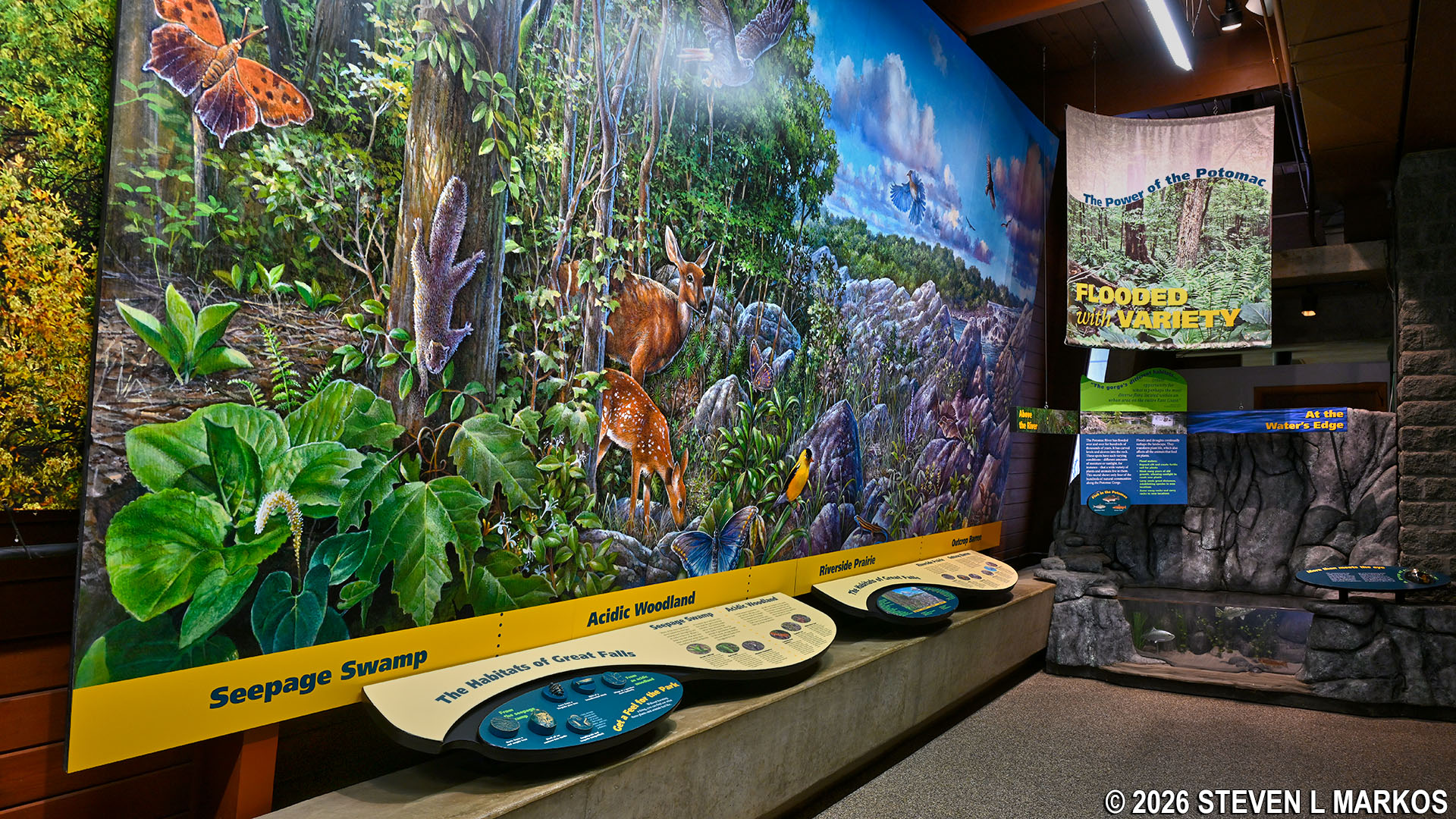
Exhibit on the ecosystems at Great Falls Park inside the Visitor Center
The majority of the exhibits focus on the modern uses of the land starting with the Potowmack Canal, a precursor to the much more ambitious Chesapeake and Ohio Canal that was eventually built on the other side of the Potomac River. George Washington was the president of the canal company—the Potowmack Company—until elected President of the United States in 1789. Construction on the canal began in 1785 and finished in 1802, though Washington never saw its completion due to his death in 1799.
The canal made it possible for boats to bypass the Great Falls, thus helping to make the southern end of the Potomac River navigable. To do so, a canal was dug parallel to the river, with entry and exit points above and below the falls. For the rest of the journey the boats plied the Potomac, which was often subject to low water levels in the summer and freezing water in the winter. With such a limited season of operation, the Potowmack Company could not collect enough tolls to stay in business. It was purchased by the C & O Canal and eventually shut down in 1830.
The C & O Canal, on the other hand, was a completely separate waterway from the Potomac River, running for 184 miles from Washington D. C. to Cumberland, Maryland. It could be filled by reservoirs during the summer, leaving only the winter as the down season.
There is a short video that shows how canal locks work and a diorama in which four different figures—a canal construction foreman, a hired construction worker, an indentured servant, and a tavern owner—tell their stories when you push a button to start the presentation.
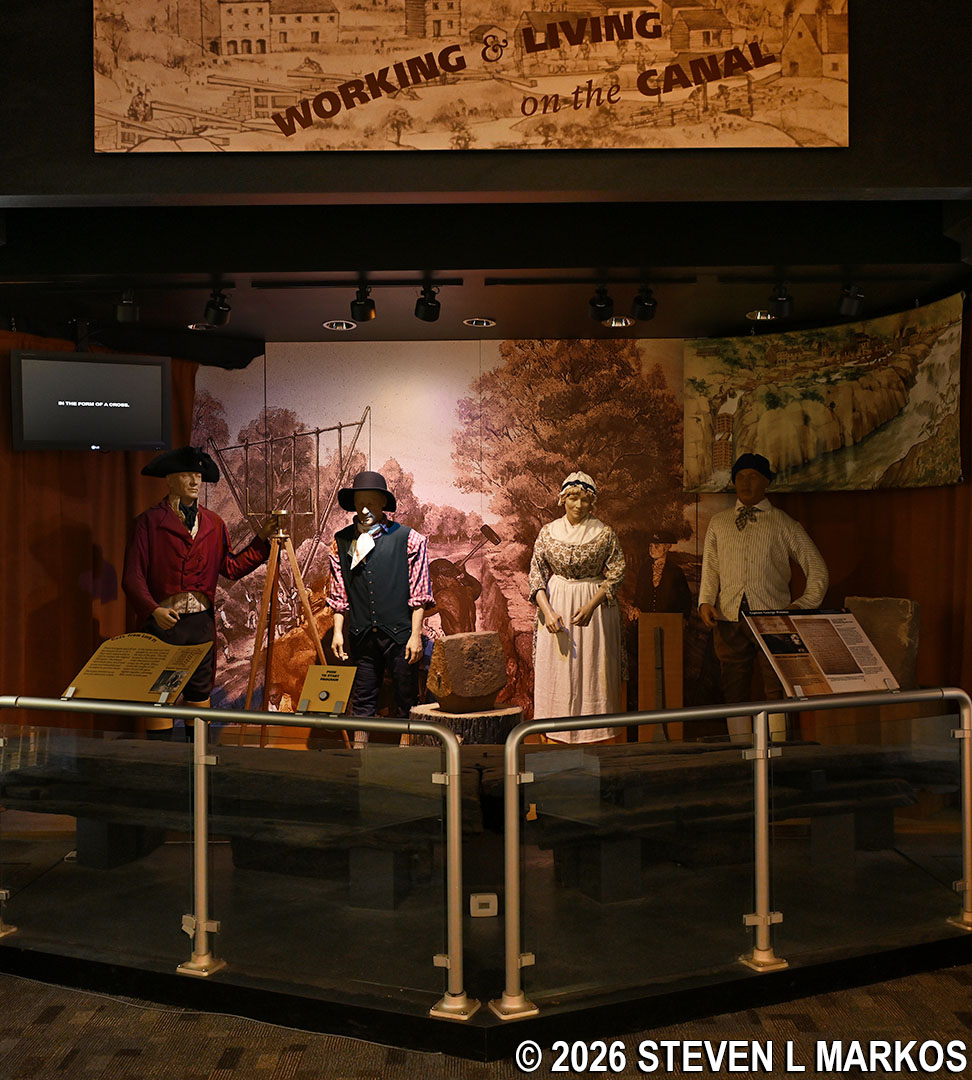
Canal worker diorama at the Great Falls Park Visitor Center
Artifacts on display from the canal include the partial gate of Lock 1. There were five locks on the canal, but only the stone structure of Lock 1 has been restored (you can see it when hiking in the park). Part of Lock 2 still exists, but the other three are no longer standing. The partial door on display is all that remains of the original wooden gates.

Part of the original gate from Lock 1 on the Potowmack Canal is on display at the Great Falls Park Visitor Center
Additional exhibits on the canal are displayed in the auditorium, so if you want to read them, you’ll have to wait until a time when the park film is not being shown.

Canal exhibits inside the auditorium at the Great Falls Park Visitor Center
Another major exhibit is on the amusement park that started in 1906 and the trolley company that owned the park. Railroad and trolley companies often owned amusement parks because such destinations were good draws, and thus great reasons for people to buy trolley tickets. Great Falls Amusement Park had an inn with a restaurant, a dance hall, a movie theater, an observation tower, and a carousel. Trolley service continued until 1934, at which time automobiles became the main mode of transportation to the park. Old Dominion Drive follows the original trolley route.

Trolley and amusement park exhibit at the Great Falls Park Visitor Center
SCHEDULING YOUR TIME
Most visitors watch the film and quickly scan though the exhibits, spending maybe 15 minutes at the Great Falls Park Visitor Center. However, if you are so inclined to read all of the exhibit information, plan to spend a half hour on that task alone. Add another fifteen minutes for the movie and time to talk with a Ranger about what there is to see and do at the park.
With a few exceptions, use of any photograph on the National Park Planner website requires a paid Royalty Free Editorial Use License or Commercial Use License. See the Photo Usage page for details.
Last updated on April 9, 2026


