
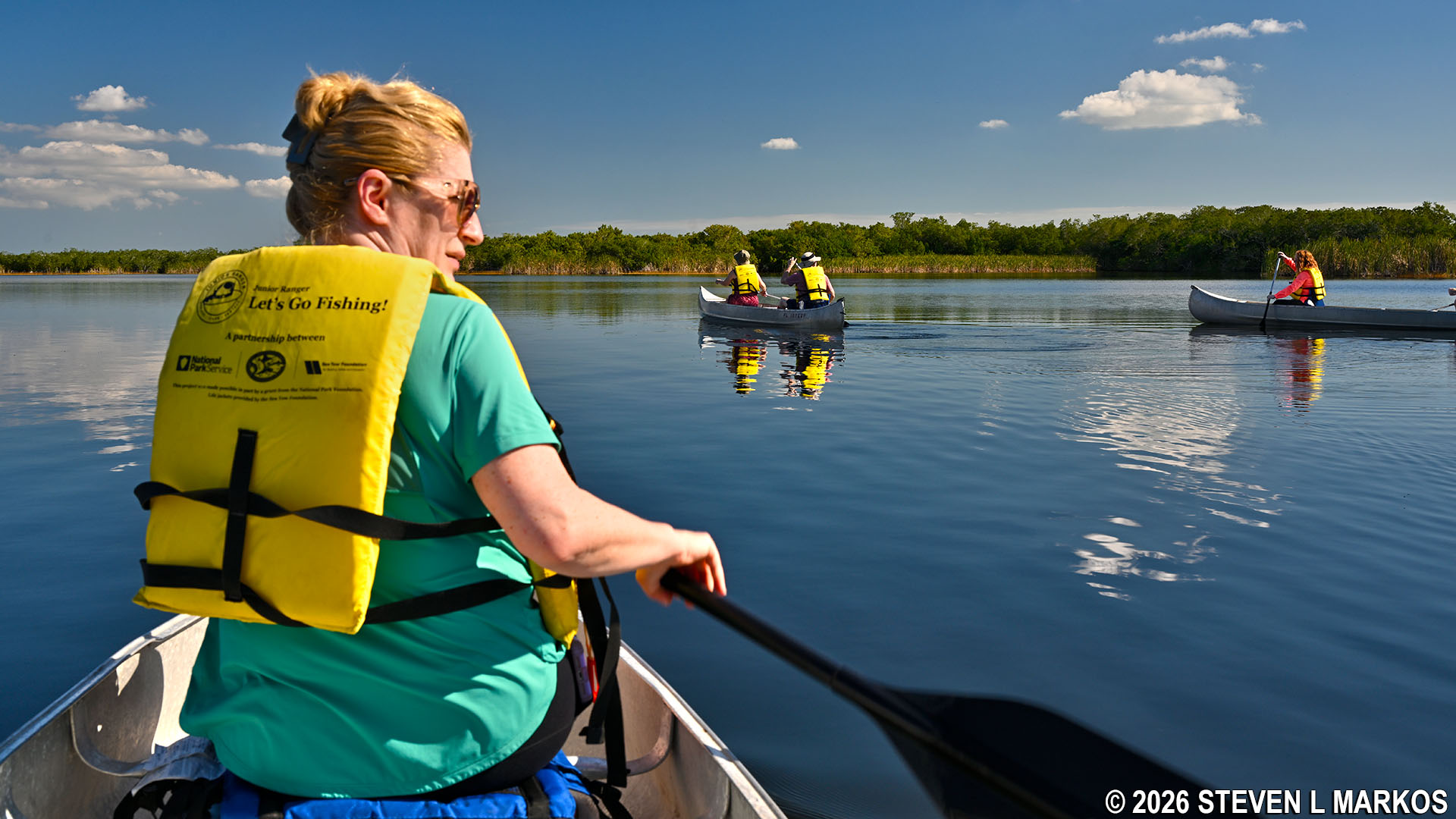
Canoeists on Nine Mile Pond in the Flamingo unit of Everglades National Park
See the Paddling web page for an interactive location map.
Length: 6-mile loop
Time: 4 hours
The Nine Mile Pond Canoe Trail in Everglades National Park is a loop that crosses Nine Mile Pond and exits into the backcountry via a small creek. The creek winds between mangrove islands before eventually emptying into a sawgrass wetland. The backcountry portion of the canoe trail makes up about five of the trail’s six miles. On the way back it crosses through two smaller ponds just north of Nine Mile Pond.

Nine Mile Pond Canoe Trail (click to enlarge)
Before heading out on the trail, be sure to inquire at either the Ernest Coe Visitor Center or the Guy Bradley Visitor Center about whether there is enough water in the backcountry areas to make the entire trail navigable. As the dry season wears on (October-April) the creek and the sawgrass wetlands get shallower and shallower; the depth of Nine Mile Pond is no indicator of the water depth in the backcountry.

Shallow water on the backcountry portion of Everglades National Park’s Nine Mile Pond Canoe Trail from late February through May
The best time for this trip is November through January. I paddled the entire trail in late February and made it through despite being told there was not enough water, but there was so much paddling through muck and sawgrass while scraping the bottom that the fun quickly wore thin. I can’t imagine there being enough water in March and April.
There is, however, usually enough water year-round in the backcountry to make it to the halfway point where there is a shortcut to the other side of the loop. In fact, this is why the shortcut was created in the first place. If a park Ranger advises taking the shortcut, take it. By the halfway point you will have seen all of the different varieties of environments the trail has to offer, so you will not be missing out on much by taking the shorter route (roughly a 3.5-mile paddle trip).
If you do not have a canoe or kayak, the Everglades Institute, a non-profit partner with the National Park Service, offers two paddling tours on Nine Mile Pond. The 3-hour Paddling in the Park: Guided Canoe Trip Through Nine Mile Pond covers the entire trail, but it is only held during the wet season (mainly in the summer and early fall). The 2-hour Nine Mile Pond Eco-Paddle takes the shortcut at the halfway point, so it is held year-round.
There is a large parking lot at Nine Mile Pond that is very close to the water, so you don’t have to carry your equipment far. You can launch your boat just about anywhere along the shore.
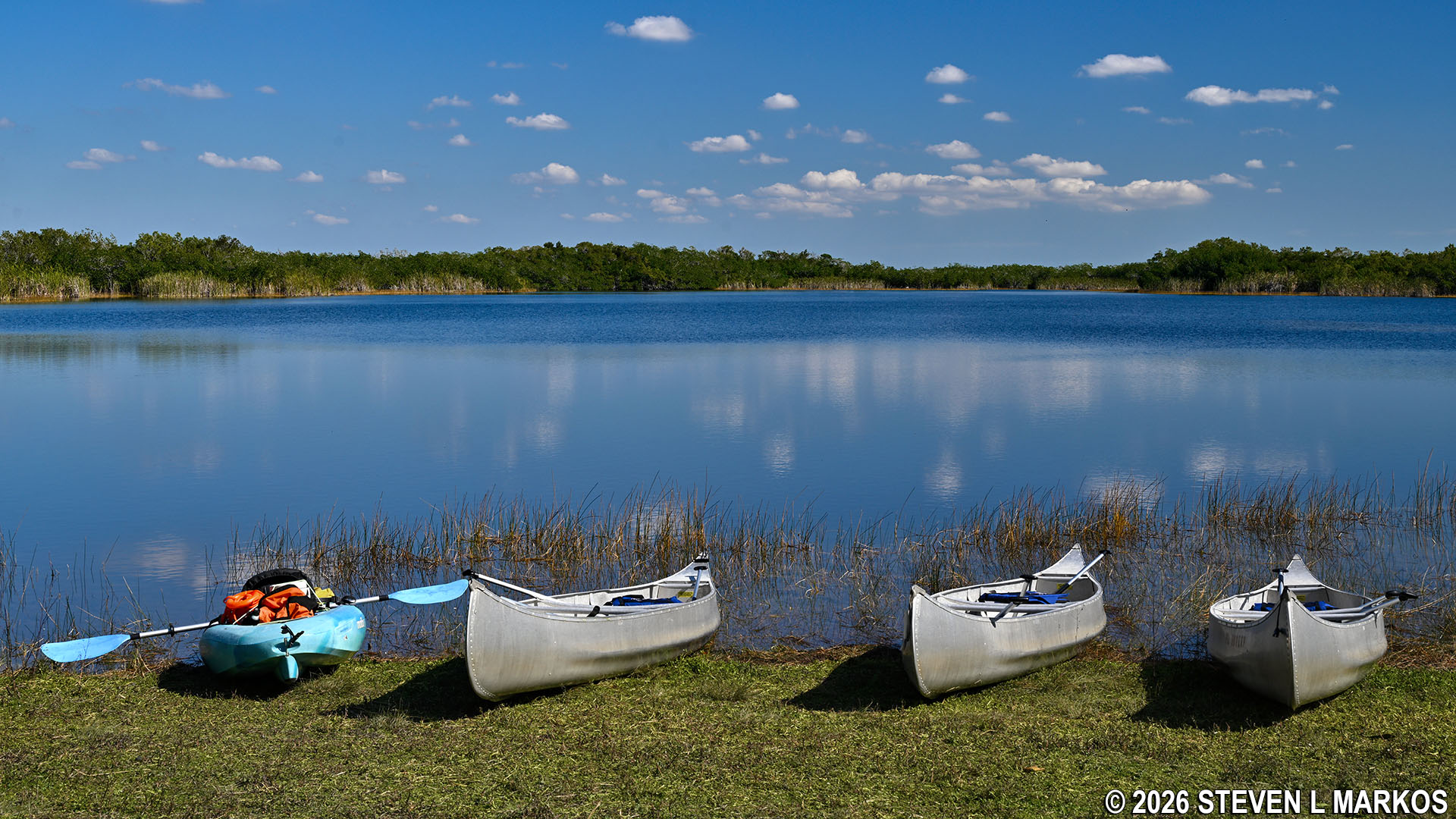
Shore of Nine Mile Pond, Everglades National Park
The Nine Mile Pond Canoe Trail is a loop, so it can be paddled in either direction. To paddle clockwise, starting with the two smaller ponds, head towards a narrow connecting channel at your 10 o’clock position when looking straight out over Nine Mile Pond from the parking lot. You may not be able to see it now, but it is evident once you get nearer to the shoreline. To paddle in the counterclockwise direction, head straight across Nine Mile Pond to the far end and look for the mouth of a small creek in the righthand corner. For the record, most everyone paddles in the counterclockwise direction, and that is how I did both trips I made on Nine Mile Pond, once doing the entire trail solo and once doing the shortcut route with the Everglades Institute.

Exit points out of Nine Mile Pond
NAVIGATING TIPS
Once off the pond and into the backcountry, figuring out the route would be tough if not for a series of poles that mark the trail. For those who have not paddled a marked canoe trail, here are some tips on how to read the markers.
(Note: the route was formerly marked by PVC poles with numbers on them that corresponded to numbers on a printed trail map, which I assume is no longer available). During my recent trip with the Everglades Institute, I noticed that the route is now marked with numberless wooden poles. Unfortunately, I did not get any photos of these markers, so the photos in this article show the older PVC poles. Keep in mind that I took the shortcut trail, so I do not know what type of markers are used on the route beyond the shortcut.)

Pole marks the route of the Nine Mile Pond Canoe Trail in Everglades National Park
Tip #1
There are some points where you pass through a narrow stretch of mangroves and emerge onto a wide, pond-like grassland area where there may be more than a half dozen channels branching off of it in different directions. In some cases the markers are hard to spot, having been hidden in the rapidly growing mangroves. You do not need to travel a short distance down each channel looking for the next marker. It is there somewhere on the pond. You just have to look carefully.

Route markers on the Nine Mile Pond Canoe Trail in Everglades National Park can be hidden in the mangroves
Tip #2
If you come to an intersection of waterways but no marker is at the turn, stay straight. There will be a marker at the mouth of any channel you are supposed to turn on.
Tip #3
There are a lot of tricky turns on the trail, and you often have to use your intuition. I never made a wrong turn, but I made plenty where I had my doubts about being on the trail. In each instance I eventually came upon a marker. There are over 100 markers on the Nine Mile Pond Canoe Trail, so if you have been paddling longer than five minutes without seeing one, you may have taken a wrong turn. The key word here is “may,” so again, you must use your intuition.

Route markers are placed frequently along the Nine Mile Pond Canoe Trail in Everglades National Park
Tip #4
The shortcut at the halfway point—1.5 miles into the trip—is clearly marked with a sign. As stated earlier, heed the Ranger’s advice. I ignored the advice, reasoning that if I got stuck and couldn’t continue that I’d just turn around and head back. My solo trip ended up being a test of endurance.
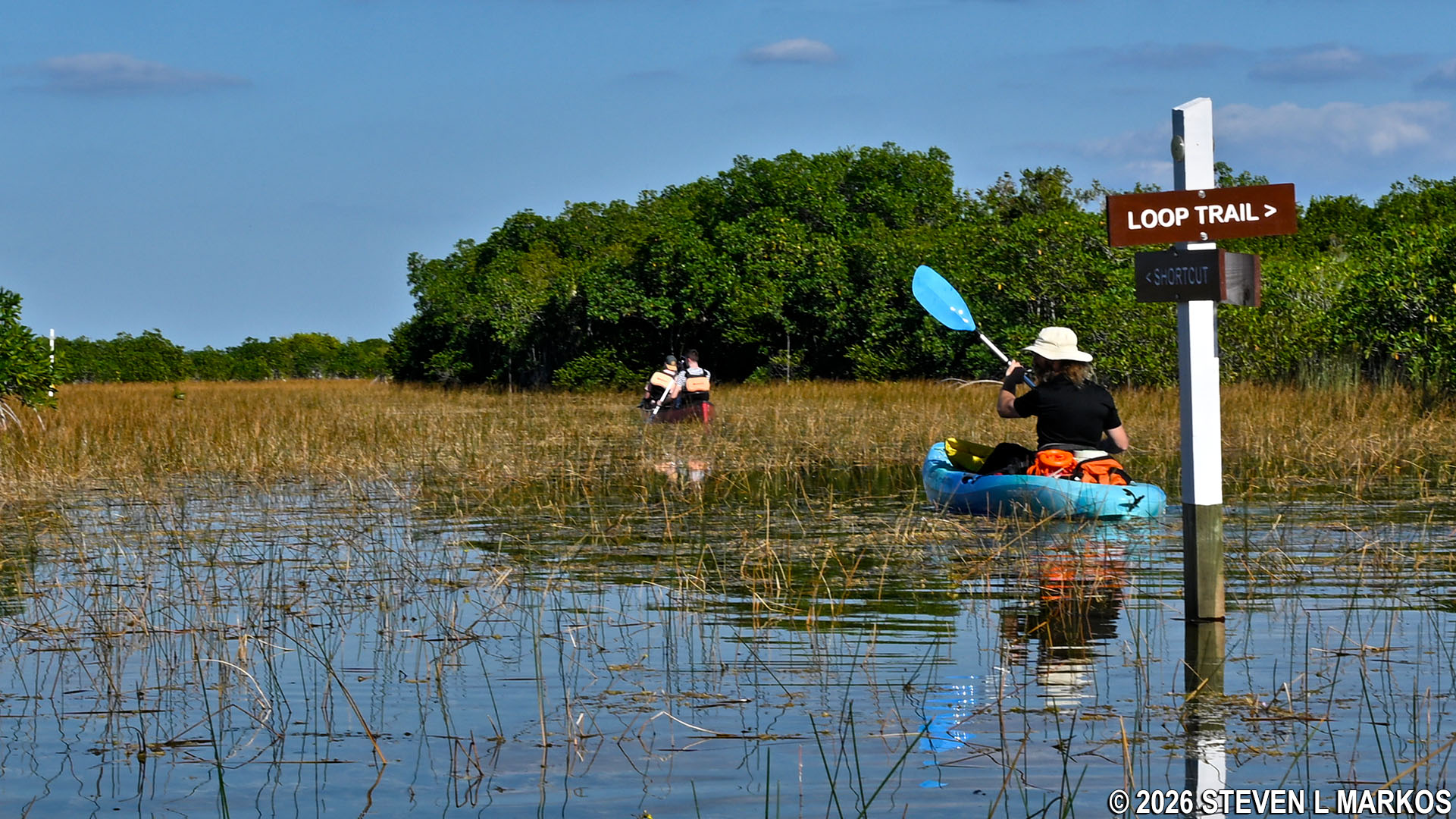
Shortcut sign on the Nine Mile Pond Canoe Trail in the Flamingo unit of Everglades National Park
TERRAIN
The Nine Mile Pond Canoe Trail provides one of the most diverse paddling experiences in the Everglades. Previously, I had paddled in the Gulf Coast Area of the Everglades and at Big Cypress National Preserve, but these trails were all on small creeks that occasionally passed through ponds of various sizes. The Nine Mile Pond trail has all of this plus the “river of grass,” the wide open sawgrass wetlands that are synonymous with the Everglades.
Directly upon exiting Nine Mile Pond at the far end, paddlers will find themselves on a very narrow mangrove-lined creek. If you are in a kayak and have a “kayak style” paddle, you must pull it apart and start paddling like in a canoe. Do not attempt this trail if your paddle cannot be broken into two pieces. The waterway is not wide enough to use the longer kayak paddle.

Narrow, mangrove-lined creek begins the backcountry portion of the Nine Mile Pond Canoe Trail in Everglades National Park
Once through the mangroves, the trail emerges onto a wide wetland of grass. Imagine a flooded city where you can still see the tops of the street signs (the route markers). You can paddle around in an empty lot or in somebody’s back yard, but ultimately you need to follow the streets. That’s what paddling in the backcountry along the Nine Mile Pond Canoe Trail is like. As long as you keep an eye on the route markers, you can venture off the canoe trail and explore the area. However, the terrain is all the same—it’s not like you are going to find Brooke Shields in the Blue Lagoon.

Open wetlands are free to explore, but keep an eye on the official route of the Nine Mile Pond Canoe Trail in Everglades National Park
The water is very clear, and you can see the bottom nearly the entire time. Gars and other fish may swim right up to you. I saw a few birds in the backcountry, but no alligators. I did see alligators in the ponds at the end of the trip.

Gar in the wetlands of Everglades National Park
Some of the narrow sections pass through what are known as mangrove tunnels. These sections are so narrow that you must grab the mangroves and pull yourself through. There is no way to use a paddle. For most people, the mangrove tunnels are the highlight of any paddling trip in the Everglades. (Note that the photo below was taken in a narrow mangrove tunnel on the Turner River in Everglades National Park.)
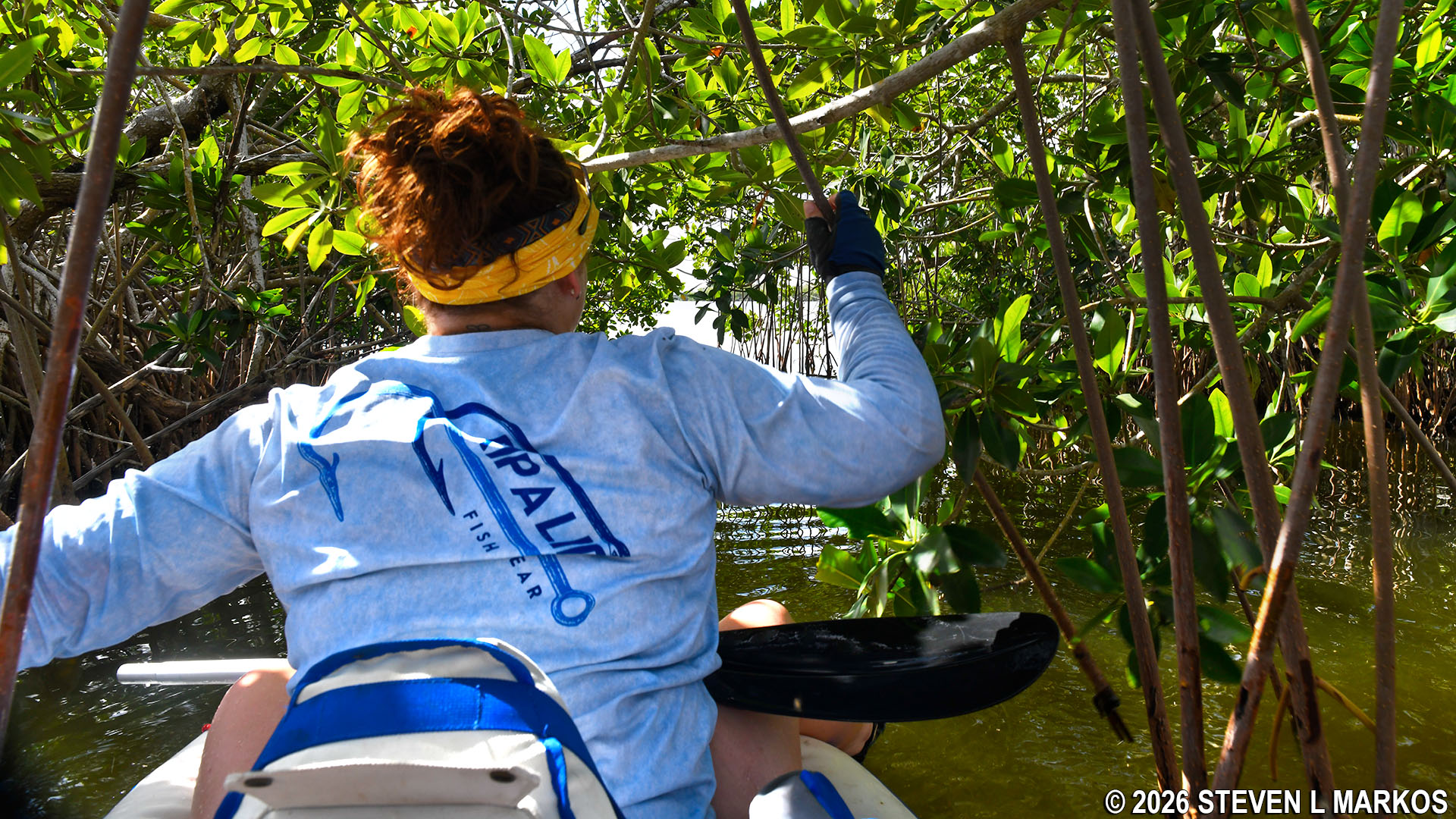
Kayaker pulls herself through a narrow mangrove tunnel on the Turner River in Everglades National Park
There are also wide open areas in the backcountry that are filled with cattails. This is an invasive plant that threatens to take over much of the wetland. They can grow so thick that canoe travel is rendered impossible.

Cattails are taking over parts of the Everglades
There are large areas of water covered in dead cattails. Periphyton, a blue-green algae that grows on grass and rocks also grows on the dead cattails. Periphyton can soak up water and provide small animals a wet place on which to lay eggs in the dry season. Large mats of the algae are floating on the water throughout the wetlands, not just in the cattail areas.

Sea of dead cattails along the Nine Mile Pond Canoe Trail in Everglades National Park
You will also come to sections in the sawgrass wetlands that are very difficult to paddle because there is so much grass and periphyton that it is like paddling through a crowd of outstretched arms that are trying to grab onto you to slow you down. At these points I was barely making a mile per hour.

Grass and other debris make paddling in the shallow water of the Nine Mile Pond Canoe Trail more difficult, Everglades National Park
There are also a few mangrove tunnels that are not so tight that you cannot paddle. These areas offer an nice respite from the sun and a good place to take a break for water, a snack, or even lunch. Unless you want to get wet and stand in muck, you can never get out of your boat because there is no dry land on the entire trail.

Emerging from a mangrove tunnel on the Nine Mile Pond Canoe Trail in Everglades National Park
During my solo paddle of the entire Nine Mile Pond Canoe Trail, it was at the far end of the loop where the water really started getting shallow and thick with grass. It wasn’t until I got all the way back to the shortcut (the other side) that I reached deeper water.

Far end of the Nine Mile Pond Canoe Trail in Everglades National Park
There were numerous times when I thought the trip would come to an end. I never hit the actual bottom, but I constantly hit the sludge on the bottom, and that slows down progress. At times I was paddling so hard that I might as well have been on dry ground trying to propel myself forward. However, I made up my mind that I would walk through the ankle-deep muck rather than go back the way I came. If you have two people in your boat, you might not make it because the weight would cause the boat to hit the bottom. Again, I write this about paddling during the height of the dry season, so I assume these problems will not exist if you paddle when there is plenty of water in the area.

Tough paddling on the Nine Mile Pond Canoe Trail on the trip back from the far end of the loop, Everglades National Park

Path on the Nine Mile Pond Canoe Trail through the grass, a former airboat trail, Everglades National Park
When you reach the shortcut (now on the opposite side of the loop), you will have traveled 4 miles. The water gets noticeably deeper at this point, but there are plenty of sections clogged with grass and periphyton. If you stop paddling, you come to an immediate stop.
After emerging from a mangrove tunnel at the 5.5-mile mark, the trail spills out onto the first of the two small ponds. It is on these ponds that you will see the most wildlife, so if that’s what you came for, you may just want to head for the ponds to begin with. Travel straight across Pond #1 to find the short channel that connects to Pond #2. When I made the trip, there was an alligator on either side of the channel, so it was like running a gauntlet of alligators to get from one pond to the next.

The small ponds along the Nine Mile Pond Canoe Trail in Everglades National Park are the best places to spot alligators
Head straight across Pond #2 to find the channel that connects back to Nine Mile Pond. From there you can see the shore and parking area, which are off to the right.

Nine Mile Pond in Everglades National Park
I highly recommend the Nine Mile Pond Canoe Trail because of the opportunity to paddle in the grasslands, the same type of terrain that airboats made famous. The mangrove thickets and tunnels are always fun. If paddling when the water is low, it will be slow going, so expect to only make half of your normal speed, if that. Furthermore, most of the route is exposed to the sun, for even the mangrove tunnels are only a hundred feet long. Be sure to wear a hat and sunscreen if avoiding the sun is important to you.

Paddling between the ponds on the Nine Mile Pond Canoe Trail in Everglades National Park
With a few exceptions, use of any photograph on the National Park Planner website requires a paid Royalty Free Editorial Use License or Commercial Use License. See the Photo Usage page for details.
Last updated on July 10, 2026


